Skip to content
DevMeme
315 of 7435
A Gopher's Reaction to Scala Developers Discovering Simplicity
Languages Post #373, on May 17, 2019 in TG

A Gopher's Reaction to Scala Developers Discovering Simplicity

Why is this Languages meme funny?

Level 1: Serious Meeting, Silly Surprise

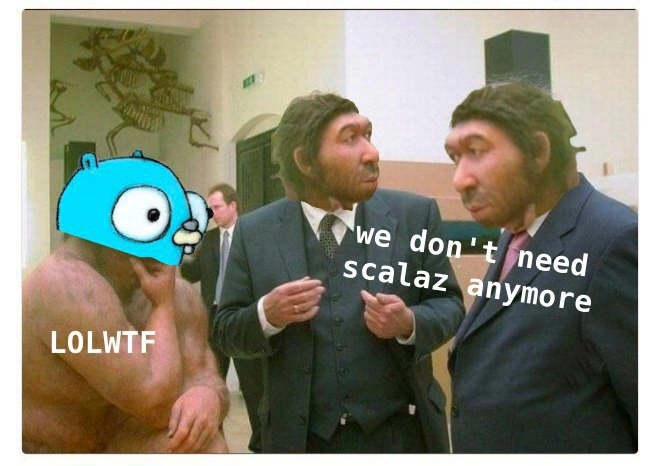
Imagine a group of very serious adults in a meeting, all wearing suits and talking in big fancy words about a super complicated toy that nobody really enjoys. They finally say, “Okay, we’re not going to play with that crazy-complicated toy anymore.” That’s the serious part. Now picture this: just when the room is quiet and serious, a funny cartoon gopher character bursts into the room with no clothes on, looking like a strongman, and shouts “LOL, WTF?!” (which is basically him laughing and saying “What in the world?!”). It’s so unexpected that everyone can’t help but laugh. The formal people and the goofy gopher are complete opposites. The gopher showing up is like your goofy friend crashing a stuffy parents-teacher conference, making everyone realize how over-the-top serious things were. The reason it’s funny is because it’s a big relief and a joke at the same time: the super complicated stuff was making life hard, and here comes a simple, silly solution (the gopher) showing up in the craziest way to celebrate that the complicated stuff is gone. It’s the contrast of very serious and very silly that makes it humorous – like a clown walking into a courtroom – and it tells a little story about choosing fun and simplicity over stuffiness and complexity.

Level 2: Goodbye ScalaZ, Hello Go

Let’s break down the meme in plainer terms. It helps to know who the “characters” and technologies are in this scene:

  • Scala – A programming language that runs on the Java Virtual Machine. Scala is known for blending object-oriented and functional programming styles. It has a lot of advanced features (like a very strong type system).
  • ScalaZ – (pronounced “Scala-Zee” or Scala Zed depending on who you ask) is a library for Scala. It provided tools to do pure functional programming in Scala, inspired by Haskell. This means things like monads (a way to structure computations), Functors, Applicatives, and other abstractions that make your code more mathematically precise. In short, ScalaZ let Scala developers write very high-minded code that avoids side effects and follows algebra-like rules. The flip side: it made the code really hard to read if you weren’t familiar with those concepts!
  • Functional Programming – A style of programming where you treat computations like math functions. Instead of changing state or using loops heavily, you use recursion, immutable data, and chain operations in a declarative way. It can lead to fewer bugs if done right, but it often has a steep learning curve. Scala (with ScalaZ) is an example of pushing this style in mainstream development.
  • Go (Golang) – A programming language created at Google (often just called “Go”). Go is designed to be simple and efficient. It compiles to machine code, runs fast, and has a garbage collector (like Java). One of Go’s standout features is how it handles concurrency (multiple things happening at once) using goroutines (lightweight threads) and channels (for communication between those threads). Importantly, in 2019, Go did not have things like generics or a complex type system – and that was intentional to keep it easy to use.
  • Go Gopher – The adorable blue mascot of Go. It’s a cartoon gopher often seen in Go tutorials, blog posts, and yes, memes. The gopher represents the Go community’s friendly and fun spirit. In the image, the gopher’s head is pasted onto a muscular body for comedic effect – obviously, real gophers aren’t buff (and usually they wear clothes! 😄).
  • “LOLWTF” – Internet slang, basically a combination of “LOL” (laughing out loud) and “WTF” (“what the fudge” – a polite version, since kids might read this). It expresses shock and amusement at the same time. It’s the kind of thing someone might post in chat when a friend says something crazy. Here it’s written near the gopher, showing his reaction.

Now, the scenario: The two men in suits are having a serious conversation – think of them like your bosses or senior team members in a formal meeting. One of them says, “we don’t need ScalaZ anymore.” That signals that the team has decided to stop using that complex ScalaZ library. This could be for many reasons: maybe it was causing delays, maybe only one person really understood it, or maybe the team wants to move to a different tech stack (like switching to Go, hinted by the gopher’s presence). Such a decision is a big deal in a dev team because it’s like changing the rules of how everyone writes code. It’s often done in formal settings after much discussion – hence the suits and seriousness.

Enter the Go gopher – but in the most outrageous way possible. He’s depicted as a naked bodybuilder crashing this stuffy meeting. This is a visual metaphor (a silly picture to represent an idea). Formal vs casual clash: The suits represent formality, tradition, and maybe an old-school or very proper approach (like using ScalaZ, which is academically proper in a sense). The naked buff gopher represents an unapologetically casual and raw approach – basically throwing formality out the window. He’s not literally a person on the team (we hope not, no one should actually attend work meetings naked 🚫👔), but symbolically, it’s saying the Go mentality is barging in. That mentality is “keep it simple, let’s not over-engineer.” The gopher laughing “LOLWTF” at the declaration suggests that from Go’s point of view, it’s about time! It’s like the Go community or advocates are reacting with “Ha! Finally you admitted ScalaZ was too much. What were you guys thinking?”

In developer culture, this plays into language wars – the friendly (and sometimes not-so-friendly) rivalries between fans of different programming languages. One common “war” is between those who love heavy use of functional programming (in languages like Scala or Haskell) vs those who prefer simple, imperative languages (like Go, or even Python). This meme is clearly siding a bit with the latter in a jokey way: it portrays the functional stuff as overly formal (suits in a museum-like hall) and the Go approach as the fun, muscular alternative that interrupts. It’s exaggerated for humor – real life isn’t black and white, but exaggeration makes the point.

Language migration is also referenced in the tags: that’s when a team or project switches from one language to another. Here it hints that maybe the team is moving from Scala (and its ecosystem, e.g. ScalaZ library) to Go. That’s a significant shift! Migrating languages is akin to moving to a new house – everything changes, and it can be chaotic but also refreshing. The meme captures the chaotic-but-refreshing part with the gopher’s grand entrance.

And of course, the whole thing is wrapped in developer humor. If you’re in on the joke, you know that ScalaZ is famously intricate and that Go is famously straightforward. Seeing the Go gopher laugh at ScalaZ being declared obsolete is funny because it’s a dramatization of countless online forum arguments and team discussions. It’s the “I told you so” moment for those who argued against needless complexity, presented in the silliest way possible. Even the setting (a museum-looking hallway with dinosaur skeletons in the back, if you look closely) adds to the joke – it implies ScalaZ and that style might be considered a “dinosaur” now, and the gopher is the new mammal taking over! 🦖➡️🐿️ (Okay, a gopher’s not exactly a mammal to replace dinosaurs in evolution, but you get the idea).

In summary, for a junior developer: this meme is saying a serious team decided to drop a very complex tool (ScalaZ), and the fans of a simpler tool (Go) find it hilariously satisfying, depicted as a goofy interruption. It’s a comment on how developer communities sometimes swing from loving something brainy and complex to preferring something simple and practical – and they love to poke fun at each other during that swing.

Level 3: Purists vs Pragmatists

In more practical engineering terms, this meme nails a common industry experience: a team abandoning an overly complex tool or paradigm in favor of something simpler that “just works.” Here, ScalaZ represents the purist, high-ceremony approach to writing code – the kind beloved by seasoned functional programming enthusiasts (and that one team member who won’t stop talking about monads 😅). Many experienced developers have witnessed (or participated in) debates about ScalaZ or its cousin library Cats, which bring Haskell-like purity into a JVM enterprise environment. At first, it sounds great – “we will eliminate nulls, we will handle effects with monadic control, our code will be provably correct!” – and indeed, ScalaZ can feel like a superpower. But it comes at a cost: steep learning curves, more verbose code, and often a smaller pool of developers who grok those concepts.

The suited gentlemen in the meme convey the formal, enterprise vibe – imagine software architects or tech leads in a serious meeting saying, in hushed executive tones, “we don’t need ScalaZ anymore.” That line encapsulates a turning point: maybe the project struggled under the weight of all that abstraction, or new leadership wants to simplify the stack. It’s the kind of decision that in real life might follow a crunch period where the fancy FP approach proved too slow or hard for the team to deliver features. Enter the Go gopher: the bright-blue mascot of Go, here hilariously pasted onto a completely naked, buff bodybuilder crashing this buttoned-up meeting. This visual is a perfect metaphor for how Go (and its community) often shows up in these stories – with a very casual, “shirts-off” attitude, flexing simplicity and raw performance. The gopher’s caption “LOLWTF” is basically the inner voice of every pragmatic engineer in that room either laughing at how convoluted things got, or in disbelief that management finally decided to drop the complexity.

This juxtaposition is comedic gold for developers because it rings true. It’s a scene that has played out in many companies: one quarter the team is all-in on some sophisticated framework (be it ScalaZ, or an elaborate microservice orchestration, or an ML pipeline nobody understands), and a few quarters later, there’s a pivot to a simpler solution after a lot of pain. Those with battle scars chuckle at the “we don’t need XYZ anymore” because they’ve survived a few waves of tech stack rewrites. The meme also pokes fun at developer culture clashes. Scala and ScalaZ often attract a niche of intellectually hardcore FP folks (the kind who might use terms like monadic comprehensions and Kleisli arrows at the lunch table). Go, in contrast, attracts the pragmatic crowd who value clarity, concurrency, and fmt.Println("Hello, world!") over fancy abstractions. When these worlds collide, you get debates on forums, snarky conference talks, and of course, memes.

The LanguageWars tag is spot-on: this image is basically a snapshot of a language war truce (or coup). The ScalaZ camp (formal suits) is conceding or moving on, and the Go camp (goofy gopher) barges in victoriously. It’s funny because of the over-the-top portrayal: the gopher didn’t even bother with a suit or any clothes for that matter – a metaphor for how Go’s simplicity doesn’t dress itself up in theoretical pomp. It just streaks into the conversation with results and a “deal with it” grin. And the caption “LOLWTF” captures what many devs feel when witnessing such a dramatic shift: a mix of laughing out loud and what the heck just happened?.

One could also read the meme as commentary on how out-of-place these two mindsets are to each other. To the ScalaZ devotees, a cartoon gopher meme saying “LOLWTF” about their beloved library being dropped might feel offensive or at least very unprofessional – much like a naked bodybuilder in a boardroom. To the Go enthusiasts, the formal suit-and-tie discussion about monadic laws might seem absurd when there are more pressing problems to solve – why are we complicating this? LOLWTF! This exact tension plays out in tech discussions all the time. The meme just dramatizes it in a way that’s immediate and visual.

For seasoned devs, there’s also a bit of dark humor: “declared officially obsolete” is an exaggeration (nobody issues an official decree that ScalaZ is dead), but it hints at real trends. By 2019, many Scala projects were indeed moving away from ScalaZ (some to the newer Cats library, some dropping heavy FP altogether). We’ve lived through cycles of hype where today’s best practice is tomorrow’s punchline. Remember when XML was the cool kid and then JSON showed up casually like the gopher here? Or when everyone was crazy about enterprise Java beans, and then along came lightweight Spring Boot (in a t-shirt and jeans)? This meme taps into that collective memory. It’s both a roast and a celebration: roasting the complexity that didn’t pan out, and celebrating the simpler approach that replaced it – all in one bizarre image.

Level 4: Monads vs Goroutines

At the most theoretical level, this meme humorously pits academic functional purity against pragmatic simplicity. The mention of ScalaZ invokes the deep end of functional programming concepts – things like monads, functors, and type classes that come straight out of category theory. In fact, in category theory terms, a monad is famously described as “a monoid in the category of endofunctors” – a tongue-twister that even many developers joke about. ScalaZ was a Scala library that embraced these abstractions, pushing Scala closer to the mathematically pure world of Haskell. This means using higher-kinded types, implicit type class instances, and other advanced type system features to ensure code follows algebraic laws (like monoid or functor laws). It’s powerful and formally elegant – you can reason about code with near-mathematical certainty.

On the other side, we have Go (Golang) crashing the scene with its minimalist, no-nonsense philosophy. Go was designed with a bias for simplicity and practicality (think of Rob Pike’s Occam’s razor-driven approach to language design). Instead of monads or complex type hierarchies, Go gives us primitives like goroutines and channels for concurrency, rooted in Tony Hoare’s Communicating Sequential Processes (CSP) model. This is a totally different branch of computer science theory – one focused on concurrent systems rather than type theory. So in a way, the meme’s scenario (“we don’t need ScalaZ anymore”) is a clash of paradigms: the category theory-heavy FP paradigm versus the concurrency and simplicity paradigm. The Go gopher barging in represents a shift from an approach that requires understanding abstract algebra, to one that deals in straightforward building blocks closer to the machine.

From a computer science perspective, it’s a confrontation between richly typed lambda calculus and pragmatic concurrent programming. The humor emerges from recognizing that these two approaches couldn’t be more different. It’s as if a highly formal proof (ScalaZ’s world of laws and monadic structures) is being interrupted by a brute-force script or a shell command (Go’s straightforward approach) saying “LOLWTF”. In theory, both have merit: ScalaZ’s camp might cite benefits like referential transparency, easier formal verification, and the beauty of mathematical consistency. The Go camp would cite ease of use, quick compile times, and the beauty of doing just enough to get the job done. By crashing the formal meeting, the Go gopher is almost mocking the fact that all those lofty FP ideals often yield to real-world demands for simplicity. This contrast is fundamentally funny to those of us who appreciate the theory: it’s like seeing a high-theory monadic castle toppled by a goroutine-powered bulldozer.

Description

This meme uses a popular format showing Neanderthals in modern suits to represent a dated or less evolved perspective. In the image, two Neanderthals in suits are conversing, with one saying, 'we don't need scalaz anymore'. Scalaz is a well-known library in the Scala ecosystem that provides advanced functional programming capabilities. To the side, a character representing the Go programming language (the 'Gopher' mascot) is depicted as a classical thinking statue, with the text 'LOLWTF' next to it. The humor lies in the perceived paradigm shift. Scala, especially with libraries like Scalaz, is known for its academic purity and high-level abstractions (like monads, functors), which can lead to very complex code. Go, on the other hand, champions extreme simplicity and pragmatism, deliberately omitting many advanced language features. The meme portrays Scala developers as finally shedding unnecessary complexity, a realization that the Go community has advocated from the beginning, hence the Gopher's amused bewilderment

Comments

8
Anonymous ★ Top Pick The difference between Scala and Go is that a Scala developer will write a 300-line dissertation on why they need a monad, while a Go developer will just write the damn `if err != nil` and move on
  1. Anonymous ★ Top Pick

    The difference between Scala and Go is that a Scala developer will write a 300-line dissertation on why they need a monad, while a Go developer will just write the damn `if err != nil` and move on

  2. Anonymous

    “We don’t need Scalaz anymore,” they said - six weeks into the Go rewrite we’re 3 000 lines deep into hand-rolled EitherT, a naked gopher in prod, and we’ve reinvented the monad without the type system to keep it sober

  3. Anonymous

    "We don't need Scala anymore" - says the team that just spent 6 months building a distributed system in Go that accidentally reimplemented half of Akka, poorly

  4. Anonymous

    Scala spent a decade evolving past scalaz into cats; Go watched the whole saga and concluded the optimal monad is copy-pasting 'if err != nil'

  5. Anonymous

    When your Scala team finally admits they spent three years learning Scalaz's monad transformers just to realize Cats does it better and ZIO makes it actually usable in production - meanwhile the Go developers have shipped 47 microservices using nothing but structs and interfaces, blissfully unaware that functors even exist

  6. Anonymous

    We don’t need Scalaz anymore; we moved to Go and reimplemented Either, Option, and IO with generics - much simpler now, the monad laws are just a Confluence link

  7. Anonymous

    Scalaz joins the dinosaurs: mighty in its type-fu prime, but too bulky to outrun Cats in the ecosystem Jurassic Park

  8. Anonymous

    Monads obey conservation of mass: drop Scalaz and they reappear as Cats/ZIO, while the Go gopher still benchmarks if err != nil as its only typeclass

Use J and K for navigation