The Unexplained Green Build
Why is this Testing meme funny?
Level 1: Phew, It Still Works
Imagine you’re playing a game where you’ve built a tall tower out of blocks. You decide to pull out one block from the middle just to see what happens. You’re almost sure the tower might wobble and crash down, and you’re holding your breath as you do it. But guess what? The tower doesn’t fall – it stays standing perfectly! You’d probably let out a big sigh of relief and maybe give your friend a high-five because nothing went wrong. That’s exactly the kind of feeling this meme is showing. The programmer did something small to a big, complicated structure (their code) and expected everything to maybe fall apart, but everything stayed stable. They’re so happy and surprised that they’re basically shaking hands with the situation, saying “Wow, thank you for not breaking!” It’s that warm, relieved feeling of “I got away with it!” when you try something a bit risky and everything still turns out okay.
Level 2: Green Build Surprise
Let’s break down what’s happening in this meme in simpler terms. In software development, we have something called a test suite. A test suite is basically a collection of automated tests (like little programs) that check if different parts of our code are working correctly. For example, if you wrote a function that adds two numbers, you’d have a test to make sure 2 + 2 really equals 4 and not something else. These tests are usually run every time you make changes to your code, especially in a team setting where you use Continuous Integration (CI). Continuous Integration is a practice (with supporting tools) where whenever a developer pushes code changes to a shared repository (like on GitHub or GitLab), an automated system will build the project and run all the tests. Think of it as an automatic safety inspector for your code: every time you make changes, it checks everything and reports back if something broke.
Now, the meme text refers to “Me after some random change to the code” and “All the tests running through successfully.” This describes a scenario where a developer made an unplanned or small tweak in the code — not a carefully planned big feature, just a quick change — and then ran the test suite (or had the CI system run it). The expectation is usually that at least one test might fail. Why might a test fail? Because changing code can have side effects: maybe a function behaves a bit differently now, or an assumption that an earlier test made is no longer true. Often, especially when you’re new, you make a change thinking it’s harmless, and suddenly one of your unit tests (tests for individual pieces of code) or integration tests (tests for how different pieces work together) starts failing. That failing test is like a red flag saying, “Hey, this part isn’t working the way it used to!”
In this meme’s situation, none of the tests failed. All the tests ran successfully, meaning the test suite didn’t catch any errors after the code change. In many CI systems, when all tests pass, the build is marked with a green check-mark or a green badge — that’s why developers often say the build is green to mean everything is okay. It’s a great feeling because it means your change didn’t break anything that was being checked. The developer in the image is shown literally shaking hands with the representation of the test results, which is a funny way to show their relationship with the tests at that moment. Imagine being ready to see error messages but instead seeing a report that says “All tests passed.” It’s kind of like taking an exam you were nervous about and then getting a perfect score unexpectedly — you’d be pleasantly surprised, maybe even a bit in disbelief!
The phrase “random change to the code” suggests the developer might not have fully thought through all the consequences of their tweak (it could have been a quick fix or a small experiment). So when absolutely everything still works (according to the tests), the developer is relieved and maybe a little shocked — in a good way. This is where the humor comes in: usually, developers approach running tests with a bit of anxiety, sort of crossing their fingers hoping nothing goes wrong. When nothing does go wrong, especially when you didn’t rigorously plan for it, it’s a moment of happy surprise. The handshake in the picture symbolizes the developer “thanking” the automated tests for not finding any issues.
Another way to think of it: the test suite is like an automated safety net or a guardian that watches over your code. If you mess something up, it will wave a red flag (fail a test) and ask you to fix it. If you don’t mess up, it gives you a thumbs-up (all tests green). In the meme scene, the tests gave a full thumbs-up, and the developer is almost shocked but definitely grateful, as if meeting a friendly ally. This is super relatable to anyone who has written code because we’ve all had times we braced for a problem but everything turned out fine. It highlights the importance of having tests (because they give you quick feedback when you break something) and also the emotional rollercoaster of coding: sometimes you’re expecting the worst, and then you get the best outcome instead.
So in summary, "all the tests running through successfully" means the code passed every check in the automated test suite with flying colors. "Me after some random change to the code" is the developer being happily surprised that their off-the-cuff code edit didn’t cause any breakages. The handshake is a playful exaggeration of how the developer feels toward their continuous integration test pipeline at that moment — friendly and appreciative. Even if you’re new to programming, you can understand the feeling: you change something in a complicated system and everything still works perfectly. It’s both a relief and a little victory, and that’s exactly why you see that big satisfied handshake in the meme.
Level 3: Truce with the Test Suite
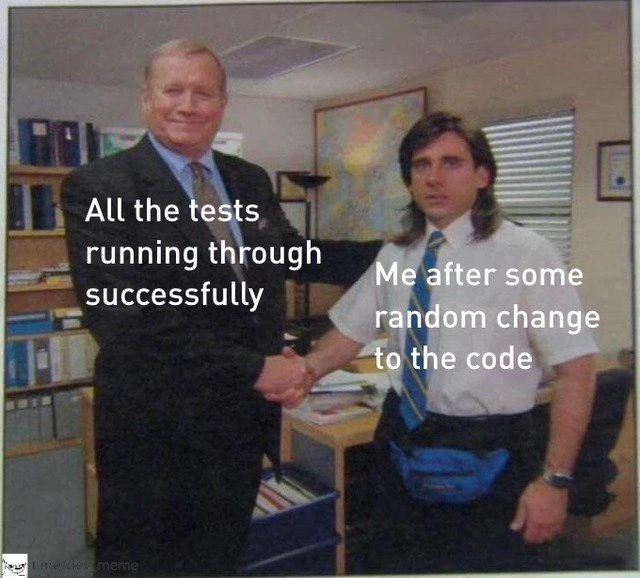
This meme nails a feeling every seasoned developer recognizes. It shows a comically formal handshake between “Me after some random change to the code” and “All the tests running through successfully,” capturing that rare moment of peace between a developer and their testing pipeline. In day-to-day development, making even a small unplanned tweak to code can often cause at least one unit test or integration test to go red (fail). There’s usually a flurry of debugging to figure out which assumption no longer holds true. But when every test passes on the first try, it feels like a borderline miraculous event. The developer in the meme is basically thinking, “Wait... nothing broke? Are these tests actually okay?!” before grinning in relief. The handshake symbolizes the developer’s shocked respect and gratitude toward the test suite (or the CI system) for giving a full green light with no complaints. It's like the tests are saying "All good, you didn’t mess anything up!" and the developer is happily responding, "Thank you, tests, you’re the best!"
For a senior engineer, this scenario brings back war stories and a good dose of irony. We’ve all had those Continuous Integration (CI) builds where one obscure test fails because of an environment discrepancy or a flaky timing issue. Many of us have an almost reflexive cringe when we see the dreaded red “X” on a GitHub pull request or a Jenkins job after a seemingly harmless change. So when everything goes green after a random code change, the first reaction is often surprise — did the tests actually run? We might even double-check that our test suite wasn’t accidentally skipped or that we’re not on the wrong branch by mistake. Once we confirm it's real, there’s genuine joy and perhaps a feeling of vindication ("Ha, I must have done something right!").
This humorous handshake moment also reflects developer emotions and team culture. In many workplaces, a fully green build can elicit a celebratory message in the team chat, sometimes with a joking tone like, “All tests passed on the first go – time to buy a lottery ticket!” The lottery joke captures how lucky it can feel. It's an unexpected green build (a successful build/test run in CI) after a change you weren’t entirely sure about. Developers might poke fun by saying this probably means either (a) the change was truly well-contained or (b) the tests aren’t stringent enough. In either case, the relief is real. There's an unspoken understanding: if all tests pass, even after a quick-and-dirty change, maybe the codebase’s design is decoupled enough to handle it, or maybe you’ve just gotten very lucky this time.
What makes this meme so relatable is the shared experience of Continuous Integration and automated testing doing their job. CI systems like Jenkins, CircleCI, or GitHub Actions run your test suite for each commit to catch bugs early (in other words, to prevent your random code change from quietly introducing a serious issue). Most experienced devs have had their share of red builds and know that feeling of dread when a test fails unexpectedly (“Did my little change really affect that module?! Uh oh.”). Conversely, an unexpected green build feels like the CI server just gave you a pat on the back. It boosts developer productivity because you don’t have to drop everything for bug-fixing; instead, you can confidently move on to the next task (or just relish how all those carefully written unit tests and integration tests had your back).
There’s also a bit of meta-humor in the meme’s image choice: a formal office handshake. Usually, running tests (especially in a fast-paced dev environment) isn’t ceremonious at all — it’s automated and happens quietly in the background. But the image exaggerates the situation by showing a very official-looking handshake, as if the developer is closing a big deal with the test suite. The personification of the tests as an office guy in a suit (with a resemblance to a serious boss or QA manager) shaking hands with the slightly goofy-looking developer (note the short sleeves and that bright blue fanny pack!) makes it even funnier. It implies that the tests, often seen as strict gatekeepers, are extending a friendly hand this time. In real-life coding terms, it's like the test suite is saying "we’re partners on this" instead of acting like an adversary.
Overall, from a senior perspective, this meme is a nod to the countless hours saved (and heart attacks avoided) thanks to automation in testing. It highlights that blissful moment when the CI/CD pipeline works exactly like it’s supposed to: catching nothing because there’s nothing serious to catch, which proves that maybe — just maybe — your random change was actually harmless. It’s a temporary truce because, let's be honest, the very next code change could break something and put you back on debugging duty. But for now, both developer and test suite are in harmony. The shared laughter here comes from that collective memory of nervously running a build, bracing for failures, and then being pleasantly shocked when the dashboard lights up all green. It's relief, validation, and a dash of luck all shaking hands together, making for a perfect inside joke about life in software development.
Level 4: The Green Bar Paradox
At the highest theoretical level, this meme touches on the fundamental limits of software testing and the contrast between proving correctness versus testing for it. In computer science theory, having all tests pass is somewhat analogous to seeing a green bar in a test runner (commonly used by frameworks like JUnit). That green bar signals success, but it’s not a formal proof that the code is correct in all cases — it's an empirical result limited to the scenarios the tests cover. This is sometimes called the "green bar paradox" because while everything looks perfectly fine (green lights everywhere), there’s an underlying understanding that passing all tests does not guarantee absence of bugs. In fact, legendary computer scientist Edsger W. Dijkstra famously said:
"Program testing can be used to show the presence of bugs, but never to show their absence!"
What Dijkstra highlights is relevant here: the developer’s surprise at a fully green test suite comes from knowing that tests are a necessary check but not a sufficient one for total correctness. After a random code change, seeing all tests pass suggests the change didn’t violate any of the tested assumptions — but it doesn’t conclusively prove the code is flawless in untested conditions. Seasoned engineers understand concepts like test coverage (the proportion of code executed by tests) and the combinatorial explosion of program states: even 100% coverage can't cover every possible input or path a complex program might encounter. The number of potential execution flows in software can grow exponentially with complexity — far too many to test exhaustively. So, while our developer is shaking hands with the test suite as if to say "Great, nothing broke!", on a theoretical level both the developer and the tests have just performed a limited handshake protocol of trust.
Interestingly, the handshake imagery also resonates with certain computing protocols. In networking, a "handshake" (like TCP’s three-way handshake) is how two systems establish a mutual understanding that they're in sync. Here, the code and the test suite perform a metaphorical handshake: all tests passing is like the test harness and the code agreeing on a common contract — at least for the scenarios under test. This momentary all-clear reflects the reliability of the Continuous Integration process: the automated checks ran and reported no issues. The humor lies in the implied improbability of this event; it’s almost as if the developer has found a loophole in chaos. In some cases, random tweaks can inadvertently fix an issue or have no negative impact thanks to clean code architecture or sheer luck. In others, it might simply mean that the particular change fell into a well-tested area of the codebase — an outcome rooted in good design and disciplined testing. Either way, there’s a tongue-in-cheek suggestion that the codebase and the tests have struck a quiet deal this time around, much to the developer’s amazement.
From a software quality perspective, we also consider concepts like false negatives and false positives in testing. A false positive would be a test failing even though the code is actually correct (for example, a “flaky test” that fails due to a timing issue or environmental glitch). A false negative — the more insidious scenario — is when the tests all pass but a bug still exists in the code that the tests didn’t catch. The meme’s scenario can hint at that tension: all tests passed (no errors detected), which could either mean the change truly caused no harm or that the tests were not looking in the right place. This is where more rigorous methods like formal verification or static analysis come into play: they aim to mathematically prove certain properties of programs to catch issues that tests might miss. But those approaches are complex and not as commonly used in everyday development. So for most of us, a comprehensive test suite running in a CI pipeline is the safety net we rely on. An all-green build is usually reason enough to celebrate — at least momentarily — even as we keep in mind the wise caution that such success is evidence of quality, not an ironclad guarantee. The developer’s handshake with the test suite is a lighthearted acknowledgment of this trust: “All checks passed? We’re good, buddy!” It’s the closest thing to a formal proof that most developers get on a daily basis. Despite all the theoretical caveats, it feels fantastic every time it happens, and that shared euphoria is exactly why this meme resonates in the developer community.
Description
A meme using the 'Michael Scott shaking Ed Truck's hand' format from the TV show 'The Office.' A man in a suit, labeled 'All the tests running through successfully,' confidently shakes hands with a younger, awkward-looking Michael Scott with a mullet and fanny pack, who is labeled 'Me after some random change to the code.' The humor captures the surreal and suspicious feeling a developer experiences when a change they made without much thought or confidence unexpectedly makes all the automated tests pass. Instead of relief, the developer is left with confusion and a sense of dread, questioning why the fix worked and fearing the underlying issue is still lurking
Comments
7Comment deleted
The only thing more terrifying than a failing build is a build that passes after a random change, because you know the bug is now sentient and just playing with you
Every time a random commit sails through CI, I imagine our over-mocked test suite shaking my hand and whispering, “Don’t worry - we have no idea how the real system works either.”
The tests pass because they only know about the bugs you've already discovered, not the ones you just invented
That moment when your test suite gives you a green checkmark, but you know you just refactored a critical path at 4 PM on a Friday. Sure, 87% code coverage looks great on the dashboard, but did those tests actually validate the business logic, or are they just asserting that functions return *something*? The real test comes Monday morning when the PagerDuty alerts start rolling in because your mocks were too optimistic and production has... opinions
Green after a random edit is proof-by-vacuous-assertion; add mutation testing and watch that handshake turn into a postmortem
Random tweak greens the suite? Congrats, you've just evolved a new strain of prod-ready tech debt
All tests green after a random change - nothing like 98% line coverage with 0% specification and mocks high‑fiving themselves