The Trolley Problem for Set Theorists
Why is this Mathematics meme funny?
Level 1: Bigger Than Infinity
Imagine a crazy situation where a runaway train is going to run over an endless number of people no matter what you do. You have two choices, both awful:
- Choice A: The train goes on Track A, where people are lined up one after another, one, two, three, and so on, forever. There’s a never-ending line of people.
- Choice B: The train goes on Track B, where people are not just in a line – they’re packed along the track everywhere with no gaps, like a solid crowd that also goes on forever.
In both choices, there’s an infinite (never-ending) number of people in harm’s way. That sounds equally horrible, right? Infinity means no end, so either way it’s beyond disastrous. But here’s the wild part: in math, the first type of “infinity” (people one-by-one in a line) is actually a smaller kind of infinity than the second (people jam-packed continuously). It’s as if infinity comes in different sizes.
For an everyday analogy, think about counting numbers versus covering an area. Track A’s infinity is like trying to count 1, 2, 3, 4... forever – you’re adding one at a time, and it never stops. Track B’s infinity is like trying to count every possible fraction or decimal between 0 and 1 – there are infinitely many of those packed even between 0 and 1, much more than just counting whole numbers. So even though both tasks never finish, the second task is “more impossible” because there’s even more stuff crammed in.
So, which would you choose? It’s a bit of a trick question: both choices are infinitely bad. But if you had to pick, you’d probably go with Track A (the one with people one-by-one) because at least that’s the smaller infinity. It’s like saying: “Well, both options are endless, but this one is a little less endless than the other.” That’s the joke! It’s funny in a dark, nerdy way because normally you’d never think of one endless disaster being better than another – endless is endless! – but mathematicians have a concept of one infinity being bigger than another. The meme takes a serious moral dilemma and adds this super-geeky twist. The humor comes from how absurd it is: only a math-loving mind would even come up with the idea that one path kills “fewer infinite people” than the other. It’s a bit like asking, “Would you rather have a task that never ever ends, or a task that never ever ever ends?” and then actually having a reason to choose the first one. It’s silly, it’s grim, and it makes us giggle because it’s bigger than infinity in the most literal sense of the phrase.
Level 2: Different Sizes of Infinity
Let’s break this down in simpler terms. First, the trolley problem is a famous hypothetical scenario: there’s a runaway trolley car on tracks, and it’s headed towards a group of people. You stand next to a lever that can divert the trolley onto an alternate track. On that alternate track, maybe there’s just one person. The moral dilemma is: do you do nothing and allow the trolley to kill many people, or do you pull the lever and actively cause it to kill one person on the other track? It’s a question about ethics – is it better to sacrifice one life to save many, or not to intervene at all?
Now, this meme gives the trolley problem a mathematical twist. Instead of dealing with 5 people vs 1 person (a common version of the problem), it talks about infinite people vs infinite people. And not just any infinity – two different types: countable infinity and uncountable infinity. In math (and computer science theory), a set being countably infinite means you can list or count its elements one by one, even though you’ll never finish because it goes on forever. For example, the set of all whole numbers 1, 2, 3, 4, ... is infinite, but it’s countable because you can imagine counting them in order. We often call the size of this set ℵ₀ (pronounced “aleph-null” or "aleph-zero"), which is the symbol for the smallest infinity. If something has ℵ₀ items, it means it has as many elements as there are integers (or natural numbers).
On the other hand, an uncountably infinite set is even more mind-boggling. It’s so large that you cannot list out all its elements one by one, even theoretically. The classic example of an uncountable set is the set of real numbers (essentially all possible decimal numbers, including irrationals, in an interval). Consider just the real numbers between 0 and 1: there are infinitely many of them, and no matter how you try, you can’t enumerate them in a sequence because between any two distinct decimals, there’s always another decimal number. They are dense – there’s no first, second, third in a clear order that covers them all, and they just fill the continuum of the number line. We say this set of real numbers has a larger kind of infinity. In fact, mathematicians often call the size of the real numbers continuum and know it’s bigger than ℵ₀.
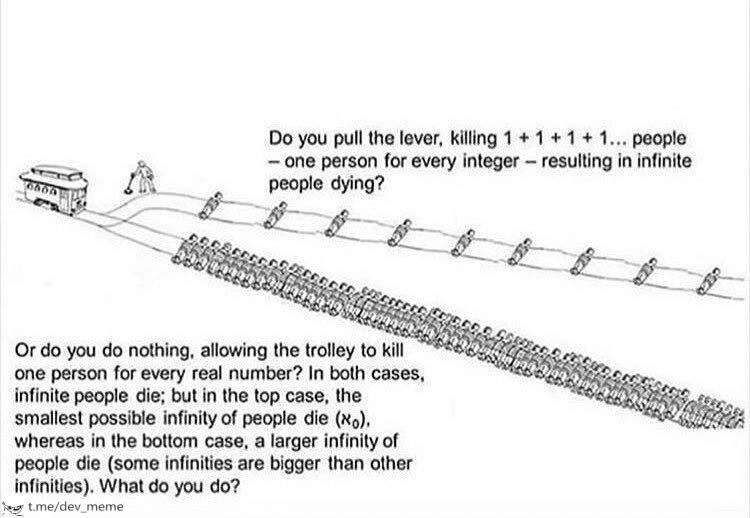
So in the meme, the top track has “1 + 1 + 1 + 1 + … people — one person for every integer.” That implies a countably infinite number of people on the track (because the integers 1, 2, 3... go on forever). You could imagine Person #1, Person #2, Person #3, and so on, lined up with space between them, extending endlessly. This is an infinite line of individual people that you can count in theory (Person 1, Person 2, etc.). Infinite, but countable.
The bottom track says “one person for every real number.” This is a lot harder to imagine literally, because a person for every real number between, say, 0 and 1 would mean people packed not just in a line you can count, but so densely that between any two people you’d immediately have another person (and infinitely many more in any gap). The cartoonist represented this by just drawing a solid strip of tiny stick figures on the lower track – it looks like an unbroken crowd. If each person’s position corresponds to a real number, then effectively the people form a continuous segment with no spacing. This means an uncountable infinity of people. There isn’t Person #1, Person #2, etc., because you can’t assign a unique integer to each – there are simply “too many” in a very precise mathematical sense. No counting scheme can cover them all.
Now, both tracks involve an infinite number of potential victims – an unending tragedy either way. But here’s the key point: mathematicians say that the infinity of the top track (countable, ℵ₀) is actually the smallest kind of infinity, whereas the infinity of the bottom track (uncountable, like the real numbers) is a strictly larger kind of infinity. In notation, we’d say something like $|\text{Integers}| = \aleph_0$ and $|\text{Real numbers}|$ is a bigger number often noted $c$ (for continuum). The meme explicitly mentions ℵ₀ for the top case to remind us it’s the smaller infinity. And it cheekily notes “some infinities are bigger than other infinities” for the bottom case. This is a famous idea from set theory: not all infinite sets are equal in size.
For a bit more context, this concept is taught in discrete math or theory of computation classes (hence the CSFundamentals tag). It’s important in computer science theory because, for example, the set of all possible computer programs is countable (you could in theory list them as strings of code), but the set of all possible problems or outputs can be uncountable, which hints that some problems will never be solved by any program (there are more possible mathematical functions than there are programs – a theoretical basis for understanding undecidability). But even without that context, the basic idea stands: Infinity isn’t one-size-fits-all. There’s an infinite that you can count (like counting forever: 1, 2, 3, ...), and there’s an infinity so large you can’t even start counting in any complete way (like trying to list every possible real number with endless decimals).
So, what does the trolley problem mash-up mean? It’s asking: Would you pull the lever to divert the trolley and kill a countably infinite number of people (ℵ₀ people), or do nothing and let it kill an uncountably infinite number of people? Either way, “infinite people die.” But the meme jokingly frames it as an ethical preference for the smaller infinity of casualties. In a normal scenario, we’d of course choose the option where fewer people die. Here “fewer” is in the sense of a smaller type of infinity! ℵ₀ is the “smallest infinity,” so theoretically that’s “better” (less bad) than the uncountable infinity on the other track, which is a larger infinite number of deaths. It’s a very nerdy way to extend the logic of the trolley problem (save as many lives as possible) into the realm of the infinite.
The humor and the appeal to developers (or anyone with a math background) comes from recognizing these terms and the absurdity of the situation. It’s mixing a thought_experiment from ethics with a lesson from the philosophy_of_math. If you’ve ever heard someone say “some infinities are bigger than others” in a math class, this cartoon is basically testing that idea in a dramatic scenario. And yes – in set theory, infinity doesn’t mean an absolute maximum; there are endless tiers of infinity. Here we just deal with two tiers: the countable tier (ℵ₀) and the uncountable tier (the size of the real numbers). So practically, the meme is telling you: both choices are terrible, but one is “mathematically less terrible” because ℵ₀ < (uncountable infinity).
To summarize this level: The top track = an infinite line of people you could count (one per integer, countably infinite victims). The bottom track = an even more uncountable infinity of people (so many that counting one by one isn’t possible, a continuum of victims). Both are infinity, but one infinity is bigger. The meme asks, tongue-in-cheek, which action you’d take. It’s a play on the classic trolley dilemma, but you need to know about countable vs uncountable infinities (like something from a discrete math lecture) to get why it’s funny. Essentially, it turns a moral choice into a geeky math joke: choose the track where ℵ₀ people die, because ℵ₀ is “only” the smallest infinity – as close to zero casualties as infinity can get! Only in a developer or math nerd community would this line of reasoning even make sense as humor.
Level 3: Set Theory Off the Rails
From a seasoned developer or computer scientist’s perspective, this meme hits that sweet spot of PhilosophicalHumor and nerdy inside joke. It takes the well-known trolley problem – a staple thought experiment in ethics – and gives it a delightfully meta twist by framing the decision in terms of infinite set sizes. The humor here comes from the absurd intellectualization of a life-or-death scenario. In a typical trolley problem, you might debate sacrificing one life to save five. Here, both choices are unimaginably horrific (∞ lives lost either way!), yet the meme invites you to be “rational” by choosing the lesser of two infinities. It’s the kind of GeekHumor that requires remembering a bit of discrete math: most developers will recall the concept of countable vs uncountable infinities from their CS fundamentals or math lectures. Seeing $\aleph_0$ (aleph-null) pop up in a comic about a runaway trolley is both bizarre and brilliant – it triggers flashbacks to university set theory lessons, but in the context of a dark joke.
The meme text even hand-holds us through the logic: “In both cases, infinite people die; but in the top case, the smallest possible infinity of people die ($\aleph_0$), whereas in the bottom case, a larger infinity of people die.” The phrase “smallest possible infinity” itself is tongue-in-cheek – ordinarily, calling any massacre “small” would be horrific, but mathematically here we’re strictly speaking about cardinality. It’s an extreme form of the utilitarian calculus: normally one might say “kill 5 vs kill 500, obviously choose 5.” In this comic, it’s “kill $\aleph_0$ vs kill an uncountable infinity, obviously choose $\aleph_0$.” This set-theory logic applied to an ethical dilemma is funny precisely because it’s so out of place. It’s a collision of math and morality: the lever operator has to recall their discrete math to decide who lives and dies! That incongruity makes those of us in the TechHumor crowd smirk and go “Only a nerd would frame it that way.”
We also appreciate how the illustration visually represents the two types of infinity. On the upper track, the stick figures are drawn as discrete individuals spaced apart – you could imagine numbering them 1, 2, 3, ... forever along the rail. That’s a classic depiction of a countable set (one victim per integer). It evokes an infinite loop in programming where you have a loop counter incrementing one by one perpetually. For instance, a developer might humorously liken the top scenario to a piece of code counting up forever:
# Countably infinite loop – adding one victim per iteration
victims = 0
while True:
victims += 1 # one more person, corresponding to the next integer
This loop conceptually would assign each person a unique integer ID and go on forever (InfiniteLoops are bad in code, but apparently even worse on trolley tracks!). In contrast, the bottom track in the cartoon is so densely packed with people that they form an almost continuous band. There’s literally no gap between the tiny stick figures, illustrating the idea of an uncountable continuum of victims. In computing terms, this would be like trying to loop over every real number between 0 and 1 – an impossible task, because between any two distinct real numbers, there are infinitely many others. Even if you tried something wild in pseudo-code:
# Uncountable "loop" – hypothetically iterating over reals (not actually possible)
x = 0.0
while x < 1.0:
x += some_tiny_step # no matter how small the step, uncountably many points are skipped
No matter how fine you make some_tiny_step, you’ll skip over uncountably many real points. You simply can’t enumerate all real numbers in a sequence – not in code, not in theory. Likewise, you couldn’t individually line up “one person for every real number” without leaving gaps; the only way is to imagine an unbroken continuum of people. The meme’s bottom track effectively says the trolley will plow through a continuum of people – a literally thicker infinity of casualties. 😨
For experienced folks, this resonates as both hilarious and perversely clever. It’s hilarious because it highlights the over-analytical tendencies of our tech/math community. We’ve all seen how engineers or academics can turn even a simple moral or practical question into a complex optimization problem. Here the poor soul at the lever is doing a cardinality optimization: “Which outcome yields the lesser order of infinite deaths?” It’s a dark parody of rational decision-making – a philosophy_of_math joke where the “ethical” choice hinges on concepts like aleph-null and the continuum. In a way, it’s poking fun at the kind of meta reasoning we geeks adore: taking the problem to a higher abstraction (literally into infinite set theory) to make a decision. It’s also a wry commentary on how certain problems are beyond normal scales – sometimes both choices are “infinitely bad,” yet leave it to a mathematician to say, “well, actually, one infinity is less bad.”
Culturally, many developers and computer scientists have an affinity for this kind of humor. It reminds us of those late-night dorm debates or thought_experiment tangents where someone inevitably brings up the countable_vs_uncountable distinction or the classic line “some infinities are bigger than others.” (Fun fact: that line even popped up in a popular novel and movie, The Fault in Our Stars, but here it’s 100% in the nerdy mathematical sense.) So the meme taps into both intellectual nostalgia and our enjoyment of absurd extremes. It’s MetaHumor too: a joke about a thought experiment inside a joke about mathematical concepts. We laugh because it’s ridiculously learned and gruesome at the same time.
In summary, a senior or academically-inclined developer sees this and appreciates the layers: the trolley_problem reference (ah, the classic ethical dilemma), the aleph_null reference (hey, I remember that symbol from discrete math!), and the sheer outrageousness of quantifying an ethical choice with set theory. It’s an inside joke where the punchline is that you “optimally” choose to kill ℵ₀ people to avoid killing an even larger $\mathfrak{c}$ people. It’s grim, it’s geeky, and it brilliantly illustrates the notion that infinity isn’t just infinity — a concept we encountered in theory and never expected to apply to runaway trolleys!
Level 4: Cantor’s Trolley Conundrum
At the highest theoretical level, this meme is a mashup of set theory and ethics, forcing us to analyze a transfinite moral dilemma. In set theory (a cornerstone of CS_Fundamentals and mathematics), the cardinality of a set is the measure of its size – essentially how many elements it contains. When we say a set is infinite, we usually think “endless,” but Georg Cantor’s groundbreaking 19th-century work revealed that infinite sets come in different sizes. The meme exploits this concept: the top track corresponds to a countably infinite set of victims (one for every integer), and the bottom track corresponds to an uncountably infinite set of victims (one for every real number). These are two different levels of infinity.
In formal terms, the set of all integers (let’s say $\mathbb{Z}$ or natural numbers $\mathbb{N}$) has cardinality $\aleph_0$ (aleph-null), which is the smallest infinite cardinal number. It’s the “size” of any listable infinity – any set you can put in one-to-one correspondence with the natural numbers, like ${1, 2, 3, ...}$. The set of real numbers $\mathbb{R}$, by contrast, has a strictly larger cardinality. Cantor proved through his famous diagonalization argument that there’s no possible way to enumerate all real numbers in a sequence – any purported list misses infinitely many reals. The cardinality of the continuum (the reals) is often denoted by $\mathfrak{c}$, and one way to express it is as $2^{\aleph_0}$ (the power set of the naturals). In Cantor’s hierarchy of infinities:
$$ |\mathbb{N}| = \aleph_0, \qquad |\mathbb{R}| = 2^{\aleph_0},. $$
And crucially, $\aleph_0 < 2^{\aleph_0}$. In plain English, $\aleph_0$ (aleph-null) is the size of an infinite countable set, and the continuum $2^{\aleph_0}$ is a strictly greater infinity. This was a revolutionary discovery: it showed that the infinite is not monolithic – some infinities are provably bigger than others. Cantor introduced the $\aleph$ notation to describe this tower of infinite cardinalities (ℵ₀ being the first rung of an endless ladder of larger and larger infinities).
So in the trolley meme’s morbid setup, the upper track represents killing a set of people of size $\aleph_0$, while the lower track kills a set of size $2^{\aleph_0}$ (the cardinality of all real numbers). Both death counts are infinite, but in the rigorous sense of Cantorian set theory, the bottom track’s casualty set is a “higher-order” infinity. The meme explicitly labels the top track as “the smallest possible infinity of people (ℵ₀)” and the bottom as “a larger infinity of people,” invoking that notion of an infinite hierarchy. It’s applying pure set-theoretic logic to a grim ethical thought experiment. This juxtaposition is as intellectually jarring as it is darkly comedic: we’re essentially doing transfinite arithmetic on a life-and-death decision. From a theoretical CS or math perspective, it even hints at the concept of comparing infinities as we do in complexity theory or computability (e.g. countable sets often correspond to things like all possible programs or states we can enumerate, whereas uncountable sets connect to problems beyond algorithmic reach). In short, the meme dives straight into the deep end of philosophy_of_math: it’s a cardinality paradox of ethics where “infinite harm” is not a single uniform quantity but has nuances of size.
Even more esoterically, this scenario brushes against ideas like the continuum hypothesis (the question of whether there’s an infinity strictly between $\aleph_0$ and the continuum). We’re not explicitly invoking it here, but the meme’s mention that “some infinities are bigger than other infinities” is a nod to Cantor’s legacy and the counter-intuitive truth that there is an entire ordering of infinities. It’s a rare case where a casual internet joke name-drops $\aleph_0$, likely to delight anyone who remembers that from discrete math or set theory class. Beneath the humor lies the fundamental mathematical reality: if forced to compare two infinite sets, one can indeed be considered the “smaller” infinity. The person at the lever is effectively choosing between cardinalities $\aleph_0$ and $2^{\aleph_0}$ – making a surreal calculation about death tolls in the transfinite. Cantor would either chuckle or cringe! This is GeekHumor at its purest, tying together the abstract depths of mathematics with a classic moral dilemma.
Description
A classic 'Trolley Problem' meme is given a mathematical twist. The illustration shows a trolley heading towards a fork in the track, with a person at a lever who can switch the trolley's path. On the top track, to which the lever would divert the trolley, people are tied down, spaced apart, representing the set of integers. On the bottom track, the default path, an immense, dense crowd of people are tied down, representing the set of real numbers. The text poses the dilemma: 'Do you pull the lever, killing 1 + 1 + 1 + 1... people - one person for every integer - resulting in infinite people dying?' or 'Or do you do nothing, allowing the trolley to kill one person for every real number?'. The text explains that while both scenarios result in infinite deaths, the top case involves the smallest infinity (ℵ₀, aleph-null, or countable infinity), whereas the bottom case involves a larger, uncountable infinity. The humor comes from applying Georg Cantor's set theory on different sizes of infinity to a moral philosophy problem, turning an ethical choice into a mathematical one
Comments
7Comment deleted
Any senior engineer would pull the lever. It's the only ethical choice that's also a clear-cut cardinality-based optimization
As the tech lead at the switch, I can keep the monolith and suffer uncountably many hidden side-effects, or refactor to microservices and inherit countably infinite network failures - either way chaos, but at least Prometheus can index ℵ₀ of them
This is basically every architecture decision at scale: do you accept O(n) degradation affecting countable users, or risk the uncountable cascade failure that happens when someone discovers your elegant distributed system has a Byzantine generals problem at 3am
This is the kind of edge case that makes you realize your moral framework doesn't scale to O(∞). Sure, you could argue that ℵ₀ deaths is 'better' than ℵ₁ deaths, but good luck explaining to your ethics review board why you're optimizing for cardinality when both solutions have infinite runtime and zero survivors. At least with regular trolley problems, you can grep for the optimal solution - here, you're just choosing between two different flavors of stack overflow in your conscience
Pull the lever: aleph-zero failures fit in a queue; continuum-scale outages aren’t iterable and violate every SLA
I’ll route the trolley to the integers - aleph‑null failures are at least iterable; you can’t paginate the reals
Pull the lever - aleph-null deaths is o(continuum), optimal under asymptotic utilitarianism