Unlikely Alliance on Child Limits
Why is this CS Fundamentals meme funny?
Level 1: Only Two Kids Allowed
Imagine a family where parents are only allowed to have two kids. They can have one child or two children, but if they try to have a third baby, the answer is “No, you can’t.” That sounds like a strict house rule or a law, doesn’t it? Well, funny enough, that was actually a real rule in China for a while – each family could have up to two kids, no more. Now, think of a family tree, the kind you draw to show who’s related to who. Usually, parents might have lots of children branching under them. But in a special “binary” family tree, each parent is only allowed two children at most. It’s as if every mom and dad in that tree has just two hands – a left hand and a right hand – and they can hold one child in each. If a third child comes along, there’s no third hand to hold them, so it just can’t happen.
This meme finds it funny that a country’s rule for families and a computer’s rule for a tree structure are the same: “two kids max”. It’s like discovering that a school rule and a video game rule accidentally matched each other. Seeing China and a computer binary tree shake hands over this shared rule is silly because one is about real people and babies, and the other is about abstract data and nodes. But they agree on the idea of “only two children allowed,” and that surprise connection makes us laugh. In simple terms, the meme is joking, “Hey, look! Even a computer tree and a big country can high-five on the rule of two kids only!” It’s a goofy way of learning that in a binary tree, just like in that strict family scenario, no one gets to have more than two children.
Level 2: Binary Means Two Kids
Let’s break down the joke in simpler terms. In computer science, a binary tree is a type of data structure that looks a bit like an upside-down family tree. Each element of the tree is called a node. A node can connect to other nodes, which we call its children. Importantly, in a binary tree, each node is allowed to have at most two children. Usually we talk about a left child and a right child – think of them as the two branches coming off a node. Why “binary”? The word binary literally means “composed of two parts” (just like binary digits 0 and 1). So by definition, a binary tree node never has three or more children; it tops out at two.
A Binary Search Tree (BST) is a special kind of binary tree that’s organized for quick searching. In a BST, if a node has a left child, that left child’s value is smaller than its own value, and if it has a right child, that right child’s value is larger. This ordering, combined with the two-children limit, lets us search through the tree efficiently (much like how you’d guess a number by asking “higher or lower?” and eliminating half the possibilities each time). But the key detail for this meme is simply the “two children max” rule. Every BST, or any binary tree, follows that rule strictly.
Now, the meme compares this programming concept to China’s two-child policy. That policy was a real-world government rule (in effect around 2016–2021) that said a family in China could not legally have more than two children. It was an update to the earlier one-child policy aimed at controlling population growth. So in everyday terms, parents were restricted: one mom + one dad = at most two kids, no third baby allowed under the law. This was a big deal in news and world politics for many years. By the time this meme was made (2019), the two-child limit was the rule.
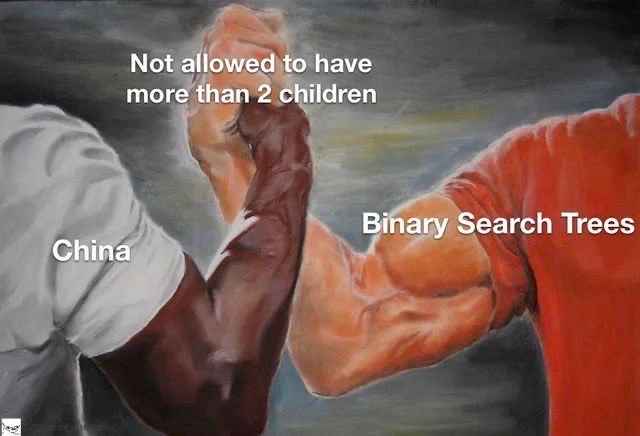
The meme image itself is the famous “Predator handshake” format, which comes from a scene in the 1987 movie Predator where two characters (played by Arnold Schwarzenegger and Carl Weathers) do a badass arm-grip handshake. Meme culture adopted that image template to humorously illustrate two very different people or things finding a shared agreement or similarity. Here, the left arm is labeled “China” (with a white shirt sleeve) and the right arm is labeled “Binary Search Trees” (with a red sleeve). They’re clasping hands firmly in the middle. Over the clasped hands, the text “Not allowed to have more than 2 children” appears, showing what they have in common. It’s like saying: Hey look, China and binary trees actually agree on something!
For a junior developer or someone just learning about data structures, this meme is a playful way to remember a core fact: a binary tree node can only have two children. We can even envision it in code. For example, in a typical definition of a binary tree node, you’d see two references for the children, one for left and one for right:
class TreeNode {
int value;
TreeNode left;
TreeNode right;
// Each node has at most two children: left and right.
}
If you try to add a third child reference, it simply doesn’t exist in this structure. It’s not allowed by the very design of a binary tree. For instance:
TreeNode root = new TreeNode(10);
root.left = new TreeNode(5);
root.right = new TreeNode(15);
// root.middle = new TreeNode(7); // ❌ Error: no 'middle' child in a binary tree!
In the code above, root.left and root.right are perfectly valid – those are the two children. But root.middle would cause an error, because TreeNode doesn’t have a field for a third child. The comment highlights that trying to give a node a middle child (a third child) is illegal in a binary tree. So, much like a law limiting family size, the binary tree’s structure limits how many “offspring” each element can have.
Now think of China’s policy in simple terms: if a couple already has two kids and they get pregnant again, that third child would break the rule. There could be penalties or it simply wasn’t allowed (depending on the era and enforcement). So both the BST and the policy share a strict upper bound of two kids per parent/node. That’s the crux of the joke — a node children limit in code is being likened to a children per family limit in real life.
It’s a form of computer science humor where we draw analogies between tech concepts and everyday things. By jokingly saying China and binary trees are doing a camaraderie handshake, the meme makes a memorable association: “two-child limit” = both a national policy and a programming rule. If you’re new to coding, don’t worry, you’re not actually expected to mix government policies into your coding style! It’s just an analogy to help recall that binary = two children. And if you’re from the coding world, it’s a quick laugh because it’s such a nerdy connection to make. This is a prime example of coding humor that blends a bit of real-world trivia with a foundational CS concept, making the learning a bit more entertaining. After seeing this, you’re unlikely to forget how many children a binary tree node can have, right?
Level 3: Two's Company, Three's a Crowd
The classic Predator handshake meme sets the stage: two bulging, muscular arms — one labeled China, the other a Binary Search Tree (BST) — clasping hands in solidarity. Hovering over their joined grip is the text:
“Not allowed to have more than 2 children.”
This absurdly unites a geopolitical policy and a data structure rule under one banner. Why is this hilarious to developers? It’s the mashup of a real-world law with an algorithmic constraint. China’s well-known two-child policy (enacted after decades of an even stricter one-child rule) limited families to at most two offspring. A binary tree in computer science, true to the Latin prefix “bi-” meaning two, limits each node to at most two child nodes (usually termed a left child and right child). The meme humorously portrays this two-child limit as the common ground where a nation’s family planning edict and a fundamental CS data structure philosophy meet and shake hands.
For seasoned developers, this resonates on multiple levels. First, it’s a tongue-in-cheek refresher of CS fundamentals. The rule “no more than two children” is literally the defining property of any binary tree – including binary search trees – which we drill into every newbie programmer’s head. Each node in a BST can branch in two directions and no more: one pointer to a smaller value on the left, one to a larger value on the right. That’s what makes it binary. In code, you typically see something like node.left and node.right — there’s never a node.middle because a third child simply isn’t allowed in the structure. The meme’s punchline takes this dry definition and gives it a sly, worldly twist by comparing it to China’s population control policy. It’s algorithm humor at its finest: mixing a technical fact with wry social commentary.
This comparison also works as a sly nod to the phrase “binary means two.” In a binary search tree, the benefit of this two-branch rule is efficient lookup – at each node you make a binary decision (left vs. right) cutting the search space in half, much like a yes/no decision tree. If nodes had more than two children, it wouldn’t be a binary tree anymore (and we’d lose that neat binary search property). In fact, computer science has entire families of trees with higher branching factors (like B-trees in databases, where nodes can have many children for optimized disk reads). But the BST is our simple, elegant two-child model. The meme wittily anthropomorphizes this model: if a BST were a society, it too would enforce a “two kids per parent” rule. For developers who’ve slogged through data structure classes (remember manually coding those tree insert and delete functions?), seeing a strict coding rule reimagined as a government policy is an instant lightbulb moment and a chuckle.
What makes the meme even more amusing is the sheer incongruity of the handshake participants. One arm represents a country’s legislative hand governing human families; the other arm represents a tree data structure governing pointers and memory. They couldn’t be more unrelated, yet here they are flexing in agreement. It’s a nerdy example of finding patterns in vastly different domains – a typical programmer impulse. Computer science humor often thrives on these analogies, because it tickles that part of a developer’s brain that loves finding structure and rules in everything. We can’t help but compare, say, a complex social system with lines of code if they share a common formula. In this case, it’s “2 children max” in both contexts, which is so specific and bizarre that it elicits an involuntary laugh. Who would have thought Chinese population control and binary tree node limits would ever be mentioned in the same breath, let alone portrayed as best buds?
To seasoned eyes, there’s also a bit of historical/technical depth here. China’s policy famously started as the one-child policy decades ago, an even stricter rule. (Enforcing that in code terms would be like a singly-linked list, where each element points to just one child node — one next pointer, no alternatives). Around 2015, the policy relaxed to allow two children due to demographic concerns. Now two kids are allowed — conveniently matching the binary tree’s two-child schema. The meme capitalizes on this updated rule: now China and a BST node have exactly the same maximum offspring count. (If China had stuck to one child, our meme-maker might’ve had to use a different data structure for the joke, perhaps a lonely linked list node 🤓.) This timely alignment makes the joke extra snappy. It’s as if the BST had been waiting decades for China to “upgrade” to two children so they could finally do this epic handshake!
All in all, the meme lands because it’s coding humor with a worldly twist. It reminds experienced devs of the rigid rules baked into our everyday algorithms and how those can weirdly parallel real life rules. It’s a knowing grin at how a strict node children limit in binary trees accidentally mirrors a strict human policy. The dramatic Predator-arm clasp image only amplifies the effect, lending over-the-top gravitas to an exceedingly geeky joke. In the world of software engineering inside jokes, this one definitely branches out in a creative direction (pun intended).
Description
A meme using the 'Epic Handshake' format from the movie Predator. The meme shows two muscular arms clasping hands in agreement. One arm is labeled 'China,' and the other is labeled 'Binary Search Trees.' The text in the middle, representing their shared principle, reads 'Not allowed to have more than 2 children.' The humor is derived from the unexpected and darkly witty comparison between China's former two-child policy and the fundamental computer science concept of a binary search tree, where each node can have at most two child nodes. This joke is particularly resonant with those who have a computer science background
Comments
7Comment deleted
The difference is, when a binary tree violates the two-child rule, you just rebalance it. The geopolitical consequences are slightly less severe
Limiting every node to two children is trivial; the real ops nightmare is when you forget the AVL rotations and the whole dynasty collapses into a billion-node linked list
After 20 years of optimizing tree traversals, you realize the real performance bottleneck was explaining to stakeholders why your perfectly balanced BST still takes O(log n) time when they expected O(1) because 'it's already organized.'
The perfect analogy: both binary search trees and China's former policy enforce a strict two-child limit, though only one of them has O(log n) lookup time for finding your descendants. At least with BSTs, you can rebalance when things get uneven - try explaining AVL rotations to a policy committee
BSTs cap children at two; production org charts tried the same, then one deletion turned the roadmap into a skewed linked list - cue quarterly rotations and a DBA muttering we should’ve used a B‑tree
Binary search trees: the only org chart where a two‑child policy is an optimization; add a third and suddenly you’re maintaining a B‑tree and a pager rotation
China and BSTs: both ruthlessly enforcing arity limits to keep hierarchies balanced and performant