When 'Let's Code Together' Feels More Like a Hostage Situation
Why is this Learning meme funny?
Level 1: First Day of School
Imagine you transfer to a new school where everyone speaks a language you don’t understand. On your very first day, two big kids come over and say, “Come on, we’re doing a group project together right now.” They seem very confident and know exactly what’s going on, but you’re just standing there, not even sure how to say “hello” in this new language. You feel a little scared and very small, like “Uh oh, I hope they don’t expect me to know this stuff!”
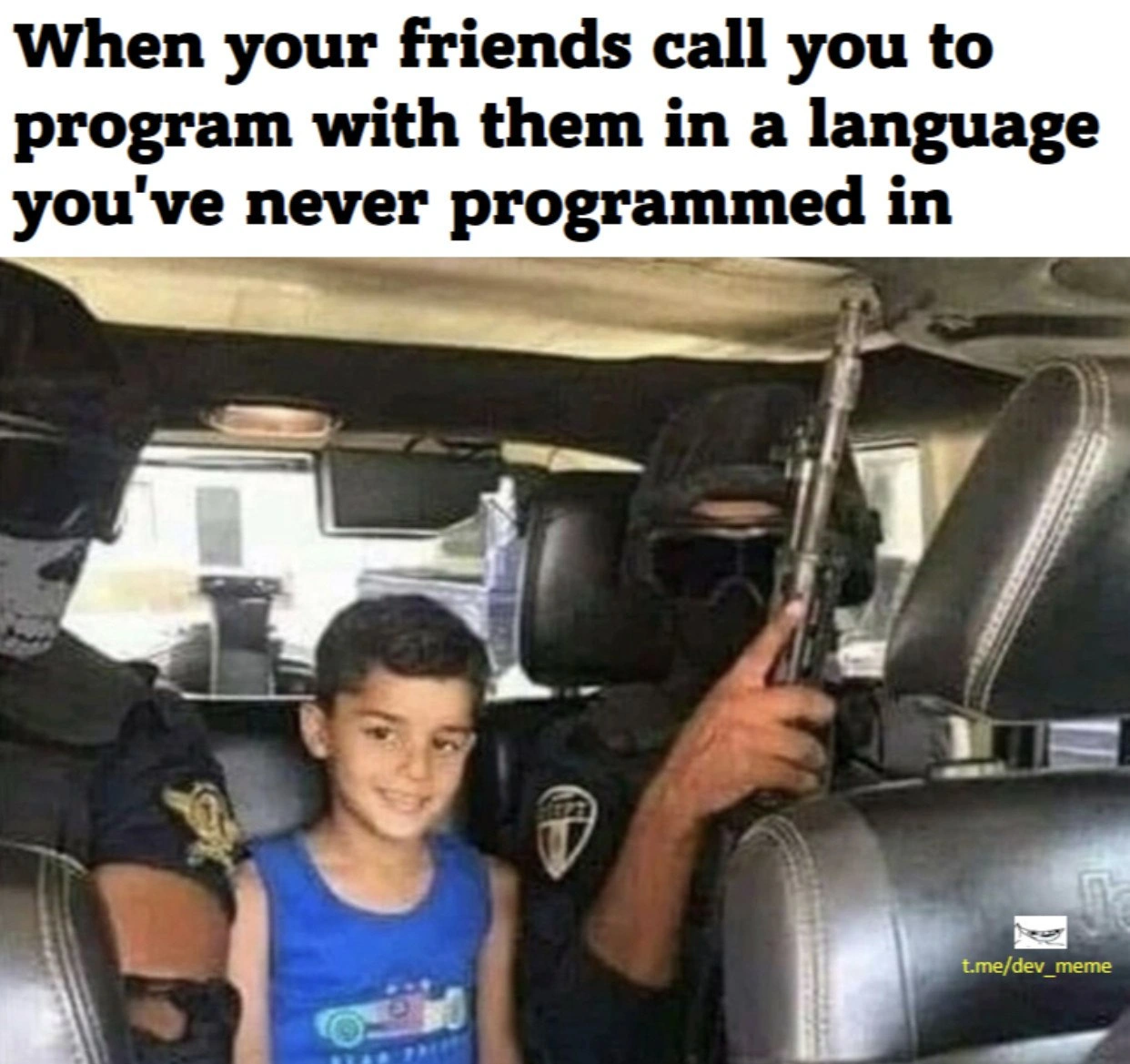
That’s exactly what’s happening in the meme. The little boy in the car is like a kid who suddenly has to play a complicated game with older, tougher kids. The older kids (in this case, they look like special forces soldiers!) are like experienced friends who know a certain programming language really well. The little kid is smiling nervously because he doesn’t want to look scared, but inside he’s thinking, “I have no idea what we’re doing, but I guess I have to go along with it.” It’s a funny picture because we can all remember a time when we felt out of place and a bit overwhelmed by something new. Just like being the new kid at school or trying to play a game when you don’t know the rules, coding with friends in a language you don’t know makes you feel lost and nervous at first. The meme makes us laugh because we recognize that exact “help, I’m in over my head!” feeling, but in a silly, over-the-top way.
Level 2: Syntax Culture Shock
For a less experienced developer, let’s break down why this situation is so uncomfortable (and thus funny in retrospect). Pair programming means two people working together on the same code: typically one is the "driver" typing, and the other is the "navigator" reviewing each line in real time. It’s like two pilots in a cockpit. Now, imagine co-piloting a plane when you've only ever ridden a bicycle — that’s the vibe when you pair up in a language you’ve never used before. The meme’s text, “program with them in a language you’ve never programmed in,” describes a classic learning curve scenario: being expected to contribute despite language unfamiliarity.
Programming languages are like spoken languages in many ways. They each have their own syntax (rules and punctuation), idioms, and vocabulary:
- A language like JavaScript might feel informal and flexible (you don’t always have to declare types), whereas Java or C# is more strict, demanding you explicitly state the type of each variable and end lines with semicolons.
- In Python, you’d write
print("Hello, world!")and be done. In C++, printing hello world requires a setup like:
If you’ve never seen C++ before, all those angle brackets, braces, and#include <iostream> int main() { std::cout << "Hello, world!"; return 0; }std::coutcan be intimidating. It feels like extra ceremony just to do something simple. - Some languages use totally different paradigms. For example, Haskell is a functional language with concepts like monads and lazy evaluation. If you come from a simple scripting background (like writing small scripts in Bash or Python), reading Haskell code might feel like math class all over again (there are
$and->symbols everywhere).
So, the “culture shock” is real: your brain has to adjust to a new set of rules on the fly. In the meme image, the two tactical officers represent friends or teammates who do know the language well — they’re comfortable, heavily armed with knowledge and tools (think of tools like IDE debuggers, linters, and frameworks they know by heart). The young boy represents you, the developer who’s new to this environment, feeling out of place and unprepared. He’s smiling nervously in the photo, which is exactly what a junior dev might do while internally panicking, “What does all this code even mean?!”
Let’s also talk about the intimidation factor. Even without actual weapons, seasoned programmers can inadvertently intimidate newcomers. They might use a lot of jargon: “Just spawn a new goroutine for that I/O call” or “We’ll implement an abstract factory here” — and if you’ve never heard those terms in this language context, it’s scary. You might fear asking what something means because you don’t want to look as lost as you feel. This is a common source of developer frustration: feeling stuck and self-conscious at the same time. When pair programming, that pressure doubles because someone is literally watching your screen or sharing the keyboard. If they’re zipping through the code with keyboard shortcuts and you’re still trying to find the semicolon key, it’s easy to feel overwhelmed.
However, here’s the uplifting flip side (the educator in me can’t resist): good friends or teammates usually know you’re new and will guide you — they’re not actually there to "attack". Pair programming in a new language can turn into a rapid learning session. It’s a bit like immersion when learning a spoken language: scary at first, but you pick up a ton by being thrown into it. The armed guards in the meme won’t actually harm the kid; similarly, your experienced buddies likely won’t judge you harshly. They remember their first time with the language too. In fact, many developers enjoy sharing knowledge. So while the learning curve initially feels steep (almost vertical!), with a little patience you go from feeling like that kid to feeling like part of the squad. The meme exaggerates the fear to make us laugh, but it’s also a reminder that everyone starts somewhere.
In summary, at this level we recognize the concrete things going on: an inexperienced developer is being asked to collaborate in real time in an unfamiliar programming language. They worry about basic syntax errors, not knowing the common functions or libraries, and looking foolish in front of peers. The “ambush” feeling comes from the lack of preparation time. But every developer goes through this when branching out to new technologies. The situation is both painful and a rite of passage — and that’s exactly why it resonates. It’s a shared developer experience (DX) moment: scary at first, but ultimately part of growing as a programmer (and later, a funny story you’ll tell!).
Level 3: Pair Programming Under Fire
This meme hits a nerve with experienced developers by exaggerating the ambush of being asked to code in an unfamiliar language. The scene of a small child flanked by masked special forces is a perfect metaphor for a developer who is proficient in one environment suddenly finding themselves in a high-stakes pair programming session in another. It’s developer humor rooted in very real anxiety: learning a new programming language under pressure feels like being a civilian dropped into a SWAT raid.
In a senior developer’s world, getting “volunteered” to help in a different tech stack is both relatable and terrifying. We’ve all been that wide-eyed programmer (the kid) sandwiched between battle-hardened experts (the tactical officers) who navigate the code with military precision. The humor comes from contrast: one moment you’re confident in, say, Python, and the next you’re staring at Rust or Haskell code as indecipherable as encrypted coordinates. Your teammates—decked out in the equivalent of tech body armor (deep knowledge, fancy IDE shortcuts, insider jargon)—assume you can keep up because “code is code, right?”. Meanwhile, you’re mentally scrambling like a hostage negotiating with curly braces and segfaults.
This scenario nails the impostor syndrome many seasoned devs feel when venturing outside their comfort zone. Developer Experience (DX) often varies widely between languages: what’s intuitive in one can be bewildering in another. For example, a simple task like printing output might be trivial in one language and require five lines of boilerplate in another. If you normally live in a world of automatic memory management and friendly error messages, jumping to a language where a single missing semicolon or a mismanaged pointer can blow things up feels like walking through a minefield. The meme’s armed escort imagery humorously captures that intimidation: the boyish grin is the facade we put on while internally thinking, “Please don’t let me break anything.”
There’s an unspoken truth among veteran coders: no matter how advanced you are in your domain, being thrown into an unknown language is a great equalizer. That moment forces you back to learning curve basics, often in front of an audience. It’s funny because it’s true — and a little traumatic. We laugh at this meme because we’ve survived similar “hostage situations” in coding interviews, on frantic Zoom calls, or at hackathons where a friend says “you know Java, so jumping into Go with me should be easy, right?” (Cue the nervous laughter.) The meme hyperbolically equates that peer pressure and sudden language unfamiliarity with a high-pressure tactical operation. In reality, nobody’s threatening you with an assault rifle if you confuse .equals() with ==, but it feels like a critical mission with your pride on the line.
By mixing the absurd (kid with commandos) and the familiar (coding with friends), the meme highlights a key industry insight: everyone has gaps in their knowledge, and teamwork can sometimes expose those gaps in painfully funny ways. Seasoned devs recognize both the humor and the subtext — it’s a lighthearted jab at the expectation that a good programmer should be instantly effective in any technology. Sure, most of us strive to be polyglots, but the transition is rarely smooth. This image says what every expert-in-one-language, newbie-in-another is feeling: “I’m armed with enthusiasm, but please go easy on me — I have no idea what I’m doing here.”
Description
A meme featuring a photograph taken from inside a vehicle. A young boy in a blue tank top is sitting in the back seat, smiling directly at the camera. He is flanked by two individuals in full black tactical gear, including helmets and masks. The person on the left wears a skull-print balaclava, and the person on the right is holding a large gun. The caption above the image reads, 'When your friends call you to program with them in a language you've never programmed in'. The humor arises from the stark contrast between the friendly invitation in the caption and the threatening visual of being held captive. For developers, this captures the feeling of being pressured or 'volunteered' into a project using a completely unfamiliar tech stack. The boy's smile represents the developer trying to be a good sport and hide their overwhelming sense of being in over their head, a common scenario in hackathons or when joining a new team. A small watermark for 't.me/dev_meme' is visible in the bottom right
Comments
12Comment deleted
That's the face you make when they say 'It's just like JavaScript' and you open the repo to find a sea of custom webpack plugins and undocumented JSX hooks
Getting “invited” to pair on a Rust module: two senior devs flanking you, and somewhere behind them the borrow checker chambers a round and whispers, “That lifetime better be explicit, kid.”
It's all fun and games until someone suggests pair programming in Haskell and suddenly you're explaining why your 15 years of imperative programming experience means nothing in a world of monads and functors
That moment when your 'full-stack' experience gets stress-tested in real-time - you're frantically tab-completing through autocomplete suggestions while your pair partner assumes you're just 'thinking architecturally.' Meanwhile, your mental stack trace is three Stack Overflow tabs deep, desperately trying to remember if this language uses semicolons or if whitespace is syntactically significant
Pair programming in a new lang: like implementing borrow checking under shotgun persuasion - smile, but one lifetime error and it's game over
A “quick fix” in an unfamiliar stack is a covert op where your velocity is the hostage and a strange toolchain is doing the negotiating
Peer pressure becomes pair pressure: hop into their Rust repo, spend an hour negotiating with the borrow checker, and ship the only safe change - README.md
Look how happy he is. Comment deleted
I mean, If you have alreday been programming, you would undestand basic constructions. Except for Brainfuck language, yo are literally fucked Comment deleted
tell me what a monad is Comment deleted
What's more, brainfuck is actually one of the simplest langs you can find... Comment deleted
Ups. Deleted Comment deleted