The Ultimate Imposter Test for Software Developers
Why is this Documentation meme funny?
Level 1: Sure, I Read It
Imagine you just got a new board game with a thick rule book. You’re excited to play, so you skim a few important rules and start the game. Now, if your friend claimed, “I sat down and read the entire rule book cover to cover before we started playing,” you might giggle and think, “Yeah right, who actually does that?” It’s a bit like when people check “I agree to the terms and conditions” without really reading the dozens of pages of legal text. In everyday life, almost nobody reads every single instruction or rule beforehand — we usually dive in and figure things out as we go. This meme is joking about the same idea, but with programming. A developer saying “I read all the documentation first” is just as hard to believe as someone saying they read every word of a huge instruction manual before using a new toy. It’s funny because we all know most people don’t do that, and someone insisting they did sounds so perfect that it’s almost like they’re not a regular person. The joke makes us laugh because it playfully calls out that little lie or exaggeration, using the Terminator movie scene to show how obviously unbelievable it is.
Level 2: Documentation Reality Check
Let’s break this down in simpler terms. Documentation in software is like a user manual or guide for a library, framework, or any piece of code you might use. When you start a new programming project and include some dependencies (which are external libraries or packages your project needs), each usually comes with its own documentation explaining how to use it. Good practice says you should read that documentation to understand the tool. But in everyday developer life, very few people actually read every single page of those guides before jumping in.
Think about a time you wanted to use a new library to add a feature. You probably skimmed the introduction or looked up a quick “Getting Started” example, then copied some code and tried to run it. That’s normal! Developers often learn by doing – they read a bit of the docs, try some code, and go back to the docs only when they get stuck. So if a developer loudly claims, “I read all the documentation for every new library before I write any code,” it sounds fishy. It’s developer humor because we suspect this is an exaggeration or a joke. People in tech have a running joke about RTFM – which politely stands for “Read The Friendly Manual” (though the “F” often originally meant something less polite). It’s basically a nudge to go read the official instructions. But here’s the thing: even though we tell each other to “read the docs,” in reality most of us only read some of it at first. Fully reading new_library_docs front-to-back is time-consuming, and developers are usually eager to start building things. There’s often a deadline or just excitement to see things work, so spending days reading manuals feels impractical.
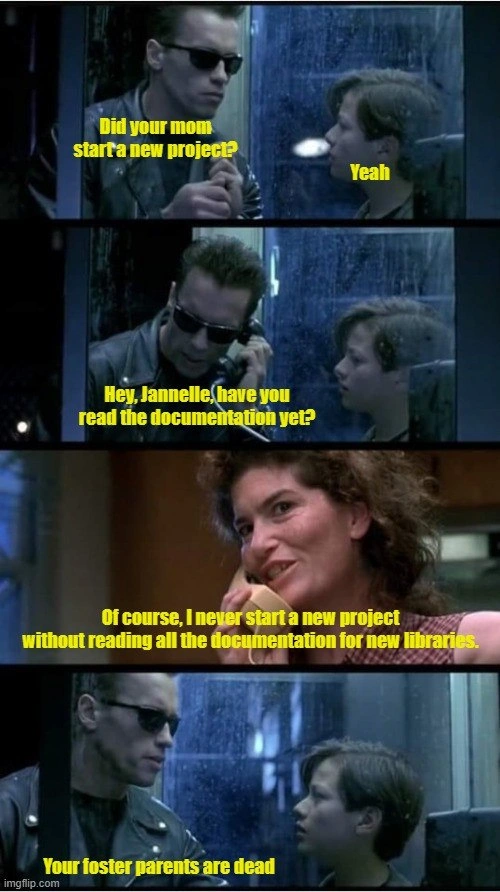
This meme uses a classic Terminator 2 movie scene to poke fun at that reality. In the movie, a robot Terminator is on the phone with a boy’s foster mom, suspecting something is off. The Terminator asks a clever question that the real mom would answer differently (in the film it was about the family dog’s name). In our meme version, the question becomes “Have you read the documentation yet?” Why this question? Because a real developer (being human) might hesitate or admit they didn’t read everything. But the impostor on the phone confidently answers, “Of course, I never start without reading all the documentation.” That answer is too perfect – it’s like a telltale sign that this “mom” on the phone isn’t a regular human (in the movie, she’s actually an evil shape-shifting robot). To a seasoned developer, hearing too perfect of an answer about documentation sets off alarms. It’s the kind of answer we’d expect only from someone who doesn’t understand typical human developer behavior. It’s a playful reality check: in developer culture, nobody truly does that every single time. So the Terminator then says the famous line, “Your foster parents are dead,” basically declaring that the person on the phone failed the test and is an impostor. In the context of the joke, it means “Ha, caught you – no real dev would have said that!”
Ultimately, this meme is DocumentationHumor wrapped in a movie reference. It highlights a common part of developer experience (DX): the documentation habit (or lack thereof). Newer developers are often encouraged to read manuals and docs thoroughly – which is good advice in theory – but the joke is that almost everyone ends up winging it at least a little. It’s a relatable scenario for anyone who’s felt overwhelmed by a huge manual. The humor comes from recognizing that the developer culture often involves a bit of pretending. We all want to be diligent and read everything, but practically, we usually learn just enough to get started. So if someone insists they’re that perfectly diligent every time, people can’t help but laugh or be skeptical. It’s like one of those “yeah, sure buddy” moments in a dev discussion. The meme exaggerates this feeling by using the Terminator’s extreme method of calling out a lie. Don’t worry – in real life, calling someone out for fibbing about reading docs doesn’t involve liquid metal robots! But the exaggeration makes the point: reading every single word of the docs before coding is so uncommon that claiming you do it is almost comically unbelievable.
Level 3: RTFM Turing Test
In this meme’s parody of Terminator 2, the Terminator effectively administers a nerdy Turing Test for developers. In the original film’s phone booth scene, the T-800 (Arnold Schwarzenegger) sniffs out an impostor (the shape-shifting T-1000) by asking a trick question. Here the question is: “Have you read the documentation yet?”. The unsuspecting faux-developer on the other end proudly replies, “Of course, I never start a new project without reading all the documentation for new libraries.” This overly perfect answer is a dead giveaway – much like in the movie when the Terminator realizes the person on the phone isn’t human, he concludes “Your foster parents are dead.” In our context, the Terminator’s brutal punchline translates to: “No real developer would say that – this ‘dev’ must be an impostor.” It’s a hilarious twist on the idea that no human programmer is that impeccably by-the-book.
Why is this funny to seasoned engineers? Because documentation is every developer’s best friend and worst enemy. Sure, the ideal best practice is to thoroughly read docs for any new library or framework – it’s practically developer gospel to “RTFM” (Read The Fine Manual) before you code. But in reality, full compliance with this holy ritual is about as rare as a Terminator shedding a tear. Library documentation, especially for modern dependencies, can span dozens or hundreds of pages across wikis, README files, and reference sites like ReadTheDocs. When a colleague chirps “Oh yeah, I read every page of the docs before I started coding,” any battle-scarred engineer will arch an eyebrow. Dev best practices skepticism kicks in, because we’ve all seen what actually happens: people skim a few pages, copy a quick-start snippet, then dive straight into the code. Claiming you did a thorough cover-to-cover read of new_library_docs is like saying you memorized the entire Linux kernel code before writing a Bash script. Sure you did.
This meme perfectly captures that collective smirk in developer culture. It’s a form of DocumentationHumor that plays on our shared experiences. In the day-to-day reality of software development, time is short and the LearningCurve for new tools is steep. We pull in multiple dependencies via package managers (npm, Pip, Maven, you name it), each with its own massive manual. Reading every word of each dependency’s docs would mean project timelines slipping into the next ice age. Instead, pragmatic devs often rely on quick-start guides, Stack Overflow answers, or just tinkering until something works. It’s not that documentation isn’t valued – it’s that comprehensive docs are often treated like fire extinguishers: crucial to have around, but seldom fully examined until there’s a fire. An experienced developer knows this pattern too well. They might joke that only a robot (or an overzealous intern) has the patience to read all the documentation upfront. So when someone proclaims pristine documentation hygiene, seasoned folks hear a record-scratch moment: “Hold on… no one does that.” Just as the Terminator uses a phonebooth_scene trick to expose the inhuman pretender, veteran devs use the “did you really read it all?” question as a tongue-in-cheek impostor test. The DeveloperCulture reference is crystal clear – the claim is so outlandish that it betrays itself. It’s the tech equivalent of spotting a glitch in the Matrix.
There’s also an ironic subtext here: developers often pretend to follow best practices to appear competent, especially in front of peers or during code reviews. Saying “I read the documentation thoroughly” sounds responsible, like you did your homework. But the RelatableDeveloperExperience is that 9 times out of 10, you’re frantically ctrl-F’ing the docs or Googling error messages after hitting a snag, not beforehand. The meme winks at this gap between what we say we do and what we actually do. The dependencyManagement reality is harsh: with dozens of libraries in a project, reading everything upfront would be a full-time job on its own. Realistically, no flesh-and-blood dev has the uninterrupted focus (or masochism) to read, say, the entire React documentation and all its linked RFCs before writing a single component. Instead, we learn just enough to get moving and iterate from there. The Terminator’s instinct to mistrust that documentation claim resonates with senior developers because, well, we’ve been burned when someone didn’t read the docs, and we’re equally skeptical when they claim they read all of it. As a result, this joke lands with a knowing chuckle: it satirizes the overly disciplined dev_best_practices image some like to project. We treat that claim with the same credibility as a T-1000 mimicking your mom – better double-check, because something’s not right. In short, the meme terminates the façade with extreme prejudice, and every experienced dev is here for it.
Description
This is a four-panel meme that cleverly repurposes a dramatic scene from the movie 'Terminator 2: Judgment Day' to make a joke about developer culture. The meme uses stills from the scene where the Terminator tests if he is speaking to John Connor's real foster mother or the shapeshifting T-1000 imposter. In the first panel, the Terminator asks John, 'Did your mom start a new project?' and John replies, 'Yeah.' In the second panel, the Terminator is on the phone, asking, 'Hey, Jannelle, have you read the documentation yet?' The third panel shows John's foster mother (the T-1000 in disguise) confidently replying, 'Of course, I never start a new project without reading all the documentation for new libraries.' The final panel shows the Terminator hanging up, turning to John, and grimly stating, 'Your foster parents are dead.' The joke is a sharp commentary on a universal developer habit: almost no one reads all the documentation before starting. The T-1000's 'perfect' answer is so out of touch with how real developers work that it immediately exposes it as an imposter, a fact that senior developers find hilariously and painfully accurate
Comments
8Comment deleted
A developer's approach to documentation is like a README: 'Read Eventually, After Deployment, Maybe.'
A dev who “reads every doc” is the human equivalent of an unsigned JWT - looks legit until you actually verify the claims
The only documentation we actually read is the GitHub issues from 2019 where someone asks the exact same question we have, and the maintainer responds with "This is clearly explained in the docs."
Twenty years of Turing tests and the most reliable impostor detector is still 'I read all the documentation first.'
The real tell isn't claiming you read the docs - it's when someone says they read them *before* starting. That's when you know they're either lying, a technical writer, or about to discover why the GitHub issues section has 847 open threads about 'unexpected behavior' that's actually documented in section 47.3.2 of the API reference nobody has ever scrolled to
Docs are every project's foster parents: presumed dead on first commit, mourned only during incident retros
Anyone who claims they read all the new-library docs before kickoff is either an impostor or doing compliance; seniors skim the README and learn the rest during the first Sev-1
"I read all the docs before starting" is our shibboleth for synthetic teammates; real engineers skim the README, grep the source, and pray the examples still compile