A Developer's Testimony on True Suffering
Why is this WebDev meme funny?
Level 1: Old Tools, New Frustrations
Imagine you have a really old, slow computer at school that barely works. Now picture your teacher insisting you do all your homework on that dinosaur of a computer, while everyone else gets to use fast new laptops. You’d probably feel upset and think, “This isn’t fair, it’s like punishment!” That’s exactly the feeling this joke is portraying. The developer in the meme is joking that having to use Internet Explorer (an out-of-date, clunky web browser) was so frustrating, it felt like a crime. It’s a funny way to show how using old tools when better ones exist can make a person super annoyed. Just like you’d complain about having to use a busted old crayon instead of a nice new marker, developers joke about being “forced to use IE” as one of the worst things someone could make them do.
Level 2: Not All Browsers Are Equal
Internet Explorer (IE) is an old web browser from Microsoft. It used to be the most widely used browser, especially in the early 2000s, but over time it became outdated. In web development, a big challenge was making websites work the same in all browsers – we call this browser compatibility. Not all browsers behave alike. Different browsers (Chrome, Firefox, Safari, IE, etc.) might show the same website in slightly different ways. This means a web page that looks perfect in Chrome could look broken in Internet Explorer.
Supporting IE became infamous among developers as a source of headaches. For a long time, many people still used IE, especially in companies and government offices that hadn’t upgraded. Developers had to ensure their sites worked for those IE users – this is what InternetExplorerSupport means. But IE was behind on modern web standards. It didn’t support many new features and had its own quirks. For example, earlier versions like IE6 and IE7 would interpret CSS rules differently (sometimes completely wrong). A simple layout might collapse or spacing would be off, because IE had a bug in how it calculated element sizes. Developers often had to write special code just for IE as a workaround.
You might have heard of polyfills – these are like little code patches that provide missing functionality for older browsers. In practice, developers would include extra JavaScript libraries or CSS fixes so that IE could handle things it wasn’t designed for. For instance, HTML5 introduced new tags (like <video> or <section>), and IE8 didn’t understand those. A polyfill script called HTML5 Shiv was commonly added to teach IE how to recognize and style new tags. Similarly, IE had trouble with modern CSS like media queries (used for responsive design), so another script called Respond.js was added to make those work. All this was additional effort only because IE couldn’t keep up with the rest.
The meme’s joke is that somebody forcing you to use Internet Explorer is treated like a serious offense. This reflects a very relatable dev experience from a few years back: working with IE was so frustrating that developers joked it was practically torture. Imagine you’re a junior web dev who just learned a cool new CSS trick or a JavaScript feature – then you find out it doesn’t work in IE at all. You’d have to spend time finding an alternative or including a fallback. It feels like being held back by an ancient piece of software. A common scenario would be: “It works in Chrome, but in IE the page is blank or messed up,” which used to be a frequent complaint. Teams even kept older PCs or virtual machines around just to test in IE and see what would go wrong.
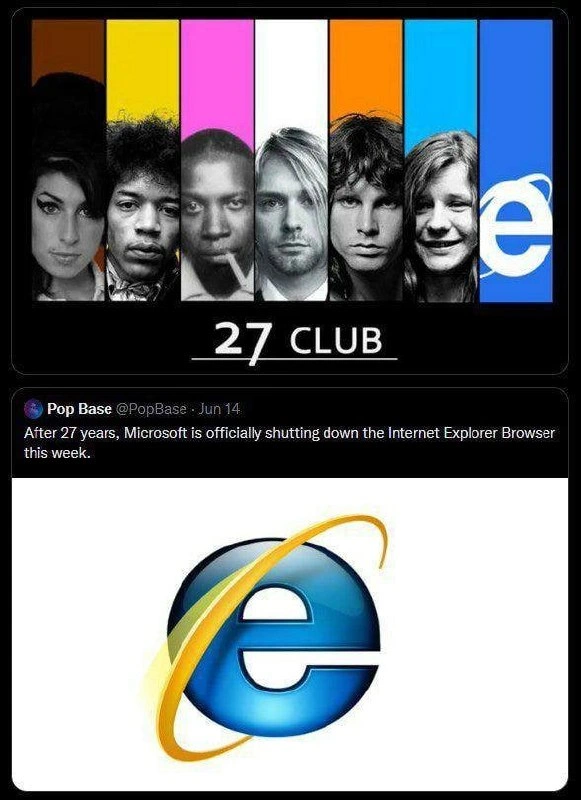
The tag BrowserWars hints at the era when browsers were competing (IE vs. Netscape in the 90s, and later IE vs. Firefox/Chrome). IE was on top for a while, but it didn’t innovate enough. Eventually, faster and more developer-friendly browsers won out. By 2015, Microsoft itself replaced IE with a new browser, Edge, essentially admitting IE’s time was over. But for years, Edge or not, developers still had to deal with IE in the wild. This meme came out around 2022, when IE was finally near its official end-of-life. So it’s both a joke and a little cheer of relief. Newer developers today might not face this exact problem because IE has been phased out – modern browsers are much more aligned with each other. But those who have been in web dev a bit longer will never forget the struggle.
In simpler terms: Frontend developers just want their web app to look good and work right for everyone. Internet Explorer made that goal a lot harder than it should’ve been. The meme exaggerates this struggle by pretending being made to use IE is like a crime you’d testify about in court. It’s funny to developers because it resonates with the feeling of “this is so wrong!” that we had every time a project’s requirements said, “must support IE.”
Level 3: Browser War Crimes
"She forced me to use Internet Explorer."
In a dead-serious courtroom tone, a developer on the witness stand delivers this line as if describing unspeakable abuse. To seasoned devs, the hyperbole is hilarious: being forced to use Internet Explorer (IE) is portrayed as a literal crime. This meme taps into a shared trauma from the frontend world — the pain of supporting Microsoft’s notorious legacy browser. The dramatic legal setting (wooden panels, microphone, blurred face) parodies how outrageous it felt to be stuck with IE, especially when every other modern browser (Chrome, Firefox, Safari) handled websites so much better. The humor clicks because it exaggerates a real frustration so many developers know: after wrestling with IE’s quirks for years, it genuinely felt like cruel and unusual punishment. Some veterans half-joke that forcing IE on someone violates the Geneva Conventions of Web Development.
For experienced web devs, IE is the villain of countless war stories. It's the browser that made simple tasks exasperating. Why? IE lagged far behind web standards, so code that worked everywhere else could blow up spectacularly in Internet Explorer. A classic example is the CSS box model bug in IE6: the browser calculated element widths wrong, consistently breaking layouts. Developers had to discover arcane hacks to appease IE’s rendering engine (Trident). It was common to sprinkle code with special cases just for IE. We used conditional comments in HTML and CSS tricks that only IE would read, essentially saying “if IE, do this completely different thing.” For instance, websites often included HTML5 and CSS3 polyfills exclusively for IE:
<head>
<meta charset="utf-8">
<title>My Site</title>
<!--[if lt IE 9]>
<script src="html5shiv.min.js"></script>
<script src="respond.min.js"></script>
<![endif]-->
</head>
Above: an example of loading extra scripts only in IE versions less than 9. The html5shiv library taught IE8 how to handle new HTML5 elements, and respond.js gave it basic CSS media query support. These kinds of fixes were necessary just to achieve baseline browser compatibility. And it didn’t stop at HTML/CSS. JavaScript had its own minefield: IE implemented events and APIs differently (looking at you, attachEvent vs addEventListener). If you used modern JS features or libraries, you often needed additional shims or alternate code paths for IE to avoid script errors. This extra overhead felt like writing code with one hand tied behind your back.
The real-world pain behind the joke is very relatable. Picture a dev who just finished a slick web feature that runs perfectly in Chrome. Then QA opens the site in IE11 (or, nightmare mode: IE6/7) and nothing works right. Fonts are wrong, layout is janky, maybe the whole page is blank because IE choked on some modern JS syntax. Now the developer has to spend days debugging a browser last updated years ago, hunting down obscure fixes on Stack Overflow. It’s the ultimate productivity killer. The meme’s punchline — "the real crime was forcing me to use Internet Explorer" — hits home because seasoned devs often felt victimized by this exact scenario.
Why was this situation so common? History and LegacySystems. In the early 2000s’ BrowserWars, Internet Explorer 6 crushed Netscape and became the dominant browser. But after winning, IE stagnated for a decade. Microsoft let IE’s technology age while Firefox and later Chrome raced ahead with faster engines and better standards support. Unfortunately, many big companies and government agencies standardized on IE-only apps (often using ActiveX or old SharePoint sites that only worked in IE). These legacy systems forced everyone to keep IE around far past its expiration date. So even as IE became a laughingstock among developers, you couldn’t just ignore it — not when 20% of your users (or a VIP client’s entire office) were still on it. Management would insist “It must work on IE,” and that was that. No engineer could easily convince a huge client to upgrade all their PCs to modern browsers. The result: a decade of webdev purgatory where we carried IE like a ball and chain. ✨ Fun fact: Entire tools and libraries (looking at you, jQuery) became popular partly because they papered over browser inconsistencies, making IE behave a bit more like the others. It was a survival necessity.
The meme also slyly references a specific courtroom drama (the meme image resembles a high-profile celebrity trial from 2022). In that trial, serious accusations were made on the stand — here, the meme replaces one with a tongue-in-cheek developer nightmare scenario. The suited witness’s pained expression, eyes closed as if reliving trauma, perfectly sells the joke. The contrast between a relatable dev experience (“Ugh, I had to use IE!”) and the over-the-top context (sworn testimony in court) makes it absurdly funny. It’s poking fun at how deeply this technical gripe cuts us. A non-dev might think, “Really, using an old browser is the worst thing ever?” But any web engineer from the 2000s will nod vigorously. We spent countless late nights fixing InternetExplorerSupport bugs that shouldn’t have existed. We felt that pain. So when we see a meme treating IE usage as a literal crime, it’s both tech humor and a tiny catharsis. We laugh because, honestly, we’ve joked in private that whoever kept IE 6 alive should be tried in The Hague.
Description
This meme captures a screenshot of actor Johnny Depp looking emotional and distressed while testifying in court during his highly publicized 2022 trial. The image has been edited to include a fake subtitle at the bottom that reads, '- She forced me to use Internet Explorer'. The visual is a still frame from the trial, showing Depp in a grey suit, speaking into a microphone with a pained expression. The humor is derived from the stark contrast between the serious, real-world legal drama and the specific, intense frustration that software developers feel towards the now-defunct Internet Explorer. For experienced engineers, being forced to develop for or use IE was a notorious source of pain due to its non-standard rendering engine, lack of modern features, and countless bugs that required ugly hacks and workarounds. The meme elevates this technical frustration to the level of profound personal suffering, a sentiment that deeply resonates with anyone who spent hours debugging CSS or JavaScript for a browser that refused to comply with web standards
Comments
8Comment deleted
Some developers have nightmares about merge conflicts. I have nightmares where I'm told the bug is 'only reproducible on IE8' and the only debugging tool is `alert()`
Judge, the real felony wasn’t in the specs - it was adding `targets: { ie: 11 }` to Babel and watching our sleek 200 KB app balloon into a 2 MB museum of polyfills
The real trauma wasn't being forced to use IE6 - it was explaining to the client why their jQuery plugin from 2009 wouldn't fix the ActiveX controls they insisted on keeping for "backwards compatibility" with Windows XP machines that haven't been updated since the Bush administration
The court accepts the evidence, but it'll take IE eleven business days to render it
The real tragedy isn't being forced to use Internet Explorer - it's having to explain to stakeholders why 'just add a few CSS hacks' actually means rewriting half your component library to accommodate a browser that interprets box-model like it's still 1999, while your modern build pipeline weeps in ES6+ that needs to be transpiled down to ES5, and your carefully crafted flexbox layouts collapse into a pile of float-based nightmares that require conditional comments and proprietary filters just to achieve what every other browser handled natively a decade ago
Nothing says enterprise like a vendor contract that still mandates IE11 for an ActiveX control signed with SHA-1, and a "modernization" plan that's just Edge in IE Mode
In enterprise court, “She forced me to use Internet Explorer” earns Edge IE mode, lifetime ES5 polyfills, and time served for documentMode
IE: the browser where 'standards mode' triggers PTSD from the 2003 CSS hacks era