Skip to content
DevMeme
4008 of 7435
The Brutal Honesty of Programming Language Evolution
Languages Post #4364, on May 6, 2022 in TG

The Brutal Honesty of Programming Language Evolution

Why is this Languages meme funny?

Level 1: Comfort, Class, Cringe

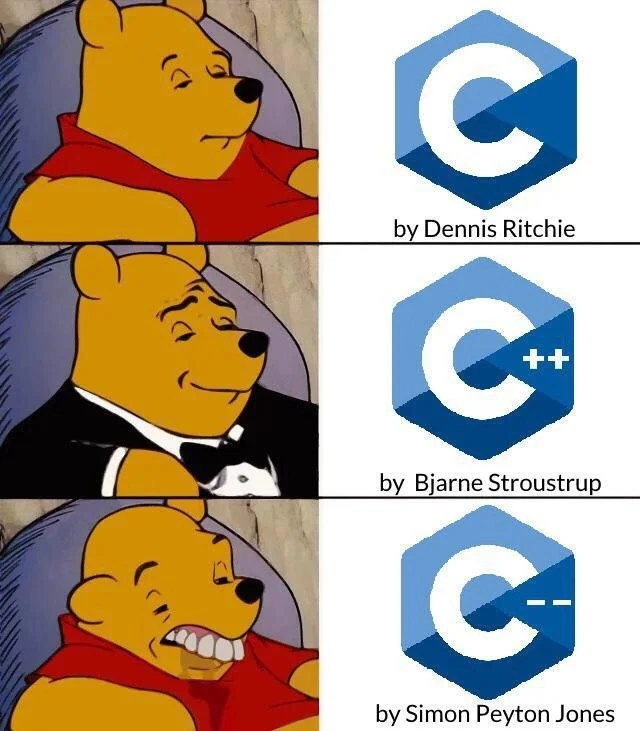
Imagine you have a favorite toy that’s simple and reliable – let’s call it the “C” toy. You really like this toy because it’s the original, made by a famous toy maker, and it just works well. Winnie (Pooh) is sitting back happily with a little smile, like when he’s got his trusty old toy. That’s comfort – the first panel.

Now suppose the toy maker’s friend makes an upgraded version of that toy – a “C++” toy that has extra features and is super fancy. It’s like the same toy but now it can do more tricks and has shiny decorations. Winnie is so impressed that he even puts on a tuxedo to play with it. He’s treating it like going to a fancy party – that’s how classy this new toy feels to him. He’s grinning in a very pleased, formal way. That’s the second panel: Pooh is saying, “Oh ho, this is exquisite!” without words.

Finally, imagine someone else comes along with a weird knock-off version of the toy, called “C--”. Maybe it’s missing some pieces or it just doesn’t do what the other toys do – it’s like a strange experiment. The person who made it is really smart, but he’s known for making very different kinds of toys, so this one is just… odd. When Winnie tries this odd toy, he makes a yucky face, like when you taste something bad. He’s thinking, “Ew, this is not what I wanted at all.” That’s cringe – the third panel.

So, put together: Pooh likes the normal original toy (that’s comfort), loves the deluxe version (that’s class), but absolutely hates the strange downgraded version (that’s cringe). The meme is funny because it exaggerates how we feel about original things, fancy improved things, and weird experimental things. Even without knowing anything about programming, you can see: first picture Pooh is okay, second picture he’s delighted and fancy, third picture he’s upset. It’s a little story of good, better, WORST! The developers who see this meme laugh because they know the “toys” are programming languages: C (good), C++ (even better), and C-- (what on earth, no thanks!).

Level 2: Know Your Pluses and Minuses

Let’s break down what’s going on for those newer to the programming scene. This meme is comparing three things that look like they belong to the same family: C, C++, and something written as C--. The first two are well-known programming languages. C (created by Dennis Ritchie in 1972) is a very influential programming language that’s still widely used. It’s a simple, low-level language, which means it doesn’t have a lot of fancy built-in features – you manage most things yourself (like memory). Think of C as the sturdy old toolbox every programmer respects: it’s not fancy, but it’s powerful and gets the job done. That’s why in the first panel Winnie-the-Pooh looks calmly satisfied next to the C logo. “By Dennis Ritchie” is basically giving credit to the legendary inventor of C and signaling, this is the real deal. Dennis Ritchie is like the origin story superhero for many languages – he also co-created Unix. So, C has a big reputation and a kind of old-school charm. Developers often speak highly of C because so many later languages (including C++ and even Python, Java, etc.) inherited ideas from it or were implemented in C under the hood.

Now, C++ (created by Bjarne Stroustrup in the 1980s) is essentially “C plus more stuff.” In fact, its name really does come from the ++ operator in C, which means “increment” (add one). So Stroustrup named his new language C++ as a playful way to say “this is one step above C.” C++ includes everything C has, but adds object-oriented programming (you can create classes and objects to model things), along with many other features like templates (for generic programming), exceptions (for error handling), and more. Over the years, C++ has evolved into a really powerful but also quite complex language. It’s used in software where performance is critical, like game engines (Unreal Engine), big applications (Photoshop), and even parts of operating systems. In the meme’s second panel, Pooh is wearing a tuxedo next to the C++ logo with the caption “by Bjarne Stroustrup.” This indicates that we’re showing extra respect or formality for C++. It’s like saying, “Ah, the distinguished C++ deserves an upgrade in attire.” For a newer developer, imagine C++ as a high-end multi-tool that not only has the basic screwdriver and wrench (like C has) but also a Swiss Army knife, a magnifying glass, and a laser cutter attached – extremely versatile, but you need to know how to handle it! Pooh’s pleased, refined look is how a lot of devs feel when they talk about C++: it’s a bit fancy, sometimes complicated, but undeniably powerful and worthy of respect.

Now, the third item “C--” might be confusing because it’s not something you hear about often in programming tutorials. The -- in C (as an operator) means “decrement” (subtract one). So, calling something “C--” sounds like “C minus minus” or essentially “C minus one.” This isn’t a mainstream programming language you’d learn for making apps. Instead, C-- is a sort of experimental or niche language developed by Simon Peyton Jones (an important figure in programming language research) and his colleague, around 1997. But it’s not meant for writing normal software directly; it was meant as a kind of simplified version of C that could be used inside compilers. A compiler is a program that takes source code (like C or C++ code that humans write) and translates it into machine code (the ones and zeroes computers execute). Sometimes compilers use an intermediate step – they’ll translate the code into a simpler language first, do optimizations, then translate that into machine code. C-- was designed to be one of those intermediate languages.

For someone new, think of it this way: if C is English, and machine code is like binary gibberish, a compiler might translate English to Pig Latin first before going to gibberish, just to make certain things easier. C-- was like a “Pig Latin” version of C – not full, proper English sentences, but all the basic words rearranged simply. The reason Pooh is grimacing at C-- is because, from a regular developer’s perspective, why would you ever use C--? It’s obscure. Most of us write in languages like C, C++, Java, Python, etc., and never directly touch these in-between representation languages. So it seems weird or even “wrong” at first glance – kind of like if someone said, “Hey, instead of writing code in C or C++, let’s write it in this cut-down strange variant of C that nobody really speaks.” The meme is joking that Pooh (representing developers) is going “Ew!” or “No way!” when confronted with this oddball.

Also note the progression in the meme panels: We start with a comfortable, casual Pooh for C, then a fancy Pooh for C++ (meaning C++ is seen as an elevated, feature-rich extension of C), and then we see an upset Pooh for C--, which implies it’s a step in a not-so-great direction (like a backward or unwanted step). It humorously reflects many developers’ preferences:

  • They like C (solid, classic choice).
  • They might love C++ (bigger and more powerful, deserving a fancy touch).
  • But they dislike or distrust C-- (because it sounds like a strange downgrade, and really, almost nobody uses it directly).

And what about the names under each logo? Those are the creators:

  • Dennis Ritchie for C – he’s basically the founding father of C.
  • Bjarne Stroustrup for C++ – the one who took C and added the plus-pluses.
  • Simon Peyton Jones for C-- – a notable computer scientist who came up with this idea (he’s more famous for working on Haskell, a totally different language, which adds to the odd factor here).

So, when you look at the meme as someone new to this, the joke is a comparison: original vs enhanced vs “what on Earth?”. It’s highlighting a bit of programmer humor about naming conventions too. We have this habit of naming new language versions with pluses or other symbols (like C→C++, or C# which is like a musical sharp meaning a half step up from C, or Google’s language Go once being jokingly called “C--” early on, etc.). So “C--” sounds like a natural joke name (“hey, if one plus means a new version, what would minus minus be? A worse version?”). And indeed, here it is kind of treated as the “worse” or at least undesired version.

In summary, the meme mocks the idea of language evolution in a playful way. C is the trusty old-timer everyone respects. C++ is the fancy upgrade that everyone either admires (or sometimes begrudgingly deals with because it’s powerful). And C--… well, most people would say “thanks, but no thanks,” because it’s an odd academic offshoot that normal developers rarely encounter. Winnie-the-Pooh’s changing expressions make it easy to understand: happy with the original, extra happy with the plus-plus version, definitely unhappy with the minus-minus version. Even if you didn’t know the specifics, you can sense from Pooh’s faces what’s good, what’s better, and what’s bleh. That’s the essence of the joke!

Level 3: C++ Pride & C-- Prejudice

At its core, this meme plays on the family lineage of the C family of languages and the attitudes developers have toward each “relative.” In the first panel, we see Pooh casually content beside the classic C logo, crediting Dennis Ritchie, C’s creator. That’s a nod of respect to the venerable ancestor: C is the founding father of modern systems programming. Seasoned devs have a reverence for C – it’s simple (by design), close to the metal, and has powered everything from operating systems to language compilers themselves. The text “by Dennis Ritchie” is basically saying “Respect, this is the original genius.” So Pooh’s relaxed smirk fits: we’re cool and comfortable with good old C. It’s the language equivalent of a classic vintage car – old but beloved. No frills, just solid engineering. Many senior engineers cut their teeth on C and still consider it the gold standard for understanding how software interacts with hardware. Hence, Pooh gives a satisfied nod.

In the second panel, Pooh dons a tuxedo and looks extra sophisticated next to the C++ logo (with credit to Bjarne Stroustrup). This is the meme’s way of elevating the formality: C++, as the successor to C, is seen as a grander, more elaborate production. C++ took C’s modest procedural model and added a whole lot of “fancy”object-oriented programming (classes), templates, exceptions, and so on. In developer culture, putting on a tuxedo is tongue-in-cheek for “Ah, now this is truly an art.” It implies that C++ is being treated as a posh upgrade to C. Indeed, many in the industry regard C++ as a powerhouse: it’s the language of big software projects (Chrome, Photoshop, game engines) where performance and complexity intertwine. Pooh in a tux captures how developers sometimes speak of C++ in almost aristocratic terms: “It’s not just C, it’s C with classes, how elegant!” The joke, of course, is that C++ is both loved and infamous – loved for its capabilities, infamous for its complexity. But here the meme chooses to applaud Stroustrup’s creation in an exaggeratedly polite way. Senior devs will chuckle because internally we know that using C++ can feel like attending a black-tie affair: powerful, formal, with many rules of etiquette (think memory management, multiple inheritance, template meta-programming – fancy stuff that requires careful discipline). Pooh’s refined grin says, “Ah yes, excellent choice, good sir.” It’s poking fun at how we often put C++ on a pedestal as the sophisticated evolution of C (even if on some late nights we curse its name while debugging).

Then we hit the third panel: the punchline. Pooh is now grimacing, teeth bared, looking uncomfortable next to “C-- by Simon Peyton Jones.” This abrupt shift in expression encapsulates a collective “Uhhh, no thanks?” from developers. Why the recoil? First, most developers have never heard of C--. It sounds like someone took C and decremented it – literally a step down or a regression. It’s as if after C++ (the big fancy step up), someone tried to take C in the opposite direction. In the world of tech humor, naming a supposed language “C--” is almost absurd – it reads like a joke or a knock-off. Senior devs know that C-- isn’t a language you’d typically write your app in; it’s a niche tool from academia. So, the grimace is partly “What is this imposter?” and partly “Why would anyone use this?” There’s prejudice against the unfamiliar at play: developers tend to be skeptical of lesser-known languages, especially one that looks like a downgrade of a long-established language.

Additionally, the meme cleverly lists Simon Peyton Jones as the author of C--. To experienced programmers, that name rings a bell – Simon Peyton Jones is a legendary computer scientist, heavily involved in the creation of Haskell (a purely functional language) and many advances in compiler research. But here’s the kicker: Peyton Jones isn’t known for C-like languages at all! He’s an academic, not someone shipping a popular systems language. So seeing his name in the context of the C lineage is both surprising and comical, like finding a renowned pastry chef cooking up a spicy curry. It’s out of place. This contrast adds to the humor: Dennis Ritchie? Legit. Bjarne Stroustrup? Also legit. Simon Peyton Jones making “C--”? Wait, what? It’s as if the meme is highlighting a family tree oddball – a cousin nobody talks about at the C family dinner. Senior devs who know the history chuckle because they recall that C-- was a thing, but it never went mainstream. It’s a bit of a tongue-in-cheek jab at language evolution: not every offshoot catches on. The industry loves C and respects C++. But C--? That one gets a polite cough and a change of subject.

The Winnie-the-Pooh format amplifies these reactions perfectly. In dev culture, we often express our language preferences with memes and hyperbole. The first two panels set up a certain pomp and reverence, and then the third knocks it down by showcasing a “pretender” that breaks the naming convention in a jarring way. It reminds seasoned programmers of all those times a new language or tool was announced with hype and we collectively winced thinking “What fresh hell is this?!” In short, the meme humorously captures the pecking order among C-like languages: the original C is cool, its well-known successor C++ is even cooler (presented with extra flair), but an obscure, academically birthed variant like C-- is met with distrust or dismissal. The “prejudice” isn’t about Peyton Jones himself (he’s brilliant), but about the idea of C-- which feels like a downgrade or a convoluted joke. It’s a lighthearted poke at how developers uphold the pedigree of languages (especially ones with ++ in their name) while giving the side-eye to oddball experiments that don’t fit the familiar narrative. After all, in the ongoing language wars, it’s common to see huge praise for popular languages and disdain for ones that don’t get widespread adoption. Pooh’s exaggerated grimace says what every C/C++ developer might think if someone seriously proposed, “Forget C++ or C, let’s code this in C--!” – “Ew, why on earth would we do that?”

Level 4: Lowering the Level

This meme touches on a deep compiler design concept: intermediate representation (IR). The punchline hinges on C--, which isn’t a mainstream programming language at all but rather a low-level portable assembly language created as a research project by Simon Peyton Jones (with Norman Ramsey). In compiler theory, IRs like C-- serve as a step between high-level source code and machine code. They’re used to “lower” your code—breaking down rich structures (like loops, objects, recursion) into simpler operations that a machine can run. Traditional compilers for high-level languages (say Haskell or Python) often compile down through multiple layers: source code → intermediate code → assembly → machine code. Historically, some compilers even emitted C code as an IR because every platform has a C compiler. C-- was designed to cut out the middleman, acting as a minimal subset of C that’s easier for compilers to generate and optimize than full C.

Under the hood, C-- provides just enough features to serve as a target for other languages: simple types, control flow primitives like jumps and calls, and a way to handle things like garbage collection or tail recursion that normal C wasn’t built for. Essentially, it’s a “C minus minus” – C with stuff removed, not added – hence the name. This naming is an academic in-joke, riffing on the ++ operator in C that increments a value. Bjarne Stroustrup humorously chose “C++” as “one better than C,” since x++ means increase x by one. By contrast, Simon Peyton Jones naming his IR C-- suggests “one step down” from C, akin to using the -- operator to decrement C’s abstraction level. It’s a clever nod to the fact that we’re going down to a lower-level representation closer to machine code.

From a theoretical standpoint, this highlights the evolution of programming language design: as languages get more powerful (from C to C++ and beyond), compilers correspondingly need robust IRs to manage that complexity when translating code to run on hardware. C-- was an attempt in the late 90s to create a retargetable compiler infrastructure – an IR that any high-level language could use as a common stepping stone. (In fact, the Glasgow Haskell Compiler (GHC) experimented with using C-- as a backend to better support optimizations and features like efficient tail calls that standard C had trouble with.) While C-- never became an industry standard (today we’re more likely to see LLVM IR or other custom SSA-based forms as the de facto compiler IR), it remains a fascinating case of language design decremented to its essentials. The meme’s dramatic reaction to C-- humorously underscores how niche and esoteric this concept is: everyday developers don’t encounter it, but to language theorists it’s a brilliant hack. Winnie-the-Pooh’s grimace at “C-- by Simon Peyton Jones” is basically the dev community going, “Wait…what did you invent now?!” – reflecting both the surprise and slight trepidation when confronted with a highly specialized, academic twist on a familiar language.

Description

This meme uses the three-panel 'Tuxedo Winnie the Pooh' format to create a joke about the evolution of C-like programming languages. The first panel shows a standard, content Winnie the Pooh next to the C language logo, attributed to its creator, 'by Dennis Ritchie,' representing the classic and respected original. The second panel features Winnie the Pooh in a tuxedo, looking sophisticated, paired with the C++ logo and its creator, 'by Bjarne Stroustrup,' portraying C++ as the elegant, feature-rich successor. The third and final panel delivers the punchline: a distorted, grotesque-looking Pooh is shown next to a logo for 'C--' (C with two minus signs), attributed to 'by Simon Peyton Jones.' The humor is an inside joke for experienced developers. C-- is a real, C-like language, but it's not a general-purpose application language; it's a low-level intermediate language designed as a portable assembly for compilers, particularly for functional languages like Haskell (Simon Peyton Jones is a key figure in Haskell's development). The meme hilariously depicts C-- as a horrifying devolution, which is funny because it's so far removed from the high-level application development that most programmers are familiar with
Comments

8
Anonymous ★ Top Pick C walks so C++ can run. C-- crawls so Haskell can fly, but it's a crawl through the nine circles of register allocation hell
  1. Anonymous ★ Top Pick

    C walks so C++ can run. C-- crawls so Haskell can fly, but it's a crawl through the nine circles of register allocation hell

  2. Anonymous

    We spent 30 years arguing about pre- vs post-increment in C++; meanwhile Simon Peyton Jones quietly decremented twice, named it C--, and reminded us the only safe language is one you’re never meant to write by hand

  3. Anonymous

    C gave us segfaults, C++ gave us template metaprogramming nightmares, and C-- gave us a portable assembly language that somehow requires a PhD to understand why it's better than actual assembly

  4. Anonymous

    C-- looks like the punchline, but it quietly compiled your Haskell for years - the rare language whose name is a post-decrement and whose adoption was lazy-evaluated

  5. Anonymous

    The real joke here is that C-- isn't actually 'C minus features' - it's a legitimate portable assembly language used as a compiler intermediate representation. But try explaining to management why you're excited about a language that sounds like you're removing features from C. At least with C++ you could claim you were adding value; with C--, you're essentially admitting you want to get closer to the metal than even C allows, which is either deeply impressive or deeply concerning depending on whether you're the one debugging segfaults at 3 AM

  6. Anonymous

    C++ is a language; C-- is a threat model - if you’re writing it by hand, your code reviewer is the register allocator

  7. Anonymous

    C hands you raw power, C++ drowns you in templates, Haskell whispers 'purity' while your stack overflows laughing

  8. Anonymous

    C is a language, C++ is a lifestyle, and C-- is the IR your compiler writes when Simon Peyton Jones subtracts everything except calling conventions - humans need not apply

Use J and K for navigation