Skip to content
DevMeme
2582 of 7435
Containers Will Fix It: The Suez Canal Approach to Kubernetes
Containerization Post #2859, on Mar 26, 2021 in TG

Containers Will Fix It: The Suez Canal Approach to Kubernetes

Why is this Containerization meme funny?

Level 1: New Captain, Giant Ship

Imagine a brand-new ship captain trying to steer one of the largest ships in the world through a very narrow canal on their first day. They’re confident and say, “Sure, I got this – what could go wrong?” Now picture that huge ship accidentally turning sideways and getting completely stuck across the canal, blocking all other boats. Whoops! Suddenly, nothing can move and it’s a giant traffic jam on water. It’s a disaster, and everyone is panicking trying to fix it. This is funny in a facepalm way because the captain thought it would be easy, but the mistake became a huge problem for everyone.

In the computer world, Kubernetes is like a super complicated ship or machine that helps people deliver their apps (the way ships deliver goods in containers). If a beginner takes control of Kubernetes without much experience, they might accidentally mess things up – kind of like that new captain did with the ship. The meme shows the real-life big ship stuck and jokes that it’s the cover of a “Kubernetes for beginners” book, with the question “What could go wrong?” The obvious answer is: a lot! We find it funny because it’s a bit like watching someone use a very powerful tool in the wrong way. It’s a friendly reminder that just because something is supposed to make life easier (like containers or fancy new tools), you still need to know what you’re doing, or you could end up with an even bigger mess than you started with. It’s the same humor as seeing a kid try to drive a huge truck — you kind of know it’s going to end in a comical stuck situation.

Level 2: Big Tools, Big Troubles

Let’s break down the joke for those newer to containers and DevOps. Kubernetes (often abbreviated K8s) is a powerful open-source system for managing containerized applications across a cluster of machines. A container (like one made with Docker) is essentially a lightweight package of software that includes everything needed to run an application: code, runtime, system tools, libraries, etc., all isolated from other apps. Think of it like a shipping container but for software: it ensures the app runs the same everywhere, much as a shipping container keeps goods secure and standardized from ship to train to truck. The meme plays on this analogy directly – it shows an actual ship loaded with containers run aground (stuck) in a canal. In software terms, Kubernetes is like the ship captain or harbor master that automates how containers (your software pieces) are loaded, unloaded, and routed to users. It decides which machine (node) runs which container, handles traffic to them, and even reschedules them if machines fail. It’s a bit like an air traffic control system but for software services.

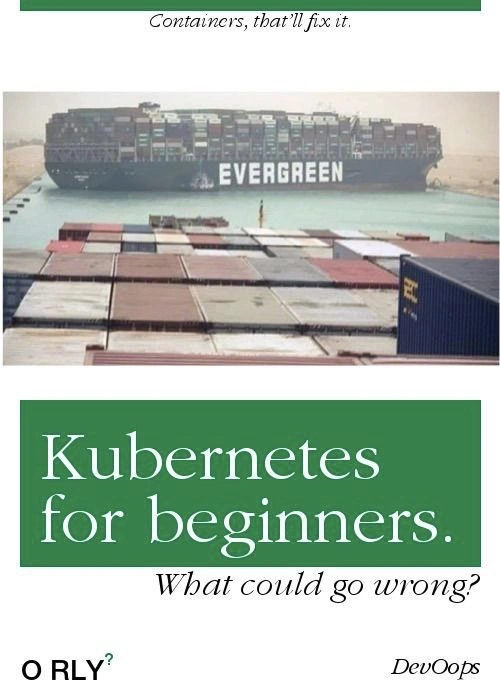
Now, why is the ship stuck and what’s the humor? The image references a real event: in March 2021, a massive cargo ship named the Ever Given (with “Evergreen” painted on its side, the name of the shipping company) got stuck sideways in the Suez Canal. This canal is a crucial narrow passage for ships between the Red Sea and the Mediterranean. When the Ever Given got wedged, it blocked all other ships from passing through for nearly a week. This caused a huge traffic jam of boats and disrupted global trade (lots of delayed goods). In the photo, you see shipping containers piled up on the stuck ship and even some fallen over on the shore – it was a big mess.

The meme cleverly uses this as a metaphor for a Kubernetes mishap. The title “Kubernetes for beginners” suggests someone new is at the helm. Kubernetes, being complex, can lead beginners to make mistakes that have outsize consequences. The cheeky question “What could go wrong?” is something people say jokingly when it’s obvious that a lot can go wrong. Here are some connections and terms, explained for clarity:

  • “Containers, that’ll fix it.” – This is the small italic text at the top. It’s poking fun at a mindset where developers think using containers will magically fix all deployment problems. Containers do solve some issues (like eliminating the “works on my machine, not on yours” discrepancy), but they also introduce new challenges. It’s a bit like saying “Oh, the house is messy? Just put everything into boxes, that’ll fix it.” Sure, the clutter is hidden, but now you have a bunch of boxes to manage, and if you label them poorly or stack them wrong, you get a new kind of mess. The meme is sarcastic here – often teams jump to containers as a cure-all, only to find they have different problems afterward (like orchestration and networking issues).

  • Kubernetes for beginners – Normally, O’Reilly (a publisher famous for tech books with animals on the cover) might publish a book titled “Kubernetes: The Definitive Guide” or something authoritative. By saying “for beginners” and showing a disaster, the meme implies that a beginner trying to use Kubernetes without sufficient knowledge could end up causing a disaster. Kubernetes is not exactly beginner-friendly; it has a steep learning curve. Imagine giving a brand-new driver a Formula 1 race car – it’s powerful, yes, but without experience they might crash spectacularly. Likewise, Kubernetes gives you tremendous power to deploy and scale apps, but a wrong command or misconfiguration can crash many apps at once.

  • Evergreen ship stuck in canal – The picture of the ship is a literal visual pun. These are shipping containers in real life, which is the same word we use for software containers. The ship being stuck = your deployment is stuck. The fact it says “EVERGREEN” (the company logo) in huge letters and the ship is wedged sideways became a famous meme on its own in 2021. People were photoshopping that ship into all sorts of “stuck” scenarios. In our context, it emphasizes how a seemingly small mistake (one ship’s wrong turn) can block an entire system (global shipping, or your entire production environment). The scattered containers in the foreground look like the aftermath of a crash, much like logs and error messages spilling everywhere when a production deployment fails.

  • “What could go wrong?” – This phrase is usually used humorously or rhetorically because the answer is “everything.” Here it underlines the irony: a guide for beginners is expected to be easy and helpful, but in complex systems like Kubernetes, beginner mistakes can lead to catastrophic failures. It’s like asking “I’ll just rebuild the engine of my car myself, what could go wrong?” – well, if you’re not an expert, a lot could go wrong.

  • DevOops – This is a pun on DevOps. DevOps is a culture/practice where developers (Dev) and operations (Ops) work together, emphasizing automation and monitoring to ensure software runs smoothly in production. When something goes wrong due to a deployment or operations mistake, tech folks humorously call it a “DevOops” (oops!). On the meme, the usual O’Reilly logo is replaced with “O RLY?” (internet slang for “Oh, really?” often with an owl meme) and the publisher name says DevOops instead of O’Reilly. This signals that the book cover is a joke. It implies the content is about DevOps gone wrong. Being on-call for production issues (that is, being responsible to fix things when a site or service goes down) is a big part of DevOps/SRE life, and we jokingly call those firefighting moments “DevOops” moments.

  • On-call/Production issues – These terms relate to the scenario. “On-call” means a person (often an SRE or ops engineer) is designated to respond to any problems with the live system, often pager or phone at the ready. A “production issue” means something is currently broken or not working right for users (production is the live environment serving customers). The image of a ship stuck in the middle of a crucial waterway is a great representation of a production issue: nothing is flowing, everybody is impacted, and it’s an all-hands-on-deck situation to fix it. Think of production as a busy highway; a big crash will cause a traffic jam for everyone. In tech, if a core service goes down, it can block requests and cause user-facing downtime until it’s resolved. So a Kubernetes cluster misconfiguration that takes out multiple services is very much a production issue that would have an on-call engineer scrambling.

To put it simply, the meme is contrasting the ideal vs reality of adopting new tech like Kubernetes. The ideal: you smoothly ship software in little container units, everything is consistent and easy (beginners welcome!). The reality: if you don’t know what you’re doing, you might ship yourself into a corner – or in this case, sideways into a canal – resulting in a huge, public mess. The categories “Containerization”, “DevOps/SRE”, “OnCall_ProductionIssues” listed for the meme are exactly what it’s about: using containers (containerization) in a DevOps context, and the kind of production issues that keep on-call folks up at night.

A beginner reading this meme might not know Kubernetes intimately, but the sight of the colossal stuck ship, plus the sarcastic text, conveys a general idea: “This high-tech thing can fail spectacularly if a newbie is in charge.” It’s both a joke and a gentle warning. Many of us learned the hard way that deploying to production requires caution, much like how steering a ship through a narrow canal requires skill. In the end, the Ever Given was freed by a team of experts working around the clock, using tugboats and dredgers (removing sand) to straighten it out. Similarly, when a Kubernetes deployment goes wrong, often a team of senior engineers has to step in with deep knowledge and heavy tools to get everything back on track. Not exactly the outcome you want from a “for beginners” endeavor! The meme’s humor lies in this mismatch between the promise (beginner-friendly! easy shipping!) and the outcome (epic failure, system stuck). It’s a chuckle of recognition from those who have been there and a cautionary tale for those just starting out with these big, powerful tech tools.

Level 3: Running Aground in Production

This meme strikes a painfully familiar chord for any DevOps or SRE veteran. On the surface, it’s a parody of an O’Reilly book cover titled “Kubernetes for beginners.” The subtitle wryly asks, “What could go wrong?” – an invitation for every battle-hardened engineer to smirk, because we all know everything can go wrong. The imagery of the Evergreen container ship (the infamous Ever Given that got wedged in the Suez Canal in 2021) is an on-the-nose metaphor for a deployment fiasco: a massive system stuck due to one wrong move. Kubernetes is often jokingly abbreviated as “K8s” (because there are 8 letters between K and s), but after a few 3 AM pages, some of us started calling it “K8-eeks!” for all the surprises it springs in production. The promise of Kubernetes is to effortlessly “ship” applications in containers—consistent, isolated, easily deployed anywhere. But in reality, handing Kubernetes to beginners can result in DevOops: a play on DevOps where well-intentioned changes lead to spectacular failures. The bottom of the meme even pokes at this with the faux publisher “DevOops” and the classic “O RLY?” owl logo, signaling that this is more of a tongue-in-cheek cautionary tale than a genuine how-to guide.

Why is this so relatable to seasoned developers? Because we’ve seen the pattern time and again: an organization hears “containers, containers, containers – they’ll solve all our problems.” Possibly they’ve had issues with inconsistent environments, slow deployments, or scaling, and someone sold them on Kubernetes as the silver bullet. So the team jumps in headfirst, often under pressure to adopt “modern” infrastructure. But Kubernetes is incredibly complex; it’s not a single tool but an entire ecosystem. For a beginner, deploying a simple app means learning to write YAML manifests for pods, services, deployments, ingress controllers, etc. There are dozens of knobs and levers – much like navigating a gigantic ship with complex controls. Without proper guidance, a newbie might, for example, open all traffic to the world (StackOverflow told them to set hostNetwork: true), or misconfigure storage volumes (losing data because they didn’t realize containers are ephemeral), or forget to set resource limits (letting a container hog all CPU/RAM and grind the node to a halt). These mistakes can bring down a cluster. If you’ve ever been on-call, you might have experienced that heart-stopping moment when an innocent looking kubectl apply -f command results in half the services going offline. Picture an urgent PagerDuty alert lighting up your phone while you realize a rookie change just ran your production aground. It’s a shared trauma among SREs and ops folks – hence the dark humor of seeing a ship literally run aground and thinking, “Yep, that was our deploy last week.”

The Suez Canal blockage metaphor is especially apt: in that incident, one ship’s mishap halted global shipping traffic for nearly a week, much like how one bad Kubernetes config can halt all your microservices. In both cases, there’s a domino effect. In shipping, hundreds of vessels backed up at either end of the canal, waiting futilely. In tech, a blocked deployment or downed service can backlog requests, pile up messages in queues, overwhelm fallbacks, and generally cause a cascade of failures. We even use the term “pipeline” for software delivery stages – and here the pipeline was physically clogged by a container ship the size of the Empire State Building. The meme asks “What could go wrong?” – well, senior devs have a list: network misconfiguration can isolate services (akin to a canal suddenly not connecting to the sea), a crash loop in a critical pod can take out dependent services (like a broken-down lead truck stalling a one-lane highway), or a faulty update can propagate bad state across the cluster (like a navigation error magnified by strong winds pushing the ship further into the sandbank). Each container on that ship was supposed to be neatly delivered – instead, we see them strewn about after a catastrophic failure. It reminds us of that sinking feeling when our beautifully containerized app doesn’t scale as expected and instead falls over, dumping core dumps (the tech equivalent of cargo) everywhere.

Historically, every generation of infrastructure tech has its learning curve and legendary mishaps. In bare-metal days, maybe a junior admin unplugged the wrong server rack. In the era of VMs, someone might have over-provisioned and caused disk thrash on a hypervisor. Now in the cloud-native Kubernetes era, we get tales of the intern who accidentally deleted the production namespace, or the newbie who thought a DaemonSet was a good way to deploy an app (which promptly scheduled it on every single node, including the CI runner and logging nodes, taking them down). The reason this hits home is that Kubernetes failures tend to be massive in scale by default. You’re not just deploying on one machine; you’re potentially impacting dozens or hundreds. The Ever Given wasn’t a tiny tugboat – it was one of the largest cargo ships on Earth. Likewise, Kubernetes often runs mission-critical, large-scale systems where a rookie mistake can have outsized consequences.

There’s also a nod to the hubris vs. humility theme. The text at the top, “Containers, that’ll fix it.” mocks a certain naïve optimism. Many of us have encountered a situation where upper management or enthusiastic architects adopt a buzzwordy solution without fully understanding it. “Our app keeps crashing? Put it in containers – that’ll fix it.” “Deployments too slow? Just throw Kubernetes at it.” It’s akin to saying “Oh, the last ship had issues? Let’s build an even bigger one and send it through the same narrow canal – what’s the worst that could happen?” 😏 Seasoned engineers know that adding complexity (like orchestration) can introduce new failure modes. Kubernetes is powerful but also notoriously finicky – misconfigure a liveness probe or a readiness probe, and your pods might repeatedly kill themselves (self-sabotage worthy of a Greek tragedy, fitting since Kubernetes is Greek for “helmsman”). The helmsman meaning is poetic: in this meme a beginner helmsman (the new Kubernetes user) has literally run the ship aground. It underscores why experienced teams insist on testing in staging, doing chaos engineering, and having runbooks: you don’t let a first-time captain solo a supertanker through a canal without lots of simulation and an expert co-pilot.

It’s worth noting the timing: this meme was posted in late March 2021, just as the real Suez Canal blockage was unfolding in the news. Tech folks immediately drew parallels on Twitter and forums, joking that the canal had a “single point of failure” and making jabs about how no one did a post-mortem or blameless RCA for the canal’s design. The “O RLY?” book cover format is a classic meme template in tech circles, and slapping “DevOops” on it really drives home the message: This isn’t a genuine training manual, it’s a cautionary portrait of operational chaos. Every panel of the image is loaded with references: the green O’Reilly-style banner (with an italic tagline) mocks quick-fix culture, the stranded Evergreen ship photograph captures the scale of the disaster, and the phrase “Kubernetes for beginners” coupled with “What could go wrong?” drips with irony because any veteran could write a novel-length answer to that question. The humor works because it’s absurdly true – putting a novice in charge of Kubernetes without proper support is courting disaster, just like expecting an enormous container ship to magically steer itself through a tight waterway without an experienced pilot. If you listen carefully, you can almost hear a tired on-call engineer utter, “I’ve seen this movie before,” while sipping cold coffee at 4 AM, countdown to when they have to explain to management how a simple container deploy ended up as a week-long full-stop outage. This meme is our gallows humor: we laugh so we don’t cry when remembering our own production incidents that felt as intractable as that darn ship stuck in the canal.

Level 4: CAPsize Theorem

At the cutting edge of cloud architecture, Kubernetes is essentially a distributed operating system for containers. It relies on complex distributed systems theory to keep hundreds of services running across many nodes. Under the hood, a Kubernetes cluster has a control plane (with components like the API server and an etcd database) that must reach consensus about the cluster state. Etcd is a strongly consistent data store (using the Raft consensus algorithm), which means Kubernetes prioritizes state consistency over availability – a nod to the CAP theorem (Consistency, Availability, Partition tolerance). In practice, this means if etcd or network links go down (a partition), Kubernetes might halt changes to avoid inconsistencies (sacrificing availability). In a way, the cluster can “capsize” if the control plane loses quorum or if a misconfiguration partitions components from each other. Just as a gargantuan ship can physically block an entire canal, a single misbehaving controller or a deadlocked lock in a distributed system can block the whole deployment pipeline. It’s a high-tech manifestation of congestion: one fatally wedged process or resource can cause a cascading failure across otherwise independent services. This phenomenon is like a form of congestion collapse in networks – where one bottleneck (be it a stuck packet or a stuck ship) reduces overall throughput to near zero.

In Kubernetes, scheduling and orchestration work like a global shipping coordinator: the scheduler packs “Pods” (groups of containers) onto nodes sort of like loading containers onto ships. It must obey constraints like resource requests and affinities – akin to weight distribution and port destinations in shipping. If a beginner declares an overly large resource request (say a pod that needs more CPU or RAM than any node has), the scheduler will be unable to place it, leaving it pending forever – effectively a container that can’t go anywhere, much like a barge stuck in a narrow channel. In extreme cases, such as a misconfigured deployment that sucks up all cluster resources or crashes critical nodes, the entire orchestration can gridlock. This is analogous to a deadlock in classical computer science: one component waits on resources held by another with no resolution. Only here, it’s on a massive scale – a production-sized deadlock. The meme visual of dozens of shipping containers strewn around a beached Evergreen ship dramatizes this kind of large-scale failure: the whole system-state has wedged sideways.

The top caption, “Containers, that'll fix it,” drips with irony known to any grizzled architect: containerization was supposed to fix the "it works on my machine" problem by standardizing environments. And indeed, containers (as introduced by Docker and managed by Kubernetes) isolate apps to run reliably across different machines. But while containers solve some consistency issues, they introduce new layers of complexity and points of failure. Orchestrating many containers across clusters involves overlay networks, service discovery, auto-scaling, and more – each with its own failure modes. For example, a naive assumption that simply containerizing a monolith will magically make it cloud-ready can lead to CPU-thrashing, memory exhaustion, or networking issues on a grand scale. If a critical container enters a crash loop (perhaps due to an unhandled exception in a supposedly isolated environment), Kubernetes will dutifully try to restart it repeatedly, potentially flooding logs or thrashing the network – like a panicked crew trying the same failing maneuver over and over while a ship remains hopelessly stuck. These are emergent properties of complex systems: small errors can amplify into colossal outages. This is why seasoned engineers approach Kubernetes with respect (and a pinch of fear) – the same way an experienced sea captain respects narrow straits. As powerful as Kubernetes is, it embodies the maxim “distributed systems are hard”: physics and math (from network latency to consensus timeouts) impose limits that no sleek new tool can fully paper over. When those limits are hit unexpectedly, you get the tech equivalent of a quarter-mile long ship sideways in a canal, and all the fancy orchestration algorithms in the world can’t automagically unwedge it without careful manual intervention. In short, container orchestration brings great power but also the potential for great catastrophe when misunderstood – a reality this meme captures through a brilliant convergence of computing metaphor and real-world chaos.

Description

A two-part tech meme that satirizes the complexity of container orchestration. The top panel features the headline 'Containers, that'll fix it.' above a photograph of the Evergreen container ship stuck sideways in the Suez Canal, an event that occurred in March 2021. The bottom panel is a parody of a classic O'Reilly technical book cover. The cover is green with white text that reads 'Kubernetes for beginners.' and a sarcastic subtitle underneath: 'What could go wrong?'. The publisher name is changed from 'O'REILLY' to 'O RLY?', and the topic, typically something like 'DevOps', is replaced with 'DevOops'. The meme humorously equates the promise of containerization with the real-world disaster of the Evergreen ship, using it as a metaphor for how complex systems like Kubernetes can lead to massive, unforeseen problems, especially when approached with beginner-level knowledge. It's a cynical commentary on the tendency to adopt complex technologies as a silver bullet without fully understanding their operational risks and steep learning curve
Comments

18
Anonymous ★ Top Pick Adopting Kubernetes to 'fix' a monolith is like trying to un-stick the Evergreen ship by adding more containers. You're just increasing the blast radius
  1. Anonymous ★ Top Pick

    Adopting Kubernetes to 'fix' a monolith is like trying to un-stick the Evergreen ship by adding more containers. You're just increasing the blast radius

  2. Anonymous

    Nothing humbles a senior like watching a rookie enable HPA on every microservice - suddenly your cluster’s the Ever Given: 4,000 containers jammed sideways in prod and one lonely `kubectl exec` digger pretending it can dig you out

  3. Anonymous

    Just like the Ever Given taught us that one misaligned container ship can block 12% of global trade, one misconfigured Kubernetes cluster can block 100% of your deployments - but at least the Suez Canal didn't require understanding CNI plugins, service meshes, and why your pods are stuck in ImagePullBackOff

  4. Anonymous

    Ah yes, Kubernetes for beginners - because nothing says 'simple container orchestration' like needing a 47-node cluster, three service meshes, and a PhD in YAML indentation just to run a hello-world app. At least when the Evergreen blocked the Suez, they only disrupted global shipping for a week. With K8s, you can achieve that level of chaos in production every Friday at 4:45 PM, and unlike the canal, your incident postmortem won't make international news - just an all-hands meeting where everyone pretends they understand what a StatefulSet actually does

  5. Anonymous

    “Containers will fix it” - until your first k8s cluster reenacts the Suez: a miswired Ingress blocking the canal, pods in CrashLoopBackOff, and ops nudging with kubectl apply like a tugboat

  6. Anonymous

    Kubernetes for beginners: one stuck pod, and your cluster's east-west traffic grinds to a Suez-scale halt

  7. Anonymous

    Beginner move: write a NetworkPolicy with egress: deny and you’ve perfectly recreated the Suez Canal - now your cluster and your supply chain are both 0/1 Ready

  8. @Rumbatutumba 5y

    «Ever Given» is only a part of the ship’s name The full name reads «No Fucks Were Ever Given On This Ship»

  9. @feskow 5y

    bruh dumb guy

  10. @deerspangle 5y

    12 knots straight into a canal wall is still pretty impressive, in a fuckup kinda way

  11. @ANTICHRISTUS_REX 5y

    I know Kung-Fu.

  12. @nuntikov 5y

    Don't you have your own messengers? Like WhatsApp, Wire, Signal?

  13. @AgafonovNI 5y

    We totally dont care

    1. @serghei_k 5y

      This picture shows a dry cargo ship, with the world's first female captain, who plugged the Suez Canal.

      1. Deleted Account 5y

        It was caused by heavy winds, idiot

  14. @funivandev 5y

    The better question may be: “What can go right?” ))

  15. @serghei_k 5y

    haha, yeah

  16. @endisn16h 3y

    i always wondered what would be written in those meme books

Use J and K for navigation