Skip to content
DevMeme
4501 of 7435
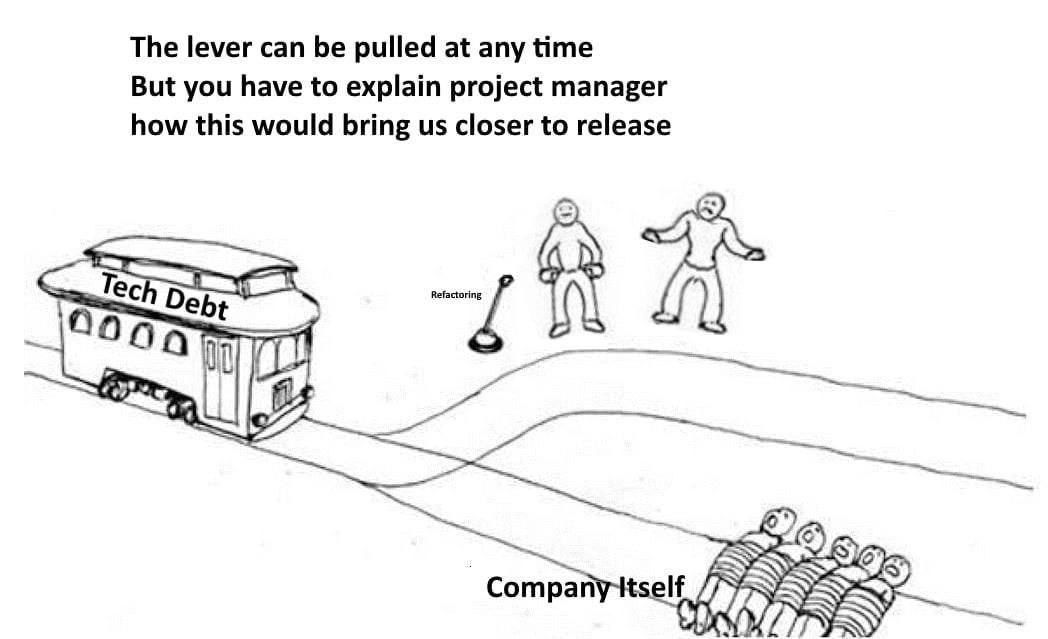
Trolley-problem meme showing tech debt tram and refactoring lever standoff
TechDebt Post #4940, on Oct 17, 2022 in TG

Trolley-problem meme showing tech debt tram and refactoring lever standoff

Why is this TechDebt meme funny?

Level 1: The Messy Room Dilemma

Imagine you’re building a huge LEGO castle for a school showcase that’s happening tomorrow. You’ve been working really fast to get it done before the deadline. But now your room is super messy – there are LEGO pieces, books, and papers all over the floor. This mess is a bit like technical debt: in your rush, you weren’t putting things back neatly, and now everything’s disorganized. You realize that if you don’t stop and tidy up (that’s like refactoring, cleaning the mess), you might trip or lose an important LEGO piece, and your whole castle (the project) could get wrecked. However, your friend who’s helping you is like the project manager – they keep saying, “Forget cleaning, we have to finish the castle right now so we aren’t late for the showcase!” They only care about being done in time and showing the castle, and they don’t see how cleaning the room helps with that.

Now you’re in a tough spot. You know that spending a bit of time to organize the LEGO pieces and clear the floor would actually help you work faster and safer after that. It’s obvious to you that if you step on a stray piece or can’t find the right LEGO brick in the mess, it could slow you down a lot or even ruin the project. But your friend is impatient and doesn’t want to pause for cleaning. The funny (and silly) part of this situation – just like in the meme – is that you have to convince your friend that cleaning up the mess will actually help you finish the castle on time. From their point of view, cleaning sounds like wasting time because it doesn’t directly add a new tower or gate to the LEGO castle. From your point of view, cleaning is necessary to prevent a disaster (like knocking over what you built or not finding a crucial piece).

In the end, the meme is like this story: The train is the big mess/problem coming, the lever to switch tracks is the decision to clean up (refactor), the tied-up people are the things that could get hurt (in the story it’s your project or even you stepping on LEGO, in the meme it’s the whole company), and the project manager is that friend who isn’t convinced cleaning is worth it. It’s funny in a cartoon, because obviously if a train is coming at people, you’d want to switch tracks! But in real life, when we replace “train” with “messy code” and “switch tracks” with “spend time refactoring,” suddenly it’s not so obvious to everyone. The meme jokes that even though the danger is real, the engineers have to pause and explain why doing the safe, smart thing (cleaning up first) will help reach the immediate goal (finishing the castle for the showcase). It’s a humorous way to show how sometimes people focus so much on a deadline that they ignore a big mess that could cause a crash — until you spell it out for them.

Level 2: Refactoring vs. Release

At this level, let’s break down the terms and imagery for a newer developer or someone outside the software world. Technical debt is a metaphor in software development: it means you’ve done things the quick-and-dirty way in your code, and as a result you “owe” additional work in the future to clean it up. It’s like writing code with shortcuts or kludges that aren’t very clean but help you meet a deadline; those shortcuts will cause you pain later (the same way financial debt causes interest payments). Every time engineers say “we’ll fix this later” or leave a // TODO: fix hack in the code, they are taking on TechnicalDebt. Over time, this debt accumulates, and the codebase can become harder to work with, full of bugs, or slow to change. That accumulated mess is what the meme personifies as a trolley named “Tech Debt” – a heavy, uncontrolled force barreling forward.

Refactoring, on the other hand, means improving the internal structure of the code without changing its external behavior. When you refactor, you might clean up duplicate code, simplify a complex function, or reorganize modules so that the code is easier to understand and maintain. Importantly, after refactoring, the program still does what it did before (if you did it right), but it’s now built on cleaner, more stable code. Refactoring is essentially how developers pay off technical debt. For example, if there’s a piece of code that’s very messy but “works,” a developer might refactor it to make it more readable and less prone to errors, ensuring that future changes or features can be added more safely. Think of it like tidying up a workshop so that tools are organized – the work output (the product) doesn’t immediately change, but everything becomes easier and safer moving forward.

Now, the conflict: deadlines and release pressure. In software projects, there’s almost always a push to deliver features by a certain date – maybe a promised release to customers or a quarterly goal. The Project Manager (PM) or product manager is typically the person responsible for making sure the team delivers on time and meets the business requirements. They coordinate tasks, track progress, and communicate with stakeholders. Because of this role, PMs are often very focused on the schedule and scope: “What features are we shipping? Are we on track to complete everything by the deadline?” They might not be as intimately familiar with the code’s quality under the hood, and even if they are, their primary concern is hitting the release date with all promised features. So there’s inherent tension: developers want to improve code quality (which is invisible to users), whereas project management is usually pushing for visible progress (new features, bug fixes that customers notice, etc.).

In the meme’s picture, these abstract concepts are represented visually. The trolley problem meme is a famous cartoon format borrowed from an ethical thought experiment: usually you see a train on tracks headed toward five people, and you have a lever to divert it to another track where there’s one person. It’s about making a tough choice. Here it’s adapted for tech humor. The train labeled “Tech Debt” is going down the track, and on that track you see “Company Itself” tied down – meaning if the train continues, the whole company (or the project) is in big trouble, probably because unchecked technical debt can lead to system failures or a grinding halt in development. The lever labeled “Refactoring” is the choice to change tracks, presumably saving the company from being run over by the tech debt train. The two stick-figure developers standing by the lever represent the engineers on the team. They clearly can pull that refactoring lever at any time – i.e., they have the ability to start refactoring the code now to address the problems. But they look hesitant and unsure. Why? The text at the top gives the reason: if they pull that lever, they’ll have to explain to the project manager how doing so brings the project closer to release. In other words, how does spending time refactoring help us hit our deadline?

This is a scenario many developers will recognize. The PM isn’t trying to be evil or ruin the code; they just have a job to deliver on time. And from a non-technical viewpoint, stopping feature work to do an internal code cleanup might sound counter-productive. The developers know that if they don’t do the cleanup (don’t pull the lever), the TechnicalDebt train will keep speeding. In real terms, that could mean the code gets buggier, maybe an important feature will be almost impossible to implement, or a crash is waiting to happen in production. Essentially, “the Company Itself” could be hurt – maybe through a catastrophic outage or lost customers because the product quality suffers. But the tricky part is convincing the PM of that future risk. It’s much easier for a PM to understand something like, “If we build Feature X, we’ll gain Y customers or meet the sales target,” versus understanding, “If we refactor Module Z, we might avoid an outage or speed up future feature work.” The latter is real but it’s not as tangible; it doesn’t show up as a direct line item in a progress report.

So the humor and pain of the meme come from this exact standoff. The lever (refactoring) is right there as the obvious solution to avoid disaster, but there’s a communication gap or priority gap. The developers basically have to argue that doing something seemingly unrelated to new features is actually super important for the project’s success. Often this involves explaining technical concepts in business terms: for instance, they might say refactoring will reduce the risk of delays later or improve our velocity in future sprints, or prevent a bug that could literally break the release. Sometimes teams will try to quantify technical debt’s impact, like saying “We spend 30% of our time dealing with this messy code, so fixing it could make us faster.” But in the heat of a release crunch, such arguments can fall on deaf ears if the pressure is high to just “get the release out.”

The image labels the five tied-up stick figures as “Company Itself” for a reason: it emphasizes that technical debt is not just a minor inconvenience – it can threaten the very business. There have been real cases where companies suffered huge losses or even went under partly because of software failures or inability to adapt quickly, which often link back to poor code quality or accumulated shortcuts. When a codebase is bad enough, adding new features slows to a crawl, or big bugs keep popping up, and a company can’t keep up with competitors. That is the ultimate consequence the developers in the meme are aware of. Meanwhile, the PM’s focus is “closer to release” – a much more imminent, concrete goal. This discrepancy in time horizon (short-term release vs. long-term health) is exactly the tension.

For a junior developer, it’s useful to know that refactoring vs. feature work is a common trade-off during planning. Good teams find a balance – for example, allocating some time each sprint for refactoring or doing it continuously in small bits. But less experienced teams or very high-pressure environments might let technical debt build up, prioritizing speed now and “hoping for the best” later. The meme is a funny reminder (or warning!) that if you always delay refactoring, you might end up in a dire situation. And it also pokes fun at how developers sometimes have to perform verbal gymnastics to justify important engineering work to non-engineering stakeholders. It’s management humor and developer humor rolled into one: each side has a perspective, and the poor developers in the picture are caught in between – they literally see the train coming, yet they have to get permission to switch tracks.

In summary, the meme’s scenario breaks down like this in plain terms: TechDebt is the speeding problem, Refactoring is the solution, the Company is what we’re trying to save, and the Project Manager is the person who needs convincing. It highlights the refactoring pain developers feel when they know something is wrong in the code but aren’t sure if they’ll be allowed time to fix it. Anyone who’s been in a sprint planning meeting where adding a “code cleanup” ticket leads to hard questions will immediately relate. The image exaggerates it to comedic effect: it’s literally life-and-death in the drawing, whereas in reality it’s project success or failure. But in a sense, for a business heavily dependent on software, project failure can feel like a life-and-death matter – hence “Company Itself” being tied to the tracks. The meme is saying: ignoring technical debt can be suicidal for a software company, yet managers often demand proof of why fixing it is necessary. That’s the joke and the frustration all in one.

Level 3: Debt on Rails

This meme perfectly encapsulates the classic struggle between software engineers and project management when it comes to technical debt. The humor flows from blending the famous trolley problem scenario with the day-to-day reality of release pressure and codebase rot. In the image, a trolley labeled “Tech Debt” is barreling down the tracks toward five unfortunate stick-figure victims labeled “Company Itself”. Translation: if this runaway technical debt isn’t addressed, it’s going to wreck the entire company (or at least its software project). Standing by the track switch are two developers staring at a lever ominously labeled “Refactoring”. They could pull it at any time to divert the speeding Tech Debt train away from disaster. So why are they hesitating? Because in the caption above, there’s a cruel twist:

“The lever can be pulled at any time
But you have to explain to the project manager how this would bring us closer to release.”

In other words, the engineers must justify how taking time to refactor (clean up code) will directly contribute to meeting the imminent deadline. This is an all-too-familiar scenario in software development. The project manager (PM), under intense DeadlinePressure and ReleasePressure, is laser-focused on features, deliverables, and the burn-down chart. To them, Refactoring can sound like an indulgent detour – “Why are we reworking code when we should be adding that last feature for the release?” They want to know how exactly pulling that lever brings the product closer to shipping. From the PM’s perspective (and likely their bosses’), every hour spent refactoring is an hour not spent building customer-visible functionality. StakeholderExpectations and management metrics often don’t account for invisible improvements to code quality.

The dark comedy here is that the developers see the big picture: the company’s very future (those five tied-up figures) is at risk from accumulated TechnicalDebt. They know that without refactoring, the codebase might become so fragile that adding new features or even keeping the product running will become a nightmare. Perhaps they’ve experienced that gut-wrenching moment when a critical bug pops up late in the development cycle or in production, caused by some quick-and-dirty code written months ago to meet a prior deadline. The unspoken trauma shared by many senior devs is that sinking realization at 3 AM during an outage: “this wouldn’t have happened if we had cleaned up that mess in the first place.” In the meme, the tech debt trolley stands for all those defects, hacks, and brittle modules racing towards a catastrophe while everyone was too busy to fix them. The five tied figures labeled “Company Itself” signify that, ultimately, everyone pays when technical debt comes due – lost revenue, emergency patches, maybe even company reputation on the line. It’s a train wreck in slow motion that the devs can see coming.

Why is this funny? It’s a wink of recognition among developers: we’ve all been in those meetings where suggesting a refactor causes eyes to roll or execs to demand, “justify it in terms of the release.” It’s absurd because it’s like having to persuade someone that repairing the brakes on a truck will actually help the truck safely complete a road trip. The outcome seems so obvious to engineers, yet they are often put in a position of having to translate code quality into business value on the spot. This meme strikes a chord because it exaggerates that standoff in a relatable way. The developers in the drawing look bewildered because they’re caught in a no-win situation: if they don’t pull the lever (don’t refactor), the tech debt will eventually derail the project (the company gets run over). But if they do pull it, they’ll face immediate scrutiny and possibly anger from management for “delaying” the release. It’s the Refactoring Paradox many teams know too well – doing the right thing for the software’s long-term health feels like the wrong thing for short-term deadlines.

In real-world scenarios, this plays out as a series of tough decisions and their consequences. For example, a team might skip writing tests and fruitful refactoring of a core module to save time for a release. The release goes out on time (hooray?), but a month later a critical customer bug surfaces because that module was a shaky Jenga tower of hacks. Now the same management is panicking and demanding an urgent fix. The developers end up refactoring under duress, perhaps pulling frantic all-nighters – essentially paying back the debt with hefty interest. As the meme implies, not addressing tech debt earlier can end up harming “the company itself”, slowing down future development or causing failures that hurt the business. There’s a reason experienced devs grimly joke, “Pay your technical debt, or it will pay you.” They’ve seen how a codebase that’s been neglected in the name of speed can grind a project to a halt.

The meme also hints at organizational dysfunction. In healthy engineering cultures, there’s an understanding that some percentage of time must be spent on code cleanup, refactoring, improving tests, etc., to keep the product sustainable. But in many companies, especially when DeadlinePressure looms large, those tasks get deprioritized. Project managers are often measured by immediate delivery success – did we hit the date, does the new feature demo well – rather than the internal code quality. This misalignment in incentive structures means the PM legitimately has a hard time approving a task that doesn’t show up in the feature list. The result? Everyone nods at the importance of addressing TechnicalDebt in retrospectives, but when planning the next sprint, new features or externally visible fixes consume all the capacity. It’s a cycle: “We’ll refactor later, we promise” – and “later” keeps getting pushed, until a crisis forces it. By then the tech debt might be so massive that the refactoring is even harder and riskier (leading to even more hesitation to do it until things catch fire).

The trolley problem framing adds a moral and slightly darkly humorous dimension: in the classic philosophical trolley dilemma, you debate sacrificing one life to save five. Here, pulling the Refactoring lever might “sacrifice” some short-term progress (maybe one feature gets delayed – representing that lone individual on the other track in a normal trolley meme) to save the five representing the company’s overall well-being. Yet the engineers are paralyzed, not because they lack ethics, but because they fear the project manager’s wrath or disbelief. The PM in this scenario isn’t drawn in the cartoon, but their presence is felt – a specter looming in the developers’ minds saying, “Prove to me this detour is worth it.” The comedy (and tragedy) is that by the time proof becomes obvious, it’s usually via a disaster everyone hoped to avoid.

In essence, the meme is laughing at the tug-of-war between doing what’s right in engineering versus doing what’s urgent in business. It’s developer humor with a dose of existential dread – knowing the refactoring lever is right there, labeled clearly, solution in hand, but having to compose a PowerPoint slide for upper management on “ROI of not crushing our company with tech debt” before you’re allowed to pull it. Those of us who have survived a few release cycles can almost hear that conversation and see ourselves in those bewildered stick figures. The next time someone asks “Will cleaning up this code help us ship faster?”, we might just point them to this meme and say, “Well, it might prevent a trolley from running over all of us.” 😅

Level 4: Entropy Always Wins

At the most fundamental level, this meme speaks to an inevitable law of software engineering: complexity (technical debt) will keep increasing unless we invest energy to reduce it. This is basically the Second Law of Thermodynamics for codebases – software entropy always increases if left unchecked. The runaway trolley labeled Tech Debt represents the compounding chaos in a codebase when shortcuts and quick hacks accumulate over time. In theory, pulling the Refactoring lever would be an application of negative entropy – injecting engineering effort to reorganize and simplify the system. But here’s the catch: doing so requires convincing a skeptical authority (the project manager) of its immediate value. It’s like a physics problem where you have to justify expending energy now to avoid even greater energy loss later.

From a theoretical perspective, the concept of technical debt was coined by Ward Cunningham in 1992 to describe how cutting corners in code is like taking on a financial debt. You gain speed now, but you accrue interest in the form of slower future development and potential system instability. Mathematically, we might humorously express the predicament as:

$$
P(\text{on-time release}) = \frac{1}{,1 + \text{TechnicalDebt},}
$$

In other words, the more TechnicalDebt in the system, the closer the probability of a smooth, on-time release gets to zero. Refactoring is essentially paying down the principal of that debt, reducing the unseen “interest payments” that drag down development velocity. There’s even a parallel to Lehman’s Laws of Software Evolution: a program that isn’t actively refactored will increase in complexity over time, which in turn makes each new change exponentially harder. Without refactoring, adding a small feature might turn into an $O(n^2)$ effort as engineers grapple with tangled code dependencies and brittle modules. This deep truth lurking beneath the humor is why the meme strikes a chord with senior developers – it dramatises a battle against a fundamental force of nature in coding.

On a lofty plane, we can see this scenario as a clash between short-term linear thinking and the non-linear reality of software complexity. Management’s focus on immediate release progress assumes a roughly linear path to the goal, but technical debt introduces non-linearity – past shortcuts amplify future drag. Refactoring is a way to re-linearize that path by simplifying architecture and reducing future friction. Yet ironically, one must often prove this using spreadsheets, charts, or dire predictions. It’s a bit like having to explain to a physicist why repairing a dam now prevents an exponential increase in flood damage later. The entropy in the system doesn’t care about quarterly goals; if you ignore it, it always wins. The meme captures that purgatory where engineers know the thermodynamics of their code are imbalanced, but getting approval to fix it is another story entirely.

Description

Black-and-white trolley-problem cartoon. Visible text at top reads: "The lever can be pulled at any time But you have to explain project manager how this would bring us closer to release". A trolley labelled "Tech Debt" races down the left track toward five tied-up stick figures on the right side captioned "Company Itself". Between the diverging rails stands a switch labelled "Refactoring" and two bewildered stick-figure developers. The scene humorously depicts engineers hesitating to pull the refactoring lever because they must justify to a project manager how code cleanup helps hit the release deadline, highlighting tension between technical-debt reduction and delivery pressure

Comments

8
Anonymous ★ Top Pick Pulling the refactor lever costs two days; convincing the PM it shortens time-to-market costs three sprints - so yes, we’re apparently A/B-testing which rail the company prefers to get flattened on
  1. Anonymous ★ Top Pick

    Pulling the refactor lever costs two days; convincing the PM it shortens time-to-market costs three sprints - so yes, we’re apparently A/B-testing which rail the company prefers to get flattened on

  2. Anonymous

    The real trolley problem: explaining to stakeholders why preventing a catastrophic system failure in 6 months is more important than shipping that half-baked feature by Friday - especially when the PM's bonus depends on the latter

  3. Anonymous

    The real trolley problem: you can pull the refactoring lever anytime, but first you need to convince the PM that 'making the code not terrible' is a valid sprint goal that somehow accelerates the release. Spoiler: the company tied to the tracks is already running legacy code from 2015, so we're really just choosing between immediate catastrophe and slightly delayed catastrophe with better test coverage

  4. Anonymous

    Refactoring: the lever you can pull anytime - if you can translate “not getting run over by the Tech Debt trolley” into better DORA metrics

  5. Anonymous

    Tech debt lever: infinite mechanical advantage, zero PM story points until the caboose hits the cliff

  6. Anonymous

    Pulling the refactor lever is the only A/B test where variant B is “company still exists next quarter” - check the DORA metrics

  7. @mrz_is 3y

    If tech debt exists can we get tech loans 👀

    1. @SamsonovAnton 3y

      Perhaps, if you sign a contract (in contract-based programming).

Use J and K for navigation