Bright-eyed C++ beginner meets seasoned dev’s reality check in Reddit thread
Why is this Juniors meme funny?
Level 1: Enjoy It While It Lasts
Imagine a kid on the first day of school, bursting with excitement, saying, “School is so awesome! I love learning new things every day!” Now picture an older student who’s been through several grades overhearing this. The older student smiles and replies, “That’s great to hear – but talk to me again after a year of homework and exams.” We instantly understand the dynamic: the younger child only sees the fun and new adventure right now, while the older student knows that over time, school also means hard work and challenges. The little one’s enthusiasm is pure and genuine, and the older one isn’t trying to be a downer – they’re half joking, based on knowing how things usually go as time passes.
This meme is just like that. The new programmer is like the excited kid, saying “Programming is awesome, and debugging is like a fun puzzle!” They’re having a blast because everything is fresh and challenging in a good way. The experienced programmer is like the older student, gently saying, “I love that you’re enjoying it – just remember, a year from now, after many late nights and tough bugs, you might feel a little different.” It’s a friendly tease, not meant to discourage.
We find it funny because it’s a very human moment. Many of us have been that beginner, thrilled about a new hobby or job, seeing only the exciting parts. And many of us have also been the veteran, smiling because we know the journey ahead has ups and downs. The phrase “check back in a year” is a lighthearted way to say “I’ve been where you are, and I know where you’re going.” The humor comes from that gentle “enjoy the honeymoon phase while it lasts” sentiment. It’s a wink from the older and wiser to the hopeful newcomer – in school, in programming, or anywhere – and it makes us laugh because we know just how true it is.
Level 2: Learning Curve Ahead
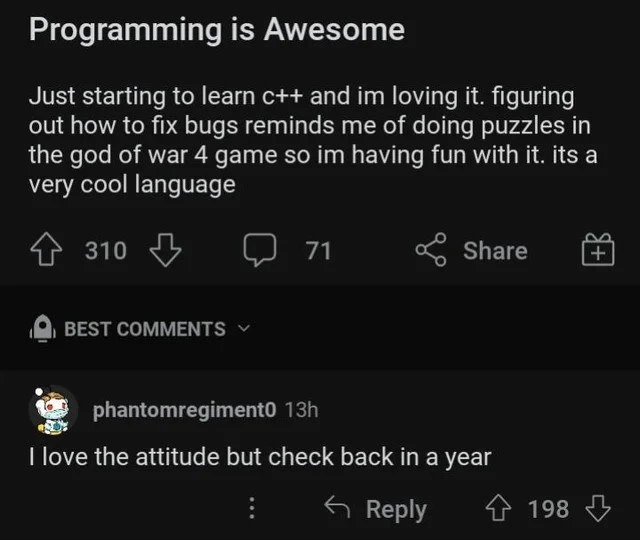
Now let’s explain this meme in plainer terms, assuming you have a bit less experience with coding. Picture a Reddit programming forum discussion. A very enthusiastic beginner has made a post essentially saying, “Just starting to learn C++ and I’m loving it. Debugging bugs reminds me of doing puzzles in God of War 4, so I’m having fun. C++ is a very cool language.” This person is clearly a junior developer (new to programming), and their excitement is through the roof. They’re finding joy in solving problems in code, comparing it to solving puzzles in a favorite video game. In God of War 4, for context, amidst all the action and adventure, there are puzzles to solve. Those puzzles are designed to be engaging and satisfying – much like how fixing a bug can feel rewarding to someone who’s just learning. So, our newbie is basically saying, “Coding is like this awesome game to me right now!”
Now, enter the seasoned developer (an experienced programmer) with a top comment replying: “I love the attitude but check back in a year.” In everyday words, the commenter is responding, “I admire your enthusiasm; let’s see if you still feel the same way after a year of doing this.” This is the meme’s punchline. Why would they say that? Because the experienced person knows that as you spend more time programming – especially in a complex language like C++ – the challenges get bigger and can become frustrating, not always fun and game-like.
Let’s break down some of the key ideas and terms to understand the joke:
- C++: A powerful programming language that gives a lot of control to the programmer. It’s used for all sorts of big projects (operating systems, game engines, etc.) and is known for being very fast. But it’s also known for being tricky to learn completely because you have to manage many things yourself (like the computer’s memory). In simpler terms, C++ is awesome but kind of hard, especially as you get into advanced stuff.
- Debugging: This means finding and fixing errors (called “bugs”) in your program. When you write code and something goes wrong – maybe the program crashes or gives the wrong output – you have to debug it. Many beginners enjoy debugging at first because it’s like solving a mystery or a puzzle: you hunt for clues (why did the program crash? which part of the code is wrong?), and then you figure out a solution. It’s very satisfying when you fix a bug and everything runs perfectly.
- God of War 4 puzzles: In the video game God of War 4, aside from fighting monsters, the player also solves puzzles to progress through the story. These puzzles are meant to be fun challenges. So the newbie is saying that fixing bugs in C++ gives them the same kind of enjoyment as solving a cool puzzle in a game. It’s a way of saying “I’m having a great time debugging!”
- Seasoned Dev’s reality check: The experienced commenter’s line “check back in a year” is what you might call a gentle reality check. This person likely has been programming for many years and has seen how one’s perspective can change. After enough time, even people who love programming encounter projects or bugs that are really hard or tedious. The phrase suggests that the newbie might feel differently after a year of real-world programming challenges. It’s often said with a smile – think of it like an older student in school seeing a freshman super excited about homework and saying, “That’s great you love it now; talk to me again at the end of the year.”
- Why a year? In a year of programming, a beginner will have time to move from small, fun exercises to bigger, more complicated projects. They might face deadlines, larger codebases, or weird bugs they’ve never seen before. C++ projects, in particular, can introduce tricky problems once they get complex. For example, the program might crash because of a segmentation fault (which happens when the program tries to access memory it shouldn’t – kind of like opening a door that says “Employees Only” in a building and setting off an alarm). Or the program might slowly use more and more memory and you have to figure out where that happens (that’s called a memory leak). These kinds of issues are not as straightforward as the small puzzles the beginner solved. They can be frustrating and time-consuming. After dealing with a nasty bug for days, even the most passionate coder might not describe the experience as “awesome.”
What this meme highlights is the classic learning curve of any challenging skill. In the beginning, everything is new and exciting. Early successes make you feel like, “Wow, I’m really getting this!” That’s sometimes called the overconfidence of beginners – not in a bad way, just that when you’re new, you don’t know what you don’t know. As you learn more, you realize there’s a lot more complexity out there. The curve ramps up. Many developers start out super optimistic like the person in the post, and later they become a bit more realistic (or weary) like the commenter, once they’ve been “in the trenches” of coding for a while.
In online developer communities (like the subreddit where this was posted), this kind of exchange is very common and usually friendly. The older pros genuinely appreciate the newbie’s enthusiasm – it reminds them of their younger self. The joke is that most of those older pros also remember the moment when their perspective shifted after encountering their first really painful bug or a crunch-time debugging session.
So, the experienced commenter isn’t trying to be mean. Think of them like a coach chuckling at a rookie who’s overly eager. The coach says, “I love the energy, kid. But check back in a year,” meaning the season is long and it won’t all be easy. In programming terms, “check back in a year” means “after you’ve been doing this for a while – handling tough bugs, long hours, maybe some late-night coding emergencies – you might not be quite as exuberant, even if you still like it.”
The humor here comes from relatability. Almost every programmer can recall being in that newbie’s shoes, and then later in the veteran’s shoes. It’s funny and a little bittersweet – we all start out thinking “Programming is awesome!” (and it is), but we eventually earn a few grey hairs from a particularly nasty debugging session. The meme gets a laugh because it captures that universal developer experience in one short interaction.
Level 3: When Puzzles Byte Back
At a senior engineering level, this meme perfectly captures a classic Junior vs Senior moment in developer culture. The bright-eyed newbie proudly proclaims “Programming is Awesome” and compares debugging in C++ to solving fun puzzles in a video game. It's adorable and newbie optimism at its finest. Seasoned devs reading this can’t help but smirk, not out of malice, but out of recognition. We’ve all seen this movie before. The top comment, “I love the attitude but check back in a year,” is the seasoned developer’s equivalent of a knowing chuckle. It’s as if they’re saying, “Been there, loved that, got the t-shirt... and then spilled coffee on it during a 3 AM production outage.”
Why is this funny to anyone with a few years of coding under their belt? Because we recognize the learning curve ahead for this enthusiastic junior. Right now, debugging C++ feels like a series of clever puzzles with satisfying solutions – much like those God of War riddles that our newbie mentioned. But give it some time, and those cute puzzles can evolve into maddening labyrinths. The meme humorously contrasts the newbie’s honeymoon phase with the veteran’s battle-worn realism. It’s developer humor 101: overconfidence bias meets reality. Early wins can inflate a junior’s confidence (“fixing bugs is just like a game!”) even as they stand unknowingly at the foot of a mountain of complexity. Experienced devs aren’t trying to crush the newbie’s spirit; in fact, most seniors find that youthful enthusiasm refreshing. But they also know what’s coming and can’t resist a little tongue-in-cheek warning.
Consider what "checking back in a year" entails in the world of C++ and debugging. A year down the line, our optimistic coder will likely have faced some legendary frustrations that temper their rosy view. Perhaps they’ll recall this very Reddit thread after spending a whole week on a bug that refused to make sense. By then, “figuring out how to fix bugs” might feel less like a fun puzzle and more like banging their head against a wall (or the keyboard). The seasoned dev’s comment resonated with 198 upvotes because so many others in the community have gone through this metamorphosis from newbie optimism to seasoned dev realism. It’s almost a rite of passage.
To paint a picture of why the senior’s cautionary tone is so relatable, here are a few “puzzles” that tend to bite back in C++ and turn fun into frustration:
- The Elusive Segfault: You run your program and boom – it closes with a
Segmentation fault (core dumped)message. No helpful pointer to where the problem is, just a crash. Now you’re digging through hundreds of lines of code, like searching for a needle in a haystack at midnight, to find that one wild pointer or buffer overflow. Fun, right? - The Memory Leak Marathon: Everything seems to work... until your app runs for a couple of hours and suddenly slows to a crawl or crashes. Surprise – it’s been leaking memory because someone forgot a
delete. Tracing which of many allocations isn’t freed feels like detective work in a crime with no witnesses. - The Heisenbug Nightmare: You discover a bug that only appears when the moon is full (or so it seems). Add a
printfor run a debugger, and the bug disappears. Remove that line, and it shows up again. Congratulations, you’ve met a Heisenbug. It’s the programming equivalent of a ghost – a glitch that changes behavior when observed – and it’s enough to turn any “cool language” into a source of sleep-deprived frustration.
After wrestling with a few of these, even the most passionate C++ fans earn their cynic stripes. The meme’s comedy lies in that contrast of perspective: the newcomer sees coding in C++ as a thrilling adventure every step of the way, while the veteran knows that adventure includes some dragons that weren’t in the tutorial. In the Reddit thread screenshot, the senior’s comment isn’t meant to discourage; it’s a light-hearted reality check — practically a tradition in programming communities. On forums like Reddit, experienced developers often joke with newcomers in this exact way, with “just wait, you’ll see” remarks, because they remember being in those shoes.
Over time, every developer learns that debugging in complex systems (especially in a language like C++ that gives you so much control) can shift from playful problem-solving to exhausting whack-a-mole. Memory errors, race conditions, undefined behavior – these aren’t nicely designed puzzles with a clear solution path. They’re more like the boss levels of programming: beatable, yes, but often requiring sweat, tears, and a few desperate Google searches at 2 AM.
So the seasoned commenter’s “check back in a year” isn’t just a snarky quip – it’s veteran skepticism distilled into one sentence. It's saying, "I love your enthusiasm, and I truly hope you keep it. But if you’re still debugging C++ a year from now, don’t be surprised if your vibe shifts from ‘this is a very cool language’ to something more along the lines of ‘why is my code randomly crashing?!’." The humor hits home because every elder developer once thought like that beginner — and then life (and segfaults) happened. It’s a nod to the shared journey: today’s overconfident junior is often tomorrow’s battle-hardened senior, chuckling when they see the next newbie declare that programming is awesome.
Level 4: Manual Memory Maze
At the deepest technical level, this meme hints at the gritty reality of programming in C++: manual memory management and the notorious realm of undefined behavior. C++ gives developers close-to-the-metal power over memory – you allocate and free memory yourself with new and delete. This is great for performance, but it’s also a maze filled with traps for the unwary. Unlike languages with automatic garbage collection (think Java or Python), C++ trusts you to manage memory. Every pointer and allocated object is like a puzzle piece you must manually place and remove correctly. Misplace one, and you might create a memory leak (forgetting to free memory so it permanently stays allocated) or worse, a dangling pointer (freeing memory and then still trying to use it). These missteps lead straight into undefined behavior territory – where the C++ standard imposes no rules on what happens, so anything can happen.
When you write beyond an array’s bounds or dereference a null pointer (nullptr), the program might crash immediately, or it might quietly corrupt data and go on running like nothing’s wrong... until hours later when it explodes in a completely unrelated part of the code. Debugging these issues can feel like navigating a dark labyrinth with hidden traps — nothing like a straightforward God of War puzzle. Why does C++ allow this chaos? It’s a trade-off rooted in computer science fundamentals: by not checking every memory operation at runtime, C++ gains speed and flexibility. The compiler assumes you know what you’re doing. That’s fine until you don’t. The result is bugs that can defy normal logic, often called Heisenbugs when they vanish upon observation (named after the Heisenberg uncertainty principle, because observing the bug via debugger or print statements can alter its behavior!). Seasoned C++ devs have learned that beneath the language’s cool features lies a minefield defined by the physics of the machine and the design of the language itself. They carry the scars of chasing down wild pointer errors that felt less like playful puzzles and more like battles with an invisible foe inside the machine.
For example, consider a simple C++ snippet:
int* arr = new int[2]{1, 2};
arr[5] = 42; // Out-of-bounds write: undefined behavior
delete[] arr;
This code compiles without complaint and might even run without an immediate crash. But writing to arr[5] (when the array has size 2) scribbles over some random piece of memory that the program doesn’t own. Maybe it overwrites a critical variable or part of the program’s control flow. The effects could be delayed and wildly unpredictable – the app might crash later in an unrelated function or produce corrupted results. Tracking down that bug is nightmarish because the cause and effect are far apart.
These are the kinds of deep technical pitfalls that an experienced C++ developer knows lurk beneath the surface. Debugging in such scenarios stops feeling like an entertaining puzzle and starts to resemble diffusing a bomb with wires leading everywhere. The bright-eyed beginner in the meme hasn’t encountered the full complexity of this manual memory maze yet, but the seasoned dev has been lost in it many times. That fundamental design of C++ – giving you both freedom and the rope to hang yourself responsibility for managing every byte – is why the senior engineer wryly suggests checking back in a year. By then, the newcomer will likely have stumbled into a few of these classic C++ booby traps and gained a new respect for why programming can sometimes feel less like solving a neat puzzle and more like surviving an unpredictable gauntlet.
Description
Dark-themed Reddit screenshot. Post headline in bold reads: "Programming is Awesome." Body text: "Just starting to learn c++ and im loving it. figuring out how to fix bugs reminds me of doing puzzles in the god of war 4 game so im having fun with it. its a very cool language." Below are icons showing 310 up-votes, a down-vote arrow, 71 comment bubbles, a share link icon and a save icon. Section label "BEST COMMENTS" appears, followed by user phantomregiment0’s comment: "I love the attitude but check back in a year" with 198 up-votes and a reply arrow. Visually, it is standard Reddit UI with dark background and light text. Technically, the meme contrasts early-stage enthusiasm for learning C++ and debugging puzzles with the more jaded perspective of experienced engineers who know the language’s pitfalls - memory management, undefined behavior, and long-term fatigue. It plays on developer culture, junior-vs-senior outlooks, and the learning curve of tackling C++ bugs

Comments
27Comment deleted
Enjoy the honeymoon - next year the “puzzle” is a Heisenbug that only appears in -O3 on Fridays when a dangling std::string_view meets a mis-aligned atomic, and even Kratos can’t rage-quit that boss fight
The real puzzle in C++ isn't fixing bugs - it's understanding why your perfectly valid code from 2011 now has 47 deprecation warnings, your template metaprogramming created a 900MB binary, and the committee just added three new ways to initialize a vector, none of which are the 'right' one
Ah yes, the classic C++ beginner arc: 'This is fun!' → segfaults → template error spanning 47 lines → 'Why does my destructor run twice?' → understanding move semantics → 'Maybe Rust wasn't so bad' → finally grokking RAII → 'Actually C++ is elegant' → maintaining legacy code with raw pointers → existential crisis. The commenter's 'check back in a year' is the most compassionate way to say 'wait until you meet std::shared_ptr<std::vector<std::unique_ptr<T>>> and the linker decides your vtable doesn't exist.'
Early C++ is puzzles; a year later it’s an escape room - floor is UB, door is templated, key only exists at -O0, and the final boss is an ABI mismatch in the linker
Give it a year - the 'fun puzzles' become chasing an intermittent segfault from UB that vanishes under -O0, reappears under -O3 with LTO, and only reproduces after you remove the printf
God of War puzzles today; tomorrow, it's Dark Souls with dangling pointers that oneshot you on every release build
1 year later: reminds antichamber Comment deleted
1 year later they either get depressed or add pronouns to their bio Comment deleted
😂😂 Comment deleted
One year later... Comment deleted
Two years later... Comment deleted
Three years later... Comment deleted
😂😂😂😂 Comment deleted
4 years later Comment deleted
Four years later... Comment deleted
Five years later... Comment deleted
Six years later... Comment deleted
He growed back his nose? Comment deleted
That Sith had to restore his appearance frequently, because his body was constantly degrading. Comment deleted
Well, looks like restoring his own nose is the only dark art plastic surgery he succeeded in. Comment deleted
He was quite successful at that, actually, until once becoming irreparably damaged by his own lightning reflected by Mace Windu. Comment deleted
Ok, let it be this way. 😌 Comment deleted
Seven years later... Comment deleted
Eight years later… Comment deleted
This looks more like the middle between years one and two... Comment deleted
Chadson Comment deleted
true Comment deleted