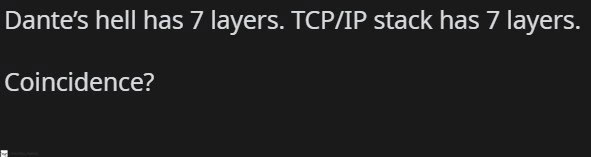
Comparing OSI’s seven layers to Dante’s Inferno in a networking meme
Why is this Networking meme funny?
Level 1: Networks are Onions
Think of a big task that you have to do in steps, one after the other. Fixing computer network problems is like that – it has many steps or layers. This meme jokes that those layers are as unpleasant as the layers of Hell from an old story. Imagine you have to go through 7 levels of challenges in a video game or peel an onion with 7 layers. By the time you get to the last layer, you might be tired or even crying (onions can do that!). People who work with computers sometimes feel like that because there’s so much complexity. So the meme is funny because it exaggerates: it says the Internet’s structure (with seven parts) is like a journey through seven levels of a really bad place. It’s a silly way to say “fixing network issues can be torture.” In other words, the computer network has many layers to go through, and dealing with each layer can feel tough – just like going deeper and deeper into a scary cave. The question “Coincidence?” is meant as a joke – it’s not really a coincidence, it just sure feels that way when you’re frustrated. Even if you don’t know Dante or the OSI model, the idea is clear: lots of layers can mean lots of trouble, and that over-the-top comparison is what makes it humorous.
Level 2: Layers of Complexity
In simpler terms, this meme jokes that computer networking is as painful as going through Hell. It references two things: the seven layers of the networking model from CS fundamentals and the layers (or circles) of Hell from Dante’s famous story. Let’s break those down.
OSI Model (Networking Layers): When computers talk to each other over a network (like the Internet), we describe the process in layers. Each layer is a step that handles a specific part of the communication. The OSI model is a classic way to teach this. It has seven layers, usually numbered from 1 at the bottom (physical hardware) up to 7 at the top (the application you use). They are:
- Physical (Layer 1) – The actual wires, Wi-Fi radio signals, and hardware – basically the physical stuff that carries bits as electrical or light pulses. Think of this as the network’s plumbing and electricity.
- Data Link (Layer 2) – This layer is about direct connections between devices. It deals with things like Ethernet protocol and MAC addresses (the unique IDs of network cards). It’s like the rules for two neighbors talking on tin-can telephones: ensuring the message goes from one device to the next without getting garbled on that local link.
- Network (Layer 3) – This is where routing happens. The most famous Layer 3 protocol is IP (Internet Protocol). Layer 3 handles addresses and getting data from one network to another. It’s like the postal system of the Internet: figuring out how to route a letter (packet) through different post offices (routers) to reach the destination.
- Transport (Layer 4) – This layer ensures the data gets to the right program on the destination and can deal with errors or ordering. TCP (Transmission Control Protocol) lives here, making sure packets arrive reliably and in sequence (like certified mail with acknowledgments), while UDP is a simpler “just send it” protocol (no receipt, hope it arrives).
- Session (Layer 5) – This one manages ongoing conversations (sessions) between two computers. It’s less visible in many modern applications, but it handles things like opening/closing a connection or session management. You can think of it as keeping track of the fact that, say, you’re logged in and having a sustained back-and-forth dialogue (like a phone call) rather than just a one-off postcard.
- Presentation (Layer 6) – This layer makes sure the data is in a usable format. It might handle encryption/decryption, or translate between character encodings. It’s like a translator or the format fixer – ensuring that when one side sends data in a certain format, the other side can understand or display it. (For example, converting text between different character sets, or formatting images).
- Application (Layer 7) – The top layer, where application protocols operate – this is basically the stuff we as users interact with. Examples: HTTP for web browsing, SMTP for email, FTP for file transfers. It’s the layer where your actual app (browser, email client, etc.) talks network.
Now, why seven layers? It’s somewhat arbitrary but was designed to compartmentalize tasks. Each layer only worries about its own aspect, providing services to the layer above and relying on the layer below. This modular design is taught in Networking 101 because it helps us reason about complex systems. You’ll often hear developers and network engineers refer to “layer X” when diagnosing issues — e.g., “This looks like a Layer 3 problem” means an IP/routing issue, or “That’s a Layer 7 issue” points to the application. It’s a fundamental part of Networking education and shows up in virtually every textbook on CS_fundamentals of networks.
Dante’s Inferno (Literary Layers): The meme pairs the tech idea above with Dante’s Inferno, a classic 14th-century Italian poem by Dante Alighieri. In that story, Dante travels through Inferno (Hell), which is depicted as having multiple levels or “circles.” Each circle of Hell is a place for a specific type of sin, and going deeper means encountering worse sins and harsher punishments. It’s a very famous piece of literature, and even if someone hasn’t read it, they might know the idea that Hell was shown as layered levels of suffering. Popular culture often references “the seventh circle of Hell” to mean a really awful place or situation. (Fun fact: Dante actually described nine circles of Hell in his Inferno, but the meme simplifies it to seven to match the OSI layers – a bit of poetic license for the sake of the joke!).
The Joke Explained: The meme text sets up a funny comparison: both Dante’s Hell and the OSI/TCP-IP network stack have “7 layers.” Then it asks, “Coincidence?” implying a tongue-in-cheek connection. Of course, it’s not seriously claiming a real link – it’s humor. The joke suggests that dealing with network layers can feel as painful as exploring the circles of Hell. Anyone who’s struggled with a tricky network bug can relate to that feeling! It’s TechHumor by exaggeration. We often make light of frustrating engineering problems by comparing them to outrageous things. Here, the networking stack (a dry subject from computer science) is being likened to Dante’s Hell (a dramatic, painful journey) to poke fun at how complicated and torturous network debugging can be.
Additionally, there’s an inside joke for IT folks: the meme calls it the “TCP/IP stack” with 7 layers, but actually the TCP/IP model traditionally has fewer layers. It’s the OSI model that has exactly seven. People often confuse the two or merge them in conversation. Seasoned network engineers notice this and find it amusing – it’s like mixing up two similar-sounding concepts from textbooks. The meme isn’t trying to give a networking lesson; it’s intentionally mixing them because most readers vaguely recall “something about seven layers” when talking about the Internet. That’s part of the humor too – it’s playing fast and loose with terminology the way a lot of casual tech talk does.
Why it’s Funny: In summary, this meme tickles people who know a bit about networking because:
- It references a fundamental concept (the 7-layer OSI network model) that we learn early in our careers.
- It uses a famous literary reference (the layers of Dante’s Hell) to dramatize the pain of troubleshooting those network layers.
- It even slips in a common mix-up (calling the OSI model the “TCP/IP stack”) which itself is a goofy nerd oversight that we recognize.
All of these layers (of meaning!) stack together to create a joke that says: Working with network layers can be a nightmare. It’s DeveloperHumor at its best – taking something arcane and turning it into a shared laugh. Any engineer who’s spent a day plugging and unplugging cables, tweaking IP settings, or reading packet logs will chuckle and say, “Yeah, sometimes it does feel like I’m in networking hell.” No coincidence at all!
Level 3: Seven Deadly Layers
Dante’s hell has 7 layers. TCP/IP stack has 7 layers. Coincidence?
This meme delivers a double punch of Networking humor and literary reference that makes seasoned engineers smirk knowingly. On the surface, it draws a parallel between the OSI model’s seven layers and Dante Alighieri’s depiction of Hell, joking that working through network layers can feel like descending through an infernal hierarchy. The phrasing mimics a conspiracy theory setup (“Coincidence? I think not.”), implying it’s no accident that both have seven layers – as if the networking protocols were designed by the devil himself. This parody taps into shared developer experiences: debugging a network issue often means digging down through multiple abstraction layers, a process as arduous (and soul-sucking) as Dante’s journey in the Inferno.
For a senior engineer, the humor operates on several levels (pun intended). First, there’s the misidentified_tcp_ip_stack: the meme says “TCP/IP stack has 7 layers,” though strict tech lore knows the TCP/IP suite is usually described with 4 or 5 layers, not 7. The classic OSI model (Open Systems Interconnection) has the famous seven. By conflating them, the meme knowingly (or accidentally) mirrors how junior admins mix up the theoretical OSI layers with the actual Internet protocol stack. It’s the kind of Layer 8 issue (user confusion) that network veterans love to tease about. In a way, the meme itself commits a “technical sin,” which is hilariously appropriate in a Dante comparison. Seasoned folks catch this and chuckle: the seven_layers_joke works even better because both references are a bit “wrong” — Dante’s hell in the Inferno actually has nine circles, and the TCP/IP stack has four-ish layers. But hey, seven is a CS_fundamentals magic number here, and the meme runs with it for comedic symmetry. Coincidence? Definitely not – it’s intentional comedic license.
Diving deeper (like descending circles of Hell), each OSI layer can indeed feel like its own mini-Inferno when something breaks. Networking failures are notoriously hard to troubleshoot precisely because of these distinct layers of abstraction. A grizzled network engineer will recount war stories of chasing a bug through the stack:
- Layer 1 (Physical) – a loose cable or fried port can bring down everything above. Discovering a bad SFP module at 3 AM in a data center feels like wandering the dark limbo of Dante’s first circle, cursed to check every wire in despair.
- Layer 2 (Data Link) – switching loops or MAC address conflicts might remind you of gluttonous frames gorging a network, a punishment fitting a second circle. The torment? Endless Wireshark captures to find the offending MAC.
- Layer 3 (Network) – missing routes or an IP address conflict can strand packets like lost souls. Misconfigured subnets become a bureaucratic hell (Dante’s city of Dis has nothing on negotiating with the network team for a new IP range).
- Layer 4 (Transport) – when TCP misbehaves (weird retransmissions or a rogue UDP flood), it’s wrathful: akin to the raging fourth circle where souls clash – except it’s your services clashing over ports.
- Layer 5 (Session) – rarely singled out, but think of nightmares with half-open sessions or an out-of-sync SSL handshake. It’s the dull ache of the heretics in the sixth circle — you don’t often see them, but when you do, it’s baffling pain.
- Layer 6 (Presentation) – mismatched data formats or encryption issues (ever debug character encoding mismatches?) can feel like fraud – a layer of treachery not unlike Dante’s penultimate circle.
- Layer 7 (Application) – finally, the application layer, where user-facing protocols (HTTP, SMTP, etc.) live. Errors here are highly visible and often dramatic (500 Internal Server Error, anyone?). This is the seventh circle of hell in our analogy, where the networking_vs_hell suffering is glaring – users wail, and devops gnash their teeth.
By the time you’ve dug through each layer looking for the problem, you’ve essentially journeyed through a personal networking inferno. The meme cleverly hyperbolizes that shared agony. Every experienced dev has at least one story of a “simple” network bug that turned into an odyssey through all seven OSI layers – as if guided by Virgil himself, spending an afternoon in protocol purgatory just to find one misconfigured router ACL (access control list) or an elusive DNS misroute. It’s developer humor gold because it’s true: each layer is a layer of torment when it fails, and together they form a hellish stack of complexity.
There’s also a historical wink here. In the 1980s, the OSI model was defined by ISO as a universal networking framework – seven abstract layers to rule them all. Meanwhile, the simpler TCP/IP model (with fewer layers) was actually winning the real-world protocol wars. Seasoned engineers know this backstory: the osi_model is mostly a teaching tool now, but it lives on as mental model for troubleshooting. Comparing OSI’s layered abstraction to Dante’s layered Hell is deliciously apt – both are structured, hierarchical, and frankly terrifying if you’re stuck navigating through them. The phrase “Layer 8 issues” (humorous slang for user or political problems beyond the technical layers) further extends the joke: if seven network layers equal Hell, then the mythical Layer 8 (where clueless users or inept managers reside) might be an uncharted deeper circle even Dante couldn’t envision. In other words, when something breaks and it’s not an OSI layer problem, it’s probably a human problem – the ultimate infernal trap.
So, is it a coincidence? Of course not. The meme winks and says: Networking can be hell. It’s a clever exaggeration that resonates with anyone who’s spent hours under the fluorescent lights of a server room, praying for a flicker of a link light on a switch (our modern-day guiding Virgil) to lead them out of trouble. It’s cathartic humor – by laughing at the comparison, seasoned developers momentarily conquer the demons of downtime and packet loss that once plagued them. Every protocol has its place and every sin its circle; mix them up in a joke like this, and you’ve got a devilishly good developer meme.
Description
The image is a simple black rectangle with white sans-serif text centered in three lines: “Dante’s hell has 7 layers. TCP/IP stack has 7 layers. Coincidence?” There are no graphics, only the stark text on the dark background. The joke equates the complexity (and occasional pain) of the seven-layer network model with the seven layers incorrectly attributed to Dante’s Inferno, hinting that working at different protocol layers can feel like descending through levels of torment. For seasoned engineers, the meme also pokes fun at the common mis-labeling of the OSI model as the TCP/IP stack and highlights how networking abstractions can seem devilishly complex
Comments
6Comment deleted
Dante drew 9 circles, OSI defines 7 layers, TCP/IP really uses 4 - turns out the worst level of hell is the conference talk that mixes them all on one slide
The real hell is explaining to management why their 'simple' request requires changes across all seven OSI layers, then watching them add an eighth layer: politics
The real hell isn't the seven layers - it's explaining to stakeholders why their 'simple' feature request requires touching all of them, then watching them ask if we can 'just skip the middle ones' to ship faster
Layer 7 hell: where the app finally realizes every layer below has been gaslighting it since physical
Dante has 9 circles, OSI has 7 layers, TCP/IP has 4 - the real hell is a design review where someone conflates them while proposing an L2 stretch across regions
TCP/IP has 4 layers, OSI has 7, Dante has 9 - and every Sev1 ends at Layer 8: politics, the only layer your observability stack can’t instrument