One Developer, Entire IT Department
Why is this Career HR meme funny?
Level 1: One Person, Whole Workshop
This is like hiring one person and asking them to be the carpenter, electrician, plumber, architect, painter, security guard, and accountant. Some people can help with many things, but nobody should be expected to be a whole building crew by themselves. The funny part is that the job ad says “developer,” while the list quietly says “please run everything.”
Level 2: Too Many Hats
A frontend developer works on what users see and interact with, such as HTML, CSS, JavaScript, and React. A backend developer works on servers, APIs, data processing, and business logic, which could involve Python, NodeJS, or GraphQL.
The list also includes cloud and DevOps tools. AWS is a cloud platform. Docker packages applications into containers. Jenkins and Drone run automated build and deployment pipelines. Terraform creates infrastructure from code. Kubernetes manages containers across servers. Puppet configures machines. The databases listed are different systems for storing and querying data.
It is reasonable for a developer to know some of these. It is unreasonable to expect one person to be an expert in all of them for one normal developer job. Early-career developers often see ads like this and assume they are unqualified for the industry. In reality, many job descriptions are wish lists assembled from every tool the company has ever touched.
Level 3: Org Chart Compression
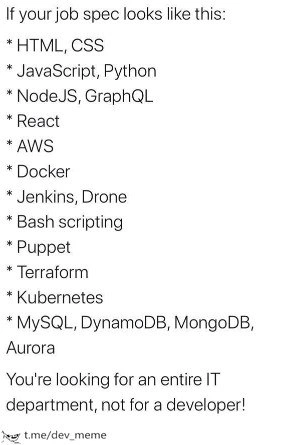
The image starts:
If your job spec looks like this:
and then lists a stack that spans:
HTML, CSS
JavaScript, Python
NodeJS, GraphQL
React
AWS
Docker
Jenkins, Drone
Bash scripting
Puppet
Terraform
Kubernetes
MySQL, DynamoDB, MongoDB, Aurora
The punchline is blunt:
You're looking for an entire IT department, not for a developer!
That is not just a complaint about long job ads. It is a complaint about role collapse. The visible list covers frontend implementation, backend services, API design, cloud infrastructure, containers, CI/CD, shell automation, configuration management, infrastructure as code, container orchestration, and several database families. Each item is plausible in isolation. Together, they describe a product team, a platform team, a DevOps function, a database function, and possibly someone who still has to answer Slack during lunch.
The humor lands because modern software hiring often treats full-stack development as infinite-stack development. A developer who can move across boundaries is valuable. But there is a difference between understanding how systems connect and being expected to own every layer at production depth. React and Kubernetes both have learning curves, failure modes, and ecosystem churn. Terraform mistakes can damage infrastructure. Database choices like MySQL, DynamoDB, MongoDB, and Aurora involve different query models, consistency behavior, scaling patterns, and operational trade-offs.
This is where DevOps gets flattened into a hiring buzzword. The original cultural idea was collaboration between development and operations, with automation and shared responsibility. The broken version is a job spec where one person builds the UI, writes the API, provisions AWS, authors pipelines in Jenkins or Drone, debugs Docker networking, maintains Kubernetes manifests, and then gets evaluated for not being “deep enough” in every specialty. Naturally, the role is listed as “developer,” because “underpaid distributed systems department with a keyboard” did not fit in the HR template.
The deeper organizational issue is that overloaded specs hide prioritization failure. If a company truly needs all those capabilities, it should decide which ones are core to the role, which are nice-to-have, and which belong to adjacent teams. Otherwise, the hiring process filters for people who either overstate expertise or have survived enough production incidents to develop the haunted look of someone who has manually edited YAML under pressure.
Description
A plain white text meme says, "If your job spec looks like this:" followed by bullets for HTML, CSS; JavaScript, Python; NodeJS, GraphQL; React; AWS; Docker; Jenkins, Drone; Bash scripting; Puppet; Terraform; Kubernetes; and MySQL, DynamoDB, MongoDB, Aurora. The punchline reads, "You're looking for an entire IT department, not for a developer!" with a small t.me/dev_meme watermark at the bottom. The joke targets inflated hiring requirements where one role quietly spans frontend, backend, cloud, CI/CD, infrastructure as code, orchestration, scripting, and database administration.
Comments
1Comment deleted
That is not a job description; it is an org chart compressed into a single salary band.