When your Git branch feels like treasured trash guarded by an angry possum
Why is this VersionControl meme funny?
Level 1: Hands Off My Stuff
Imagine you spent all afternoon building a big, messy pillow fort in your room. Blankets and pillows are everywhere. To you it might look chaotic, but you're proud because you built it. Now picture a friend or parent coming in and, without asking, starting to "fix" your fort — moving pillows, rearranging blankets, trying to make it neater. You'd probably get upset and shout, "Hey, stop! Don't touch that, it's mine!" Even if it looks like a pile of junk to them, it's your creation and you want it left alone. That's the feeling this meme is showing. The possum in the trash can is like a person defending something they made (even if it’s kind of garbage). When someone else tries to change it without permission, the immediate reaction is, "Hands off! It's my mess and I know where everything is!" In other words, we all get protective of our stuff when someone tries to take over, just like that possum guarding its treasured trash.
Level 2: Don't Touch My Code
Let's break down what's happening in this meme in simple terms. It's talking about Git, which is a system developers use to keep track of code changes (version control). In Git, a branch is like a separate workspace for a feature or bug fix. Think of it as making a copy of the project where you can experiment freely. Later, you can merge your branch back into the main project when it's ready.
Now, "somebody pulls your branch" means someone else on your team retrieved your branch from the shared Git repository. They basically downloaded your work-in-progress code to their own computer using a command like git pull origin your-branch-name. Usually, teammates might do this to review your code or test it on their machine. That's normal. The problem starts when that somebody not only pulls your branch but also starts making changes to your code without asking you. In a normal workflow, if they have suggestions or improvements, they'd open a Pull Request or at least talk to you first. A pull request is a way to propose your changes formally so others can do a code review (give feedback or approve the changes) before everything gets merged together.
Why is it bad if someone edits your branch directly? For one, it skips communication. Imagine you're still working on your feature, and suddenly you see new edits in it that you didn't do. It can lead to confusion and more work to sort out. Here are a few reasons this is frowned upon:
- Merge conflicts: If both you and your teammate changed the same parts of the code in different ways, Git won't know which change to keep when combining them. A merge conflict happens, and then someone (probably you) has to manually fix the code. This is extra stress that could be avoided with coordination.
- Lost context: You might have written the code a certain way for a reason. Maybe your code looks like a weird workaround (kind of "garbage" in your own eyes), but that's because of a specific constraint or a plan you have. If your teammate changes it, they might break something without realizing it. They don't have the full picture that you, the original author, have in your head.
- Surprise factor: It's jarring to pull the latest updates and discover code in your branch that you didn't write. You end up thinking, "Wait, who did this? And does it even solve the problem?" It takes a moment to understand what's going on, which slows everyone down.
- No consent: In team projects, yes, the codebase is ultimately shared. But people feel a sort of ownership over the parts they're working on. It's like having your own section of a group assignment. If someone jumps in and edits your section without asking, it feels upsetting. It’s usually done with good intentions, but it comes off as rude or disrespectful to not get your OK first.
The meme's picture with the possum shouting "don't touch my garbage!!!!" is a humorous way to express the emotion behind this. The possum represents the developer (maybe a bit wild-eyed and angry) and the "garbage" is the code. Calling your own code "garbage" is a self-deprecating joke developers make when they know something isn't their best work or is a quick-and-dirty solution. But even if it's messy, it's their code. So the caption really means "Don't touch my code!" in a funny, exaggerated way.
For someone early in their career, the takeaway here is about communication and courtesy in teamwork. If you think a teammate's code needs changes, it's usually better to discuss it or suggest it through the code review process. Don't just directly change things on their branch out of the blue. And on the flip side, if someone does tweak your code without asking, try to stay calm and talk it out (channel your inner possum mentally, but maybe don't actually hiss at them 😅). The meme is joking that even normally calm developers might feel like that angry possum on the inside when it happens. It’s a reminder that a little heads-up and discussion go a long way in avoiding hurt feelings and confused code.
Level 3: Git Off My Branch
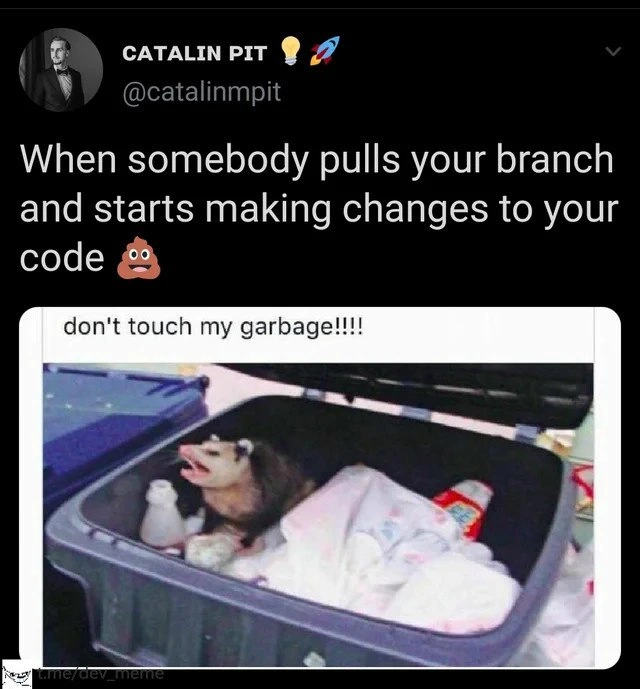
When a teammate brazenly git pulls your feature branch and starts committing changes, it feels like a violation of your coding territory. In this meme, a tweet by Catalin Pit sets the stage: "When somebody pulls your branch and starts making changes to your code 💩". Below it, we see a snarling possum in a trash bin with the caption "don't touch my garbage!!!!". The developer is being compared to that angry possum – fiercely defensive of their code, even if they half-jokingly call it "garbage."
Why do experienced devs chuckle? Because we've all been that possum at some point. It's a satire of code ownership and the unwritten branch etiquette in teams. Technically, pulling someone’s branch means using Git to fetch their code from the remote repository. It's something you'd normally do to review or test their work, not to start writing your own changes on it without permission. Skipping the usual Pull Request process and making unsolicited edits is a cardinal sin of collaboration. It's as if a colleague broke into your sandbox with zero warning. The humor comes from that visceral, absurd overreaction we feel inside: "How dare they tweak my imperfect but sacred code!" – a thought many developers have had, even if they won't admit it at stand-up.
This scenario highlights a classic CodeReview pain point: personal attachment to code. Developers often refer to their half-baked solutions as "trash" in a self-deprecating way, but heaven forbid someone else agrees or tries to "fix" it. It's the "I can call my code crap, but you can't" phenomenon. The possum image nails this possessiveness. Your code may be a tangle of hacks and TODOs (treasured trash), but it's your tangle, and you’ll hiss at anyone who pokes it. There's truth in this exaggeration about developer defensiveness – we invest time and creativity into a solution, so we react emotionally when someone hijacks it without asking, even if they meant well.
From an engineering perspective, directly editing a teammate’s branch without discussion is a recipe for chaos. Consider what might happen:
- Merge conflicts: Two people editing the same code on one branch will almost certainly step on each other's toes. When it's time to merge to
main(or integrate each other's work), Git will throw conflict markers like little red flags. It's like two authors trying to edit the same paragraph in a book simultaneously – not pretty. - Lost context: The original author has context for why the code is the way it is (yes, even the "garbage" has a purpose). A drive-by contributor might unknowingly remove a crucial workaround or assumption. I've seen well-meaning coworkers
improvebreak code by not realizing how fragile that "trash" really was. - Bruised egos: Let’s be real, pride is involved. Discovering someone modified your branch can feel like a sneak attack. Instead of a polite suggestion or a code review comment like, "Maybe we could refactor this part," they just went in and changed it. It can come off as disrespectful: "Was my code so bad you couldn't even discuss it with me first?"
The meme’s popularity shows how common these feelings are. It riffs on branch protection culture in a jokey way. On platforms like GitHub, we literally have protected branches (like main) to prevent unauthorized pushes. But on a personal feature branch, the "protection" is supposed to be basic courtesy. When a teammate ignores that courtesy – voilà, unsolicited code changes and a grumpy code-possum emerges. It highlights a gap between how version control works technically (anyone with access can fetch any branch) and how we manage teamwork socially (clear communication and boundaries).
Interestingly, older version control systems (like SVN) had file locking, which forced everyone to take turns editing. In modern Git workflows, we favor parallel work on branches and trust our teammates to coordinate. This meme humorously shows what happens when that trust breaks down. It's exaggerated, of course – most devs won't literally slam their laptop lid like a trash can and start hissing. But emotionally, it’s not far off. We're laughing at ourselves for getting that protective over code.
The tweet+image format delivers a truth wrapped in humor: even in a team where "our code" is the mantra, touch someone’s branch without warning and you might trigger their inner possum. One developer’s trash is that same developer’s treasure – at least until they refactor it themselves next week (but that’s different, of course). So if you ever feel the urge to clean up a teammate's "garbage" code without asking... be prepared for some snarls in return.
Description
The image is a screenshot of a tweet from the account “CATALIN PIT 💡🚀 @catalinmpit” on a black Twitter UI. The tweet text, shown in large white font, reads: “When somebody pulls your branch and starts making changes to your code 💩”. Under the tweet is a reaction meme: a smaller post that says “don’t touch my garbage!!!!” above a photo of a snarling possum sitting inside a garbage bin surrounded by plastic bags and trash. The juxtaposition humorously equates a protective developer’s reaction to code ownership with the possum defending its trash. Technically, it references Git branching etiquette, code review boundaries, and the emotional friction that arises when teammates modify someone else’s work without coordination
Comments
6Comment deleted
Push to my branch without asking and you don’t just inherit my code - you inherit the angry possum guarding the 600-line regex, the 45-minute CI pipeline, and the git blame that never forgets
After 15 years in the industry, you learn that the only thing worse than someone criticizing your code is someone actually trying to improve it - because now you have to explain why that seemingly nonsensical workaround from 2019 is actually load-bearing technical debt that three microservices depend on
Every senior engineer knows that moment when someone force-pushes to your feature branch without a heads-up - suddenly you're debugging merge conflicts in code you wrote three days ago, except now it's been 'improved' with nested ternaries and a mysterious global variable. Sure, your original implementation might have been held together with duct tape and prayer, but at least *you* knew where all the bodies were buried. Now you're archaeology-ing through git blame trying to figure out why the CI pipeline is red and who decided that refactoring the entire authentication layer was a reasonable side quest for a 'fix typo in README' commit
Senior dev branches: sacred dumpsters where you commit every WIP sin, then opossum-hiss at rebases - 'touch my trash, face my merge conflict wrath.'
Yes, it’s garbage - and it’s tuned. Touch my branch and Git rewrites history, the GC goes stop-the-world, and our SLA graphs become abstract expressionism
Drive‑by pushes to my feature branch make me go full CODEOWNERS - open a PR or I’ll curate your history with git push --force-with-lease