Skip to content
DevMeme
6629 of 7435
IMDb Error Page Accidentally Quotes Jurassic Park About Engineers
Bugs Post #7263, on Oct 13, 2025 in TG

IMDb Error Page Accidentally Quotes Jurassic Park About Engineers

Why is this Bugs meme funny?

Level 1: When Things Break

Imagine you’re at a big theme park and you get on your favorite ride. Halfway through, the ride suddenly stops. Uh oh! Everyone is safe, but the ride isn’t moving. Usually, you’d be worried or annoyed. Now, instead of just silence or a boring apology, a funny voice on the loudspeaker says, “God help us; we’re in the hands of the mechanics!” Basically, it’s joking that the people who need to fix the ride (the mechanics, who are like the engineers of the ride) are the only ones who can help now – and it says “God help us” as a playful dramatic touch. You might chuckle a bit, right? It lightens the mood even though the ride is broken.

That’s exactly what happened on this website. IMDb (which is like a giant library of movie information online) had something go wrong – kind of like the ride stopping. Instead of the page you wanted, you see a message telling you something broke. But they added a joke: a quote from a dinosaur movie (Jurassic Park) saying “God help us; we’re in the hands of engineers.” Engineers are the people who built and run the website, just like mechanics are the people who keep a ride working. The message is a fun way of saying “Oops! Our tech isn’t working right now, and our tech team is fixing it (fingers crossed!).” It’s funny because normally we trust engineers to fix things, but the quote jokes that being in their hands is a little scary. It’s like the site is teasing its own builders, kind of how a cartoon might tease its inventor when an invention malfunctions. In simple terms: the website broke, and it showed a silly movie line to make you smile while the real-life engineers worked to get things running again.

Level 2: Outages & Easter Eggs

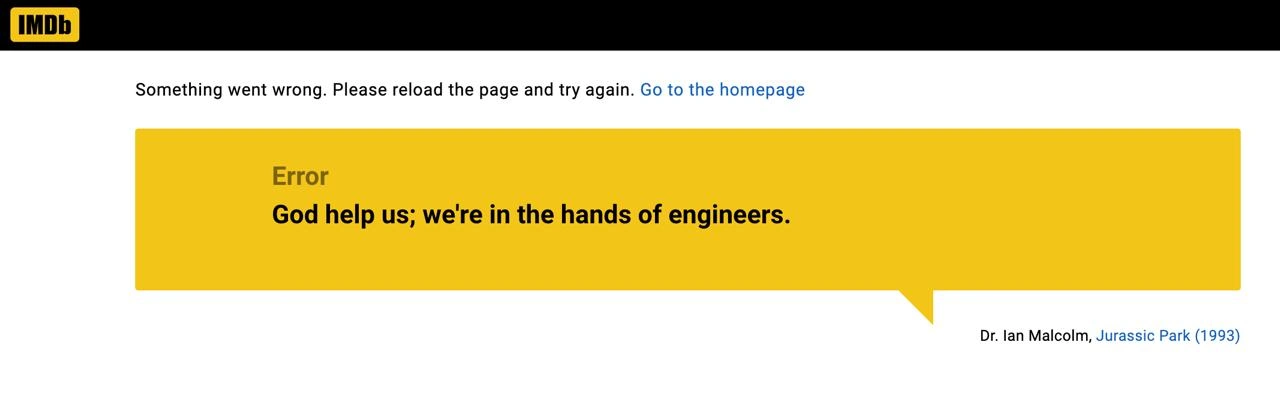
When a website like IMDb breaks or encounters a problem, it shows an error page to users. An “outage” or production incident means something went wrong on the server or in the application – often due to a bug (an error in the code) or an unexpected condition. Instead of showing users a confusing code or a blank screen, websites usually display a friendly message like “Something went wrong. Please reload the page and try again.” This is part of good UX/UI design: inform the user that a problem occurred and guide them (for example, suggest they reload or go back to the homepage). In this case, IMDb’s error page has a normal header and a clean white background, consistent with their site’s style. The surprising part is the big yellow speech bubble with a quote in it. That quote – “God help us; we’re in the hands of engineers.” – is actually a line from the movie Jurassic Park (1993). Specifically, it’s said by the character Dr. Ian Malcolm, who was observing the park’s technology failing. By including this, IMDb turned a bland error notice into a little Easter egg for users to discover. (In software, an Easter egg is a hidden message or joke tucked into the product for fun.)

So what does the quote mean in context? In Jurassic Park, things go terribly wrong largely because the park’s systems (designed by engineers) malfunction. Ian Malcolm’s line “God help us; we’re in the hands of engineers” was a witty way of saying, “Uh oh, the people who built this might not have full control over it.” In that scene it’s a bit of dark humor—he’s implying that the situation is dire if all they have is the engineers’ assurances. Now, on IMDb’s site, using this quote is a funny form of OnCall humor or Developer humor. It’s like the site is jokingly admitting, “Oops, something broke on our end… and now our engineers have to fix it (so cross your fingers!).” The engineers are the folks who write and maintain the website’s code. At a big company, engineers also take turns being on-call. Being “on-call” means that if an alert or emergency happens (like the site crashing in the middle of the night), one of the engineers is designated to jump in and fix it ASAP. It’s a lot of responsibility – imagine getting woken up at 3 AM because thousands of people can’t access the site, and it’s your job to resolve the issue quickly. That on-call engineer, upon seeing this error page, might chuckle and groan at the same time. The site itself is essentially saying, “we’re depending on the engineers now,” which is exactly what happens during an outage.

From a junior developer perspective, there are some key takeaways here. First, error messages don’t have to be dry. This one is actually a bit of industry satire – it lightly pokes fun at the situation and the people responsible for fixing it. It’s what we’d call a quote-based error message, using a pop culture reference instead of a generic “Error 500” text. Many tech companies do fun things with their error pages. For example, the classic “404 Not Found” pages on some sites have funny images or puns (GitHub has a page with a Mona Lisa octocat, and older versions of Windows had quirky messages in BSOD Easter eggs, etc.). The idea is to make an annoying situation (not getting the content you wanted) a bit more pleasant or shareable. In IMDb’s case, referencing a famous movie line is very on-brand (since IMDb is all about movies).

Let’s break down the elements to make sure everything is clear:

  • IMDb: A popular online database for movies, TV shows, and celebrities. It’s where you go to find info about that actor you recognize or to read movie trivia. It’s owned by Amazon and is a pretty high-traffic site. Even big sites have issues sometimes – no system is perfect.
  • Error Page: The content shown when the site can’t load normally. Instead of the movie info or whatever you were trying to see, you get this fallback page. It usually has a polite apology or instruction. Here it says, “Something went wrong. Please reload… Go to the homepage.” That’s standard wording to gently tell users “hey, it’s not you, it’s us; try again later.”
  • The Quote: “God help us; we’re in the hands of engineers.” This is not a typical error message! It’s an example of an error_page_easter_egg – a hidden joke for those who notice. The quote is from Dr. Ian Malcolm in Jurassic Park. He’s basically a mathematician who was skeptical of the park’s safety. When he says that line in the movie, it’s after seeing the park’s control systems fail one by one. So he’s cheekily implying that the park’s creators (engineers and scientists) might have designed something they can’t fully control. By placing this quote on the error page, IMDb is humorously implying “our site’s gotten away from us, even we (the engineers) lost control for a moment.”
  • Blaming Engineers (jokingly): Usually, companies don’t openly blame their staff on public pages! That’s what makes this funny. It’s self-deprecating humor. The people who wrote the site’s code (the engineers) likely are the same folks who decided to include that line on errors. It shows a bit of humility and the ability to laugh at themselves. Basically, they’re acknowledging that mistakes happen. A junior dev might worry, “Oh no, if something I code breaks, will I be blamed?” In modern teams, the approach is to fix the problem first and not single out individuals – because bugs are inevitable and usually a team responsibility. This error message is a very tongue-in-cheek way to say “yeah, we messed up, whoops.”
  • User Experience (UX): From a user’s point of view, seeing a famous quote (especially one as sardonic as this) might actually make them less frustrated. They might think, “Ha, that’s clever,” instead of just being angry that the page didn’t load. It turns a negative moment into something a bit more positive or at least memorable. That said, if the site stayed down too long, no witty quote will save you from user frustration. But for a quick glitch, it’s a nice touch.

So overall, this meme/image is highlighting a clever way a dev team handled an error. It’s Developer humor meets UX design. The engineers prepared this little joke in advance, and it auto-appeared when a bug or crash occurred. For new developers, it’s a lesson that even error handling can have some creativity. And for users, it’s a reminder that behind every website are human engineers – who sometimes have a sense of humor, and sometimes need a bit of divine help when things break!

Level 3: Spared No Expense (Except Testing)

This error page is a masterstroke of Industry Satire and OnCallHumor. The site is down, and instead of a bland apology, IMDb serves up a famous Jurassic Park quote that blames the engineers. It’s as if the system itself is saying, “We spared no expense building this park… except maybe on QA testing.” The humor lands because experienced devs have lived this story: a production bug hatches unexpectedly, much like a rogue dinosaur, and suddenly everyone is scrambling. The quote “God help us; we’re in the hands of engineers” is attributed to Dr. Ian Malcolm (Jeff Goldblum’s character) – the snarky chaos theorist who watched Jurassic Park’s high-tech security system crumble. In the film, that line was a sly dig at the folks who built the park, suggesting they didn’t have things as under control as they thought. Sound familiar? In real life outages, no matter how many DevOps tools or deployment pipelines we have, there comes a moment in a crisis where all eyes turn to the on-call team and we think, “Welp, it’s up to them now.” This meme nails that feeling.

From a senior developer perspective, several layers of satire are bubbling here. First, it’s a quote-based error message – a deliberate Easter egg likely planted by some IMDb engineer with a sense of humor (and a love of 90s movie lines). It turns a frustrating user experience into a chuckle-worthy moment. It’s also a bit of a self-own: the development team essentially preemptively poked fun at themselves for when a ProductionIncident happens. It’s the kind of dry wit a battle-hardened on-call veteran might add late at night: “If this ever goes belly-up, let’s at least get a laugh.” Notably, the message throws shade while remaining family-friendly and on-brand – a quote from a popular movie in IMDb’s database. It's a clever error_page_easter_egg that transforms a boring error box into something shareable. In fact, that’s probably how this image became a meme: some user encountered the outage, saw the Jurassic Park reference, and appreciated the meta-joke enough to screenshot it.

The scenario depicted is all too real in the tech world. A critical service crashes, and the on-call engineer gets the dreaded page at 2 AM (because of course it’s at 2 AM). While the engineer is frantically reviving servers or chasing a mysterious bug, the end-users see this friendly “Something went wrong. Please reload…” banner. The kicker is the bold text: “God help us; we’re in the hands of engineers.” It’s a simultaneously comforting and panic-inducing thought. Comforting, perhaps, to a user because at least someone (the engineers) is presumably working on it. Panic-inducing to the engineer because even the website is praying for them. OnCall_ProductionIssues often feel exactly like this – you become the last line of defense between a fix and total chaos. No pressure, right? The meme resonates with developers who have lived through deploy disasters and midnight rollbacks, because it slyly acknowledges the underlying truth: software is written by humans, and humans are fallible. No matter how much we automate or how many tests we write, there will be bugs that slip through and cause public-facing BugsInSoftware like this one. And when it happens, it sure feels like “God help us” might be the appropriate reaction.

There’s also an inside-joke about blame. Modern tech culture preaches blameless post-mortems – when something breaks, you focus on fixing and learning, not on naming, shaming, and blaming an individual. Yet here we have the site cheekily blaming engineers collectively. It’s done in jest, but it taps into that imposter syndrome many devs have: “If things go wrong, everyone’s going to think it’s my fault.” Dr. Ian Malcolm’s quip implies the engineers might not have everything under control (and in Jurassic Park, they sure didn’t – one rogue programmer and a can of shaving cream took the whole park down). Seasoned developers recognize this as a gentle roast. We’ve all heard the phrase “It’s always DNS” or “It’s always the engineer’s fault” when diagnosing issues. Here, IMDb’s error page just comes out and says it with a cinematic flair.

From a UX/UI standpoint, this approach is risky but memorable. Instead of a sterile code or an obscure error number, the page gives a clear “Something went wrong” plus a famous quote to humanize the moment. It almost gamifies the failure – users might think, “Ha! Nice Jurassic Park reference,” and be slightly less angry that the page they wanted isn’t available. Companies like Twitter did something similar with the Fail Whale (an illustration shown during Twitter outages) – acknowledging failure in a cutesy way. IMDb opted for a movie quote (fitting for a film database). It’s a nod to their more savvy users and an attempt to turn a bad situation into a shareable laugh. Of course, the irony isn’t lost on devs: someone had time to implement this snarky ErrorMessage instead of, say, building a feature to prevent the error in the first place. 😏 But hey, when you’re deploying on Friday and the ProductionBugs strike, at least the users will be entertained while you frantically roll back that release. In the end, the meme gets a knowing laugh from the tech community because it captures a universal truth of our field: systems fail, and when they do, we pray our engineers (maybe with a bit of divine help) can put the dinosaurs back in the cage.

Level 4: Chaos Finds a Way

In the Jurassic world of complex systems, Dr. Ian Malcolm’s warning about chaos rings eerily true for modern web infrastructure. Jurassic Park wasn’t just a zoo of dinosaurs; it was a chaotic network of systems – much like a contemporary microservices architecture. The quote on IMDb’s error page (“God help us; we’re in the hands of engineers.”) is a tongue-in-cheek nod to chaos theory and unpredictability in engineered systems. In chaos theory (Malcolm’s specialty), tiny changes in initial conditions can lead to wildly unpredictable outcomes – just as a small bug in software (maybe a misconfigured server or one unchecked null pointer) can cascade into a full-blown production incident. Modern Site Reliability Engineering even embraces this with Chaos Engineering: tools like Netflix’s Chaos Monkey randomly kill services to ensure the overall system survives unexpected failures. It’s as if the IT team intentionally released a velociraptor in the data center to test the electric fences. When IMDb’s site went down, the system fell back to this movie-quote error message, acknowledging the unpredictable nature of complex platforms. Under the hood, there might have been a cascade – one service failing, causing timeouts downstream, eventually triggering the generic “Something went wrong” page. The irony is rich: after all our load balancers, auto-retries, and fail-safes, sometimes production still feels like a prehistoric wilderness where chaos finds a way. The quote slyly suggests that once things go off the rails, we’re left praying the engineers (our modern park rangers) can wrestle the system back under control. This wink to chaos theory doubles as an admission: even in high-tech environments, a dash of entropy can bring everyone back to the stone age (or the age of dinosaurs). It’s a playful acknowledgment of a fundamental truth in computing – complex systems are inherently unpredictable, and when they falter, God help us, indeed, we’re in human hands again.

Description

A screenshot of an IMDb error page showing 'Something went wrong. Please reload the page and try again.' with a link to 'Go to the homepage'. Below is a yellow speech bubble containing 'Error' in gold text and the quote 'God help us; we're in the hands of engineers.' attributed to Dr. Ian Malcolm from Jurassic Park (1993). The irony is that the error page itself is the result of those same engineers failing, making the quote a perfectly self-aware error message

Comments

7
Anonymous ★ Top Pick When your error page roasts your entire engineering team harder than any post-mortem ever could
  1. Anonymous ★ Top Pick

    When your error page roasts your entire engineering team harder than any post-mortem ever could

  2. Anonymous

    Nothing like a production 500 that doubles as a code review - apparently our retry logic now includes existential dread

  3. Anonymous

    The perfect error page for when your microservices architecture has evolved into a distributed system of velociraptors - each one testing the fences for weaknesses while your SRE team frantically types 'docker restart' faster than Newman saying 'ah ah ah, you didn't say the magic word.'

  4. Anonymous

    IMDb's error page perfectly captures the existential dread of production incidents: when your monitoring alerts fire at 3 AM and you realize the system is indeed in the hands of engineers - specifically, the ones who thought 'it works on my machine' was an acceptable deployment strategy. At least they're self-aware enough to quote Jurassic Park, because like dinosaurs breaking containment, production bugs always find a way

  5. Anonymous

    Chaos theory confirmed: engineers deploy butterflies, users get hurricanes

  6. Anonymous

    When your error page quotes Jurassic Park, you’ve crossed from graceful degradation into chaos theory - the error budget’s gone and marketing owns the incident comms

  7. Anonymous

    If the error page is quoting Jurassic Park, it’s already SEV‑1 - our error budget’s extinct and an SRE is whispering, “life, uh… finds a rollback.”

Use J and K for navigation