Skip to content
DevMeme
3807 of 7435
Networking Protocols and Consent: UDP vs. TCP
Networking Post #4149, on Feb 1, 2022 in TG

Networking Protocols and Consent: UDP vs. TCP

Why is this Networking meme funny?

Level 1: Permission vs Surprise

Imagine you have a funny picture and you want to show it to a friend. In one case, you just shove the picture in front of them out of nowhere – they didn’t ask for it, and they might be shocked or not even pay attention. That’s like the first scenario: one person sends something without permission. In the other case, you tap your friend on the shoulder first and say, “Hey, can I show you this picture?” and your friend says, “Sure!” Then you show it, your friend smiles and says “Ha, that’s nice!”, and you say “Thanks!” and put the picture away. This second way is all about asking first and making sure the other person is okay with it. It’s much more polite and both people end up happy. The meme is funny because it compares these two ways of sharing – one rude and one polite – using the language of computer messaging. It’s basically saying good communication is like asking permission, and bad communication is like an unwanted surprise. Even if you don’t get all the tech specifics, you can laugh because it’s obvious you should always ask before surprising someone with something personal!

Level 2: Datagram vs Dialogue

Let’s simplify what’s going on. UDP and TCP are two fundamental ways (protocols) that computers send messages over a network, but they work very differently:

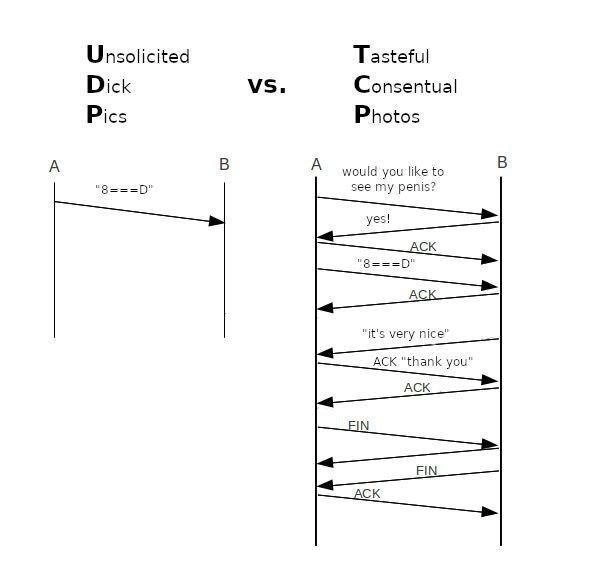
  • UDP (User Datagram Protocol): Think of this as just throwing a message at someone. It sends a single datagram (a small packet of data) from sender to receiver with no questions asked. There’s no setup beforehand and no built-in confirmation that the message got there. In the left diagram, A just sends the 8===D message to B and that’s the end of it. Notice B doesn’t send anything back in that picture – that’s normal for UDP. It’s often described as connectionless, meaning A doesn’t even establish a connection to B; it just launches the data into the network. UDP is super fast and simple for things like video streaming or online games where you prefer speed and can tolerate some lost packets. But it’s a bit like dropping a letter in the mail without tracking – you hope it arrives, but you never know for sure unless the other side specifically tells you later.

  • TCP (Transmission Control Protocol): Now this is more like having a polite conversation or making a phone call. Before sending any real data, the two sides connect and agree to talk – this is the handshake. In the right diagram, notice how A and B exchange multiple messages before and after the actual photo (8===D) is sent. A asks for permission ("would you like to see my penis?"), B agrees ("yes!"), and only then does A send the photo. After sending, B says “ACK” which is short for acknowledgment (meaning “okay, I got it”). B even comments on it ("it’s very nice"), and A responds back with an ACK and a "thank you." Finally, they both formally end the conversation with those FIN messages (FIN stands for “finish”) and a final ACK to confirm the end. All of this setup and confirmation is exactly how TCP operates: it is connection-oriented, meaning it establishes a connection first, and it’s designed to be reliable – every piece of data sent is acknowledged. If something goes missing, TCP can tell (because it won’t get an ACK) and resend that piece. It’s like sending a certified letter or having a phone conversation: you get feedback at each step that the other person is hearing you. This makes TCP a bit slower than UDP (due to the extra messages), but very trustworthy for things like loading webpages, sending emails, or downloading files where you absolutely need everything to arrive intact (and in order!).

Now, look at how the meme’s two panels reflect those differences:

  • In the UDP panel (left side), A and B don’t exchange any pleasantries. A just sends the ASCII art picture 8===D without any prior discussion. It’s one-way. B’s reaction isn’t shown (maybe B never asked for it or never got it). This matches UDP’s “send and forget” style. In real networking with UDP, B might not even be listening, in which case the packet is just lost. And A wouldn’t know – in the same way someone sending an unsolicited pic doesn’t know if it was seen or simply deleted. The meme cheekily labels UDP as "Unsolicited Dick Pics" to emphasize that lack of consent or setup.

  • In the TCP panel (right side), there’s a whole conversation. This is like a formal request-response exchange. A only sends the actual picture after getting a clear yes from B. Every message is acknowledged (ACK) so we know it’s received. They even exchange polite comments (which stand in for data going back and forth). And at the end, both A and B explicitly close the conversation with FIN signals and an ACK. This is exactly what happens with a TCP connection: first a three-way handshake (SYN, SYN-ACK, ACK – here represented by the "would you like...?" and "yes!"), then the data transfer with acknowledgments, and finally a connection teardown with FIN packets which is like a goodbye handshake. The meme labels TCP as "Tasteful Consensual Photos," highlighting that everything was agreed upon and properly exchanged.

You might have noticed the funky text 8===D appearing as the message content. That’s not random – it’s actually a little piece of ASCII art (using keyboard characters to draw a picture). Here, 8===D is a crude depiction of a penis (8 for the head, === for the shaft, and D as the end). This is the “photo” being sent in the joke. It’s intentionally silly and immature-looking, which makes the whole serious networking diagram even funnier. ASCII art like this often pops up in internet jokes, and developers immediately recognize what that string represents. So A is effectively sending a “dick pic” in text form.

To put it plainly, the meme is comparing sending something without permission vs. sending it with permission using geeky network terms. UDP’s lack of a handshake is like just shoving a photo at someone (they might not want it, and you won’t know what happened to it). TCP’s lengthy handshaking is like politely asking first, getting a yes, then sharing the photo, and even saying "thank you" afterward – making sure both sides are okay throughout. It’s a great analogy because it shows why TCP is considered polite and reliable: both sides talked to each other the whole time.

We can summarize the differences as follows:

Feature UDP (No Handshake) TCP (Handshake)
Connection Setup None. Send immediately (no "hello"). Yes. Three-way handshake before sending data.
Confirmation of Data None. Sender doesn’t know if it arrived. Yes. Every important packet is acknowledged (ACK).
Message Order Not guaranteed (may arrive out of order or not at all). Guaranteed (arrives in order, or it’s retransmitted if lost).
Overhead & Speed Low overhead, very fast (no waiting). More overhead, slightly slower due to handshakes and acknowledgments.
Use Cases Live video, online games, DNS lookups (okay if a few packets are lost). Web pages, file transfers, emails (need all data reliably).
Meme Analogy Unsolicited Dick Pic – A sends 8===D without asking; B doesn’t respond (no feedback). Tasteful Consensual Photo – A asks, B consents; A sends 8===D, B says "it’s very nice" with ACKs; then both say goodbye with FIN/ACK.

In the table, “no handshake” means UDP doesn’t set up a dedicated connection, and “handshake” means TCP goes through the connect-acknowledge steps first. ACK stands for acknowledgment, and FIN is a finish signal used to close connections.

So basically, a junior developer should take away that UDP is like a quick shout – you just send data out, no guarantee of response – whereas TCP is like a structured conversation, where you introduce yourself, make sure the other party is ready, exchange information reliably, and then end the conversation politely. The meme just uses a funny (if a bit crass) scenario to illustrate that contrast in a memorable way!

Level 3: Fire-and-Forget vs Formality

Any seasoned developer or network engineer will immediately smirk at this meme, because it personifies the essence of UDP vs TCP in such a cheekily accurate way. The humor arises from mapping dry technical behaviors to an all-too-familiar social scenario. Let’s break down why this combination is so spot-on (and hilarious):

Acronym Alchemy: First off, the meme-maker performs some brilliant acronym jujutsu. UDP typically expands to User Datagram Protocol, but here it’s reinterpreted as Unsolicited Dick Pics. Likewise, TCP normally means Transmission Control Protocol, reinvented as Tasteful Consensual Photos. This isn’t just random; it’s very intentional wordplay. By choosing phrases with the same initials, the meme explicitly tags each diagram “UDP” and “TCP” in a memorable way. Devs love this kind of wordplay – it’s like an inside joke. The moment you read “Unsolicited Dick Pics vs. Tasteful Consensual Photos,” you know it’s going to be a networking joke with a spicy twist. It sets the stage for comparing a crude one-way surprise with a polite negotiated exchange, mirroring the protocols perfectly.

Visual Metaphor & Contrast: The side-by-side sequence diagrams drive the joke home. On the left, representing UDP, the interaction couldn’t be any simpler: A → B with 8===D and done. One arrow, no response. It screams “no coordination, no permission” – exactly what unsolicited implies. In real life, an unsolicited explicit pic is usually just dumped on the recipient without warning or agreement, much like a UDP packet is dumped on a destination without a handshake. If you’ve ever debugged networking or built a system using UDP, you know this feeling: you fire off a packet and just assume it arrived (and often joke that UDP stands for “Unreliable Data Protocol” because who really knows if it got there?). The meme basically says: A didn’t even wait to hear from B, he just yeeted the image out there. Technically and comically, that’s UDP in a nutshell — a one-way datagram with a hope and a prayer, and no follow-up.

Contrast that with the right side: the TCP exchange is drawn out like an overly courteous conversation. There’s a multi-step back-and-forth:

  • A politely inquires “would you like to see my penis?” (setting up the scenario, much as TCP sets up a connection).
  • B actually responds “yes!” (giving explicit consent, akin to agreeing to the connection).
  • Only then does A send the actual 8===D photo (now it’s welcome, just as TCP only sends data after the handshake).
  • B replies with an ACK, confirming receipt (like saying "got it, thanks"), and even follows up with a kind comment “it’s very nice”.
  • A then ACKs that and says “thank you” in return.
  • Finally, they exchange FIN messages (essentially both saying "Alright, we’re done here, goodbye") with a closing ACK.

For anyone who knows TCP, this sequence is a spot-on parody of the protocol’s etiquette: the famous three-way handshake to start, acknowledgments for every message, and a graceful termination. It’s exaggeration through formality — TCP is depicted as almost absurdly polite in this humanized form. Senior devs find this hilarious because we often joke that TCP is like making a phone call or a formal request, whereas UDP is like shouting and hanging up. Here that abstract joke is brought to life in a PG-13 scenario! By the time you see the multiple "ACK" lines and the final FIN/ACK exchange accompanied by pleasantries, you can’t help but laugh at how true it is: TCP won’t even end a connection without a courteous farewell.

Shared Pain & Context: This meme also lands because it taps into two very relatable experiences:

  1. Tech Relatability: Pretty much anyone who’s dealt with network programming or troubleshooting knows the difference between UDP and TCP. We’ve heard the classic “I’d tell you a UDP joke, but you might not get it,” and we’ve dealt with TCP’s chatty handshakes. So the groundwork is there – the community already finds the unreliability vs. reliability contrast amusing. Here it’s just framed in an outrageous way that’s hard to forget. Seeing ACK "thank you" and dual FIN arrows in a meme about personal photos is so out-of-place it’s brilliant. It’s taking something mundane (protocol diagrams) and injecting just enough irreverence (ASCII genital art and flirty dialogue) to catch us off-guard. That element of surprise – mixing layers of formality with crudeness – is comedy gold for the tech crowd.
  2. Social Relatability: On the flip side, the scenario of unsolicited naughty pictures is a known cultural phenomenon, especially in the age of DMs and dating apps. It’s widely considered bad behavior to send such images without consent. So when devs see “UDP = Unsolicited Pics,” it’s instantly clear what behavior is being lampooned. And “TCP = Tasteful Consensual Photos” humorously depicts the proper way – ask first, get a yes, then send, and even exchange compliments after. It’s basically sketching out digital consent etiquette but with network jargon. This dual relatability (tech and social) means even if you’re not a networking guru, as long as you know the basics that UDP doesn’t require a response and TCP does, the joke lands. And if you happen to have ever received or heard complaints about random indecent images, it lands even harder. You find yourself nodding: “Yup, UDP is the rude way and TCP is the right way.”

Attention to Detail: Seasoned engineers appreciate the little details the meme gets right. It’s not just the broad concept; the specifics are on point. The ACK after sending the photo? Check – TCP does that. The inclusion of a final ACK after FIN? Yep – that’s the complete connection teardown. Even the way the text is laid out – with A and B as lifelines – mimics real documentation. It shows the creator deeply knows the subject. That accuracy elevates the humor because it’s not just a superficial joke, it’s one that insiders can see was made by one of their own. It’s as if the meme is saying, “We all know how ridiculously elaborate TCP can be, so let’s have a laugh about it by comparing it to an overly polite exchange.” Meanwhile, UDP’s single arrow with no return drives home how “empty” that interaction feels, much like the silence you get after a UDP packet if you’re expecting a reply (spoiler: there is none).

Why It's Hilariously True: In the real world of computing, if you send a UDP packet and the other side isn’t listening (or the packet gets dropped by the network), you literally get no response – it vanishes into the ether. Many of us have probably sat there debugging, thinking “Hello... did it arrive? Anybody?” Similarly, an unsolicited photo sent to someone’s inbox might get no reaction (best case) or a very negative reaction (worst case), but the sender often has no idea if it was seen or welcomed. Conversely, TCP’s style is to make sure both sides are ready and willing. Data exchange in TCP is like a well-rehearsed dance: each step is acknowledged, and either side can say “Stop” if something’s wrong. It’s reliable partly because it’s consensual – just as any respectful interaction should be. So the meme isn’t just arbitrarily mixing tech and an off-color topic; it’s highlighting an underlying analogy: good communication (whether between computers or humans) is a two-way street with agreement, whereas blasting out information without agreement can lead to awkward or lost outcomes.

In summary, from a seasoned dev perspective, this meme is funny on multiple levels:

  • It captures the defining traits of UDP and TCP in a single, ridiculous scenario.
  • It uses sarcasm and tech humor to poke fun at both networking protocols and social faux pas.
  • It’s instantly recognizable: we see that little 8===D in a diagram and know some boundary is being pushed; then we see ACK/FIN and realize it’s also nerdy – that contrast is chef’s kiss for an internet joke.
  • And admit it, after seeing this, you might jokingly think of UDP whenever you hear about someone oversharing, and vice versa. It’s a meme that educates as it entertains.

Within dev circles, we often find ourselves saying things like “That code drop was basically UDP – it went out and nobody knows what happened” or “Let’s TCP this situation, make sure everyone’s on board first.” This meme just gives us a more… vivid mental image for those analogies. It’s the kind of humor that makes you laugh, then immediately want to show your co-workers (assuming they’re cool with a bit of NSFW networking wisdom). If you’ve ever had to explain the difference between UDP and TCP to someone new, you might even grin and think, “Well, here’s the unofficial explanation: don’t be UDP, always be TCP when it comes to sending pics!”

Level 4: Etiquette at OSI Layer 4

At the deepest technical level, this meme is all about contrasting how two transport-layer protocols handle communication. UDP (User Datagram Protocol) is a connectionless protocol, meaning it doesn’t establish a session or perform a handshake with the receiver before sending data. It’s essentially a fire-and-forget approach: send one packet out and move on, with no built-in guarantee the other side is even listening or that the packet will arrive intact. This is perfectly depicted on the left diagram: node A sends one slanted arrow carrying 8===D (an ASCII representation of a certain object) to node B, and then... nothing. No reply, no follow-up, just a single datagram shot across the void. In networking terms, A has no idea if B received that packet – there’s no acknowledgment, no feedback loop in UDP by default. It mirrors an unsolicited, one-sided communication: A just blasts the message out. If B wasn’t prepared or willing (like an application not listening on that port), the packet is simply discarded (akin to someone deleting an unwanted image). UDP’s simplicity means minimal overhead (no setup or teardown), but also no built-in reliability or consent mechanism. There is no handshake here – A doesn’t ask “Are you ready?” and B doesn’t say “Okay, send it.”

On the right, we see a much longer exchange labeled as TCP (Transmission Control Protocol) – a connection-oriented protocol. TCP requires a three-way handshake to establish a connection before any real data flows. In actual TCP, this involves a SYN (synchronize) packet from A, a SYN+ACK (synchronize-acknowledge) from B, and an ACK from A – only after this handshake do we say the connection is "established." The diagram cleverly substitutes this with a polite conversation: A asks "would you like to see my penis?" which is analogous to sending a SYN request to initiate contact. B replies "yes!", functioning like a SYN+ACK – B is both acknowledging A’s request and agreeing to proceed. If B had said “no” (or if there was no response), that would be equivalent to a failed handshake and no photo would be sent at all (no connection = no data transfer). But since B consents, the handshake completes. In a real TCP exchange, A would send the final ACK confirming the handshake; in the meme’s dialogue, we can assume A’s sending of the actual photo might implicitly serve as that final ACK (the meme simplifies a bit; in practice, the handshake ACK would be a separate small packet, often so quick you barely notice it before data starts flowing).

Once the “connection” is established, A sends the actual payload: the 8===D ASCII art, representing the photo in this metaphor. In TCP, every data segment that B receives must be acknowledged. Sure enough, the diagram shows B sending an ACK after the photo arrives – a little arrow from B to A labeled "ACK." That’s exactly how TCP’s reliability mechanism works: for each chunk of data, the receiver sends back an acknowledgment to inform the sender “Got it!” (if those ACKs don’t come, the sender will retransmit the data, but in this meme scenario, B clearly got the picture and even appreciated it!).

Then B sends a message back ("it’s very nice"), which in TCP terms is just data flowing in the opposite direction over the same connection (TCP connections are full-duplex, allowing both sides to send data). A, in turn, sends an ACK for that message along with "thank you." The diagram actually labels this arrow from A as ACK "thank you" – implying A’s acknowledgment of B’s comment and a polite response combined. In real TCP, acknowledgments can be piggybacked with outgoing data; here A’s “thank you” is like piggybacking a small bit of data on an ACK packet. We see another ACK from B confirming receipt of that “thank you.” This playful exchange of messages corresponds to the reliable back-and-forth data delivery that TCP provides. Every significant message is acknowledged, maintaining a tight protocol of confirmation so that nothing is lost or misunderstood.

Finally, the sequence concludes with a termination procedure. In TCP, ending a session is a careful process involving FIN (finish) flags: one side sends a FIN to signal “I’m done sending,” the other side ACKs it and typically sends a FIN of its own when it’s also done, followed by a final ACK from the first side. The right diagram shows exactly this: A sends a FIN, B responds with its own FIN (implicitly acknowledging A’s and indicating B is done too), and A replies with a final ACK. This is the graceful teardown of a TCP connection – comparable to politely saying “goodbye” at the end of a conversation. It prevents any data from being left hanging and frees up resources on both sides. In the context of the meme’s story, it’s like both A and B making sure to wrap up the exchange courteously, which humorously parallels TCP’s orderly wrap-up.

From a protocol design standpoint, the meme underscores why TCP is known as a reliable, ordered, and connection-oriented protocol: it mandates a negotiation (consent) before sending data, it ensures every piece of data is acknowledged (so nothing is accidentally missed), and it closes the session explicitly. UDP, on the other hand, is unreliable (no guaranteed delivery), unordered (no enforced sequence), and connectionless – it just emits packets without prior arrangement or formal conclusion. The trade-off is speed and simplicity vs. reliability and courtesy. TCP’s approach has more overhead (lots of extra packets for SYN, ACK, FIN, etc., which the diagram exaggerates in a funny way), but it provides delivery guarantees, similar to certified mail that requires a signature. UDP is more like dropping a postcard in the mail without expecting a reply – often fine for quick updates or data that’s okay to lose occasionally (like a video stream or a DNS query), but definitely not ideal for something important or, in the spirit of the meme, for something as sensitive as personal photos unless you’re okay with it possibly never reaching (or annoying) the recipient.

It’s also worth noting how the meme uses a sequence diagram format – a tool normally used to document protocol exchanges or object interactions – to juxtapose these two “conversations.” The left side’s stark simplicity (just one arrow) versus the right side’s verbose exchange is exactly how an engineer might sketch out UDP vs. TCP flows in a whiteboard discussion. Only here, the formal labels like SYN or “DATA” have been replaced with a tongue-in-cheek human dialogue. For seasoned network engineers, seeing familiar elements like ACK and FIN intermingled with phrases such as "would you like to see my penis?" is both hilarious and technically insightful. It draws a direct parallel between the consent in human interactions and the “consent” (handshake) in network connections. In fact, the concept of consent maps surprisingly well to the idea of a connection handshake – both involve an agreement to communicate. The meme essentially says: sending data without a handshake is like oversharing without permission.

In summary, at this in-depth level we appreciate how the meme encodes key protocol behaviors:

  • UDP: no handshake, no acknowledgments, one-way datagram, possible loss — analogous to an unsolicited, one-off send.
  • TCP: explicit negotiation (3-way handshake), bidirectional communication with continuous acknowledgments, and a formal shutdown (FIN/ACK sequence) — analogous to a mutually agreed, courteous exchange.

The humor works on this level because the creators nailed the technical accuracy: the TCP side truly reflects the nitty-gritty of reliable transport communication (just spiced up with a bawdy example), while the UDP side is comically lacking any handshake or feedback – exactly how UDP behaves. This alignment of network mechanics with social etiquette (or its breach) makes the meme resonate with anyone who understands how network protocols work under the hood.

Description

A two-panel diagram comparing the networking protocols UDP and TCP using a sexually explicit analogy. The image is on a plain white background with black text and lines. The left panel is titled 'Unsolicited Dick Pics,' with 'UDP' bolded, and shows a simple diagram where entity 'A' sends a single, unacknowledged message, '"8===D"', to entity 'B'. This represents the connectionless, 'fire-and-forget' nature of the User Datagram Protocol. The right panel is titled 'Tasteful Consensual Photos,' with 'TCP' bolded. It depicts a much more complex, multi-step sequence diagram where 'A' and 'B' engage in a full conversation, including asking for consent ('would you like to see my penis?'), receiving it ('yes!'), sending the message, and then exchanging multiple acknowledgements (ACK) and a final termination sequence (FIN). This humorously illustrates the connection-oriented nature of the Transmission Control Protocol, famous for its three-way handshake, guaranteed delivery, and formal connection teardown, by likening it to a polite and consensual interaction
Comments

13
Anonymous ★ Top Pick UDP is like shouting a joke into a crowd; you don't know who heard it and you definitely don't care. TCP is like telling a joke via certified mail, requiring a signature, a confirmation of the punchline landing, and a formal notice that the conversation is over
  1. Anonymous ★ Top Pick

    UDP is like shouting a joke into a crowd; you don't know who heard it and you definitely don't care. TCP is like telling a joke via certified mail, requiring a signature, a confirmation of the punchline landing, and a formal notice that the conversation is over

  2. Anonymous

    UDP is that engineer who drops the migration script straight into prod without warning; TCP is the senior who does the design review, collects ACKs, validates rollback, and finally sends a FIN - guess which one ends up starring in the post-mortem

  3. Anonymous

    The only time a senior architect appreciates an unsolicited packet dump is when debugging network issues, not in their DMs. At least TCP has the decency to establish a connection first and gracefully terminate when done - unlike that junior dev who force-pushes to main on Friday afternoon

  4. Anonymous

    UDP senders never know if the message landed - which, given the payload, is probably for the best

  5. Anonymous

    This brilliantly illustrates why TCP's three-way handshake exists: consent and acknowledgment aren't just good manners, they're fundamental protocol design. Unlike UDP's 'fire and forget' approach (the digital equivalent of unsolicited messages), TCP ensures both parties agree to communicate before data transmission begins. The real engineering wisdom here? Proper connection establishment prevents dropped packets AND awkward situations - though admittedly, most RFCs don't explicitly cover the latter use case

  6. Anonymous

    Unsolicited payloads: the networking sin that gets you RST faster than a bad merge

  7. Anonymous

    In human protocols, consent is the SYN/ACK - if you’re blasting UDP, expect Legal to start tcpdump

  8. Anonymous

    Consent is a transport-layer feature: no SYN/SYN-ACK/ACK, no payload - otherwise you’re just UDP-blasting a packet straight into the moral firewall

  9. @maraz99 4y

    From now on I'll send this to anyone who sends me UDP in chat

  10. dev_meme 4y

    weird flex

    1. @dsmagikswsa 4y

      But not ok

  11. @s2504s 4y

    I am UDP gun 😂

  12. @antibi0tic 4y

    Our backend supports both protocols.

Use J and K for navigation