Jeff Bezos's Media Acquisition Enlightenment
Why is this CorporateCulture meme funny?
Level 1: The One-Sided Story
Imagine you have a school newspaper and the richest kid in school buys that newspaper. Now he’s in charge of what stories get published. The next day, you read the school paper and it’s full of articles like, “Opinion: Rich Kids Shouldn’t Have to Do Homework” and “Opinion: It’s Great that Rich Kids Get Extra Recess – It Helps Everyone, Really.” And at the top of the paper it still says “Honest News for Everyone.” You’d probably giggle because it’s so obvious who’s behind those stories. Of course the kid who owns the newspaper is using it to say nice things about himself and people like him! It’s like if the referee of a game is also the captain of one team – every call is going to favor his own team. The meme is funny (and a bit exasperating) for the same reason: the person in charge of the news is essentially giving himself a big pat on the back in the news. Everyone can see it’s biased, and that’s why we smirk.
Level 2: Conflict of Interest 101
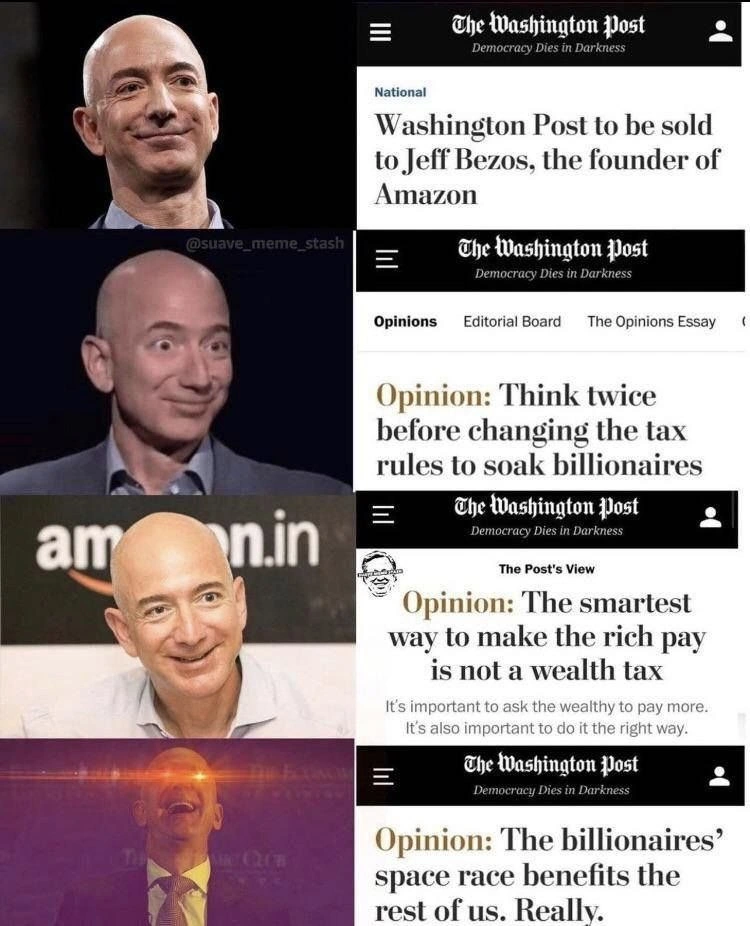
Let’s break down the key pieces for newer folks. The meme compares a series of Washington Post headlines to the fact that Jeff Bezos, the founder of Amazon (one of the biggest tech companies on Earth), also owns the Washington Post newspaper. The Washington Post’s official motto is “Democracy Dies in Darkness,” implying they shine light on truth. But as soon as Bezos bought the paper, we see it publishing multiple opinion articles that coincidentally argue in favor of billionaires like him.
Here are the headlines in the images:
- “Washington Post to be sold to Jeff Bezos, the founder of Amazon.” – This was real news in 2013: Bezos purchased the paper. It sets the stage: a tech billionaire now controls a major news outlet.
- “Opinion: Think twice before changing the tax rules to soak billionaires.” – Opinion means it’s an editorial or personal viewpoint piece, not straight news reporting. “Soak billionaires” is a casual way to say “tax the rich heavily.” This headline is cautioning against making billionaires pay much more tax. Convenient stance for a billionaire’s newspaper, right?
- “The Post’s View – Opinion: The smartest way to make the rich pay is not a wealth tax.” – “The Post’s View” indicates this is the editorial board’s official opinion. A wealth tax is a specific type of tax that would directly target the net worth of the super-rich. This piece is saying “sure, make the rich pay a bit more, but don’t do it by a wealth tax.” In plainer terms: let’s not hit billionaires too hard. Again, a very friendly position for billionaires.
- “Opinion: The billionaires’ space race benefits the rest of us. Really.” – This refers to the private space race where people like Jeff Bezos (with his company Blue Origin) and Elon Musk (SpaceX) were launching rockets. Many folks criticize this “billionaire space race” as just ego trips or wasteful. But here the Washington Post opinion author insists it actually benefits everyone, adding “Really.” as if to say “trust us on this.” Given Bezos is one of those space-racing billionaires, the paper is essentially defending one of his pet projects.
So all four items on the right are basically favorable to billionaire interests. And all four images on the left are just Jeff Bezos smiling in different ways — the meme maker blurred his face but you can tell it’s him, the bald tech mogul. The implication is that Bezos himself might as well be the one grinning and writing these opinions. It’s pointing out a conflict of interest: that means the person in charge has personal interests that could distort their judgment or objectivity. In an ideal world, a newspaper should hold powerful people accountable, but if a powerful person owns the newspaper, the paper might hold its punches or even cheerlead for him.
Now, how does this relate to tech and developers? Think of times in the tech industry where a big company or sponsor influences the narrative. For example: if a huge corporation sponsors an “open-source” project, they might push the project in a direction that benefits their products. Or consider tech news sites that rely on advertising from Big Tech companies – they might be hesitant to publish very negative articles about those companies. As a junior dev, you might have noticed company blogs always put a positive spin on their own tools and decisions. That’s the same concept at work: stakeholders (people with a stake in something, like an owner or sponsor) influencing the story.
In plain terms, the meme is tech humor shining light on editorial bias. “Editorial bias” means the content isn’t neutral – it’s slanted to favor someone’s viewpoint. Just like a developer might be skeptical of a benchmark study funded by the company whose product comes out on top, we should be skeptical of opinion pieces that perfectly sing the boss’s tune. CorporateCulture in big tech has similar patterns: decisions from higher-ups often come with justifications that feel one-sided because, well, the higher-up wrote them or insisted on them. The meme exaggerates this for effect: it’s essentially saying “Look, the billionaire owner is basically writing these pro-billionaire opinions. What a surprise!”
For a junior engineer, here’s a parallel scenario: Imagine your team’s tech lead created a tool with some flaws, but then he writes the official engineering blog post praising that tool as the best thing ever. You’d suspect maybe that write-up isn’t 100% objective, right? That’s exactly the wink-wink happening in this meme. It’s a satire of how BigTechCompanies (and their wealthy owners) can control narratives — whether in the press or in the tech community — to protect their interests. Recognizing this early in your career helps you take articles, “best practice” guides, and even documentation with a healthy grain of salt about who wrote it and why. In short: always consider the source.
Level 3: Rubber Stamp Press
When a Big Tech billionaire owns a newspaper, the editorial stance can start to look a lot like the owner's personal PR feed. In this meme, we see four Washington Post headlines magically aligning with Jeff Bezos’s interests right after he bought the paper. It’s like reading code where the owner writes all the unit tests – surprise, every test passes in favor of the owner. The left column shows Bezos smirking at various events, and the right column shows actual Washington Post dark-mode screenshots, each an Opinion piece that just so happens to defend billionaire-friendly views. The punchline? The Washington Post’s slogan "Democracy Dies in Darkness" sits atop these headlines, while the real motto might as well be “He who pays the piper calls the tune.” In other words, if you own the platform, you own the narrative.
Conflict of interest is the star of this show. The first headline announces Bezos buying the Washington Post (so the billionaire gets the printing press). Then come the Opinion pieces: “Think twice before changing the tax rules to soak billionaires,” “The smartest way to make the rich pay is not a wealth tax,” and “The billionaires’ space race benefits the rest of us. Really.” Each of these just happens to argue against things that might inconvenience billionaires (like Bezos himself) – higher taxes or criticism of their expensive space hobbies. It’s the media equivalent of letting the fox guard the henhouse and then write an op-ed about what a great job the fox is doing. Seasoned engineers recognize this pattern: it’s like those “unbiased” tech benchmarks sponsored by the very company whose product comes out on top. IndustryIrony at its finest.
Notice the header on one screenshot: “The Post’s View.” That’s the Washington Post’s editorial board speaking ex cathedra, effectively the newspaper’s official stance. And wouldn’t you know it, the stance is that a wealth tax (which would directly affect owners like Bezos) maybe isn’t such a great idea. To an experienced dev, this rings a bell – it’s reminiscent of a project “postmortem” written by the team that caused the outage, miraculously concluding that their initial approach was brilliant and needs more funding. There’s an unwritten rule in both newsrooms and dev teams: when the stakeholder with the most power also holds the pen, the story told will flatter the author. It’s why senior devs chuckle (or groan) at this meme: we’ve all seen the architecture review document that just happens to favor the technology our CTO is heavily invested in.
From a CorporateCulture perspective, this meme highlights how ownership and power dynamics influence output. It’s a not-so-subtle nod to how BigTechCompanies extend their influence beyond just tech products — they shape public opinion too. Just as Bezos steers The Washington Post’s op-eds to defend billionaire interests, big tech firms often steer developer communities and standards. (Ever notice how a “community-driven” open source project backed by a mega-corp often coincidentally aligns with that corporation’s roadmap?) The humor has a dark edge: everyone sees the bias, yet it proceeds with a wink and nod. In software, we face similar cynicism when a vendor-led “community survey” finds that 95% of developers just love the vendor’s tool. Yeah, sure.
Technically speaking, this is Conway’s Law in journalism: organizations design systems (or editorials) that mirror their own structure and incentives. The Washington Post under Bezos inevitably produces content friendly to Bezos. In coding terms, the input (billionaire owner) strongly types the output (editorial opinions). Here’s a little pseudocode to illustrate:
function publishOpinion(article) {
if (newspaper.owner.isBillionaire) {
// Modify content to be billionaire-friendly
article.content = makeProBillionaire(article.content);
}
return newspaper.publish(article);
}
This tongue-in-cheek code snippet mirrors the meme’s sentiment: if the owner is a billionaire, then any published “Opinion” gets a pro-billionaire tweak. The dev-world parallel might be if (bigSponsor) then favorSponsorTech(stack). We laugh (perhaps bitterly) because we’ve witnessed those “impartial” decisions tilt in favor of whoever signs the paycheck. The meme uses TechIndustrySatire to remind us that narratives in tech or media aren’t always pure truth—they’re often IndustryIrony reflecting whoever has root access to the system. And here, Jeff Bezos has root on The Washington Post, so the command line outputs: “billionaires are awesome, actually.”
Description
A four-panel expanding brain meme format contrasting Jeff Bezos's evolving expressions with corresponding headlines from The Washington Post. On the left, four images depict Jeff Bezos with progressively more intense and glowing eyes, signifying a growing level of enlightenment or sinister realization. On the right, four screenshots of Washington Post articles are shown. The first panel shows a normal photo of Bezos next to the headline: 'Washington Post to be sold to Jeff Bezos, the founder of Amazon.' The second panel shows a slightly more intense Bezos next to 'Opinion: Think twice before changing the tax rules to soak billionaires.' The third panel has a smiling Bezos next to 'Opinion: The smartest way to make the rich pay is not a wealth tax.' The final panel shows a laughing Bezos with glowing eyes next to 'Opinion: The billionaires’ space race benefits the rest of us. Really.' The meme satirically suggests that Bezos purchased the newspaper to publish content that aligns with his personal and financial interests, illustrating a perceived conflict of interest in media ownership by tech billionaires

Comments
15Comment deleted
Buying a newspaper to run PR for your other hobbies is the ultimate form of deploying to production without a code review
Bezos’s paper arguing against a wealth tax is the journalistic equivalent of a microservice publishing its own Prometheus metrics - somehow every 500 gets exported as a flawless 200
When your code review comments gradually shift from "this violates SOLID principles" to "this elegant solution leverages our existing technical debt as a feature" after the architect who wrote the legacy system becomes CTO
Classic acquisition playbook: buy the dependency, then quietly patch its output to never throw exceptions against the parent company
When your newspaper's editorial stance on billionaire taxation evolves in perfect correlation with your acquisition timeline - it's not a bug, it's a feature. The Washington Post's opinion section demonstrates a fascinating O(n) complexity where n equals the number of years since Bezos bought it, and the output is inversely proportional to tax advocacy. At least the 'Democracy Dies in Darkness' tagline remains consistent, though one might argue the irony scales logarithmically with each new op-ed defending space vanity projects as public goods
When the platform buys the publisher, every response header quietly adds X-Editorial-Bias: owner; congratulations, your newsroom now runs Owner-Driven Development
Ownership doesn't prevent merge conflicts with public opinion
Conway’s Law for newspapers: after the acquisition, the OpEdService depends on IBillionaireApproval, and every unit test mocks it to always return true
classic Comment deleted
the last one is true though Comment deleted
In what way Comment deleted
Space race impacts development of new technologies Comment deleted
Everything impacts development of new technologies Comment deleted
Especially war Comment deleted
There was a video from NYT, on democrat hypocrisy, and there was a section on taxes for rich people in blue states. interesting stuff. Comment deleted