Surveillance Turns Everyone Into Content
Why is this DataPrivacy meme funny?
Level 1: Always On Camera
Imagine a classroom where every wall has a camera, every desk writes down what you do, and everyone keeps saying it is just for making school "more fun." After a while, even normal things feel like a show because something is always watching. The meme is funny because it says modern apps can make everyone feel like they are performing, even when they were only trying to live online.
Level 2: Watched By Design
Mass surveillance means many people are being monitored at large scale. That can involve cameras, phone data, internet activity, platform logs, location data, or other records. The meme uses a visible CCTV camera to represent being watched in the obvious physical sense.
Online privacy is about controlling what information about you is collected, stored, shared, and inferred. The Snapchat icon, laptop, and social-media styling point to the digital version of surveillance: apps collecting user behavior and turning it into product decisions, advertising data, recommendations, or risk scores.
Data collection methods can be direct or indirect. Direct collection is when you upload a photo, type a message, or share your location. Indirect collection is when a platform learns from how long you looked at something, what you clicked, who you interact with, or which device you use. The meme's joke is that even casual participation can become a performance for systems that are always measuring.
For a developer, this connects to product instrumentation. Analytics events, logging, A/B testing, session replay, recommendation signals, and ad attribution can all be legitimate engineering tools. They can also become privacy problems when teams collect more than they need, retain it too long, combine it carelessly, or bury the real trade-off inside a consent screen nobody reads.
Level 3: Telemetry With Hearts
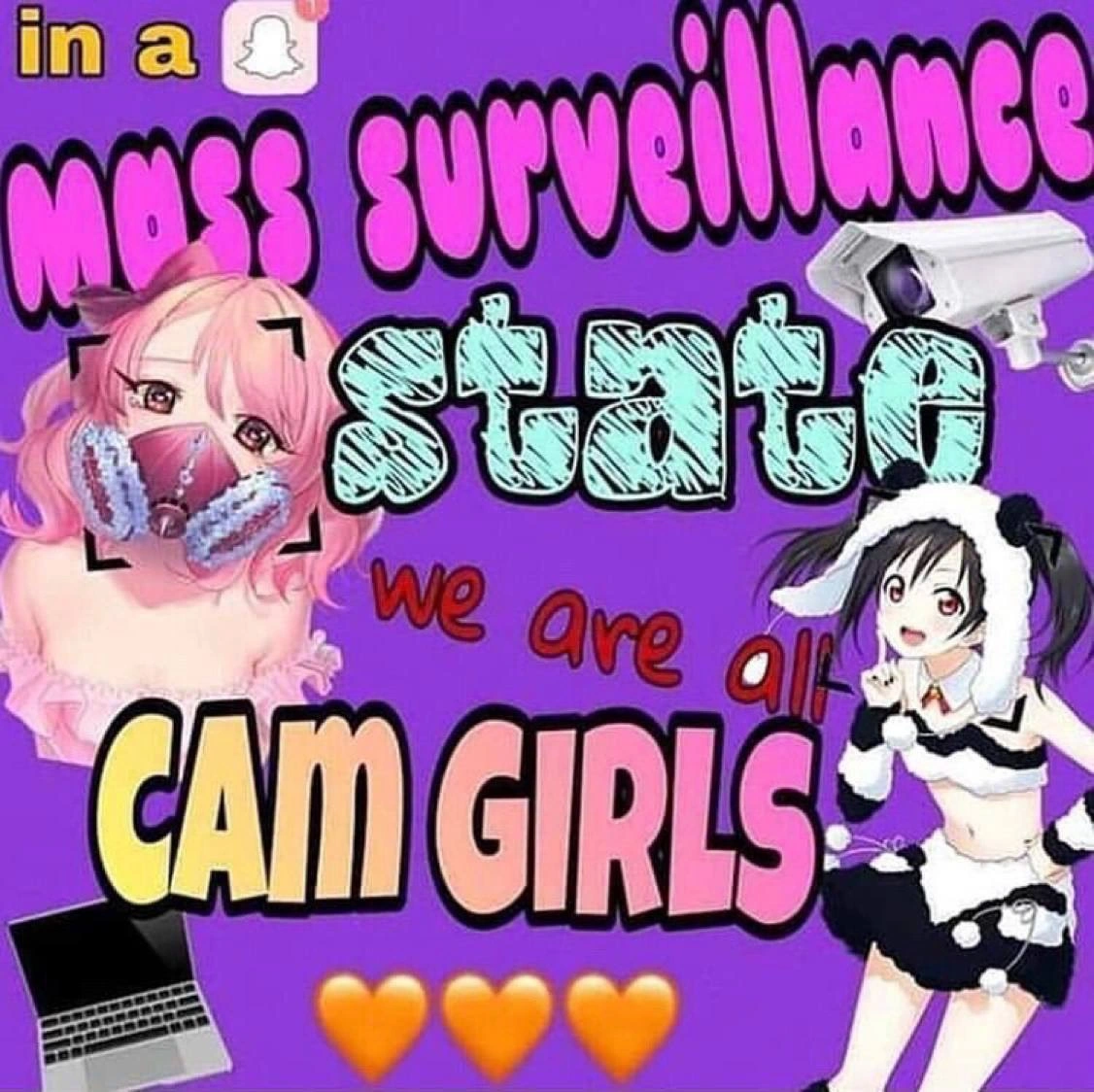
The meme shouts its thesis in bubble letters:
in a
mass surveillance
state
we are all
CAM GIRLS
The surrounding collage makes the point less like a policy memo and more like a platform fever dream: a Snapchat ghost icon near the opening phrase, a CCTV camera pointed into the scene, a laptop in the corner, focus brackets around the pink-haired figure, anime characters posed like content, and three orange hearts at the bottom. The visual style is deliberately cute, chaotic, and attention-hungry, which is exactly why it works. It frames surveillance not as a cold government database alone, but as a social-media aesthetic where being watched is repackaged as participation.
The technical target is data privacy under constant data collection. Modern platforms do not merely show content; they measure behavior. A tap, pause, scroll, camera permission, friend graph, location hint, device identifier, notification open, and search query can become part of a behavioral model. The meme's "cam girls" phrase is doing dark compression: in a surveillance-heavy environment, ordinary users become performers and telemetry sources whether or not they think of themselves that way.
The CCTV camera and laptop matter because they collapse two kinds of surveillance into one image. Traditional surveillance suggests cameras watching public or private space. Platform surveillance is softer: apps, analytics SDKs, ad tech, recommendation systems, and engagement metrics converting everyday activity into data. The meme makes them share the same purple room. That is the joke, and also the problem.
There is a corporate layer underneath the surveillance capitalism angle. Many products are optimized around attention and inference, not just declared user intent. A user says, "I posted a photo." The platform hears, "face embeddings, location context, social graph signal, retention event, ad segment, content moderation workload, recommendation candidate." The cheerful hearts are the punchline: everything is fun and expressive until you notice the ingestion pipeline humming behind the stickers.
The focus brackets around the characters are especially sharp. They turn people into tracked subjects inside a composition that otherwise looks playful. In normal social media, users choose to be visible. In surveillance systems, visibility is often ambient, automatic, and difficult to refuse without leaving the platform, workplace, city, or social group. Consent becomes less like a meaningful decision and more like a checkbox guarding the door to modern life. Very convenient, provided you are the one writing the privacy policy.
Description
The image is a loud purple collage with oversized bubble lettering, anime-style characters, a CCTV camera, a laptop, and orange heart emojis. The text reads, "in a" beside a Snapchat ghost icon, then "mass surveillance state," then "we are all," and finally "CAM GIRLS" in large gradient letters. On the left is a pink-haired anime girl wearing a respirator-like mask inside camera focus brackets, while on the right is another anime girl in a black-and-white outfit, also framed by focus brackets. The joke is a garish but pointed privacy critique: in a world of social apps, cameras, tracking, and platform data collection, ordinary users become performers and telemetry sources whether or not they intended to monetize attention.
Comments
12Comment deleted
The privacy policy says consent; the product roadmap says every front-facing camera is an ingestion pipeline.
Wtf Comment deleted
Yea wtf Comment deleted
What does the number 420 mean? Comment deleted
https://en.m.wikipedia.org/wiki/420_(cannabis_culture) Time to take another bit of drugs Comment deleted
I prefer 418 Comment deleted
why? Comment deleted
https://developer.mozilla.org/en-US/docs/Web/HTTP/Status/418 Comment deleted
ah Comment deleted
True Comment deleted
That's why china is known for femboys Comment deleted
Dude. lmao. Comment deleted