Database Theory for Dummies: A Guide to Human Relationships
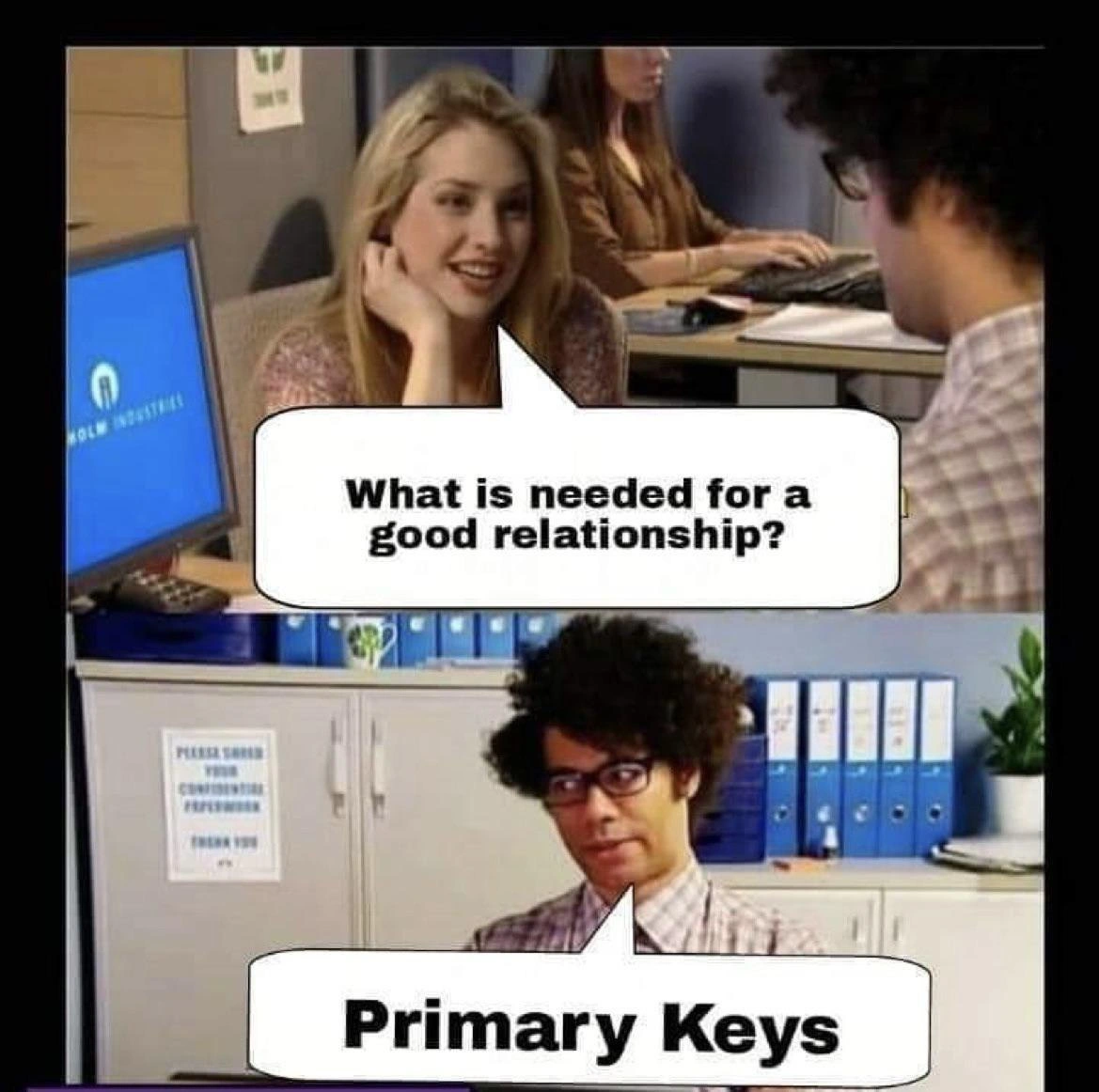
Why is this Databases meme funny?
Level 1: Key to Good Relationships
Think of a primary key like a special name tag that only one person (or one thing) can have. Imagine you have two toy figures that are best friends. You give one a blue sticker with the number "1" and the other a blue sticker with the number "2". Now, if you have a box of accessories or items for these toys, you might mark which item belongs to which toy by also putting a tiny matching sticker number on each item. All the items with sticker "1" go to toy #1, and items with sticker "2" go to toy #2. This way, you’ll never mix up which item goes with which toy, even if the toys happen to have the same name or look similar. In this little analogy, the sticker number is like a primary key – it uniquely identifies each toy. The friendship (or relationship) between the toys and their items stays neat and happy because of those unique stickers.
Now, the meme joke is basically saying a good relationship needs a “primary key.” It’s a silly play on words. In normal life, if someone asks "What is needed for a good relationship?", you might answer "trust" or "kindness". Those are the keys to a good friendship or romance. But a computer person made a joke that flips this: in the land of databases (where a relationship means linking information in tables), the key to a good relationship is literally a key – a primary key! In other words, the joke is comparing a loving relationship to a database, saying you need a unique ID (like a special tag) to make it work.
It’s funny because it mixes something very human with something very technical. Picture a boy and girl asking for dating advice, and instead of saying "be honest with each other," the advice is "use primary keys." 🤭 Of course, real relationships between people don’t have ID tags or primary keys, but in the database world they kind of do! The meme makes us laugh because it’s as if the person answering only knows about databases and treats everything like a computer problem. It’s a gentle nerdy joke: to keep any two things together (whether it’s two database tables or two lovebirds), make sure you have a clear, unique connection – the key that links them.
Level 2: Keys to Relationships
Let’s break down the joke in simpler technical terms. In a relational database (think of systems like MySQL, PostgreSQL, or Oracle where you use SQL), data is organized into tables. Each table is like a spreadsheet: it has rows and columns. Now, a primary key is a special column (or set of columns) in a table that uniquely identifies each row. Unique means no two rows can have the same primary key value. For example, you might have a table Employees with a column employee_id as the primary key. If one employee is assigned ID 42, no other employee can be 42. This way, if someone says “employee 42,” you know exactly which record to look at. The database even enforces this rule for you: try to insert a duplicate primary key, and the database will throw an error. Primary keys also can’t be NULL (unknown) because then it wouldn’t identify anything. It’s essentially a unique identifier or tag for each record.
Now, why does that matter for a "relationship"? In databases, tables have relationships through foreign keys. A foreign key is a column in one table that refers to the primary key of another table. This is how you connect data between tables. Let’s say we have a table Orders that has a column customer_id to show which customer placed the order. That customer_id in Orders would be a foreign key referencing employee_id (the primary key) in Employees if our customers are employees, or more likely referencing a Customers table if we have one. The database can enforce that every customer_id in Orders must actually exist as an ID in the Customers table – this is a rule known as referential integrity. But here’s the catch: the Customers table needs to have a primary key (say customer_id) defined, otherwise the database won’t know how to ensure the IDs match uniquely. Without a primary key on Customers, the Orders table’s foreign key would have nothing reliable to point to, or the database might not even allow you to create that link. It’d be like trying to say “this order belongs to customer X,” but there’s no guarantee who X really is because the customers aren’t uniquely labeled.
So the meme’s joke answer “Primary Keys” is referencing exactly this concept. The question in the image asks, “What is needed for a good relationship?” and the answer given is “Primary Keys.” In human terms, you’d expect something like trust or love. But in database design terms, a “good relationship” between two tables absolutely needs a primary key on one side (and usually foreign keys on the other side). It’s a pun coupling relationship advice with database humor. A developer sees “relationship” and their mind jumps to relational databases, because that’s our world! The line “every lasting relationship starts with a primary key” implies that for two tables to be reliably linked (lasting relationship), the first thing you need is a primary key (the unique ID in one table).
If you’re newer to these concepts, think of it this way: Suppose you have two lists of data and you want to match items between them. One list is a bunch of people’s names and addresses (like a Customer list). Another list is orders they made, but it only stores a customer name for reference. If there are two Alice Smiths in the customers, and an order just says “Alice Smith”, how do we know which Alice Smith made the order? We’d be stuck – that’s a bad data relationship. The solution is to give each customer a unique code or number (that’s the primary key, like Customer #101, #102, etc.). Then each order can store that number instead of the name. So an order might say “customer_id = 101”. Now we look up customer 101 and we get Alice Smith from 123 Maple Street, uniquely identified. No confusion with Alice Smith from 456 Oak Street who might be customer 102. That unique ID is the primary key for Alice’s record, and it ensures the relationship (link) from Orders to Customers is unambiguous and solid.
In SQL, defining a primary key is straightforward. You’d do something like:
CREATE TABLE Customers (
customer_id SERIAL PRIMARY KEY,
name VARCHAR(100),
email VARCHAR(100)
);
CREATE TABLE Orders (
order_id SERIAL PRIMARY KEY,
customer_id INT,
product VARCHAR(100),
FOREIGN KEY (customer_id) REFERENCES Customers(customer_id)
);
In this example, customer_id in Customers is the primary key (often a unique number, and SERIAL in some SQL dialects auto-generates sequential IDs). The Orders table has its own primary key (order_id), and also a customer_id column. The FOREIGN KEY line ensures that any customer_id entered into Orders must match an existing customer_id in Customers. If you try to insert an order with a customer_id that doesn’t exist in Customers, the database will reject it. This protects the relationship: every order is linked to a real, uniquely identified customer. Data integrity is preserved.
Now, back to the meme: it’s funny to us developers because we constantly deal with these keys and relationships in our day-to-day coding and database management. The office scenario in the meme is playing on the dual meaning of "relationship". One person asks an apparently normal question, and the other responds like a database engineer. We find it relatable because many of us have a habit of accidentally answering real-world questions with tech answers (and usually getting weird looks 😅). The background details – the blue binders, the potted plant, the slightly outdated CRT monitor – just set a mundane office mood. It’s the kind of place where such geeky jokes either make your coworkers laugh or shake their heads. The categories tagged for this meme, like DatabaseHumor or RelationalDatabaseDesign, clue us in that it’s about databases. Topics like primary_keys, foreign_key_romance, and data_integrity all point to the core idea: good database design (and data relationships) hinge on keys.
So in summary, for a junior developer or someone just learning databases: the meme is saying “for a good relationship (between database tables), you need primary keys.” It’s using a bit of wordplay to connect that with human relationships for comedic effect. And it underscores a real lesson in Database Design: always set up your primary keys and foreign keys properly if you want your data tables to play nice with each other. Otherwise, you’re headed for trouble. It’s a funny way of reinforcing a best practice that might otherwise sound dry – and now you’ll probably never forget it! Primary keys = good relationships, at least in the database world.
Level 3: Unique Constraint of Love
For seasoned developers, this meme hits on a core truth of database design with a hearty dose of irony. Everyone who’s spent nights poring over an Entity-Relationship diagram or untangling a spaghetti-like schema knows that primary keys are not optional – they’re the first thing you check in a well-designed schema. The top panel’s question, “What is needed for a good relationship?”, sets you up to think about trust, communication, or other human relationship advice. Instead, the bottom panel’s deadpan answer “Primary Keys.” flips the context to databases. It’s a classic relational pun: the word “relationship” is being interpreted in the database design sense (tables relating to tables) rather than the dating sense. That twist is the crux of the humor.
Why do devs smirk at this? Because we’ve all seen what happens to a database with poorly defined keys. Imagine a critical table with no primary key: duplicate rows proliferate, updates become a nightmare since you can’t target a single record reliably, and establishing any foreign key romance (i.e., linking tables) is risky or impossible. It’s like trying to refer to someone in a crowded room when half the people share the same name – utter chaos! We’ve inherited legacy systems where lack of proper keys turned the database into a dysfunctional family of tables 😅. Data integrity suffers terribly when you don’t have that unique identifier; foreign keys might point to multiple possible targets or to nothing at all, causing those dreaded orphan records. Senior engineers know that a schema without keys is a ticking time bomb. Thus, the phrase “every lasting relationship starts with a primary key” rings true in the most literal sense for us: a robust database relationship (say, between an Orders table and a Customers table) must start with a primary key on the Customers side, or you can’t be sure which order belongs to which customer.
The meme’s imagery heightens the joke for the initiated. The curly-haired colleague pictured giving the answer is actually Maurice Moss from The IT Crowd, a TV character who epitomizes the uber-nerd. It’s perfect casting – Moss is exactly the type who would answer a life-question with a database joke. The office setting with its CRT monitor (displaying “WOLF Industries” as a faux company name) and neat blue binders is a generic corporate backdrop, but those who know Moss instantly recognize the nerd factor has entered the chat. It’s as if a normal office small-talk question got hijacked by the resident database geek. That scenario is so relatable in tech teams: someone sets up a joke or a question, and the database guru answers completely deadpan with a tech truism. Cue groans and laughter across the cubicles.
The phrase “Primary Keys” as the answer also slyly nods to the fact that in relational databases, everything truly revolves around keys. It’s the key to data happiness, if you will. Veteran developers might chuckle recalling the countless times they had to explain to junior teammates: “Yes, we absolutely need a primary key on that table, or our joins will go haywire!” The meme resonates because it compresses that lengthy lecture into two words. It’s the ultimate inside joke for database folks – we all understand that a table without a primary key is a relationship doomed to fail. In fact, it’s common to say a database table “is not in a good relationship” with others unless a primary key/foreign key link exists to bond them. And if you’ve ever tried to retrofit a primary key onto a table late in development (or worse, in production), you know that pain intimately. RelationalDatabaseDesign 101: define primary keys upfront, or suffer the consequences later.
So when Moss (the meme’s hero) answers “Primary Keys,” it’s funny because it’s true: in database land, the primary key is literally the key ingredient for any table relationship. The meme is basically a nerdy one-liner that says, “Forget flowers and chocolates – if you want a dependable relationship, ensure you have a primary key!” It’s exaggeration and truth rolled together. Seasoned devs appreciate how the joke mixes a touch of absurdity with a real best practice. The absurd part is applying a dry tech concept to personal relationships; the real part is that data relationships indeed won’t last without enforcing uniqueness. After years in this field, you can’t help but read the meme and nod: yup, every solid (database) relationship I’ve seen started with a primary key. No primary key? No relationship – and plenty of drama cleaning up the mess afterward. Just like in life, ignoring foundational needs leads to heartbreak… except here it’s the database crying.
Level 4: Functional Dependencies of Love
Deep in the theory of relational databases, a "relationship" isn’t about people at all – it’s about how tables of data connect. In the formal relational model (pioneered by E. F. Codd in 1970), a table (called a relation in math-y terms) is essentially a set of rows (tuples). One fundamental principle is that each row must be uniquely identifiable. That’s where the primary key comes in: it’s a designated attribute (or combination of attributes) that uniquely identifies each tuple in a relation. In formal terms, the primary key establishes a functional dependency – all other attributes in the row depend on this key. If you know the primary key value, you can determine the entire record. This guarantee of uniqueness is mathematically beautiful: it means no two rows have the same key, which is analogous to saying a set can’t contain duplicate elements.
Why is this so crucial for relationships (in the database sense)? Because in relational algebra and SQL, the way you join tables together is by matching keys. A foreign key in one table references the primary key of another, creating a relationship between the two sets of data. Without a primary key on one side, the connection becomes ambiguous or impossible to enforce. It’s like trying to line up pairs of data without a consistent reference – a theoretical no-go if you want integrity. In fact, relational database theory insists on referential integrity: every foreign key should correspond to an existing primary key in the related table, ensuring no loose ends (or "orphaned" references) in your data. This is formalized in the notion that a valid relational design has key constraints; you can’t even express a proper foreign key relationship in SQL unless the target has a unique key. The entity-relationship model taught in CS fundamentals is built on this concept: entities have identifiers (keys), and relationships link those identifiers across tables.
From a theoretical perspective, a primary key is the bedrock of schema design. It’s tied to normal forms in database normalization – for instance, to satisfy Third Normal Form (3NF), every non-key attribute must depend on the key, the whole key, and nothing but the key. This prevents anomalies and duplication. The meme’s punchline “Primary Keys” playfully hides this serious theory behind a simple two-word answer. It’s hinting that, just as the math of a good schema starts with unique keys, perhaps the “math” of a good romantic relationship starts with a unique foundation too (an amusingly strict approach to human connections!). It’s a nerdy joke that compresses decades of database theory into a flirty one-liner. Who knew relational algebra could sound so romantic? The humor here is that in database terms, every stable relationship truly does start with a key – a primary key – to ensure everything matches up consistently. Without it, the whole relational model collapses into chaos. In a way, the meme is academically on-point: a lasting relationship (between tables, of course) is impossible without that unique identifier anchoring it. It’s a delightfully geeky reminder that even in love (at least, data love), you can’t escape the laws of data integrity.
Description
A two-panel meme featuring characters from the British sitcom 'The IT Crowd'. In the top panel, Jen Barber, a blonde woman in an office, leans forward with a smile and asks, 'What is needed for a good relationship?'. The bottom panel shows Maurice Moss, a socially awkward IT technician with an afro and glasses, looking directly at the viewer with a serious expression, responding with the answer in his speech bubble: 'Primary Keys'. The humor stems from a classic tech pun, where Moss interprets the word 'relationship' not in the human, emotional sense, but in the context of relational database design. In databases, relationships between tables of data are established using primary and foreign keys to ensure data integrity and unique identification. For experienced developers, this is a relatable joke about applying technical logic to social situations, and a nod to the beloved nerdy culture depicted in 'The IT Crowd'
Comments
14Comment deleted
Sure, primary keys are essential for a good relationship, but the real challenge is dealing with all the legacy data and messy foreign key constraints from previous connections
Sure, communication is important, but without a primary key the whole relationship degrades into a full Cartesian product
After 20 years of maintaining legacy databases, I've learned that both romantic and database relationships fail for the same reason: someone forgot to properly define constraints and now there's orphaned data everywhere wondering where their parent went
Moss isn't wrong: every good relationship needs a stable unique identifier, no nulls, and absolutely no natural keys you'll regret in five years
Every senior engineer knows that just like in databases, relationships without proper primary keys lead to orphaned records, cascading failures, and eventual data corruption - though in real life, there's no CASCADE DELETE to clean up the mess
Healthy relationships need trust; healthy schemas need primary keys - otherwise every join becomes therapy and ON DELETE CASCADE handles the breakup
Primary keys: because composite keys in relationships just lead to messy joins and endless denormalization regrets
Healthy relationships need primary keys and enforced referential integrity - otherwise every conversation turns into a cross join followed by cascading deletes
Lol Comment deleted
{ "You're my key": "I'm your value" } Comment deleted
So romantic😍 Comment deleted
ok, let's go, we can close internet for today! Comment deleted
foreign key Comment deleted
TEXAS HAIRCUT Comment deleted