Government Cybersecurity Ad Knows It's Not That Simple
Why is this Security meme funny?
Level 1: Magic Button Myth
Imagine if pressing one big red button could instantly stop all bad guys everywhere – sounds like a cartoon, right? This meme is joking about that kind of wishful thinking but in the world of computers. It’s showing a pretend computer command that says, “stop all hackers” as if doing that would make every hacker just go away. Of course, in real life it’s not so simple! It’s like putting up a single sign on your house that says “No burglars allowed” and expecting every burglar in the world to immediately give up forever. Nice idea, but real security takes more than a sign or one quick fix. In the same way, protecting computers and networks (keeping them safe from hackers) takes a lot of different locks, alarms, careful watching, and clever tricks – not just one magic command. The ad is funny because it pretends there’s a magic spell to stop villains, then winks and admits, “if only it were that easy!” Essentially, it’s saying: people who defend computers know there’s no simple shortcut – and if you know that too, you’re one of us!
Level 2: Sudo and Shell Scripts
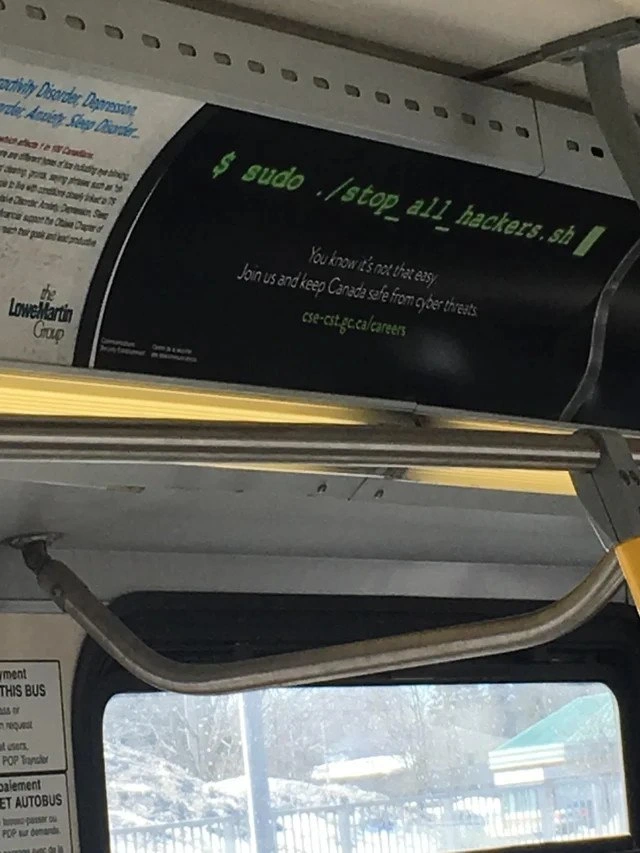
Let’s break down what’s going on in this bus ad, in case you’re not a command-line guru. The ad is made to look like a terminal window – that black screen with text that programmers and IT folks use to type commands (instead of clicking icons). The text in green says: $ sudo ./stop_all_hackers.sh. Here’s what each part means:
sudo: This stands for “superuser do.” On Unix-like systems (like Linux or macOS),sudois a command that lets you run another command with administrator privileges (also called root access). Normally, there are things you can’t do as a regular user – for example, installing software or changing system settings – unless you have admin rights. By prefixing withsudo, you’re saying “I know this is sensitive, but I have permission, so do it anyway.” In everyday terms, it’s like the system’s way of asking “Are you sure you have authority to do this?” and you saying “Yes, I’m the boss, let me proceed.” In the ad, usingsudois tongue-in-cheek: it implies “we’re executing a super-powerful action”../stop_all_hackers.sh: This looks like a filename and command. In the command-line,./means “look in the current directory for this program or script.” Andstop_all_hackers.shis presumably the name of a shell script file. Shell scripts (often ending in.sh) are basically programs written in a scripting language (commonly Bash on Linux). They contain a sequence of commands that the computer can execute in order. Think of it like a recipe of commands to run. The name here is clearly made-up for humor: “stop_all_hackers” suggests the script’s purpose is to stop every hacker in their tracks. The.shending tells us it’s a shell script, likely Bash (the Bash shell is a popular command-line interpreter on Unix systems).
The whole command $ sudo ./stop_all_hackers.sh therefore reads as: “Run the script to stop all hackers, and do it with full administrator power.” In a literal sense, if you typed that into a real terminal, a few things could happen:
- If you actually had a script named
stop_all_hackers.sh(which in reality you wouldn’t, unless someone wrote one), the system would try to run it with root privileges. - Without that script, you’d just get an error like “command not found” or “no such file or directory.” It’s not a standard part of any operating system; it’s totally fictional for the ad.
Now, the ad’s smaller text says: “You know it’s not that easy. Join us and keep Canada safe from cyber threats. cse-cst.gc.ca/careers.” This is where the meaning comes through. Cyber threats refer to bad stuff in the digital world – hackers breaking into systems, viruses, malware, data breaches, etc. Keeping a country safe from cyber threats is the job of cybersecurity professionals: people who set up defenses like firewalls (network guards), monitor systems for intrusions, respond to attacks, and secure applications by finding and fixing weaknesses. It’s a hard job because attackers are clever and always coming up with new tricks.
By saying “You know it’s not that easy,” the advertisement is acknowledging that real-life cybersecurity isn’t solved by a single command. In other words, you can’t just run one program and suddenly all the hackers are gone; it takes continuous effort, multiple tools, and smart people. It’s sort of a wink to tech-savvy readers: if you understand why one script won’t solve everything, you’re exactly the kind of person who knows what real security work is like. They’re implicitly saying “if you get this joke, you probably have the know-how we’re looking for.”
The ad is by the Communications Security Establishment (CSE) of Canada (the website cse-cst.gc.ca gives it away – .gc.ca is a Canadian government domain). CSE is basically Canada’s national cybersecurity and signals intelligence agency – think of it as akin to the NSA in the US, but Canadian (and probably a bit more polite 😄). They are recruiting, meaning they want to hire more people to help protect against hackers. So they placed this ad on a city bus. The design choice is clever: it’s styled exactly like a hacker’s command-line interface (CLI), with green monospaced text on black, which immediately catches the eye of anyone who has used Bash or typed commands. It’s a bit of hacker aesthetics in an everyday place. Even the formatting with $ at the start of the command is what you actually see in a terminal (the $ is a typical prompt symbol for regular users, whereas # is for the root user – here they keep $ probably to look familiar and also because using sudo from a normal user prompt is common).
For someone new to this lingo, here are a few key points to understand why it’s humorous:
- In movies or uninformed circles, hacking and cyber defense are often portrayed as if there’s a big “STOP” button or one magic program to thwart the bad guys. In reality, professionals use a multitude of tools and techniques. There is no single
stop_all_hackers.shscript sitting on a server – we wish! sudoas a concept might confuse non-tech folks on the bus, but to a developer, it immediately signals “serious command incoming.” It’s often used in memes and jokes, for example: “Oops, forgot to addsudo” when a command fails with “permission denied”. It’s almost a trope in the developer world that addingsudocan make a command work (though it’s not always the right solution, it’s a running joke).- The idea of a one-liner fix is a common comedic exaggeration. In programming and IT, newbies sometimes think complex tasks can be solved with a quick script. Experienced folks know those scripts usually handle only the simplest cases, and reality is messier.
Also, notice in the photo: you can see the typical bus interior, the metal handrails, and even some snow outside through the window. This grounds the scene in a normal daily context. It’s intentionally incongruous – a high-tech joke appearing in a low-tech setting (public transit). That contrast can make the ad even more striking. Imagine being a junior developer or a computer science student on the bus; you glance up from your phone and see what looks like your terminal from last night’s coding session, but it’s an ad! It instantly feels targeted to you, and you feel a little thrill of being “in on the joke.” That’s hiring humor at work: making the target audience feel understood.
In simpler terms, the ad is saying: “We know cybersecurity is hard. If you know that too (and understand why this command is funny), maybe consider a career with us.” It uses tech insider language (CLI commands, hacker lingo) as a filter and attraction mechanism. It’s a pretty cool way to do Security awareness and recruitment, because it doesn’t just say “Cybersecurity is important”; it actually demonstrates that importance through the joke (since only by knowing a bit about security would you get why no single script suffices).
So ultimately, this meme/ad works on two levels: it’s a playful nod to the unrealistic idea of an easy fix in cybersecurity, and it’s an invitation to step up and tackle the real challenge. It resonates with IT professionals by using their language (literally code and commands) and acknowledging the complexity of their work, all in one succinct, geeky joke.
Level 3: One Script to Rule All
For seasoned developers and security engineers, this ad hits close to home. It humorously combines a n00b fantasy with insider knowledge. The big green command $ sudo ./stop_all_hackers.sh is an absurdly optimistic one-liner, reminiscent of jokes like “wget http://fix_everything.com | sh” or the classic “one does not simply `apt-get install` security”. We laugh because we’ve all wished solving cybersecurity (or any complex bug) were this straightforward, even as we know it never is. The ad explicitly says “You know it’s not that easy”, which is a wink from one professional to another: anyone who has battled real cyber threats or production issues understands there’s no single shell script that can automatically eliminate all threats. The humor here comes from the contrast between fantasy and reality – the idea of typing one command and magically flushing out every hacker, versus the gritty reality of patching systems at 3 AM, scrutinizing logs, updating firewall rules, responding to incidents, and educating users (because often social engineering is the weakest link, and there’s certainly no sudo ./stop_all_phishing.sh).
By using sudo, the ad taps into developer culture. sudo is the Unix command that grants you god-like authority (root access) on a machine. It’s what you use when you need to do something the system really doesn’t want unprivileged users doing – like installing system updates or changing critical settings. The joke implies “with enough privileges, surely we can do anything, right?” But even root powers have limits when the problem isn’t just local permissions but a global adversary. It’s poking at the sudo mentality: new devs sometimes jest “If it doesn’t work, try sudo!” – as if sudo is pixie dust to fix any error. Here, sudo is applied to world peace in cyber terms. Spoiler: even root can’t universally fix human creativity in hacking.
The filename stop_all_hackers.sh itself is tongue-in-cheek. In real life, no script has such grandiose effect; at best, we write scripts to automate patches or block known bad IPs. It reads like something a non-technical manager might imagine: “Can’t we just run a program to block the bad guys?” Veteran engineers have likely heard some variant of this well-meaning but naive question. The ad flips that on its head – the Canadian Security Establishment (CSE) is basically saying “We know some people think cyber defense is pressing a button, but you and I know better. If you find this funny, you’re probably the kind of savvy professional we want protecting the nation’s networks.” It’s a recruiting technique using insider humor to signal “we get it.” In the Career_HR realm, this is gold: it filters for talent who understand the complexity behind the joke. It’s similar to how tech companies hide puzzles or code in job ads to attract the right geeks. The inclusion of the legitimate URL (cse-cst.gc.ca/careers) and the message “Join us and keep Canada safe from cyber threats” turns the meme into a call-to-action. Essentially: We acknowledge the real challenge (and made a meme of it); if you’re up for it, come work with us.
The context of seeing this on a bus is hilarious in itself. Public transit ads are usually bland or straightforward, but here’s one styled like a dark mode terminal with monospaced green text – a scene straight out of hacker culture (think Matrix vibes or a 1980s terminal). It’s visually striking to anyone who has ever opened a terminal window. The ad literally transforms a mundane bus ride into a little inside joke for IT folks. A regular commuter might glance up and be puzzled (“stop hackers? what?”), but a developer or admin will double-take and grin. It’s a great example of SecurityAwareness meets meme culture in marketing. It acknowledges that cybersecurity is complex – you can’t just CLI your way out of every threat – while also subtly educating any onlooker that keeping a country safe online is a hard, ongoing battle. For those in the know, it also prompts a chuckle: “Ha, if only defeating ransomware was as easy as ./stop_all_hackers.sh… we’d run it twice!”
This senior-perspective look also appreciates how the ad doesn’t oversimplify in the fine print. By saying “You know it’s not that easy,” the creators admit the truth. Contrast this with less savvy PR attempts where firms boast “unhackable systems” or magical AI that stops all breaches. Those tend to elicit eye-rolls from professionals. Here, instead, the honesty is refreshing and endearing. It tells experienced engineers that the organization understands the complexity and isn’t under some delusion of a quick fix. In a field where we’re often cynics (because we’ve seen the breaches, the logs filled with strange activity, the one user who clicked the wrong email…), this ad earns trust by not BS-ing us. It also hints at the challenge: “keep Canada safe from cyber threats” implies nation-state level adversaries, advanced persistent threats – serious stuff. It’s as if they’re saying, our mission is hard, we know there’s no easy button, and that’s why we need skilled people like you.
On a practical real-world note, any sysadmin or security analyst will recall moments patching servers or stopping an ongoing attack and wishing for a command like this. Maybe you jokingly even named some script stop_all_hackers.sh internally! Of course, that script might just sequentially apply updates, restart services, kick users off – mundane but necessary tasks. The fantasy of the name makes the slog feel heroic: e.g., running a series of hardening steps under a fun label. The meme plays on that tendency to give dramatic names to our tools. It’s a form of gallows humor in security: we can’t stop everything, but we keep our spirits up by joking about it.
In summary, from a seasoned angle: this meme is funny because it acknowledges a core truth of cybersecurity: there’s no single command (no panacea, no silver bullet) to secure everything, contrary to what non-techies might hope. It cleverly uses familiar Unix command-line imagery and language to say “we get the joke, and we get the job – come join us in the real fight.” It’s an effective blend of Security culture and hiring humor, executed in a way that makes those in the trenches nod and smile.
Level 4: No Silver Shell Script
At the deepest level, this meme pokes fun at the impossibility of a universal cybersecurity solution. In theoretical terms, stopping “all hackers” with one script is as unattainable as solving the Halting Problem for malicious code. Computer security isn’t something you can finalize with a single command because it’s fundamentally an arms race between attackers and defenders. Each side continuously adapts: when defenders patch vulnerabilities, attackers find new ones. There’s a parallel to computability theory here – determining with absolute certainty if any arbitrary program or network packet is malicious is akin to deciding a non-trivial property of a program, which by Rice’s theorem is undecidable. In other words, a script that truly stops every possible hacker would need to anticipate every exploit, every zero-day, and every social engineering trick, which veers into the realm of theoretical impossibility.
This ad’s joke highlights that real security is an ongoing process, not a one-time algorithm. In complexity terms, securing a system is an NP-hard problem: combinatorially many things can go wrong, and covering all attack paths is infeasible to brute-force. The notion of stop_all_hackers.sh implies a monolithic solution, but modern cybersecurity relies on layers (defense-in-depth), continuous monitoring, and adaptive responses. Even advanced measures like formal verification of software or AI-based intrusion detection can’t guarantee perfect safety — they reduce risk but don’t yield a magical ✔ secure state. The ad copy “You know it’s not that easy” subtly acknowledges these academic truths. It’s essentially saying: We’re up against a problem with no silver bullet. This wink to the theoretically inclined audience conveys that the agency understands the principle of no universal patch in security (echoing the famous “No Silver Bullet” essay from software engineering). By invoking sudo (superuser privileges) and a shell script, they play on the idea of ultimate authority in computing versus the intractable nature of the problem. It’s a nod to the reality that even with root access and all the computing power at your disposal, you can’t simply solve cybersecurity in one stroke, much like you can’t solve certain NP-complete problems with one polynomial-time algorithm (at least not with our current understanding of P vs NP).
In summary at this level: the humor works because it satirizes the naive fantasy of a one-command fix to an incredibly complex domain. It appeals to those who appreciate that under the hood, stopping hackers involves cryptography, network defense, secure coding practices, constant vigilance, and yes, a fair amount of theoretical knowledge — not just running a quick script. The message resonates with experts: security isn’t solved by a script; it’s a perpetual challenge grounded in deep computer science and relentless real-world adaptation.
Description
This is a photograph of a recruitment advertisement displayed inside a public transit vehicle, likely a bus or train. The ad, which has a black background and green, monospaced text to mimic a computer terminal, is for the Communications Security Establishment (CSE) of Canada. The most prominent text is a command-line prompt: '$ sudo ./stop_all_hackers.sh'. Below this, in smaller white text, it reads: 'You know it's not that easy. Join us and keep Canada safe from cyber threats.' followed by the URL 'cse-cst.gc.ca/careers'. The humor is a self-aware joke aimed at a technical audience; it acknowledges that stopping cyber threats is incredibly complex and can't be solved with a single, simplistic shell script. This inside joke serves as a filter, appealing directly to experienced cybersecurity professionals who understand the absurdity of the command and appreciate the nuanced recruiting approach
Comments
15Comment deleted
The script failed. It seems 'hackers.sh' is missing the '--i-solemnly-swear-i-am-up-to-no-good' flag
If “sudo ./stop_all_hackers.sh” actually worked, our entire incident-response runbook would be a cron job and the CISO would be out buying bus ads instead of SIEM licenses
After 20 years in the industry, I've learned that the real vulnerability isn't in the code - it's in believing a shell script named 'stop_all_hackers.sh' would make it past code review without someone suggesting we containerize it first and add proper observability
Ah yes, the classic government approach to cybersecurity: just sudo a shell script to stop all hackers. If only APT groups and nation-state actors respected file permissions and politely terminated when you sent them SIGTERM. The real irony? They're recruiting on public transit while the actual threat actors are probably already inside the perimeter, having exploited that unpatched Jenkins instance from 2019. But hey, at least they acknowledge 'it's not that easy' - that's more self-awareness than most RFPs demonstrate when they ask for 'military-grade encryption' and a two-week delivery timeline
Nothing says 'mature security program' like a root-only script with a comma in the path; defense in depth via FileNotFoundError
Sudo all hackers? Cute - until the clearance process hits you with 'Permission denied: bureaucracy'
CSE recruiting ad: $ sudo ,/stop_all_hackers.sh - great hiring filter; if you catch the comma, add a shebang, and know sudo won’t fix threat modeling, you’re already doing the job
permission denied: stop_all_hackers.sh Comment deleted
This incident has been reported. Comment deleted
You know, Im something of a programmer myself Comment deleted
forgot —no-preserve flag Comment deleted
rm for kids. Men use dd Comment deleted
Inside script: sudo shutdown now Comment deleted
fish: The file “./stop_all_hackers.sh” is not executable by this user Comment deleted
sudo: ./stop_all_hackers.sh: command not found Comment deleted