Skip to content
DevMeme
2373 of 7435
The 'Test in Production' Gambit on GitHub
VersionControl Post #2639, on Jan 21, 2021 in TG

The 'Test in Production' Gambit on GitHub

Why is this VersionControl meme funny?

Level 1: Cooking Without Tasting

Imagine you cooked a big pot of soup for your friends, but you never tried a spoonful of it yourself to check the taste. Instead, you just serve it to everyone and say, "Well, let's see how it is!" If it's too salty or not cooked right, you'll only find out when your friends start eating it.

This meme is joking about a programmer doing something like that with their code. The programmer had some changes (like adding new ingredients to a recipe) but didn't test those changes to see if they were good. Instead of trying it out on a personal computer (like tasting the soup first), they just put it on the real website for all the users and thought, "hopefully it works okay!" It's funny (and a bit scary) for the same reason serving untested soup is funny: normally you'd be more careful, but here the attitude is "ah, it'll be fine, let's just do it."

We find it humorous because it's a bold move — kind of silly but also relatable. It's like turning in homework without checking it, or putting on a play without any rehearsals, just hoping everything goes perfectly. The developer basically said "forget it, let's put it out there and watch what happens," which gives us that nervous laugh. We all know you should double-check your work, but seeing someone skip that step and cross their fingers is both humorous and nail-biting. The joke is in that fingers crossed, hope for the best vibe, something even a kid who’s rushed through homework can understand.

Level 2: Testing in Production

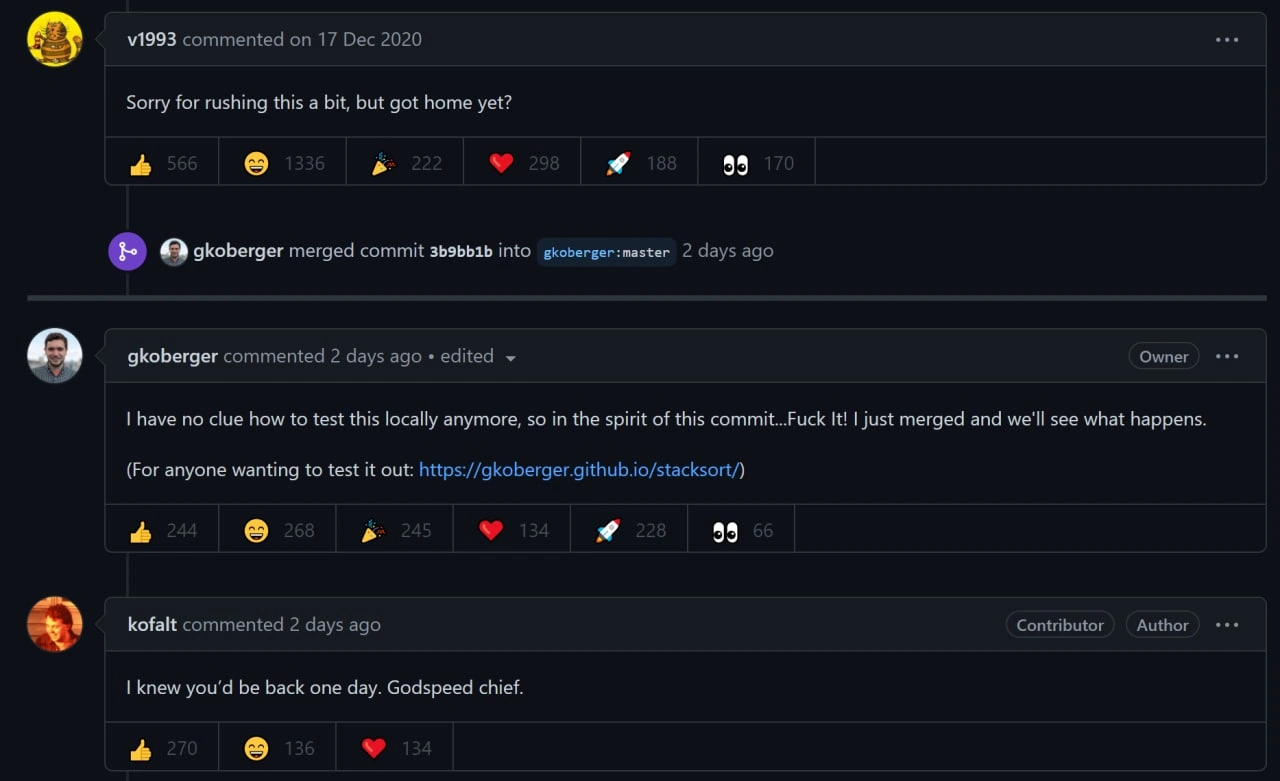
For those newer to GitHub and the PullRequestProcess, let's break down what's happening here. The image shows a conversation on a pull request (PR). A Pull Request is when someone proposes changes to code in a repository, and those changes need to be reviewed and then merged into the main codebase (often the master or main branch). Normally, before merging a PR, developers will test the changes: run the app on their local machine, make sure all the features work, maybe even run automated tests. In a perfect world, you'd also have a staging environment or continuous integration (CI) system to run checks before anything goes live.

But this PR was long dormant – it sat around for quite a while without being merged. Over time, things changed: maybe new commits went into the master branch, or the tools needed to run the project (like specific library versions) changed on the maintainer's computer. This leads to what's jokingly called environment rot. Essentially, the instructions or setup that used to launch the app successfully might no longer work because the world has moved on. Imagine trying to open an old school project on your computer and suddenly nothing compiles or runs because your system updated or the software it depends on got outdated. That's what the repository owner (gkoberger) means by "I have no clue how to test this locally anymore." His development setup is out of sync with the project – a common side effect of neglect and time.

So what does he do? He decides to merge without testing and rely on the real site (the production website) to see if the code works. "Production" is the live environment where real users interact with the software – basically the actual website or application out in the world. Merging untested code to production is often humorously referred to as "testing in production" because, well, instead of testing in a safe, controlled setting, you're testing it live on the actual users. It's like saying: "We didn't test this change in the lab, so if there's a bug, our actual users might be the ones to find it." 😅 This is generally considered a risky practice! Normally you want to catch bugs before your code hits production, not after, which is why this situation is both cringe-worthy and funny to developers.

In the GitHub conversation, after merging, the owner even provides a link (gkoberger.github.io/stacksort/) and basically says, "if you want to try it out, here it is." That's effectively inviting anyone to go to the live page and see if the merged code actually works. It's a bit like deploying a fix and asking users to be beta testers. The phrase "we'll see what happens" is a tongue-in-cheek way to acknowledge, "I have no idea if this will work, let's find out by watching it in action."

Now, why are there so many emoji reactions and funny comments from others? On GitHub, people can react to comments with emoji (like 👍 for approval, 😆 for laughter, 🎉 for celebration, etc.). The initial comment from user v1993 ("Sorry for rushing... got home yet?") has a lot of 😆 laugh reactions and 👍 likes. It seems v1993 was playfully nudging the maintainer about the delay in merging this PR. When gkoberger finally merges and drops the "Fuck It!" comment, he gets tons of reactions too – developers found this scenario both very relatable and comical. It's like the whole community is saying, "We’ve all been there, and we salute your honesty/bravery." The final reply, "Godspeed chief," is basically another developer wishing him luck, as if he's about to do something daring (which, in coding terms, he is!).

Let’s touch on a couple of terms that popped up:

  • Technical Debt (Tech Debt): This is a concept where if you take shortcuts or don’t maintain your code, you’ll have to pay the price later because things get harder to change or fix. Here, not keeping the project up-to-date (so it can be easily run and tested) accumulated tech debt – now it’s a pain to even test something that should have been straightforward.
  • Version Control (like Git) is the system that tracks changes in code. GitHub is a platform built on Git for collaboration. A PR is part of using version control to merge changes safely. When a PR is "long-forgotten," it often means no one merged it for a long time, and the codebase might have changed in the meantime. That can cause merge conflicts – where the PR's code clashes with other changes made to the codebase. We don’t see a conflict here (maybe the contributor kept it updated or got lucky), but dealing with conflicts after a long time is another headache that makes people sometimes say "ugh, just merge it and we'll fix forward."
  • Production vs Development: A development environment (like your local computer or a test server) is where you try things safely; production is where real users see and use the product. The golden rule is usually "don’t break production," which is why people are amazed (and amused) that someone merged code without being sure it wouldn't break things. It’s basically doing the opposite of standard procedure.

In summary, a maintainer came back to an old code change, found it too tricky to test properly (his local setup probably failed to run the project), and decided to trust the contributor’s code and push it out live. It’s humorous because it’s a bit of an anti-pattern – skipping the careful steps everyone is taught to do. Seeing an experienced person do it, and openly admit it with a casual "We'll see what happens," created a moment of camaraderie among other devs. They’re laughing because it’s risky and they know it, but they also understand sometimes you just throw up your hands and deploy when you’re out of other options (or patience). The whole thing turned into a lighthearted community moment, with everyone eagerly watching production to spot any explosions or, hopefully, a smooth success.

Level 3: Production Russian Roulette

When a long-forgotten pull request finally gets merged straight into the master branch without any local testing, you're witnessing a high-stakes game of Production Russian Roulette. In this GitHub screenshot, the repository owner (with that shiny "Owner" badge) basically says "I can't even run this code on my machine anymore, so screw it – let's ship and see." Seasoned engineers recognize this as the ultimate YOLO deploy: skipping the safety net of a dev environment or staging server and trusting the live production environment to reveal any lurking bugs. It's an insane move in serious projects, but let's be honest, we've all felt that temptation when a branch has been gathering dust for ages.

Why is this hilarious (and horrifying) to experienced devs? Because it condenses several CodeReview pain points and TechDebt nightmares into one scenario. First, the environment rot is real: the maintainer admits "I have no clue how to test this locally anymore", implying that over time the project's setup became so broken or outdated that even the person in charge can't easily spin it up. Think of dependencies that have aged out, config files lost to time, or a README that only made sense two years ago. This is classic technical debt – neglect a codebase long enough and it "rots," making every update a risky adventure.

Then comes the bold solution: merge now, pray later. By merging commit 3b9bb1b without testing, they've effectively said "Let's let users or production logs be our test suite." In deployment circles, this is jokingly referred to as "testing in production" – as risky as it sounds, akin to deploying code and then refreshing the site with one eye open, hoping not to see a flurry of errors. Instead of running the code in a controlled setting first, they're using the real world as the test harness. It's a bit like defusing a bomb without checking the manual: thrilling for onlookers, stomach-churning for those responsible.

The GitHub comments amplify the humor. User v1993 pokes the bear on Dec 17 2020, "Sorry for rushing this a bit, but got home yet?" – cheekily asking if the maintainer is back and ready to deal with the PR. This suggests the PR had been idle so long that contributors started wondering if the repo owner disappeared into the void (or maybe just stepped out for a very long coffee break). Fast-forward to "2 days ago" in the screenshot: gkoberger (the Owner) returns and merges the PR, leaving a legendary comment: "I have no clue how to test this locally anymore, so in the spirit of this commit... Fuck It! I just merged and we'll see what happens." The reactions tell the story: 👍 approvals for the gutsy call, 😂 laughter at the craziness, 🎉 confetti for finally closing the darn thing, ❤️ hearts for solidarity, 🚀 rockets for the bold launch, and even 👀 eyes, as if everyone is now intently watching production to see if it catches fire.

Then contributor kofalt responds: "I knew you’d be back one day. Godspeed chief." — basically saluting this daring move as if our hero just jumped on a live grenade in the name of progress. The whole thread reads like a scene from a dev sitcom: the prodigal maintainer returns, merges first, asks questions later, and the crowd goes wild with a mix of admiration and schadenfreude.

Underneath the laughs is the shared trauma of real-world software development. Any battle-scarred dev reading this can recall a similar moment of resignation. We've all encountered a long_dormant_pull_request or a project that's been on the shelf so long that reviving it feels like archaeology. You try to fire it up and nothing works: the build fails, tests won't run, maybe your laptop doesn't even have the right version of Python/Node/Java anymore. Fixing all that is tedious, so in a moment of either brilliance or madness, you decide to trust the contributor's code and just merge it. It's a roll of the dice – maybe everything will be fine (🤞), or maybe you'll be paged at 3 AM because something broke (😱).

This meme nails that bittersweet reality. It's funny because developers know better than to do this, yet it still happens. You can almost hear the inner monologue: "What’s the worst that could happen? If it breaks, at least we'll finally know what's wrong!" It's the same energy as merging a huge PR on a Friday evening – you know you shouldn't, but sometimes you just hit that purple merge button out of impatience or sheer confidence (cue the famous last words: "it worked on my machine..."). In the world of VersionControl and peer reviews, this is the equivalent of a daredevil stunt. Everyone in that GitHub thread is strapping in with popcorn, ready to watch either a spectacular production fail or the miraculous resurrection of an ancient code branch. Either way, it's a story for the ages.

Description

A screenshot of a GitHub conversation captures a moment of developer candor and humor. The image displays several comments on a dark-themed GitHub page. The central comment, from the repository owner 'gkoberger', reads, 'I have no clue how to test this locally anymore, so in the spirit of this commit...Fuck It! I just merged and we'll see what happens.' This is followed by a link for others to test the live version. The project in question is 'stacksort', a known joke project that 'sorts' code by searching Stack Overflow. The surrounding comments add to the lore, with one user welcoming the developer back and another asking if they 'got home yet', referencing a past event. This meme is highly relatable to experienced developers who have faced situations where local testing becomes unfeasible and have felt the temptation to merge and hope for the best, colloquially known as a 'YOLO merge' or testing in production
Comments

7
Anonymous ★ Top Pick Some engineers use a canary release. This developer prefers the 'phoenix release' strategy: burn it all down in production and see what rises from the ashes
  1. Anonymous ★ Top Pick

    Some engineers use a canary release. This developer prefers the 'phoenix release' strategy: burn it all down in production and see what rises from the ashes

  2. Anonymous

    Shu: write tests. Ha: mock dependencies. Ri: merge the 2-year-old branch straight to master and let Datadog page whoever still remembers the monolith

  3. Anonymous

    The beautiful thing about merging untested code directly to master is that it transforms every user into a QA engineer with production access and no ability to quit

  4. Anonymous

    When your local environment is so broken that production becomes your staging server - because nothing says 'battle-tested architecture' quite like using your users as QA. The 'Fuck It! I just merged' approach: a time-honored tradition where confidence inversely correlates with test coverage, and the only CI/CD pipeline is 'Commit and Pray.' At least he provided a URL for brave souls to test - that's practically enterprise-grade risk management in startup culture

  5. Anonymous

    When your local setup is irreproducible, the acceptance test is the SLO - merge to master and watch the error budget

  6. Anonymous

    “I can’t test locally anymore, so I merged” - otherwise known as a canary deploy with 100% traffic and observability provided by GitHub emoji

  7. Anonymous

    Senior dev special: Skip tests, merge to master, treat prod as the ultimate integration suite - revert velocity measures your true skill

Use J and K for navigation