US Politics as a Git Workflow: A Rewrite or a Revert?
Why is this VersionControl meme funny?
Level 1: Start Over vs Undo
Imagine you’re building a huge tower out of LEGO blocks, and part of it starts looking really wobbly and messy. You and your friend want to fix this big problem with the tower. Your first idea is, “Let’s take it completely apart and start over fresh. We’ll rebuild the whole thing better from scratch!” That’s a bit like saying you want to throw away the old tower and make a brand new one because the old one has issues. Now, your friend has another idea: “Wait, how about we just go back to the earlier version that was stable and not wobbly? We can remove the last few blocks that made it unstable, basically undo those changes, and have our solid tower back.” This is like using an undo button in real life – just revert to the time when the tower wasn’t falling over.
The meme is funny because it’s comparing a country changing its leader to your LEGO tower fix-it ideas. One person jokes that the country is doing the “start over from scratch” plan (like rebuilding the tower entirely), and the other person jokes, “nah, it’s more like they’re undoing some bad moves and going back to a safe point” (like removing the wobbly blocks). We laugh because in everyday life you can’t really just hit an undo button or rebuild a country from zero in one go, but developers love to think about problems in those terms. It’s like seeing a real-world situation and imagining you could fix it with a simple tech trick – either wipe the slate clean and remake it, or step back to an earlier, better state. The contrast is silly and relatable: we’ve all wanted a do-over or an undo for mistakes. So this joke makes us smile by showing two extreme “fix it” ideas – a complete do-over versus a quick undo – applied to something huge, which makes it playfully absurd yet easy to understand.
Level 2: Revert to Stable
Let’s break down the technical goodies in this meme for a less-seasoned developer. First, the joke lives in the world of version control and refactoring. Version control (like Git) is a system that tracks changes to code over time, letting multiple developers collaborate and giving you the magical ability to travel back in history. Think of it like a giant undo/redo timeline for your entire codebase. When the tweet says “maybe a rewrite will save the project,” it’s using a software term: a rewrite means throwing away the current code and building everything again from scratch, presumably “better” this time. This usually happens when a codebase has accumulated so much technical debt – i.e., messy, quick-and-dirty code and design flaws that have piled up – that engineers feel fixing it piece by piece is too hard. It’s like if you have a building with a shaky foundation (too many patches and add-ons), and someone suggests knocking it down and rebuilding anew instead of trying to fix all the cracks. In developer lingo, a rewrite is basically an extreme form of refactoring where instead of cleaning up the existing code, you start fresh on a blank slate. The tweet humorously applies this idea to America on Inauguration Day 2021: new leadership is coming in, so maybe they’ll just rebuild the “project” (the nation’s policies and systems) from the ground up because the old one is so broken.
Now, the reply from @susanjstahl counters that with, “Nah, more like a revert to previous stable state.” Here we get another dev concept: revert. In Git (the most popular version control system), git revert is a command used to undo the changes introduced by a specific commit. Importantly, revert doesn’t erase history; instead, it applies a new commit that negates (reverses) the changes of an earlier commit. For example, if commit A introduced a bug, doing git revert A will create a new commit that removes the changes from A, effectively rolling back the project to how it was before that commit, while still keeping a record of everything. When the reply mentions a “previous stable state,” it’s referencing the idea of a known good commit or release – a point in the project’s history where things actually worked correctly. In software teams, we often label certain commits as stable (like v1.2 "stable release") once they’ve been tested and proven reliable. If the latest changes break everything, the quickest fix is often to rollback to that stable version. In plain terms, that’s like hitting an “undo” button to go back to when things weren’t on fire.
So the meme sets up a contrast between two solutions a development team might consider when a project is in chaos:
- Rewrite the project: This means start over from scratch with a new codebase. It’s a bit like saying “our current approach is hopeless, let’s build a brand new app to replace it.” Developers might consider this if the code has become unmaintainable. Maybe it was written in an outdated framework or just poorly structured over the years. A rewrite promises a clean design, using all the lessons learned (and perhaps a shiny new tech stack). But it’s also risky and time-consuming – you might spend months or years rewriting features the old system already had, and until the rewrite is finished (if ever), you have two systems in play.
- Revert to a stable state: This is usually a short-term fix. It implies you identified a recent change (or series of changes) that made things worse, and you decide to undo those specific changes, restoring the system to how it was before. It’s like saying “we know version 2.0 is full of bugs, so let’s go back to version 1.9 that we know worked fine, and then figure things out from there.” In Git terms, that could mean using
git reverton the bad commits, or deploying an older version of the software while we troubleshoot. This is common in crisis management: for instance, if a new update crashes a website, the ops team might redeploy the previous stable build (effectively reverting) so users aren’t stuck with a broken site.
The twist in the meme is applying these concepts to a political scenario in a tongue-in-cheek way. On January 20, 2021, the United States had a presidential transition (a new president being sworn in). The original tweet by “I Am Devloper” jokes that this transition feels like the country is attempting a big refactor or rewrite of itself: starting fresh policies, undoing old ones, essentially rebooting the system. This is something developers joke about often with real life events – for example, in 2020 when things were tough, you might have seen posts like “can we revert this year to 2019? it had fewer bugs.” We’re anthropomorphizing reality as if it were a software project that we manage with Git! It’s geek humor – taking something non-technical and framing it like a coding problem.
The reply by @susanjstahl saying “more like a revert to previous stable state” suggests that rather than a brand-new system, the new leadership will just roll things back to how they were before the “bad commit.” In context, that implies going back to policies or norms from an earlier era that was considered more stable. For a junior developer, think of it this way: imagine your team deployed version 5.0 of your app, and it turned out terribly unstable. One engineer says, “This is a disaster, we need to rewrite everything from scratch for version 6.0.” But another (probably more senior) engineer says, “How about we revert to version 4.0, which was stable, and then incrementally improve from there?” The meme is funny because it’s exactly that conversation, but about a country instead of an app. It connects to a common engineering experience: deciding between a radical rewrite versus a rollback when under pressure.
Let’s clarify a few terms and tags here:
- Refactoring: This means improving the internal structure of code without changing its external behavior. It’s like cleaning up or reorganizing code – e.g., renaming variables for clarity, breaking a large function into smaller ones, eliminating duplicate code. Refactoring is usually done in small steps on an existing codebase. It’s different from rewriting because when you refactor, you’re working within the existing system, not discarding it entirely. The meme’s talk of rewrite is more extreme than typical refactoring; it’s basically saying throw the whole thing out (which is why it raises eyebrows among experienced devs).
- Technical Debt: This is a metaphor likening messy code or quick-fix solutions to financial debt. If you take shortcuts “on credit” (like skipping tests, using crummy hacks to meet a deadline), you incur a debt that must be “paid back” by fixing or refactoring later. If you don’t pay it back, the interest (in the form of increased complexity and bugs) accumulates. Eventually, the code becomes so hard to work with that even simple changes are expensive and risky – that’s heavy technical debt. In our scenario, the “project” (whether an app or the nation) has accumulated a ton of issues that feel almost impossible to fix one by one. That’s often when someone throws up their hands and suggests a rewrite, basically declaring bankruptcy on the code and starting fresh.
- Git / Version Control: Git is a tool that developers use to manage code history. It lets multiple people work on code simultaneously and keeps track of every change in units called commits. Each commit is like a snapshot or checkpoint. With Git, you can do magical things like branch off to try experiments, merge changes together, or revert back to an earlier commit if something goes wrong. In this meme, when they say “revert to previous stable state,” they’re referencing the idea of using Git to undo changes – specifically the
git revertcommand or a similar approach. - Previous Stable State: In software, we often mark certain versions as “stable” (meaning they’re tested and reliable). A stable state refers to a version of the system that isn’t known to be broken. If the latest version is busted, identifying a previous stable state is crucial so you can roll back to it. In practice, you might maintain a stable branch or use tags in Git for releases that passed QA. Here, the phrase is used humorously: implying the country had a stable state (maybe a reference to how things were before the tumultuous changes). To a junior dev, think of it like restoring an old backup that you know worked.
Now, if you’re newer to development, you might not yet have experienced the pain that leads to these drastic ideas. But imagine this relatable scenario: you’re working on a group coding project for class or a new feature at your first job. The code has been changed by many people over time, and suddenly nothing works right – maybe after you merged someone’s big changes, everything started crashing. You spend hours trying to debug, but it’s a tangled web. Frustrated, you blurt out, “Ugh, this code is such a mess. Wouldn’t it be easier to just rewrite it from scratch than to figure this out?” That’s the exact sentiment the original tweet mocks – it’s that developer impulse to hit the reset button when faced with daunting complexity. It’s a bit of a running joke because junior engineers often suggest rewrites without realizing the full cost, whereas senior engineers are very cautious about them.
Conversely, perhaps you or a teammate has actually broken something and then someone said, “Let’s revert those changes.” For instance, you deploy an update and suddenly users start seeing errors. The immediate response might be, “Quick, roll back to the previous version until we figure this out!” That’s one of the first real-world lessons in using version control on a team: the power of revert/rollback to quickly fix production by literally undoing a bad change. It’s almost magical the first time you do it – like a time machine for your software. But you also learn that revert is not a permanent solution, it’s more like a safety net. You still have to address why things went wrong, but at least you stopped the bleeding.
The tweet’s reply leaning towards a revert implies a cynical view: the new “project managers” (leaders) aren’t gifting us a brand-new system, they’re just undoing the last bad update. It’s a bit like saying “we’re not getting a shiny new app, we’re just going back to version 1.0 for now.” That’s funny to developers because we often use that phrasing in our daily work, and seeing it applied to something as grand as a country is both nerdy and comically relatable. It also reflects an insight: sometimes the safer bet is to restore a prior stable version rather than gamble on an unproven big rewrite. It’s a nuanced joke about caution versus bold action, illustrated through dev terminology.
Also, notice the format: it’s presented as a Twitter thread screenshot (dark mode – a detail many of us prefer for coding too!). The top tweet and a reply tweet give it the feel of a mini-discussion – exactly how devs banter on tech Twitter. The like and retweet counts show that this witty comparison struck a chord with a lot of people. It’s essentially a meme in textual form: no images of code or cartoons needed, just a clever one-liner and an equally clever retort. Developer humor often thrives on these concise social media exchanges. If you frequent places like “Tech Twitter” or subreddits like r/ProgrammerHumor, you see this pattern: take a current event or everyday situation and overlay a programming analogy on it. The tags like DeveloperHumor, RefactoringPain, VersionControl clue us in that this meme is part of that culture, joking about the pains of refactoring and the salvation of version control. So even if you’re a junior dev still learning Git, you can appreciate the gist: it’s comparing a big change in real life to a big change in a software project, and the punchline hinges on two different strategies we use in software to deal with messes—one ambitious (rewrite) and one cautious (revert).
Level 3: Refactoring a Nation
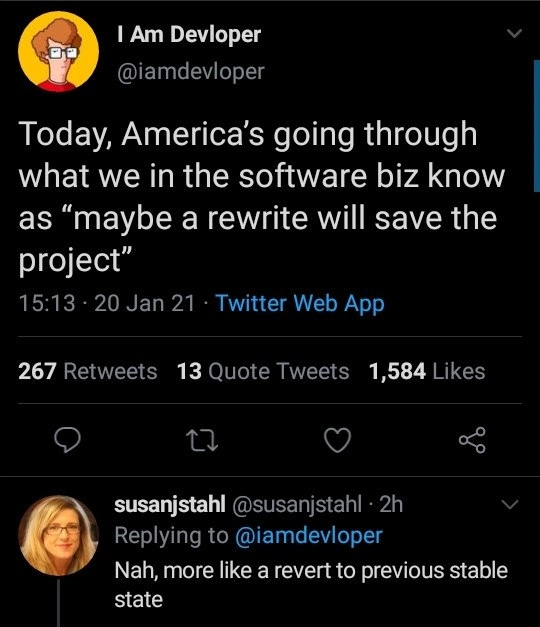
In this meme, a well-known dev humor account quips that the United States on Inauguration Day 2021 is experiencing what software engineers recognize as “maybe a rewrite will save the project.” The tweet lands with dark irony for seasoned devs. We've all been in those desperate project post-mortems where someone suggests hitting the big red rewrite button on a doomed codebase. It's the ultimate tech Hail Mary: scrap all the messy legacy code and rebuild from scratch in hopes of salvaging a failing project. Here, that grand idea is applied tongue-in-cheek to an entire country undergoing a leadership change, as if the nation were a giant app release gone wrong. The reply doubles down on the programming metaphor: “Nah, more like a revert to previous stable state.” Any senior engineer reading this almost instinctively smirks – we’ve seen this debate play out at 3 AM during on-call emergencies. Are we going to rewrite the entire system for a fresh start, or simply revert to the last known good version and call it a night?
This humor hits close to home for experienced developers because it satirizes two classic rescue tactics in software development: the big rewrite versus the rollback. The rewrite option is that seductive fantasy every dev has entertained when neck-deep in a technical debt swamp. The project’s code has become a tangled mess of quick fixes, hacks, and WTFs “innovative solutions” piled up over time. The managers are panicking, users are screaming, and nothing short of a miracle seems likely to fix the myriad bugs. In such dire moments, somebody inevitably says, “Maybe we should just start over and do it right this time.” That’s the rewrite will save us refrain. It’s simultaneously hopeful and naive – a silver-bullet solution that almost never works out as simply as it sounds. Seasoned devs know that a full rewrite often replaces your old problems with a whole set of new ones. It’s like burning down a house to get rid of a cockroach infestation: technically, you’ll eliminate the bugs, but you’ve also now got no house until you build a brand new one (and surprise, construction might run years late and over budget). The meme’s tweet captures that absurdity by implying the entire “project” (the country) is being rebooted from scratch under new management, as if decades of complexity and history could just be coded anew in one triumphant sprint.
The reply, however, is the voice of the battle-weary maintainer. It says, forget the heroic rewrite, let’s just revert to a stable commit. In version control terms, reverting means undoing changes back to a previous known good state. This is the pragmatic, immediate fix we senior engineers trust when a deployment goes sideways. Did a new release break production? Git has our back: roll back to the last stable build, the equivalent of saying “let’s pretend that bad commit never happened.” The tweet reply’s analogy suggests that the new administration isn’t introducing a radical new system from scratch (the rewrite) so much as it’s undoing the last few years (the buggy “commit” in our metaphor) to return things to a more stable state. That resonates with developers who’ve lived through nightly deployments where the safest course was to hit git revert and restore sanity. We get the subtext: sometimes progress means admitting a recent change was a mistake and rolling back before moving forward. There’s a wry cynicism here: after a particularly chaotic period (in code or in politics), the best path might just be to restore an old backup rather than bet everything on an all-new system that nobody’s even tested.
Why is this so funny (and a bit painful) to those of us in engineering? Because it’s too real. The meme is poking fun at grand fixes we propose when a project (or nation) is on the brink. The “rewrite the project” mentality is a known anti-pattern when dealing with massive tech debt, famously cautioned against by veteran programmers. (Joel Spolsky’s old maxim echoes in the background: “Never rewrite your code from scratch, you’ll lose years of hard-won bug fixes.” Netscape tried it in the ‘90s and practically wrote themselves out of the browser market.) Yet, in moments of despair, even experienced teams flirt with the idea of a clean slate because untangling a knotted codebase is grueling work. The tweet nails this shared developer trauma by comparing it to a nation attempting a clean sweep after turmoil. And then the reply brings us back to earth: instead of some revolutionary new code (which could introduce unknown issues), maybe we just revert to the last configuration that actually worked. It’s the classic battle between refactor vs. rebuild condensed into a one-two punchline on Twitter.
There’s also an undercurrent of gallows humor about technical debt in this meme. Picture an enterprise software project that’s been mismanaged for four years – deadlines rushed, no time for refactoring, countless “temporary” hacks solidified into production. Sound familiar? By the end, the code’s so brittle that even adding a print statement might bring the whole system crashing down. At that point, developers joke about throwing it all away and rewriting in some shiny new framework (maybe in Rust this time, because that’s our latest fix-all fantasy). That’s exactly the mood captured by “maybe a rewrite will save the project.” It’s funny because it’s a desperate kind of optimism we’ve all felt, and also a bit of a running joke — akin to “maybe if we rewrite it in JavaScript, it’ll magically work,” said with heavy sarcasm. The reply’s “Nah” is the seasoned dev rolling their eyes: we’ve been down that road, kid. Instead of chasing unicorns with a ground-up rewrite, just revert the bad parts and patch things up. In real life, governments can’t literally time-travel to a previous state, but the metaphor holds: you roll back policies like you roll back code and hope the system stabilizes.
The meme’s format as a Twitter screenshot adds another layer that tech folks appreciate. Twitter is often where devs share these pithy analogies in real-time, especially during major events. Here it’s the day after the U.S. inauguration (January 20, 2021), and our community’s immediate reflex is to frame it in software terms – as if the USA has a Git repository and we’re debating a git rebase of history versus a git revert of the last commit. The dark-mode tweet UI with likes and retweets count is a familiar sight in dev circles, making it clear this is a social media quip gone viral among programmers. It’s a software metaphor for politics, and a pretty apt one at that. We’ve even got a mini code-review in progress: original poster suggests a full rewrite; commenter suggests a rollback instead. Developers reading this meme nod knowingly because it mirrors discussions we’ve had in code reviews and war rooms. It highlights our skepticism about grand refactoring schemes – we joke that management treating a crisis like a shiny greenfield project is wishful thinking. The truth is, you can’t wish away complexity; whether in a legacy app or in a country, there’s no easy reset without consequences. The humor, ultimately, comes from recognizing this shared wisdom. We laugh so we don’t cry, because deep down every senior dev has whispered “let’s just revert and pretend this never happened” after a prod deployment fiasco, just as every citizen has maybe hoped for a simple undo of a rough period. By translating a national reset into repo terms, the meme speaks directly to developers’ hearts – it’s our language for coping with chaos, whether in code or current events.
Description
A screenshot of a Twitter exchange from January 20, 2021, the day of the US Presidential Inauguration. The first tweet is from the popular developer humor account 'I Am Devloper' (@iamdevloper). It reads, 'Today, America's going through what we in the software biz know as “maybe a rewrite will save the project”'. Below this, a user named susanjstahl replies, 'Nah, more like a revert to previous stable state'. The humor stems from applying high-stakes software development metaphors to a major political event. The initial tweet sarcastically frames the change in administration as a desperate, often-doomed 'rewrite' of a failing project. The reply offers a more pointed and arguably more technically apt analogy: a 'revert,' suggesting the previous four years were a disastrous feature branch and the country is simply rolling back to the last known-good configuration. This resonates with senior engineers who understand the immense risk of a rewrite versus the relative safety of a revert

Comments
83Comment deleted
It wasn't a clean revert. They had to use `--force` and now half the config files are missing and no one remembers what the environment variables were
“Go ahead, call it a rewrite if you want - but recompiling a 50-state monolith that’s been in prod since 1776 feels more like praying Maven finds a legacy JAR that isn’t even on the mirror anymore.”
After 20 years in tech, you realize every 'revolutionary rewrite' eventually becomes someone else's legacy system to revert - whether it's your microservices architecture or your democracy
The eternal engineering debate: 'This time the rewrite will be different!' versus 'git revert HEAD~4years && git push --force'. Spoiler: reverting to the last known stable state usually has fewer merge conflicts and doesn't require explaining to stakeholders why the new architecture will definitely solve all problems this time, promise
If “rewrite” appears in the incident runbook, you don’t have a runbook - you have a manifesto; ship the revert, then refactor when the pager stops screaming
Nothing says senior engineer like choosing git revert over a fantasy rewrite; one restores service, the other restores your backlog
If only nations had Git: 'git revert authoritarianism' instead of endless rewrites that ship the same tech debt
But there is no backups since no one thought about them initially. Comment deleted
Pretty funny to live in a former Soviet Union and see, how Americans trying to play in socialism and marxsism, thinking they will not fail. Well, kids, you can try. You already lost your freedom of speech, what next? Will see! Comment deleted
So true Comment deleted
…I don't think socialism is inherently bad. It's just that governments tend to corrupt more, the more power they have. I'm not too familiar with the specifics of marxism so I can't say anything about that. Comment deleted
WTF BROTHER 🤬🤬🤬🤬🇺🇲🇺🇲🇺🇸🇺🇲🇺🇸🇺🇸 Comment deleted
Lol, more socialism = more corruption. Cause you put more money in government, so it has more power and steal more money. And leftist already get rid of freedom of speech and want to get rid of guns, so people cant fight corruption. Comment deleted
I think @RiedleroD was quite correct with his statement. More power = bigger potential for corruption Comment deleted
How would you make socialism without rising taxes? Comment deleted
That's quite funny topic. What about no taxes at all? Comment deleted
And how you will redistribute income without taxes? Comment deleted
If there is no personal property, there is no need to seize anything from workers. Everything is owned by gov. That's basically slavery. Who will put taxes on slaves? Comment deleted
right? instead in the USA rn everything is owned by companies that pay you minimum wage. much better. Comment deleted
So this is how you want i to be? Cause otherwise you prove my point Comment deleted
Bruh, that's named perfect communism. Socialism is a transition point to communism Comment deleted
False, there is no government during final communism AND armed militia. Armed people without government cant be slaves Comment deleted
Anyway communism suck and never work Comment deleted
true but the same goes for true capitalism Comment deleted
Well, it best we have, all alternatives failed Comment deleted
But there much more to try in our century! Comment deleted
Tbh, this looks somehow imminent Comment deleted
Like what? Comment deleted
the alternative would be balance. As I said, here in austria, we have a mix of socialism and capitalism, and it works well! In fact, most of europe is built on top of a very similar idea of balance. Comment deleted
Socialism in not contrary to capitalism, lol Comment deleted
that's not what I said either Comment deleted
Well, you lost freedom of speech and guns too, nice balance, slaves) Comment deleted
Not sure that in Europe we could talk about lost freedom of speech at that point Comment deleted
what? I can say literally anything except denying the holocaust without getting problems and you call that "losing freedom of speech"? right. Comment deleted
and I'd rather have a lack of gun if I also have a lack of people that want to shoot me in my country. Comment deleted
People who want to shoot you, will get guns anyway lol, cause that illegal, lol. What will you do if they buy black guns? Comment deleted
uh we don't have that problem here. First, we have a way smaller wage gap, which makes people more content and less likely to want to murder you, and honestly, most people just try the thing with knifes. Comment deleted
Ahahaha, we have a proverb. come with a knife to a shootout Comment deleted
there is no shootout here my friend Comment deleted
Melbourne nightclub shooting, Darwin shooting, Melbourne triple shooting, that massacres all from 2019 1) it makes your statement false. 2) where these people get their guns, lol?) 3) why low wage gap didnt protect them from bullets? Comment deleted
australia!=austria dumbass Comment deleted
Its all the same left shit Comment deleted
it's very much not Comment deleted
How is that? Comment deleted
Be a man, you confused countries Comment deleted
I am, true Comment deleted
…nah Comment deleted
Just admit your mistake and let's move on Comment deleted
I admit Comment deleted
yeah, my fault, sorry, was thinking about Australia all the time, my statement about freedom of speech is false about Austria, im sorry. I have sister in Austria, beautiful country, how about Vienna attack, she was pretty frightened. Comment deleted
right, that's true. that was executed & organized by a pretty well-known guy. Well-known in the german defense ministry at least. They kinda feared to be accused of racism if they arrested him before he did the crime. He got the weapons by smuggling them from western asia into europe afaik. But I think it's kinda telling that the whole country is shaken once a shooting takes place. I think 2 people died? Not really that bad if we compare it to the USA. Comment deleted
7, including policeman Comment deleted
a single one? or several policemen? Comment deleted
afaik 1 Comment deleted
Wow, that's quite popular across ex-USSR too! Comment deleted
And get in your family house? Call to police?)) Comment deleted
Just quickly google how to get firearms license Comment deleted
😂👌 Comment deleted
uh we lock our doors. And yes, we do have a functional police. Comment deleted
The point is not about comunism, but there is no gov who will "just" resign Comment deleted
So your point that socialism suck with or without taxes? I agree with this statement Comment deleted
My point in overall that both of them is dead end (in their traditional interpretation). At the same time, we have China, who started as socialism, but more like Government Capitalism right now (with goal to achieve communism at some point... 😄 ) Comment deleted
Yeah, they going full singapore now, not quite communism, lol Comment deleted
that's the problem - your current gov. likes to tax the average people while billionaires pay close to nothing. The point is not to increase wealth by reducing taxes but to decrease uhh non-wealth (english knowledge lacking, sorry) by taking the most from the rich & using it for idk building proper roads and a healthcare system. Comment deleted
more socialism!=more corruption by itself. Here in austria, we're actually quite socialist, but despite that, we also still have most of the freedoms you guys have. The point of getting rid of guns is to prevent people from killing each other, has worked wonderfully in austria for over 100 years. I haven't heard of a single school schooting here… ever. Comment deleted
Ahem, when saying "we also still have most of the freedoms you guys have.": With who exactly you do compare? Comment deleted
USA in this case Comment deleted
Honestly, I'm quite curious, which freedom rights (from you PoV) USA citizens have while Austrian citizens doesn't? Comment deleted
right to have a gun Comment deleted
Exactly that's why socialism it's bad and never last long Comment deleted
dude read the rest of the conversation before starting a war again Comment deleted
Argh, you missed the topic and switched to gun laws Schade Comment deleted
I didn't miss the topic, I was finished with it. As was everybody else in the conversation afaik Comment deleted
meaning we all agreed that balance is the thing Comment deleted
That'a why it is bad lol. Comment deleted
capitalism is also 'bad' since the more wealthy companies are, the more corruption they can inflict on the gov. Comment deleted
In capitalism the government at least can't fire you or send you to desert to die Comment deleted
true, in capitalism, the company you work at can fire you or send you to desert to die. actually, the gov can definitely still do that in both systems. Comment deleted
Cant even tell if governemnt told you to shut up Comment deleted
not comparing russia to austria, but usa to austria here, but that's a valid argument here. We have a lot less people to control the area too though, so that's my counterargument. Comment deleted
we do actually Comment deleted
It should have never been written in the first place. The ideation and implementation of the process competition system, where the most "efficient" processes are assigned disproportionately more cpu time than the less efficient ones has been a disaster for their users Comment deleted
"Normal" socialism requires obligatory working, you can not just do nothing and sit on welfare without reason, we had that in USSR - prison term (weeks/months) for tuneyadstvo. And yet it all still failed, modern takes on the subject don't even have this. Comment deleted