Skip to content
DevMeme
1425 of 7435
The Ultimate Network Protection: A Subnet Mask
Networking Post #1598, on May 17, 2020 in TG

The Ultimate Network Protection: A Subnet Mask

Why is this Networking meme funny?

Level 1: A Mask for the Internet

Imagine you hear someone talk about a “mask” for the internet – sounds silly, right? This joke is basically doing that. It takes a normal face mask (like the kind people wear to stay healthy) and treats it as if it’s a computer thing. In computers, there’s something called a “subnet mask,” which is just a fancy way to help computers know who is nearby in the same group. It has nothing to do with your face or germs – it’s just numbers that computers use, kind of like part of an address. The funny picture shows a man wearing a face mask with those special computer numbers printed on it, as if that mask is the “subnet mask.” It’s like saying a computer idea became a real-life object you can wear! The reason it’s funny is the play on words: in real life a mask covers your face, and in computer-land a “mask” covers part of an address. The grown-ups who work with computers find it hilarious because they never expected to see their boring network settings turn into something you put on your face. It’s a bit like joking that your laptop has “cookies” and then actually sticking real cookies on it. It’s unexpected and cute. In simple terms, the meme makes us laugh by mixing a serious computer term with an everyday thing in a goofy way – showing an “internet mask” on a person’s face. Even if you don’t get all the computer details, you can giggle at the idea that the internet is wearing a mask just like we do!

Level 2: From PPE to IP

In simpler terms, this meme is combining a COVID safety item with a computer networking term, playing on the word “mask.” The picture shows a man wearing a regular white face mask (the kind used for health protection) and the text above says, “Look! A Subnet mask:”. The humor is that in computer networking a subnet mask is a special number (like 255.255.255.0) used in IP subnetting – but here they’ve taken that term literally and put the number on an actual mask for your face. It’s a straightforward bit of tech humor: if you’re into networking, you immediately see the numbers and chuckle because you recognize a networking configuration on personal protective equipment. If you’re not into tech, you might just see a guy in a mask with some weird numbers and be confused. So basically, it’s an inside joke for IT folks, relying on a pun with the word “mask.”

Let’s break down the technical part in a beginner-friendly way. Computers on a network have an address called an IP address (Internet Protocol address). It’s usually written as four numbers separated by dots, for example: 192.168.1.42. Each of those numbers ranges from 0 to 255. Now, to organize networks, we also use something called a subnet mask, which is another set of four numbers like 255.255.255.0. The subnet mask’s job is to tell the computer which part of the IP address is the network part (kind of like a neighborhood name) and which part is the host part (like a house number on that street). In our example mask 255.255.255.0, the 255 values act like a signal that “this portion is network info” and the 0 means “this part is for individual hosts.” So if two computers both have addresses starting with, say, 192.168.1. and they use the mask 255.255.255.0, they’re considered on the same local network (same subnet). It’s similar to how phone numbers share an area code: two phones with the same area code (network part) are in the same region. The mask 255.255.255.0 is extremely common – for instance, many home routers use it by default (often for networks like 192.168.1.xxx). Network engineers see that number and immediately think “oh, that’s a standard subnet mask for a small network (/24 in nerd-speak).”

Now the fun part: a face mask is something you wear to cover your nose and mouth (especially in 2020’s pandemic era, everyone was wearing masks to stay safe). The meme takes the term “subnet mask” and shows an actual mask labeled with a subnet mask number. It’s a play on words – essentially a pun. The phrase “subnet mask” in tech has nothing to do with clothing or health, but because it contains the word “mask,” it sounds like it could be something you wear. The meme creator ran with that idea: What if a subnet mask were literally a mask? The result is the image of a guy wearing 255.255.255.0 on his face. If you’re a junior developer or just getting into IT, you might not have worked much with subnet masks yet, but you’ve likely heard the term in a networking class or while setting up a network. This joke is a lighthearted introduction to that concept: it basically says, “Hey, I know subnet masks sound boring, but look, we turned it into a goofy visual!” It’s using wordplay and tech lingo to get a laugh. And it also subtly reminds you that in computing, we often reuse everyday words (like mask) to mean very specific things. Here, the everyday meaning and the tech meaning collide in one funny picture.

In summary, the meme is funny to people in IT because it’s referencing a common networking setting in a completely unexpected place. It’s like seeing a sign in the real world that only tech folks can read. Think of it as a little Easter egg for networking nerds: a subnet_mask_pun that connects the COVID meme reference (everyone wearing masks) with network humor. Once you know what a subnet mask is, you can appreciate the cleverness of actually putting one on a face mask. It’s simple, nerdy, and oh-so-relatable to anyone who’s had to configure network settings – a perfect recipe for a quick techie laugh.

Level 3: Unmasking CIDR Humor

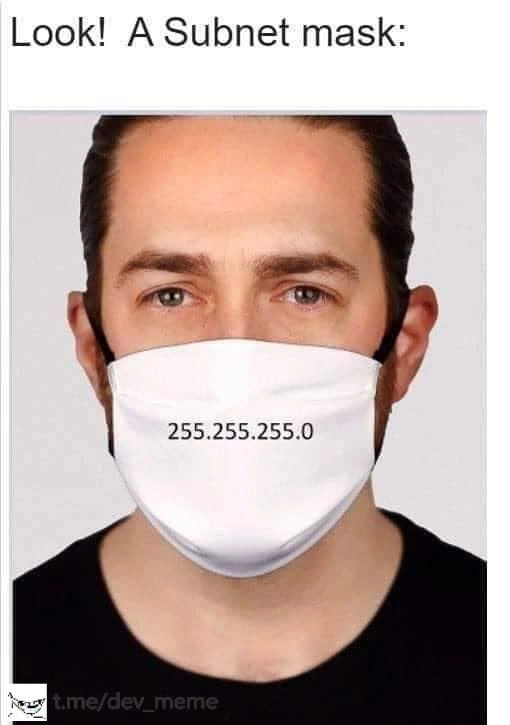
At first glance, this meme is a classic slice of TechHumor that only a network engineer could have concocted. The caption declares, “Look! A Subnet mask:” and then shows a man wearing an actual face mask emblazoned with 255.255.255.0. To anyone steeped in Networking, seeing that familiar 255.255.255.0 on a piece of cloth is immediately hilarious. Why? Because a subnet mask in computing is not a physical mask at all – it’s a configuration number defining IP address ranges. It’s pure wordplay: a networking pun that turns an abstract technical term into a literal visual gag. The humor comes from that jarring contrast between contexts: a subnet mask is usually something you set in a router or OS config, not something you’d wear on your face! By slapping those specific octets on a medical face mask, the meme creator brilliantly bridges the nerdy world of IP subnetting with the all-too-relatable world of pandemic PPE. It’s the kind of joke that makes network engineers chuckle and everyone else scratch their heads.

The choice of 255.255.255.0 is no accident – this number is the iconic subnet mask for IPv4 networks with 24 network bits (commonly notated as /24 in CIDR). It’s basically the Hello World of subnet masks. If you’ve ever configured a home router or a corporate LAN, you’ve probably encountered 255.255.255.0 more times than you can count. Those four numbers separated by dots might look random to the uninitiated, but seasoned devs instantly recognize them as a netmask. In binary, this mask is 11111111.11111111.11111111.00000000, meaning the first 24 bits are set to 1 (the network portion) and the last 8 bits are 0 (the host portion). In plain English, it says “the first three numbers of an IP address define the network, the final number identifies the specific host.” This is why any IP address from, say, 192.168.1.1 up to 192.168.1.254 (with 255 reserved for broadcast) would all fall under the same /24 subnet when using 255.255.255.0.

To truly unmask the joke, it helps to recall what a subnet mask does. Every device on an IPv4 network has an IP address (e.g. 192.168.1.42) and a subnet mask (e.g. 255.255.255.0). The mask acts like a filter: it tells the device which part of its IP address is the network ID and which part is the host ID. Technically, the device performs a bitwise AND between its IP and the mask to determine the network address. For example:

IP:    192.168.1.42      // in binary: 11000000.10101000.00000001.00101010  
Mask:  255.255.255.0     // in binary: 11111111.11111111.11111111.00000000  
AND -> 192.168.1.0       // result (network ID): 11000000.10101000.00000001.00000000  

Here the mask 255.255.255.0 effectively covers up the last 8 bits of the IP (the part after the third dot), leaving only the network part (192.168.1.*) visible. That’s exactly why it’s called a “mask” – just like a cloth mask covers part of your face, a subnet mask covers (hides) part of the IP address. In everyday networking terms, if two computers have IPs that, when masked, yield the same network ID, they’re in the same local subnet and can talk directly. If not, the traffic gets sent to a router. The mask is the unsung hero that makes sure your LAN parties and office networks know who’s “local” and who’s not.

By printing 255.255.255.0 on a face mask, the meme is making a perfect one-liner for network geeks: it’s literally a subnet mask you can wear. It’s a textbook WordplayPun – taking a serious tech term and flipping its meaning. There’s also a bit of situational humor here: this was posted around May 2020, when wearing masks became a daily reality due to COVID-19. Network engineers stuck at home on Zoom, perhaps configuring VPNs and subnets, suddenly saw their two worlds collide in one image. The absurdity of treating pandemic gear as if it were networking gear is what sparks the laugh. Who says personal protective equipment can’t double as a networking inside joke? In an era when everyone was talking about masks (for health reasons), the meme deftly injects some NetworkHumor to lighten the mood. It’s the kind of joke that not only gets a laugh but also a knowing nod: the people who get it feel like they’re part of an inside joke about IP subnetting. And honestly, in the stress of a global pandemic, what techie wouldn’t smile at the idea of a router configuration crossing over into real life as wearable nerd merch?

Description

A pun-based meme that visually merges networking terminology with a real-world object. The image shows a man wearing a white cloth face mask. Printed prominently in the center of the mask is the common IP subnet mask '255.255.255.0'. Above the photo, a caption reads, 'Look! A Subnet mask:'. The humor comes from the literal interpretation of the word 'mask' in two different contexts: a physical face covering and a fundamental concept in computer networking used to divide IP addresses into network and host portions. This specific value, 255.255.255.0, is the default subnet mask for a Class C network, a detail that adds an extra layer of recognition for anyone familiar with IT or networking fundamentals

Comments

7
Anonymous ★ Top Pick This mask only protects you from the first 254 hosts on the network. For anything more serious, you'll need to upgrade to a CIDR-rated N95 mask
  1. Anonymous ★ Top Pick

    This mask only protects you from the first 254 hosts on the network. For anything more serious, you'll need to upgrade to a CIDR-rated N95 mask

  2. Anonymous

    Swapped my N95 for a /32 - now I’m isolated from aerosols, broadcast storms, and unsolicited feature requests

  3. Anonymous

    Finally, a mask that blocks everything except the last 8 bits - perfect for when you need to isolate yourself from the other 16 million hosts in your /8 network

  4. Anonymous

    Finally, a mask that actually provides proper network isolation. Though at /24, you're still exposing 254 potential hosts to infection - might want to upgrade to a /32 for true zero-trust protection

  5. Anonymous

    Subnet mask under the chin - the L3 version of running prod as a single /8: feels simpler, leaks every host bit, and ARP won’t stop yelling

  6. Anonymous

    Procurement finally delivered the subnet mask we asked for - a surgical /24; it blocks droplets, not broadcast storms - turns out the incident was Layer 8

  7. Anonymous

    Finally, a mask that enforces proper subnetting - no more sprawling broadcast domains leaking everywhere

Use J and K for navigation