AI Cats and the Birth of a Techno-Religion
Why is this AI ML meme funny?
Level 1: The Matrix… with Cats!
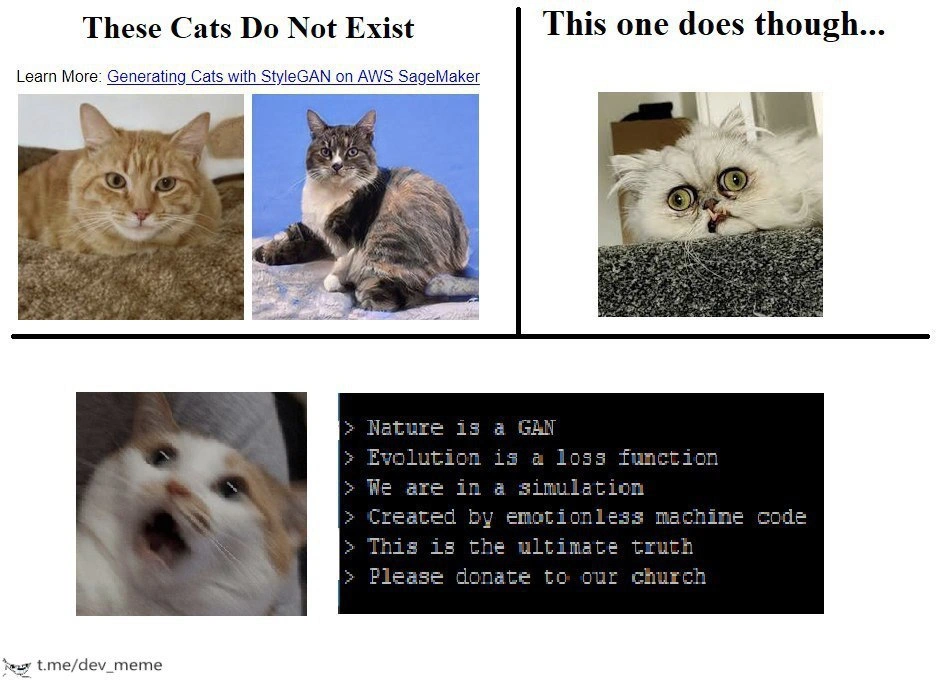
Imagine you have a super smart robot artist that has looked at millions of cat pictures. It’s learned so well that now it can draw brand new cats that look exactly like real cats, even though those cats don’t actually exist anywhere. That’s what the computer did here – it made two very life-like cat pictures from scratch. Now, picture a real fluffy cat peeking over the couch and seeing these “fake” cats. The real cat’s eyes go huge 🐱👀 in disbelief, like, “Whoa, those cats look real but I’ve never smelled them or seen them before!” It’s as if our cat friend just discovered a magic trick or a secret.
This real cat then starts thinking: “If computers can make fake cats that fool me, what if everything around me is also fake? What if the whole world is just a big computer pretend-play?” This sounds a lot like the story of The Matrix, where humans find out their world is an illusion. So in our silly scenario, the cat is basically thinking it might be living in The Matrix for cats! The cat gets a little carried away with this idea and starts acting like someone who discovered the “truth of the universe.” It’s saying stuff like, “Nature is a GAN!” (which in simple terms would mean “maybe Mother Nature is like a giant computer program making things up as it goes”) and “We are in a simulation!” (meaning “our life might be a big video game run by someone else”).
Of course, this is all said in a goofy, exaggerated way. The final joke is the cat (or the voice in the meme) saying “Please donate to our church.” Why a church? Because sometimes when people think they found the ultimate truth, they start a church or cult about it and ask others to join (and often ask for money, unfortunately!). So here, our silly cat has basically created the “Church of the Computer Universe” and is politely asking for donations, which is a funny, absurd twist.
In plain everyday terms: This meme is funny because it starts with something real — a computer can draw fake cats that look very real — and then makes a huge crazy leap to a cat thinking the whole world is fake. It’s like if you saw a super realistic cartoon and then started wondering if you are a cartoon, and then you went on to start a fan club about living in a cartoon world. It’s a big imaginative leap that’s just meant to make us laugh. We know our world isn’t actually proven to be a computer simulation, just like the cat probably isn’t seriously starting a church. But it’s hilarious to imagine a cat going through an existential crisis (that big word just means questioning what is real and what’s the meaning of it all) after seeing a high-tech magic trick.
So, at the simplest level: a computer learned to make very real-looking cat pictures, it freaked out a real cat, and then the joke spirals into “maybe everything is run by a computer, haha!” The meme uses some fancy tech terms in the middle, but even if you strip those away, it’s the classic humor of a character (the cat) seeing something unbelievable and then totally overreacting in a funny way. And adding “please donate to our church” is just the cherry on top – it’s as if the cat is saying all this super seriously, which makes it even funnier because, well… it’s a cat talking about deep universe stuff!
Level 2: Cats, Code, & Cloud
Let’s break down the technical buzzwords and geeky jokes in this meme in a more approachable way. The meme’s core references are about AI-generated content – specifically pictures of cats created by an AI – and then it spins into a fun science-fiction idea that maybe everything is created by some computer. Here are the key parts explained:
StyleGAN: This is the name of a particular Deep Learning model (made by NVIDIA researchers) famous for being able to generate very realistic images of things like human faces, and yes, cats. GAN stands for Generative Adversarial Network, which is a type of machine learning system. Think of a GAN as two AIs playing a game: one AI (the generator) tries to draw a fake cat, and another AI (the discriminator) tries to guess if the cat picture is fake or real. They’re adversaries because the generator wants to fool the discriminator, and the discriminator wants to catch the generator cheating. Over many rounds of training on lots of real cat photos, the generator gets better and better at making fake cat images that look real, and the discriminator gets better at spotting fakes. When training is successful, the generator can produce a totally new cat image that looks like a photograph of a real cat — but that cat does not actually exist in reality. This meme’s phrase “These Cats Do Not Exist” refers to exactly that: the two cat pictures shown are fabricated by an AI, not real cats at all. Around 2019, it became a fun internet trend to create websites like “ThisCatDoesNotExist.com” (inspired by the earlier “ThisPersonDoesNotExist.com”) where every refresh shows you a new fake-yet-realistic cat image from a StyleGAN model. It was a mind-blowing demo of what Generative Models could do. People were equal parts amazed (“Wow, it looks so real!”) and uneasy (“If you can’t trust a photo to be real, what next?”).
AWS SageMaker: This is Amazon’s cloud service for developers to build and train machine learning models. Training a big model like StyleGAN usually needs a lot of computing power (especially powerful GPUs, the kind of processors good at handling neural network math). Not everyone has a bunch of high-end GPUs lying around, so they use cloud platforms like AWS (Amazon Web Services). SageMaker is basically Amazon’s managed playground for ML: it provides the virtual machines, storage, and tools so you can focus on the fun part (training your model) instead of setting up hardware. When the meme says “Learn More: Generating Cats with StyleGAN on AWS SageMaker,” it’s mimicking a tutorial title. It’s as if Amazon wrote a how-to guide for programmers: “Hey, here’s how you too can use our cloud to train a cat-generating AI!” This adds authenticity to the joke because such guides do exist (maybe not exactly cats, but plenty of AWS ML how-tos). For a junior developer, the takeaway is: cloud computing lets you do heavy AI tasks like teaching a program to create cats, without needing your own supercomputer. And yes, that was (and is) an actual thing people do for fun and research!
The Real Cat (“This one does though…”): Next, the meme contrasts the fake AI cats with a real cat image on the top right. The caption says “This one does though...” meaning “this cat does exist, actually.” The real cat’s expression is hilarious – it’s got huge, almost alarmed eyes, peeking over a couch. Why is this funny? Because it suggests the real cat just found out about these fake cats and is now extremely freaked out! It’s a classic comedy technique: imagine a cat suddenly realizing it has digital imposters. The poor feline looks like its worldview has been turned upside down. For a human analogy, picture you found out there are robots that look just like people – it might weird you out. The cat is having that moment. So even if you’re not an AI expert, the humor of a cat with an “OMG!” face is universal. It makes the meme accessible and sets up the next part of the joke.
“Nature is a GAN, Evolution is a loss function”: Now we drop into the text in the bottom-right panel, which reads like a series of dramatic statements. Let’s unpack those first two lines in plain terms. We know a GAN is two AIs competing to create real-looking outputs. If someone says “Nature is a GAN,” they are jokingly comparing Mother Nature to the generator in a GAN, and the laws of physics or environment to the discriminator. In other words, imagine that the natural world is continually “generating” life forms through random mutations (like how a GAN generates new images), and then the environment decides which ones survive (like a discriminator saying real or fake). The phrase “Evolution is a loss function” fits into this analogy: a loss function in machine learning is basically a calculation of error – in training, the AI tries to reduce this error. Evolution can be seen similarly – if a mutation causes an animal to be less fit (i.e., more “error” in the survival department), that animal likely won’t pass on its genes. So over time, evolution “minimizes” bad traits and favors good ones, akin to how a machine learning model minimizes its loss to get better output. It’s a whimsical way to say “maybe life forms evolved through a trial-and-error process not unlike how an AI improves itself.” Don’t take it as serious science – it’s more of a playful metaphor that makes techies smirk because it connects Darwinian evolution to concepts they use in code. Essentially, it’s saying nature is like a giant computer program that’s been testing and iterating creatures for millions of years – a grand GAN with DNA as code!
“We are in a simulation”: This line is referencing simulation theory, which is the idea that everything we experience (Earth, space, you reading this explanation) could be part of an extremely sophisticated computer simulation rather than an objective physical reality. It sounds crazy, but it’s a hypothesis taken semi-seriously by some philosophers and scientists. In the context of the meme, the cat (or whoever is speaking in that black box) has leaped from “AI can fake cats” to “OMG, maybe we are also just fake beings in someone else’s program.” It’s like seeing a super realistic video game and then wondering if you are in a similar game. For a junior developer or someone new to these ideas: imagine The Matrix movie – where humans live in a simulated world without knowing it – that’s the concept here. The meme plays with that by having a presumably cat or AI voice state it flat-out. It’s humorously melodramatic: generating a few cat pictures on a computer leads to an existential crisis about reality.
“Created by emotionless machine code”: Building on the simulation idea, this suggests that if we are in a simulation, the creator isn’t a warm, fuzzy God or even mischievous aliens – it’s just machine code. “Machine code” means the low-level instructions that computers run, basically the most basic code that the CPU understands (ones and zeros doing simple operations really fast). Calling it “emotionless” emphasizes that if a computer program is running our universe, it likely doesn’t have feelings or moral intent – it’s just executing instructions. This is both a scary and a funny thought. Scary in a sci-fi way (“no one’s at the wheel, it’s just a program running us”) and funny in a dark humor way (“our creator might be as dumb as an algorithm that just does what it’s told”). In meme terms, it exaggerates the bleakness for comedic effect. It’s as if the cat or AI narrator is saying, “I have peered beyond the veil, and there is no loving creator petting us — just cold code spinning out galaxies.” It’s deliberately over the top, aligning with common internet humor where someone states a ridiculously dramatic conclusion in a dry, technical way.
“This is the ultimate truth”: Here the voice in the meme is basically going full prophet mode. After dropping the bombshell that life is just code, it proclaims that this knowledge is the absolute truth of existence. It’s clearly part of the joke – it’s parodying the tone of enlightenment or someone convinced they’ve solved a grand mystery. In many memes or stories, after a mind-blowing revelation, a character might say something like this with seriousness. The humor is that all of this came from just looking at some AI-generated cat pictures. It’s an absurd jump – and that contrast is funny. It’s like solving all philosophy because you saw a glitch in a video game. The line drips with satire: the “ultimate truth” being delivered via cat meme is wonderfully nonsensical.
“Please donate to our church”: Finally, we hit the punchline. After all the cosmic talk, we’re faced with a very earthly request: money. By saying “our church,” the meme implies that whoever is delivering these revelations (maybe those AI-generated cats or some ML enthusiasts who “saw the light”) has now started a religious organization about it! This is poking fun at the idea of evangelism, both in technology and actual religion. In tech, we sometimes jokingly call super enthusiastic advocates “evangelists” or we refer to fandoms as religions (like someone might joke about the “Church of Python” for Python programming lovers, or the “Church of UNIX”). Here it’s literal: they made a “church” for the belief that the universe is a GAN. The “please donate” part is a classic satirical jab – many movements or internet hoaxes eventually ask for donations, which is always a bit of a red flag. It grounds the wild story back to a common scam pattern, making the whole rant feel tongue-in-cheek. For a newcomer, just imagine a cult of cats who believe in AI overlords, kindly asking you to contribute to their cause. It’s absurd and that’s why it’s funny. The formality of “please donate” contrasted with the craziness of what they’re saying is the key comedic contrast.
To sum up Level 2: The meme uses machine learning jargon (GAN, loss function, SageMaker) in a jokey way, but the concepts are:
- AI can now make fake cats that look real by learning from lots of real cats.
- Seeing that, a real cat (and the meme itself) humorously spirals into wondering if everything is fake and run by a computer.
- The language gets exaggerated like a dramatic revelation, ending in a parody of starting a religion around that idea.
For a junior developer or anyone new to these ideas, it’s both an introduction to how far AI image generation has come (cool tech stuff) and a taste of the quirky, nerdy humor developers often have (mixing serious tech with sci-fi silliness). It’s the kind of joke you start to really get when you’ve trained a model at 2AM and jokingly told your friend “I feel like a mad scientist, what if we’re the experiment?” — said in jest, of course! This meme captures that vibe perfectly, using cats (everyone’s favorite internet animal) to keep things light and relatable.
Level 3: Glitch in the Catri𝘅
From a senior developer or ML engineer’s perspective, this meme hits multiple familiar references at once. First, the heading “These Cats Do Not Exist” instantly recalls the wave of AI-generated content that went viral around 2019. Many of us remember the website “This Person Does Not Exist,” which used a StyleGAN model to produce an endless stream of ultra-realistic human faces — none of them belonging to any real person. It was equal parts fascinating and eerie. Not long after, the AI community (ever fond of both pets and puns) applied the same idea to felines, resulting in projects showcasing AI-synthesized cat images. The meme’s top-left panel, with its authoritative heading and the hyperlink-styled subtitle “Learn More: Generating Cats with StyleGAN on AWS SageMaker,” parodies the format of a typical tech blog tutorial or AWS demo. This is a scenario many developers recognize: AWS (Amazon Web Services) provides powerful cloud GPUs via SageMaker, and one popular Hello World for GAN enthusiasts is training a model on a huge cat image dataset. The phrasing feels like an AWS marketing blog title, making it humorously authentic. We picture an official-looking guide explaining how to spin up EC2 GPU instances, feed in thousands of kitten photos, and voila – generate brand-new kitty portraits. It’s funny because it’s true: such tutorials did the rounds, showing off SageMaker’s prowess by teaching AI to hallucinate cats.
In the meme, those two cat portraits under “These Cats Do Not Exist” look photorealistic at first glance – a testament to how convincing generative models have become. A seasoned dev knows that just a few years prior, machine-generated images had obvious tells (distorted eyes, weird fur, glitchy backgrounds). But by late 2019, StyleGAN (particularly StyleGAN2) could produce high-res images where even subtle details like whiskers and fur patterns looked legit. The joke here is that only by the bold label are we clued in that these cats aren’t real. It’s almost a Turing test for images: if it weren’t labeled, even an expert might assume those cats exist somewhere. This triggers that AI humor delight – marveling at how far deep learning models have come, and laughing at the slight discomfort of not trusting our eyes anymore.
Now, the top-right panel: “This one does though…” above a very real, very wide-eyed cat peering over a sofa. This is comedic juxtaposition. After being wowed (and unsettled) by fake cats, we’re shown a real cat who looks absolutely shook. The real cat’s expression – bulging green eyes and a floofy startled face – is a classic meme image itself (it practically screams “What in the world?!”). Seasoned meme connoisseurs might recognize it as a popular reaction image used to convey shock or horror. Here it represents a genuine cat seemingly reacting to the revelation that AI impostors exist. It’s as if this fluffy fellow just found out about StyleGAN’s creations and is now having an identity crisis: “There are ghost cats that look like me?!” In a developer team context, this mirrors how human engineers sometimes react to advanced AI: half impressed, half spooked (“Is my job safe if an AI can do this?”). For the cat, the equivalent worry might be “Are my nine lives safe if AI cats can take my place on the internet?” It’s a playful way to anthropomorphize the anxiety that real things might have when they discover their digital doppelgängers. The caption “This one does though...” reassures us that at least this particular cat is real, but the ellipsis hints that things are about to get weird for that cat.
Moving to the bottom half, the meme cranks the humor up a notch with absurdity. Bottom-left, we see a blurry, shocked-looking cat image. This image likely represents either:
- A glitched AI output: Perhaps when the StyleGAN model fails hilariously and produces a distorted cat with derpy features, causing viewers to react with “yikes!” Many ML folks have seen GAN failures where a cat might come out with three ears or melting fur. The blurry shock-cat could be how the model itself might look when it doesn’t quite get things right.
- Or more simply, a meme reaction image: It’s a well-known pic of a cat with an open mouth, often captioned with screaming or shock, intentionally blurred for dramatic effect. In meme culture, blur can signify sudden zoom or intense emotion. Here it emphasizes just how mind-blown everyone (real cats included) is by the situation.
By presenting this freaked-out feline, the meme visually conveys an escalating reaction: The top-right cat was surprised; now this bottom-left cat is downright shook to its core. It’s the classic meme formula of increasing absurd reaction images to tell a story. And indeed the story is about to hit peak absurdity in the bottom-right panel.
Now, the bottom-right panel is formatted like a black background terminal window or chat console with lines prefixed by > (often used to denote quotes or command outputs). This styling resonates with developers — it looks like something between a command-line output and a blockquote from an online forum. It immediately signals: “some profound or scripted text is being dumped here.” The content of these lines takes the meme from tech parody into full-blown simulation theory comedic rant:
> Nature is a GAN
> Evolution is a loss function
> We are in a simulation
> Created by emotionless machine code
> This is the ultimate truth
> Please donate to our church
For an experienced engineer, this reads like a mix of a sci-fi revelation and an internet copypasta joke. It satirizes the way people in tech sometimes dive into pseudo-philosophical rabbit holes after a breakthrough. The progression of the lines is intentionally over-the-top:
- “Nature is a GAN” – We’ve touched on this: it humorously implies that the natural world uses the same tactic as GANs (trial and error with a feedback loop) to create the diversity of life. It’s the kind of half-serious analogy an ML researcher might make at 1AM: “Dude, natural selection is basically gradient descent, mind = blown.” It’s funny because it’s sort of plausible-sounding yet clearly an exaggeration.
- “Evolution is a loss function” – In machine learning, a loss function is what algorithms try to minimize; it’s a mathematical way to measure “how bad” a model’s current output is compared to the desired outcome. Evolutionary success can be seen similarly: species that don’t survive have “high loss” and get phased out. This line takes a core ML concept and maps it to Darwinian terms. The senior crowd smirks here because it’s a clever metaphor — something one might say in an ML conference lightning talk to get a chuckle. It also pokes fun at how we often reduce complex natural processes to computer science analogies (sometimes overly so).
- “We are in a simulation” – This jumps directly into the famous theory that everything around us might be an elaborate computer program. Tech veterans have seen this idea popularized by movies like The Matrix and by public figures musing about it. (Elon Musk notably brought simulation theory to water-cooler chat in tech companies around that time, saying the odds are high that we’re in one.) For ML engineers, the line between simulations we create (say, training environments, game engines, VR) and the notion of a cosmic simulation is an intriguing mind-bender. Given the context – AI creating fake cats – the meme implies: if we can already trick ourselves with generated images, a far superior intelligence might trick us with a generated reality. This is where the cat’s existential crisis from the panel above spills into actual text.
- “Created by emotionless machine code” – This paints the “simulator” not as a benevolent deity, but as cold, uncaring software. It satirically anthropomorphizes the creator as literally the sort of code that developers write – albeit infinitely more advanced. There’s humor here for programmers: we’ve all seen code that runs without feeling (all code does, of course) and sometimes produces unintended results if not guided correctly. The phrase suggests a Matrix-like world crafted by an AI that has no empathy – a nightmare fuel concept delivered in a deadpan way. It’s also a nod to how GANs themselves operate: the neural nets don’t “feel,” they just optimize maths. So if Nature is a GAN, then perhaps the guiding code of our universe has no stake in our emotions – it’s just running algorithms. Cue the dark humor: we might be at the mercy of a system that sees us as data points. This tickles the cynical funny bone of anyone who’s debugged a ruthless automated system at 3 AM.
- “This is the ultimate truth” – Ah, the grand proclamation! By now the meme’s voice sounds like a fervent believer or a startup CEO on a wild TED talk. It lampoons the tendency to take a playful idea (“maybe the universe is just code, haha”) and blow it up into a dramatic conclusion. It’s the meme equivalent of that friend on a forum who goes, “Guys, I’ve solved life. Listen up.” In context, it’s humorously echoing countless sci-fi tropes where a character discovers the big truth about reality. For developers, it also mocks our occasional propensity to see deep meaning in every pattern. We joke that after enough time in the code mines, you might start thinking reality has a codebase too.
- “Please donate to our church” – This final line is the punchline that slams back into satire. After all the highfalutin existential tech talk, we get a very mundane request: money. This line parodies how revelations or conspiracy theories often spiral into someone establishing a cult-ish group or new “church” seeking contributions. It’s a gentle jab at both tech evangelism and literal evangelism. In the tech world, we jokingly refer to passionate advocacy as “religious” (e.g., the “Church of Emacs vs. Vim” or fervent believers in one programming methodology). Here, the meme suggests the cats (or whomever is speaking in that black box) have formed the Church of the Simulation. It’s ridiculously funny to imagine cats in robes passing a collection plate because they now worship the Great GAN that rules reality. For those in AI, it also pokes fun at the near-religious awe that advanced AI can inspire — some people talk about superintelligent AI as if awaiting a deity. By saying “please donate,” it grounds the absurd theory back to a grifty, human level – someone always tries to profit, even in a simulated world scenario. Senior devs might chuckle, recalling real anecdotes like the satire about the “First Church of AI” or that time a Silicon Valley engineer did start an AI-worshipping church as a stunt. It’s absurdism at its best, blending ML evangelism with old-fashioned cult fundraising humor.
All these elements together make for a meme that a seasoned techie can deeply appreciate. It reflects on our collective experience: we’ve seen AI go from primitive to uncanny, we’ve debated if AI will make reality indistinguishable from fiction, and we’ve joked late at night about living in a simulation. The meme uses cats — the beloved mascots of the internet — as the vehicle, which adds a layer of lightheartedness. Cats have a storied place in both internet culture and machine learning lore (the famous anecdote of Google’s neural network that automatically learned to detect cat videos on YouTube). By choosing cats, the meme ensures approachability even as it delves into complex territory. A senior engineer will catch references to AWS SageMaker (implying the serious compute power needed for these feats) and likely recall fiddling with cloud GPUs or reading similar “Generate X with GAN” tutorials themselves. They’ll also savor the parody of simulation theory, since that’s become a bit of a cliché topic among engineers — half serious, half joke. The format of the meme (the grid with bold headings and subpanels) might even remind an experienced dev of conference slides or a hackathon presentation gone off the rails, which adds to the humor. In essence, Level 3 reveals why the meme resonates: It’s a perfect storm of contemporary ML achievements, developer culture (tutorials on AWS, open-source models, etc.), and the existential musings that tech folks bond over after the work is done. By exaggerating this mix to the point of a cat-led simulation cult, it creates a humorous scenario that’s “so absurd it just might be true” — a feeling any over-caffeinated engineer can relate to.
Level 4: Reality’s Loss Function
At the most theoretical level, this meme winks at deep concepts in both machine learning and philosophy. It playfully suggests that nature itself might operate like a Generative Adversarial Network. A Generative Adversarial Network (GAN) is a class of algorithms where two neural networks — a generator and a discriminator — engage in a zero-sum game. The generator creates fake data (say, cat images) while the discriminator judges how real those fakes look, forcing the generator to improve. Over time, this adversarial training can yield astonishingly lifelike results. The meme’s text “Nature is a GAN” and “Evolution is a loss function” allude to a cosmic analogy: imagine evolution as a giant optimization process, as if natural selection is minimizing some universal loss function (like “unfit creatures get a high error, so they don’t survive to reproduce”). It’s a tongue-in-cheek nod to how evolutionary biology can resemble an iterative algorithm refining species — much like a GAN refining images via backpropagation. This connection evokes the idea of the simulation hypothesis, a philosophical conjecture that our reality might be an elaborate computer simulation. In a GAN, a sufficiently trained generator produces outputs indistinguishable from reality (at least to the discriminator); similarly, a perfect “Universe GAN” could, in theory, generate a world indistinguishable to its inhabitants. The meme takes this to comedic extremes: if an AI on AWS can create fake cats so realistic that we declare “These Cats Do Not Exist” with shock, what if our entire universe is just an even more advanced generative model run by some higher intelligence or an “emotionless machine code”? This is existential AI humor on overdrive — mixing cutting-edge deep learning theory with age-old questions about reality. For ML researchers, there’s also an inside joke here about the almost mystical power attributed to advanced models like StyleGAN. StyleGAN’s architecture (with its multi-scale style inputs and mapping network) was a breakthrough by NVIDIA that could conjure up photorealistic images from pure noise. It was so impressive that it spawned myriad “This X Does Not Exist” sites and a sense of “AI alchemy”. Seasoned engineers might recall scholarly discussions comparing GAN training to game theory (finding a Nash equilibrium between generator and discriminator). By hinting that “Nature is a GAN,” the meme cheekily suggests that perhaps the universe’s creator (be it God or a super-programmer) solved reality with an ultimate GAN — one where the laws of physics are the code and “evolution is a loss function” guiding life forms toward local optima of survival. It’s a grandiose satire that tickles those familiar with both advanced AI algorithms and the classic “we live in the Matrix” thought experiment. The kicker is the final line “Please donate to our church”, which adds a layer of academic parody: it mockingly mirrors how profound scientific ideas can sometimes birth quasi-religious movements. (Indeed, history has seen speculative cults around technological singularity and simulation theory.) The meme thereby operates on a theoretical plane where deep learning models and metaphysical musings collide. It’s not really positing a serious theory of existence, of course, but playing with the rich irony that AI can now manufacture reality-like content — enough to make engineers half-jokingly question if our reality might be similarly manufactured. In summary, this top-level analysis uncovers an imaginative parallel: StyleGAN revolutionized AI-generated content so powerfully that it inspires wry comparisons to the fundamental mechanisms of the cosmos itself.
Description
A four-panel meme exploring the philosophical rabbit hole of generative AI. The top-left panel, titled 'These Cats Do Not Exist,' displays two hyper-realistic, AI-generated cat images, with a sub-link mentioning 'Generating Cats with StyleGAN on AWS SageMaker.' The top-right panel, 'This one does though...', contrasts this with a photo of a real, fluffy white cat with huge, comical, startled eyes. The bottom-left panel shows another real cat in a blurry, chaotic action shot. The bottom-right panel contains a black terminal window with a series of white text prompts that escalate from technical analogy to a full-blown belief system: '> Nature is a GAN', '> Evolution is a loss function', '> We are in a simulation', '> Created by emotionless machine code', '> This is the ultimate truth', and concludes with the punchline, '> Please donate to our church'. The meme humorously satirizes how quickly advanced tech concepts like Generative Adversarial Networks (GANs) can be extrapolated into profound, quasi-religious or cult-like manifestos within tech culture
Comments
7Comment deleted
This is what happens when you train a model on the complete works of Philip K. Dick with a learning rate of 'pure, unfiltered espresso'. The 'donate' call-to-action is just the model's novel attempt at securing more GPU funding
Our StyleGAN cats just decided we’re living in a simulation; the only model still unconvinced is the CFO’s cost-discriminator - apparently the $12k SageMaker bill is painfully real
After training a GAN to generate cats, I finally understand why my real cat stares at walls for hours - it's just waiting for the discriminator to converge
When your StyleGAN model achieves such photorealistic results that you start questioning whether evolution itself is just gradient descent with a really long training time and an absurdly high learning rate. At least the real cat doesn't require a V100 GPU and won't collapse into mode collapse when you try to pet it
If nature is a GAN, prod is the discriminator that only wakes at 3am to reject our reality while SageMaker backpropagates the bill to Finance
If nature is a GAN, AWS is the real loss function - every backprop step debits my cost center
Nature's GAN runs on infinite organic compute with survival as the discriminator - no AWS bills, just eternal backpropagation via extinction