Skip to content
DevMeme
800 of 7435
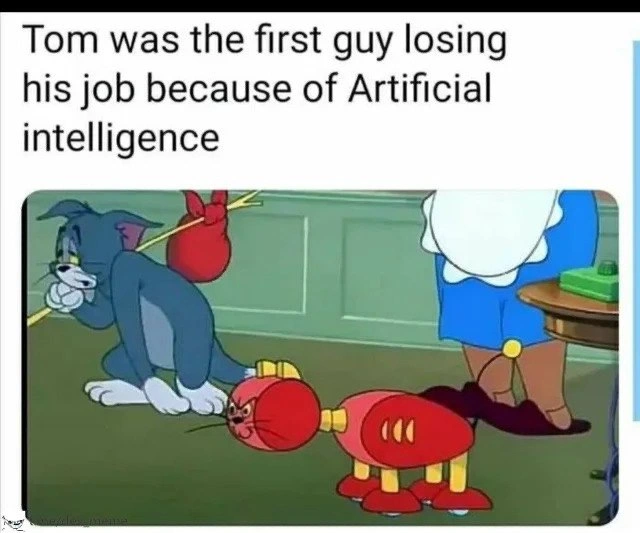
Tom Cat: The Original Victim of Automation
AI ML Post #904, on Dec 10, 2019 in TG

Tom Cat: The Original Victim of Automation

Why is this AI ML meme funny?

Level 1: When a Robot Does Your Job

Imagine you have a pet cat who’s really good at catching mice in your house. That’s his special job. Now picture that one day your family brings home a new toy – a bright red robot cat – that can also chase mice around. Suddenly, the real cat isn’t needed to catch mice anymore because the robot does it instead. How do you think your cat would feel? Probably sad and a bit left out, like “Hey, that was my job!” In the cartoon, that’s exactly what happens to Tom. He’s the cat who got replaced by a machine, and he’s walking away with a little sack of his belongings because his family decided they don’t need him to catch mice now. It looks funny because we don’t usually see a cat acting like a person who got fired from work – he even has a bundle on a stick like an old-time traveler, which is silly. But at the same time, we feel sorry for him. Nobody likes to be replaced by a fancy gadget. This meme makes us laugh (a robot taking a cat’s job is a pretty goofy idea!), but it also shows us in a simple way that if a machine takes over something you love to do, it can make you feel upset. It’s using a joke to talk about a real feeling.

Level 2: Feline vs Machine

Let’s break down what’s happening in this meme in simpler terms. The image comes from a classic Tom & Jerry cartoon. Tom is a cat who usually chases Jerry (a mouse) as his “job” in the house. In this scene, Tom’s owner brings in a robot cat to catch the mouse instead. Tom stands sadly with a bindle (a little bag on a stick that cartoons use to show someone has been fired or kicked out). In other words, Tom just lost his role to a machine. The meme’s caption jokes that this is because of Artificial Intelligence (AI).

So, what is AI in this context? Artificial Intelligence (AI) means a machine or software doing something we would normally think requires a human (or animal) mind. For example, learning, problem-solving, or making decisions are things we usually associate with intelligent beings. If a computer or robot starts doing those kinds of tasks, we call it AI. Today, a lot of AI is achieved through machine learning (ML) – that’s when a program improves at a task by learning from data, rather than just following a fixed set of instructions. However, the robot cat in the cartoon isn’t some advanced learning machine; it’s basically a wind-up toy with a very simple built-in program (essentially: “find the mouse and chase it”). It’s an early idea of a robot, not truly a thinking computer. But the meme humorously labels it as “AI” to connect this old cartoon situation to our modern AI conversations.

This brings us to the joke’s deeper point: automation. Automation is when a task is done by a machine so that humans don’t have to do it manually. In the cartoon, catching mice has been automated – the owner uses a gadget instead of relying on a real cat. Tom essentially got automated out of his job. This leads to something called automation anxiety, which is just a fancy term for the worry that people (or cats, in this case) feel when they think a machine might take over their job. Tom is experiencing what we’d call job displacement – losing a job because a machine took over that role.

People in tech and other fields discuss this a lot. It’s a serious topic, but we also joke about it to ease our worries – that’s a bit of career humor at play. For example, a programmer might quip, “I hope that new AI tool doesn’t take my job!” with a nervous laugh. Often these worries come in waves, following what we call the AI hype cycle. Hype means a lot of excitement and talk about how amazing something is, sometimes making it sound better than it actually is. So with AI, there’s usually a phase when everyone says “AI is going to change everything and do all our work!” (that’s the hype). Then later on, people realize the limitations and say “Okay, AI is good, but it can’t actually do everything” (that’s the reality check). In real life, AI and machines have certainly changed many jobs. Some jobs become easier or safer because machines handle the dirty or boring parts. Some jobs do get replaced entirely (for instance, you don’t see many elevator operators or switchboard operators these days because those tasks are automated). However, new jobs also appear – after all, someone has to build and maintain all these robots and AI systems!

In plain terms, this meme uses a funny old cartoon to talk about a modern worry: being replaced by a machine. Tom the cat represents a worker who finds that a robot or software can now do the same task he used to do. It’s amusing because it’s exaggerated – a cat with a bindle acting like a laid-off employee, which is a silly image. But it connects to a real feeling many people have about job security in the age of AI. The meme lets us laugh at the idea that “even a cartoon cat isn’t safe from automation!” while also acknowledging that technology can change the way we work. The basic idea for a newcomer is: yes, AI and automation do affect jobs, but it usually doesn’t happen as suddenly or as completely as a cartoon might suggest. In reality, people and machines usually end up working together, and a lot of the scary “robots will take all our jobs” talk is exaggerated. This joke simply captures that fear in a lighthearted way.

Level 3: Automation Anxiety, Circa 1950

Experienced developers can’t help but smirk at this meme because it captures automation anxiety in such a literal, retro way. In the cartoon scene, Tom stands dejected with a bindle over his shoulder (the universal cartoon symbol for getting fired) while the homeowner’s new robot cat rolls in to take over mouse-catching duty. It’s a hilarious early portrayal of job displacement: the trusty old worker (Tom) is shown the door because a shiny mechanical employee promises to do the job better, faster, or cheaper. Sound familiar? This is essentially a 1950s humor sketch of the very real fears people have today about AI and automation edging them out of work.

The caption “Tom was the first guy losing his job because of Artificial Intelligence” is obviously an exaggeration – it playfully declares a cartoon cat as the inaugural victim of the robot revolution. Of course, in reality, automation replacing jobs has been happening for centuries (we could go back to the Luddites around 1811 smashing textile machines, yelling “They took our jobs!” in their own Victorian way). But crowning Tom as the “first” is part of the meme’s joke. It winks at the audience: we’ve been talking about robots taking jobs for a long time, and even our beloved animated classics made a gag out of it. This frame from an animated classic is basically automation in pop culture long before modern AI – an early robot-replacement scenario played for laughs.

For today’s engineers, the humor cuts close to home. We live in an era of relentless AI hype cycles. Every few years there’s a wave of hype proclaiming that some new technology – maybe a revolutionary neural network or a smarter robot – will automate away whole professions. Then reality sets in and we realize the takeover is slower or more limited than the breathless predictions. Still, that initial hype can cause a buzz (and sometimes panic) about job security. In the tech industry, we’ve heard it all: “Will machine learning models replace data analysts?”, “Will no-code tools and AI assistants replace programmers?”, “Is that new chatbot going to make all the support reps obsolete?”. This meme nods to that hype-vs-reality dynamic. The robot cat looks impressive in theory (just as AI is often hyped to seem almost magical), but seasoned devs know there’s usually more to the story — bugs, maintenance, edge cases… or mischievous mice that find loopholes in any system.

There’s an unwritten rule in engineering: if you automate yourself out of a job, you’ll probably be rehired to fix the automation. We laugh about it, but it’s often true. In the meme’s scenario, if that red robot cat breaks down at 3 AM or fails to catch a particularly crafty mouse, guess who the homeowner is going to call? Poor Tom might be back on the job as a “robot repairman” — the very first DevOps feline, in a sense. This tongue-in-cheek twist reflects a real pattern in tech jobs: new tools and AI systems often need people to implement, monitor, and maintain them. Instead of a clean swap of humans for machines, what really happens is that roles shift. A developer whose manual task is automated might move on to overseeing the automation or tackling the more complex problems that the AI can’t handle. In other words, the arrival of “robot coworkers” often means humans just do different work, not no work at all.

The meme resonates as career humor among tech folks because we’ve all felt that mix of nervousness and nerdy amusement when a new automation comes along. On one hand, we love building these nifty tools — who wouldn’t want to create a robot to take over a boring task? On the other hand, there’s that nagging thought: Human vs. AI – are we competing with our own creations? It’s usually not as dramatic as sci-fi movies make it, but we still joke, “Don’t let the boss see how easily this script could do my job!” Tom’s plight is basically that joke in cartoon form. It illustrates the classic pattern: “Look, a robot can do it!” followed by the anxious question, “Oh no, does that mean I’m out of a job?” – all condensed into one image.

And let’s appreciate the irony: this fear is being highlighted through Tom & Jerry, a slapstick cartoon many of us watched as kids. It adds a layer of nostalgic humor. Who would have thought a childhood cartoon would end up symbolizing a 21st-century conversation about AI job loss? Yet here we are. Engineers share this meme because it’s both funny and on-point: an early robotic replacement played for laughs, reflecting our very real modern-day debates about automation’s impact on jobs. It’s a way to collectively grin at our industry’s hype trains. After all, if even a cartoon cat wasn’t safe from getting automated, the absurdity helps us cope with the fact that none of us are entirely safe either – at least if you believe the hype. But between the lines, every senior dev knows: behind every “fully automated” system, there’s usually a team of humans making sure that wind-up robot (or script, or ML model) actually does what it’s supposed to. Tom might have lost this round, but he’s not completely out of the picture — much like us, he’ll be around in the background, keeping the show running when the robots inevitably need a helping hand.

Level 4: Moravec's Paradox on Wheels

Even behind the cartoon silliness, there's a genuine AI conundrum being poked at. The idea of a robot effortlessly doing a cat’s job touches on a well-known observation in artificial intelligence: Moravec’s paradox. This paradox highlights how tasks that animals and humans find easy (like moving around a house, recognizing objects, or in this case chasing a mouse) are actually extremely hard for machines. Conversely, tasks we find intellectually difficult (such as complex calculations or even playing chess) turned out to be relatively easy to automate with computers.

The meme humorously ignores how complex Tom’s job really is from a robotics perspective. A wind-up robot cat taking over the mouse-catching duties would need to solve multiple hard problems simultaneously:

  • Perception: It must detect a tiny, fast-moving mouse (Jerry) in a cluttered room. In real life, this requires advanced computer vision or sensor systems to spot and track the mouse.
  • Navigation & Locomotion: It needs to move through a domestic environment without getting stuck. A real robot would require sophisticated locomotion (wheels or legs) and path-planning algorithms to maneuver around furniture at Tom’s speed.
  • Planning & Reaction: It must anticipate the mouse’s evasion tactics. Jerry isn’t just running randomly; he’s clever. A robotic mouser would need real-time decision-making, predictive modeling of Jerry’s movements, and quick reactions — essentially an on-board AI brain orchestrating everything.

These are non-trivial challenges even for modern machine learning and robotics. The cartoon simplifies it to a comedic degree: the bright-red automaton just zooms after Jerry as if it were as capable as a living cat. In reality, building a machine with the agility and cunning of a cat is a massive undertaking. This contrast is where Moravec’s paradox comes in full force: what Tom the cat does naturally (balancing during a chase, sensing tiny motions, making split-second decisions) embodies millions of years of evolved complexity. Trying to replicate those instinctive skills with circuits and code is an ongoing research frontier.

It’s telling that this 1950s animated classic imagined a push-button solution to pest control. (Fun fact: the actual Tom & Jerry episode is titled “Push-Button Kitty” (1952), a nod to mid-century automation fever.) Back then, Artificial Intelligence as a field was just getting named – the famous Dartmouth workshop that officially coined "AI" was in 1956 – and computers were extremely primitive by today’s standards. Yet popular culture was already dreaming about household robots. The wind-up robot cat in Tom & Jerry isn’t using any real computational intelligence; it’s essentially a mechanical automaton following a fixed program (likely something like “run after any small moving object”). There’s no learning, no adaptation – certainly no cat-like curiosity or creativity. In modern terms, this gizmo would be considered a very narrow, specialized machine, not a thinking AI at all.

From a theoretical standpoint, the meme highlights how people often overestimate what’s easy for machines. Chasing mice seems simple until you try to get a robot to do it. Even today, we don’t have Roomba-like pets that can replace real cats as mousers – it’s just too complex a problem outside of controlled lab environments. We do have supercomputers that can beat chess grandmasters or AI that can sift through big data, but a little rodent darting around a messy room can still thoroughly humble a robot. The fact that the cartoon treats this as a solved problem is part of the whimsy. It’s a case of AI hype vs reality long before that phrase was common: the promise that a machine can seamlessly replace an animal (or human) worker, versus the technical reality that such a replacement is far more challenging than it looks.

In summary, Tom losing his job to a toy robot underscores a deep truth: replicating the full range of human (or feline) intelligence in a physical form is incredibly hard. The humor lands because we intuitively know how absurd it is to think a cheap wind-up gadget could outperform a real cat at its own game. It’s a playful early illustration of the gaps in AI capabilities – a gap that, despite all our advances, still exists in many ways. Tom’s job security, at a fundamental level, is protected by the sheer complexity of what it means to be a cat chasing a mouse, something no simple robot on wheels can truly match (at least not yet).

Description

A meme featuring a still frame from the classic cartoon 'Tom and Jerry.' The image is captioned with the text: 'Tom was the first guy losing his job because of Artificial intelligence.' In the scene, Tom the cat looks sad and dejected, walking away with a red bindle on a stick, signifying he has been kicked out. In front of him, a new, red robotic cat with a menacing expression struts confidently. In the background, the lower half of Mammy Two Shoes, Tom's owner, is visible. This meme humorously retrofits the contemporary anxiety of AI-driven job displacement onto a nostalgic piece of pop culture. It frames Tom's replacement by a mechanical mouse-catcher not as a simple cartoon plot point, but as the earliest instance of a worker being made redundant by a more efficient, automated technology
Comments

7
Anonymous ★ Top Pick Tom's role was deprecated after failing to meet the new performance SLOs. The replacement, 'Mechano v1.0,' boasted 99.99% mouse-catching uptime and was fully managed. Tom just couldn't compete with that SLA
  1. Anonymous ★ Top Pick

    Tom's role was deprecated after failing to meet the new performance SLOs. The replacement, 'Mechano v1.0,' boasted 99.99% mouse-catching uptime and was fully managed. Tom just couldn't compete with that SLA

  2. Anonymous

    GitHub Copilot files the PR, the LLM reviewer approves, Argo rolls to prod - and I’m Tom with a bindle, updating my LinkedIn to “Legacy Human Engineer.”

  3. Anonymous

    Jerry was basically a reinforcement learning agent that achieved superhuman performance through millions of episodes of adversarial training against a single-threaded legacy system that never got its model weights updated

  4. Anonymous

    Tom's real mistake wasn't the mechanical trap - it was not pivoting to a role that couldn't be automated. Classic case of failing to upskill when you see the writing on the wall. Should've learned Kubernetes while he still had the chance, but instead he kept chasing the same mouse with the same approach expecting different results. Now he's just another statistic in the 'replaced by automation' column, except his replacement didn't even need a GPU cluster

  5. Anonymous

    That 'AI' dog is just a two-state DFA with a squeak actuator; a VP would still pitch it as transformational AI while cutting one FTE

  6. Anonymous

    Tom didn’t lose his job to AI - finance approved a ‘multi‑agent RL platform’ that’s actually a three‑state Mealy machine with a better SLA and a Gartner quadrant

  7. Anonymous

    Tom's eternal O(n=∞) chase loop? AI refactored it to O(1) success - now that's a killer optimization

Use J and K for navigation