Skip to content
DevMeme
802 of 7435
Overfitting vs. Overfeeding: A Tale of Two Models
AI ML Post #906, on Dec 11, 2019 in TG

Overfitting vs. Overfeeding: A Tale of Two Models

Why is this AI ML meme funny?

Level 1: Knowing When to Stop

Imagine you have a friend who’s practicing for a spelling test. Instead of just learning the spelling rules and a bunch of common words, they go and memorize the entire dictionary word for word. Crazy, right? Come test day, the teacher asks something a little different, and your friend gets confused because they only memorized exact sequences and didn’t actually learn the patterns – that’s like an overfit model in machine learning. Now compare that to another friend who just loves cookies and eats a whole jar in one go every single day. A month later, their pants don’t fit because they’ve been overfed with too many treats. This meme jokes that these two situations are alike. Both friends didn’t know when to stop – one crammed in too much memorization, and the other crammed in too many snacks. It’s funny because the word “overfit” (too much fitting/training) and “overfeed” (too much feeding/eating) sound similar and both lead to over-the-top outcomes. The lesson in both cases is pretty simple: whether you’re training a smart computer model or just eating dinner, too much of a good thing can cause trouble. So it makes us grin and maybe think, “Yep, even computers and tummies have a limit!”

Level 2: Too Many Bytes and Bites

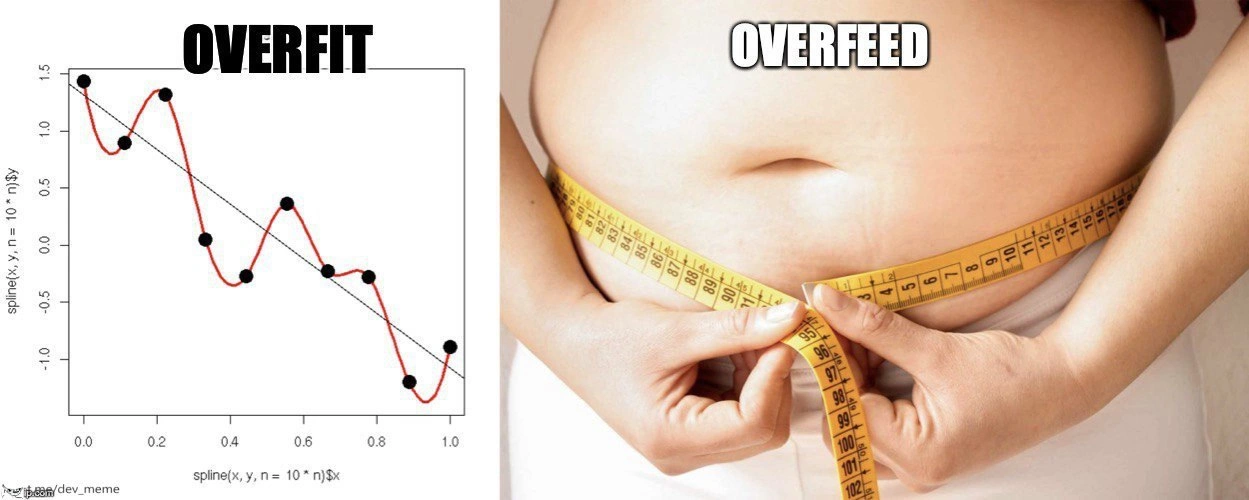
In simpler terms, this meme compares two ideas of “too much of a good thing” – one from technology and one from everyday life. On the left side under “OVERFIT,” we see a graph with black dots (data points) and a red squiggly line trying to go through all those dots. That red line is a spline curve, which basically means a smooth line drawn to pass exactly through each point. In programming, especially in AI and machine learning, “feeding” a model lots of data and giving it a very flexible ability to learn can sometimes lead it to do something like that red line – it learns the random quirks and noise in the training data instead of the actual generalized trend. This is what overfitting means: the model has fit the training data too well. It’s as if a student memorized the answers to every question in last year’s homework (getting those all correct) but then utterly fails the exam because the questions are a little different. The dashed black line in the graph is what a simpler model might do – it draws roughly a straight line through the data, capturing the basic trend (maybe the data overall was going downward). The simple model makes some mistakes on individual points (it’s not going through every black dot), but it’s likely to do better on new unseen points because it’s not chasing every wiggle.

Now the right side, “OVERFEED,” is a photo of someone’s belly with a measuring tape around it. We usually use a measuring tape like that to check our waist size, often when we worry we’ve gained weight. The word “overfeed” isn’t a technical term – it just literally means “fed too much” (like overeating). The idea here is just like a model can be given too much or trained too specifically and becomes overfit, a person can eat too much food and become overfed, ending up with a larger belly. The measuring tape implies this person might have been indulging in a few too many desserts and now the result is showing. It’s a pun: overfit vs overfeed sounds similar, and visually we’ve got an overfit model and an overfed waistline side by side. For someone who knows a bit about machine learning, this is funny because we often talk about “feeding data” to models. If you feed a model irresponsibly – giving it too many chances to just learn the training examples by heart – you get an overfit model (bad!). And if you feed yourself too much cake, you get an overfed body (also not great!). In both cases, the solution is moderation. In ML, we use things like validation data or add some noise (called regularization) to prevent overfitting – basically telling the model “don’t get too fancy, just get the general pattern.” In life, if we don’t want to overfeed ourselves, we watch our portions and maybe skip that second helping of fries. So the meme is a light-hearted way to say: be careful of overdoing it, whether you’re training AI models or eating lunch.

Level 3: Regularization Regimen

For seasoned ML engineers, this meme hits home because overfitting is the ultimate newbie mistake – and a constant threat even for experts. The left panel’s graph is instantly recognizable: those black dots are data points, the dashed line is a simple linear regression (capturing the overall downward trend), and the red line is a spline contorting itself like a circus acrobat to go through every point. That red curve represents a model with way too much flexibility (too high capacity). In practice, this could be like training a 100-layer neural network on 50 data samples: it will absolutely find a way to perfectly predict those 50 samples (probably by essentially memorizing them), but it will fail miserably on the 51st sample it’s never seen. Every experienced data scientist has seen that overly optimistic training plot where accuracy hits 100% and you get suspicious – “Did I just solve AI? …or did I overfit?” Usually, it’s the latter. We’ve all had that sinking feeling after deploying a model that aced the training set, only to watch it predict garbage in the real world. It’s the Machine Learning equivalent of a crash diet that promises quick results but fails when you go back to normal eating.

The meme brilliantly pairs this with “OVERFEED” on the right – a visual of a person measuring their waistline with a tape measure. It’s a perfect everyday analogy: overfeeding means taking in more calories than you burn, resulting in extra body weight (often showing up around the waist). In other words, too much input leading to undesirable output. In the coding and AI world, we sometimes joke about “feeding the model” data – and if you feed it too much of the wrong stuff (or let it indulge in the training set without restraint), you get an overfit model. The tape measure in the image even evokes how we measure error or performance; here it’s measuring inches gained, whereas in ML we’d be measuring accuracy lost on the validation set. Seasoned developers see the parallel: both situations require self-control and balance. In a diet you’d count calories or hit the gym, and in machine learning you’d apply regularization, gather more data, or stop training early to avoid that bloated model syndrome. Just like a healthy regimen prevents weight gain, a good regularization regimen (like L2 weight decay or dropout layers) keeps your model lean and generalizing well.

The humor also touches on lifestyle: many programmers and data scientists can chuckle at the double meaning because late-night coding sessions often involve overfeeding themselves on snacks while possibly overfitting models. It’s a bit of AI humor reflecting real life – picture an engineer at 2 AM, surrounded by empty pizza boxes, tweaking a model that’s starting to memorize the training data. They glance down and realize their belt is getting tighter too. MachineLearningHumor often comes from these relatable experiences. The term “overfit” itself carries a slightly guilty connotation in ML circles (we know we should avoid it, but sometimes in a hackathon or Kaggle competition, the temptation to push for that perfect score is strong). Similarly, “overeat” carries guilt in real life. The meme playfully says: “Hey, we know both kinds of over-indulgence are bad, but we’ve all been there.” It’s a gentle roast of our tendency to overdo things – whether it’s over-engineering a model or having that extra donut during deployment night. In an industry obsessed with optimization, it’s ironically easy to go overboard. That’s why best practices (and doctors!) constantly remind us: simpler models generalize better, and moderate diets keep you healthier.

Level 4: No Free Lunch Buffet

At the deepest level, this meme highlights a fundamental truth in machine learning: more is not always better. In the left panel, the red curve is an extreme example of overfitting – the model is so flexible that it passes through every single data point (the black dots) perfectly. This is essentially a high-degree interpolation (the graph even hints with spline(x, y, n = 10 * n) that it generated a super-fine curve through all points). Mathematically, if you have $n$ data points, you can always fit them exactly with a polynomial of degree $n-1$. But doing so often produces wild oscillations (as shown by that wiggling red spline) – a classic symptom known as Runge’s phenomenon in interpolation theory. The dashed black line on the graph is a much simpler linear trend. According to Occam’s Razor (a principle that the simplest explanation is usually best), the straight line is likely closer to the true underlying relationship, while the crazy red spline is chasing random noise. In machine learning terms, the overfit model has memorized the training data instead of learning the general pattern. It achieves near-zero training error ($E_{\text{train}} \approx 0$), but at the cost of sky-high error on new data ($E_{\text{test}} \gg E_{\text{train}}$). This is because the model’s capacity (its ability to wiggle) has been gobbled up by meaningless fluctuations that don’t generalize.

From a theoretical perspective, this connects to the bias–variance trade-off: an overfit model has extremely low bias (it can approximate the training data very closely) but ridiculously high variance (its predictions swing dramatically with tiny changes in input or dataset). It’s reminiscent of an unregularized high-degree polynomial regression or an overly deep network trained too long – the model effectively gorges on noise. There’s even a cheeky allusion to the No Free Lunch Theorem: in machine learning, you can’t get performance on new data “for free” just by over-cramming the training set. The meme’s caption “Overfit” paired with “Overfeed” wittily invokes no free lunch in its literal sense too – at an all-you-can-eat buffet (free lunch), if you gorge yourself, you pay for it later. Similarly, an overfit model tries to eat up every detail of the training set, but later pays with poor performance on unseen cases. In both situations, the fundamental constraints (whether it’s conservation of energy in a body or statistical generalization limits in a model) assert themselves. You can’t magically break the laws of physics by overeating without gaining weight, and you can’t break the laws of information theory by overfitting without losing predictive power.

This meme also subtly nods to how data scientists and ML engineers combat overfitting. Techniques like cross-validation, regularization (e.g. adding a penalty term to weight coefficients or using dropout in neural nets), and simplifying model architectures are essentially a diet & exercise regimen for the model, preventing it from becoming overfit (or “obese” with noise). Historically, statisticians have long warned against using overly high-degree polynomials or too many parameters – as far back as the 1970s, methods like AIC (Akaike Information Criterion) were developed to penalize excess complexity. The meme distills all that theory into one visual pun. The “OVERFIT” graph screams “too complex!” while the “OVERFEED” belly image screams “too much!” It’s a delightful convergence of academic insight and everyday experience.

Description

A two-panel horizontal meme that creates a visual pun to explain a machine learning concept. The left panel is labeled 'OVERFIT' in bold white text and displays a scatter plot graph with several black data points. A dashed black line shows a simple linear trend, while a complex, wavy red line passes exactly through every single data point, illustrating a model that has perfectly memorized the training data, including its noise. The right panel, labeled 'OVERFEED,' shows a close-up of a person's torso with a yellow measuring tape wrapped around their waist. This meme provides a simple, humorous analogy for the technical concept of overfitting in machine learning. Overfitting occurs when a statistical model or algorithm becomes too complex and begins to describe random error or noise in the data rather than the underlying relationship, making it perform poorly on new, unseen data. The pun 'overfeed' makes this abstract concept instantly relatable to a non-technical, everyday experience

Comments

7
Anonymous ★ Top Pick L1 regularization is skipping dessert. L2 is having just one bite. This model clearly ate the entire cake, cross-validated with a second one, and is now deploying to production with a 100% confidence interval of regret
  1. Anonymous ★ Top Pick

    L1 regularization is skipping dessert. L2 is having just one bite. This model clearly ate the entire cake, cross-validated with a second one, and is now deploying to production with a 100% confidence interval of regret

  2. Anonymous

    Pro tip: apply early stopping to both your training loop and the buffet line - L2 regularization can’t fix a model or a belt that’s already blown past its parameters

  3. Anonymous

    Just like that spline function with n=10*n degrees of freedom, both my neural network and my waistline have discovered that memorizing every single data point from the training set doesn't generalize well to production - one fails on new data, the other fails on new pants

  4. Anonymous

    When your model has more parameters than training samples, it's not learning the pattern - it's just memorizing the menu. This spline has clearly been trained on a dataset of one, achieving perfect training accuracy while completely missing the point. Remember: a model that fits every fluctuation in your training data is like a tailor who makes a suit so specific it only fits you while standing in one exact pose - technically perfect, practically useless

  5. Anonymous

    Both problems have the same cure: regularization - L2 for the weights, L1 for the pantry

  6. Anonymous

    Your neural net and gut both crave that perfect fit, but skip the L2 regularization and watch validation error (or beach photos) skyrocket

  7. Anonymous

    When p >> n and you skip cross-validation, the model binge-eats noise, and regularization is the only diet plan that works in prod

Use J and K for navigation