Viewing The Same Codebase: Gloomy Cliff Versus Scenic Ghibli Vista Bus Ride
Why is this LegacySystems meme funny?
Level 1: Same Ride, Different View
Imagine two kids are in the same playroom, and it’s super messy. There are toys and crayons scattered everywhere. One kid sits in the middle of the room, arms crossed, frowning because all they can think is, “This place is a disaster! What a mess.” Now, the other kid is in that exact same messy room but is excited. This kid is smiling, looking around and thinking, “Wow, look at all these toys! I bet I can find something fun to play with or build a cool fort with all this stuff!”
It’s the same room, the same mess. Nothing changed except how the kids see it. The first child sees only a boring chore and feels gloomy. The second child sees an adventure and feels happy. That’s exactly what’s happening in the meme’s picture: two people sharing the same ride but having completely different feelings about it. One sees only problems, the other sees possibilities. In other words, whether it’s a messy playroom or a big tangle of code, your experience can be negative or positive just based on what you focus on – kind of like sitting on a bus and choosing to look out the window at the dark rocky wall or at the beautiful sunny view.
Level 2: Debts & Daydreams
Let’s put this in simpler terms. Imagine you just joined a software team and they hand you a project that’s been around for ages. This is what we call a legacy codebase – it’s basically an older code project that has a lot of history (and maybe a lot of baggage in terms of code quality). Working with legacy code can feel like exploring an old, dark attic filled with stuff piled up over years. Some of that “stuff” is what developers refer to as technical debt.
Technical debt is a metaphor: it’s like when the original programmers took shortcuts to get things done quickly (say to meet a deadline) but didn’t have time to clean up the code properly. Those shortcuts are like borrowing time – eventually you have to “repay” that debt by fixing or refactoring the messy parts. Just like financial debt accrues interest, technical debt makes future changes harder (the “interest” is the extra time and headaches needed to modify the code later). In our old attic analogy, technical debt is all those cobwebs, wobbly shelves, and boxes of junk that make it hard to find or change anything. One developer looks at this messy old code and feels overwhelmed — that’s the gloomy passenger. You can imagine him thinking, “Ugh, what a huge mess. Every time I try to fix one thing, something else breaks!” That feeling is pure developer frustration: working with the code is difficult and stressful. It’s a very common, relatable experience for developers dealing with aging software.
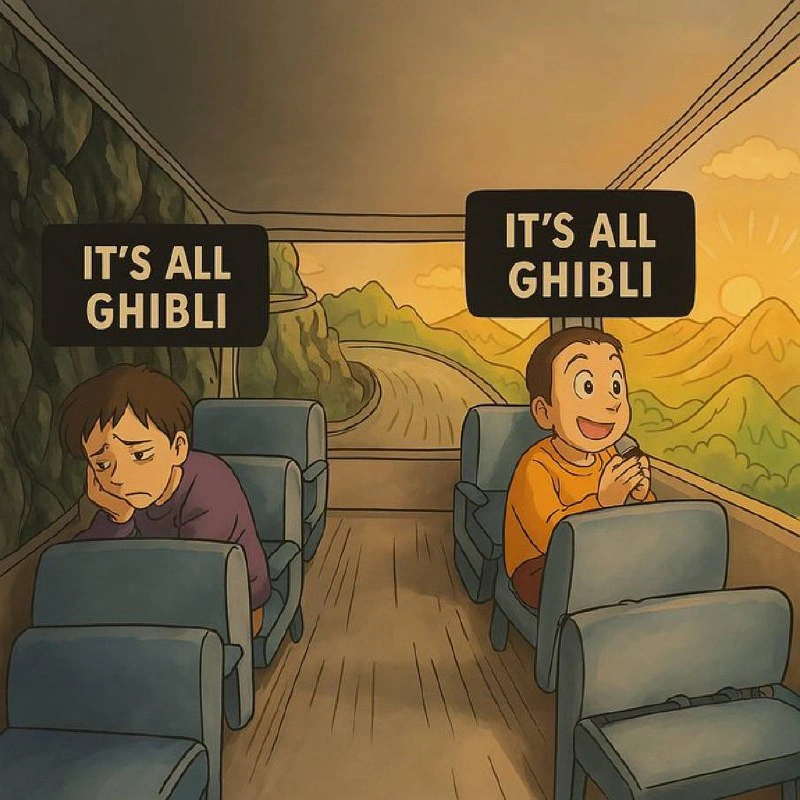
Now, the meme itself plays on a popular scene: two people on a bus with very different views. On the left side of the bus, the pessimistic developer sees a literal rock wall out the window – representing the “wall” of problems in the code. On the right side, the optimistic developer sees a beautiful sunrise over rolling hills – representing hope and possibilities. It’s the same bus ride, but one side looks depressing and the other looks inspiring. This is a classic optimist vs. pessimist metaphor: the situation is the same, but one person focuses on the bad view, the other finds the good view.
In this version, both speech bubbles say “IT’S ALL GHIBLI.” So what does that mean? Studio Ghibli is a famous Japanese animation studio known for its gorgeous, magical movie scenes (imagine the breathtaking landscapes in films like My Neighbor Totoro or Spirited Away). Saying “It’s all Ghibli” implies seeing something as whimsical or beautiful, like a scene from those movies. The happy developer on the right is literally looking at a Ghibli-style sunrise outside. He’s basically saying, “This codebase is awesome – it feels like a beautiful world I get to work in!” He sees the legacy code as fun and full of potential, almost like a fantasy landscape where he can go on an adventure by refactoring and improving it. Refactoring means cleaning up and reorganizing the code without changing what it actually does – sort of like tidying a messy room so that everything is neat but nothing new is added. Many programmers find refactoring satisfying, and clearly the right-side passenger is one of those people. He’s excited, maybe thinking about implementing new designs or modern practices to transform the old code into something elegant.
Meanwhile, the left-side developer also says “It’s all Ghibli,” but look at his face – he’s miserable. He’s using the same phrase in a totally different way. He might be saying it with heavy sarcasm, like, “Yeah right, so magical. This is nothing like a fairy tale, it’s a nightmare.” To him, comparing the ugly code to Ghibli’s beauty is absurd, and he’s kind of mocking that idea. In other words, he doesn’t see any magic in this situation at all. He sees the codebase as dark and frustrating, more like a big scary cave than a sunny hillside. So even though both devs are saying the identical words “It’s all Ghibli,” one means it in a positive, excited way and the other in a negative, defeatist way.
Neither of these reactions is unusual. When confronted with a messy legacy system, developers often split into these two mindsets. If you’ve ever opened a big project that someone else wrote years ago, you might have felt that shock: “Whoa, this is so confusing. Why did they do it this way?!” That’s the gloomy cliff feeling – it can make you want to close the code editor and cry. But there’s also the opposite reaction: maybe you think, “Hey, I know how to make this better!” Perhaps you’ve learned a new framework or pattern and you see exactly where it could help. That enthusiasm is the sunny view – it makes you want to roll up your sleeves and start improving the code.
For example, let’s say the legacy code is written in an old style, using a framework that was popular 10 years ago. The pessimistic dev will worry: “If we try to update this, everything might break. It’s working okay right now, so maybe just leave it.” The optimistic dev will say: “If we update this to a modern framework, it’ll run faster and be easier to maintain. Let’s do it!” The first sees risk, the second sees reward. Both have a point: updating an old system is risky, but not updating it means carrying that baggage longer. This meme just dramatizes those points of view to an extreme for humor.
We often tag these situations as DeveloperHumor or RelatableDeveloperExperience because almost every programmer can see a bit of themselves in both passengers. Early in your career, you’re more likely to be the person excited about redesigning everything (everything is new and fun to you). After you’ve been called at 2 AM because an “innocent” change brought production down, you learn caution and might become a bit more like the grumpy guy who prefers the devil he knows. It’s actually healthy for a software team to have a mix of both: the enthusiasm to improve things and the wisdom to do it carefully.
One more term to clarify: Developer Experience (DX). This refers to how it feels for a developer to work on a project or with a tool – basically, how smooth or painful the process is. In this meme’s story, you could say the codebase provides a very poor developer experience for the guy on the left (he finds it tedious, confusing, and annoying), whereas the guy on the right is having a strangely good experience because he’s enjoying the challenge and the creativity of it. And what’s funny is that the code itself is the same for both; it’s their perspective that makes the experience different.
To sum up, this meme humorously shows two ways a programmer might react to the same messy situation:
- Pessimistic view: “This is awful, everything here is broken and hopeless.” (That’s our gloomy cliff-side passenger.)
- Optimistic view: “This is cool — we can fix this and make it great!” (That’s the sunny Ghibli-side passenger.)
They even use the exact same words “It’s all Ghibli” to describe it, but one says it with a defeated sigh and the other with an excited grin. It’s a lighthearted reminder that in coding (and in life) the same ride can feel totally different depending on your outlook.
Level 3: Battle-Scarred vs Starry-Eyed
In this meme’s coding road trip, two developers sit on the same project bus but see completely different scenery. They’re both looking at the exact same legacy codebase, yet one side is a shadowy tech debt cliff and the other is a radiant Studio Ghibli sunrise. The left passenger is the battle-scarred veteran engineer: slouched, weary, and all too familiar with the dark rock wall of a legacy system that’s right outside his window. He sees the code as a sheer face of accumulated technical debt – years of quick-fixes, deprecated APIs, and temporary hacks turned permanent. This view is grim: every bump in the road reminds him of a production outage or a 3 AM emergency patch.
Across the aisle, the right passenger is the starry-eyed optimist (perhaps a new hire or just an incurable enthusiast). To them, that same old codebase looks like a world of whimsical refactor opportunities. They gaze out at pastel mountains and a hopeful sunrise, imagining the legacy app transformed into something straight out of a Studio Ghibli film – elegant, magical, and better than ever. In other words, “sure, the code’s a mess now, but think of the elegant design patterns and shiny new frameworks we could introduce!” This developer’s excitement is practically bouncing in the seat: they see an adventure where the cynic sees a horror story.
A brilliant touch here is that both characters’ speech bubbles say “IT’S ALL GHIBLI.” Same words, totally different tone. The gloomy dev might be muttering it sarcastically under his breath – meaning “this code is an unrealistic fantasy (and not in a good way)”. Meanwhile, the cheerful dev is exclaiming “It’s all Ghibli!” with genuine delight – as if to say “this codebase feels like a magical Ghibli world to explore!”. The meme humorously captures how attitude colors interpretation: one developer’s dream is another’s nightmare, even when they’re literally using the identical phrase.
This comedic contrast resonates with any team dealing with LegacySystems full of TechDebt. One engineer sees a spaghetti code disaster where every function call could hide a trapdoor. The other sees a puzzle they can’t wait to solve, like untangling spaghetti into a neatly plated dish. It’s poking fun at a real-world dynamic: the pessimist vs optimist (or call it realist vs idealist) approach to old code. We’ve all sat in meetings where someone groans, “This module is a ticking time bomb, don’t touch it unless you have to,” while another teammate chimes in, “Actually, if we refactor this, we can add features and improve performance!” The meme exaggerates it by literally drawing one side of the bus in darkness and the other in light, but it’s not far from reality on many dev teams.
Let’s break down the two perspectives in a more concrete way. They’re essentially looking at the same facts with opposite interpretations:
| Gloomy Developer | Optimistic Developer |
|---|---|
| “This code is held together by hacks and prayers.” | “This code just needs a little love and it’ll shine.” |
| “If we touch that part, the whole app might crash.” | “If we refactor that part, the app will run smoother.” |
| “We’ve accumulated so much tech debt, it’s hopeless.” | “Yeah, there’s debt, but we can pay it down gradually!” |
| “The last guy who ‘improved’ this triggered a production outage. 😞” | “This time we’ll do it right and make it better! 😃” |
Each row above is essentially them both saying “It’s all Ghibli” about the code, but the cynic interprets “Ghibli” as chaos, and the optimist as wonder.
From a seasoned developer’s standpoint, this meme cuts deep. The left-side dev likely earned that gloom by witnessing well-intentioned refactors go awry. Maybe they remember when someone tried to “modernize” the codebase and ended up introducing a ton of bugs, causing a week of firefighting. Their skepticism isn’t just grumpiness – it’s scar tissue. Over years, they’ve seen how a seemingly small change in a legacy system can cascade into major issues (like pulling a thread that unravels the whole sweater). Tech debt in a large codebase can create hidden dependencies: an old global variable or a bizarre workaround that, if removed, makes the whole thing fall apart. The dark rock wall outside the bus is a perfect metaphor for that feeling of being boxed in by past decisions. It’s the “we can’t move fast here, everything’s too brittle” mindset born from hard experience.
On the flip side, the optimistic developer’s attitude is often seen in those who haven’t been burned yet – or who just have an infectious enthusiasm. This might be the person who just read a blog on the latest framework or saw a conference talk on “refactoring legacy codebases” and feels inspired. They genuinely look at the old code and see potential. That overgrown code isn’t scary; it’s like an old garden that just needs weeding and some care to bloom again. The meme’s right side with the scenic Ghibli vista (soft green hills, a bright sunrise) perfectly captures that hopefulness. It’s the “look what this could become!” outlook that newer team members or passionate Developer Experience advocates often bring. They treat the legacy code as if it were a classic car: sure, it’s a bit rusty, but imagine restoring it to glory.
This meme is also a commentary on morale and developer experience (DX). The environment is the same bus (same codebase, same job), but the emotional experience is totally different. The left engineer likely dreads opening this project in their IDE each morning – they expect frustration, confusion, and maybe blame when things break. The right engineer might actually be excited to dive into the code, treating it like a fun challenge or a chance to shine by improving things. It highlights a shared experience in software development: two people can share the same code and yet live in different mental worlds. That’s relatable humor because many devs have felt both of these ways at different times. Some days you’re energized to clean things up; other days the same code crushes your soul.
Historically, the industry has repeatedly swung between these two mindsets. There’s a famous essay by Joel Spolsky advising never to rewrite code from scratch – because he saw companies destroy themselves chasing the optimistic dream of a perfect rebuild. One well-known example is Netscape: they threw out their successful browser’s code to rewrite it “the right way,” and that ambitious do-over took so long that competitors (like Internet Explorer) swooped in and took over. That’s the cautionary tale the battle-scarred dev on the left is remembering: “We’ve been down that road, and it wasn’t the scenic route they promised.” There’s also the flip side: sometimes a bold refactor or fresh outlook does pay off, rejuvenating a project that everyone thought was a lost cause. The optimist is banking on being the hero who turns the clunky legacy app into a streamlined modern service.
In practice, teams learn to balance these viewpoints. Too much gloom and you’ll never improve the code (you’ll just keep slapping duct tape on that rock wall). Too much rosy optimism and you might underestimate the effort or risk, and drive the project off a cliff when reality doesn’t match the daydream. The meme’s humor lies in how extreme the difference is drawn, yet every developer recognizes a bit of truth in it. We’ve all met the colleague who calls the code “garbage” and warns “leave it alone if it works,” sitting right next to the colleague who says “This is fine, we can totally refactor it, trust me!” – sometimes they’re even both right, each in their own way.
Ultimately, “IT’S ALL GHIBLI” here is a tongue-in-cheek way to say that perspective is everything. The codebase itself isn’t inherently a cliff or a vista; it’s the developers’ outlook that makes it seem gloomy or hopeful. Experience (and maybe a few all-night debugging sessions) often nudges people toward the left side of the bus, whereas fresh eyes or an imaginative mindset can find beauty even in legacy chaos. That contrast – between battle-hardened realism and starry-eyed idealism – is what makes this meme hilariously spot-on. It’s a snapshot of the daily mental tug-of-war in software development: maintain the old or boldly reinvent it? Survive the rocky road or reach for the sunrise? Both passengers are buckled in for the same ride, but their internal journey couldn’t be more different.
Description
Illustrated riff on the classic two-passengers-on-a-bus meme. Interior shows a narrow coach aisle with blue seats and wooden flooring; outside the left window is a dark rock wall while the right window reveals a radiant sunrise over pastel mountains. Both characters have speech bubbles in bold white capitals reading “IT’S ALL GHIBLI,” but the left rider slouches sadly against the window and the right rider grins eagerly at the view. Faces are blurred for anonymity. The visual contrast mirrors how two engineers can examine the exact same legacy codebase - one only sees the overgrown tech-debt cliff, the other imagines a whimsical Studio-Ghibli-style refactor adventure

Comments
6Comment deleted
Two staff engineers board the same 2-million-line monolith: one spots the looming rock-wall of side effects, the other sees a Catbus-ready microservice adventure - either way, soot sprites are what your error logs call “unexpected null.”
When you realize your entire microservices architecture is just Conway's Law with extra steps, but the PM behind you has been shipping org chart features to production for years
When you finally realize that every 'innovative' design system your team has built over the past decade is just Material Design with extra steps, or Bootstrap with rounded corners, or that one Dribbble shot everyone copied. Just like how every beautifully animated scene seems to trace back to Ghibli's influence, every modern UI framework is essentially just a rebranding of the same foundational patterns - we're all just shipping variations of the same design tokens with different marketing. The real architectural decision isn't choosing a unique approach; it's admitting we're all iterating on the same canonical implementations and calling it 'our design language.'
After two decades of migrations, I’ve learned the scenery changes - monolith to microservices, on-prem to cloud - but the executive deck still concludes “It’s all Ghibli”: same patterns, new branding, and observability costs that stubbornly refuse to trend down
Pick any seat - our architecture diagram is just a screenshot of package-lock.json; it’s all GH lib
AI image models overfitted on Ghibli datasets: no matter your prompt, every gen spits out enchanted buses and forest spirits