Skip to content
DevMeme
6017 of 7435
Bell-curve meme on over-complicating tech stack decisions
DesignPatterns Architecture Post #6585, on Mar 27, 2025 in TG

Bell-curve meme on over-complicating tech stack decisions

Why is this DesignPatterns Architecture meme funny?

Level 1: One Tool for Everything

Imagine you have a big box of LEGO blocks. There’s a kid who just takes a handful of basic bricks and builds all sorts of things with them. Maybe he doesn’t know about the fancy specialized pieces, but he manages to create a nice simple castle that’s sturdy. Now there’s an older kid who’s learned about all the special LEGO parts (like gears, hinges, custom figurines) and insists, “No, you can’t just use the plain bricks for everything! We need to use these fancy pieces for the door, those unique pieces for the windows, and this complicated gear system for the drawbridge!” He starts adding so many special pieces that building the castle becomes confusing and it takes forever, and the castle might even fall apart because it got too complicated. Finally, imagine a master LEGO builder (like an adult who’s been building for years). She quietly smiles and also uses mostly the simple bricks – maybe she adds one or two special pieces only where it’s really needed – and quickly builds a beautiful, solid castle. In the end, her castle and the little kid’s castle are both standing nicely, while the over-complicated one of the older kid is half-finished and kind of shaky.

In this story, the first kid and the master builder both understood one thing: you can do a lot with just a few reliable pieces used in a consistent way. The overly excited kid in the middle who knew about all the options ended up slowing himself down by trying to use everything. That’s the joke of the meme: sometimes, whether you’re just starting out or you’re very experienced, you realize that keeping it simple works best. It’s only when we’re in that in-between stage of learning, feeling we have to prove how clever we are, that we complicate things more than we need to. The meme uses this idea to make us laugh, because we’ve all seen someone (or been someone) who tried to “do too much” when a basic approach would have worked just fine. In short, it’s saying: often one good tool or one clear method for everything is better than mixing in every fancy trick you know. Sometimes, one size really does fit all, and that can be both smart and effective.

Level 2: Too Many Tools

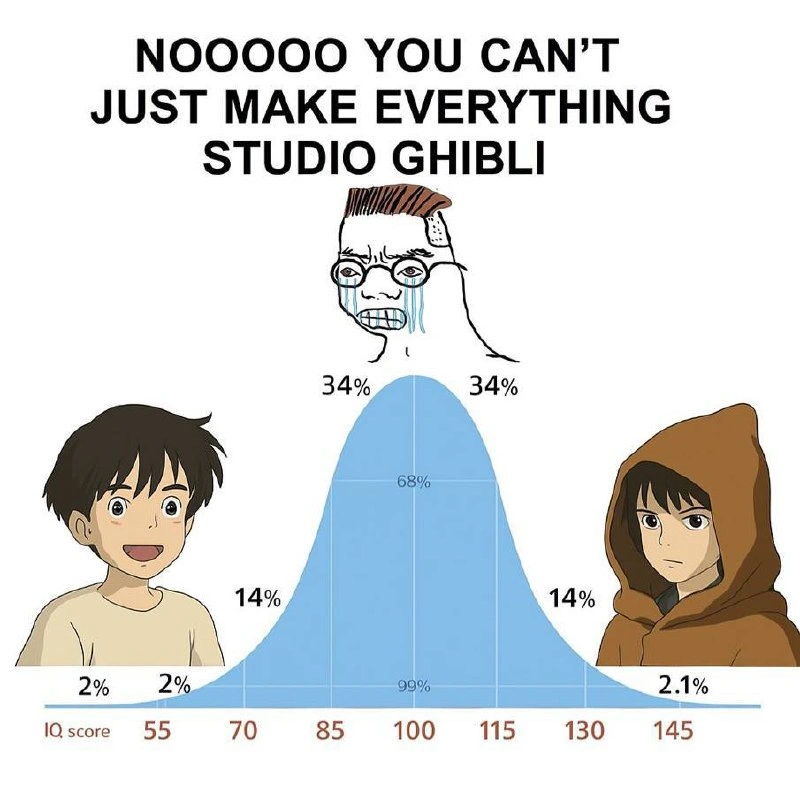
Let’s break down what this meme means in plain technical terms. It’s highlighting the classic issue of over-engineering versus keeping things simple. In software development, the tech stack means all the technologies you use to build your product – programming languages, frameworks, databases, services, etc. Sometimes engineers get excited and add too many tools or complicated designs to a project when a simpler approach would work. This meme uses the funny IQ bell curve image to tell that story. On the left side (low IQ score), we have a happy young anime character (drawn in the style of Studio Ghibli, a famous Japanese animation studio known for its consistent and beautiful art). This character represents a junior developer or someone new, who says in effect, “Let’s just use one approach for everything, it’s fine.” On the right side (high IQ), there’s another calm anime character (also Studio Ghibli style, maybe representing a wise senior developer or architect), who also says, “Yes, actually, using one consistent approach for everything can be a great idea.” Now, in the middle of the bell curve, there’s a drawn Wojak figure – a meme character often used to depict someone upset or overthinking. This middle person is the mid-level developer, and he’s yelling, “NOOOOO YOU CAN’T JUST MAKE EVERYTHING STUDIO GHIBLI!” which translates to “No, you can’t just do everything in one simple style or with one tool!” He’s basically freaking out because he believes that using a single approach for all parts of the project is wrong or too simplistic.

So why is he upset? Mid-level developers often have enough knowledge to know multiple ways of doing things, and they might feel every component should use the “best” specific tool or pattern. For example, imagine a project that needs a database, a backend, and a frontend. A junior might just use one general-purpose programming language they know for both the database interactions and the server, keeping it straightforward (like using JavaScript for everything with a simple design). A very experienced developer might intentionally make the same choice of sticking mostly to one language or one framework across the project, because they know it keeps the system easier to understand and maintain (this is called standardization – using a standard set of tools). But the mid-level person might protest: “No! The database should be this new XYZ database, and the backend should be split into five different microservices (small separate programs) each using the ideal language for that part, and the frontend should be this hottest new framework, etc.” They have a lot of ideas and have seen many technologies, so they think not using each specialized tool is a missed opportunity or a sign of being lazy. This tendency to add complexity is sometimes jokingly called “hype-driven development” – choosing tech because it’s hyped or trendy, not necessarily because the project truly needs it.

The phrase “make everything Studio Ghibli” in the meme is a metaphor. Studio Ghibli movies all have a certain look and feel – you could say they all use the same “technique” to create a cohesive, familiar experience. In a tech team, “making everything Studio Ghibli” means adopting one consistent approach everywhere. For instance, maybe the team decides: we’ll do the entire web application in JavaScript (Node.js for the server and React for the frontend, for example) and stick with a relational database like PostgreSQL for all data. That’s one stack, consistently used. A junior dev might be okay with that because it’s the one way they know. A senior dev often also favors that because they’ve seen projects succeed with simplicity and fail when over-complicated. But an intermediate dev might feel that’s oversimplifying; they might argue, “Shouldn’t we use separate microservices with different languages? Shouldn’t we try a NoSQL database for this part? And maybe add a message queue just in case? Using one style everywhere seems like we’re not using the ‘best tool for each job’!” This is where the term over-engineering comes in – it means designing a solution that's more complicated than it needs to be. Over-engineering often happens when someone has learned a bunch of new techniques and is eager to apply all of them, or when they’re trying to anticipate every possible future need (even ones that might never happen). There’s a famous principle called YAGNI: “You Aren’t Gonna Need It,” which warns engineers not to add functionality or complexity until it’s actually needed. A related principle is KISS, which stands for “Keep It Simple, Stupid,” a cheeky way of saying simple solutions are usually better. The junior on the left and the senior on the right of the meme are basically following YAGNI and KISS, even if they don’t say it explicitly. They’re fine with a simple, unified solution that works. The mid-level guy in the middle is the one violating those principles out of an excessive desire to be “optimal” or up-to-date with every trend.

To put it plainly, this meme is about DecisionMaking in engineering and how experiences at different levels influence choices. It’s common in IndustryTrends to see waves of hype where everyone says “you must use this new tool or you’re doing it wrong.” A mid-level dev might be very influenced by this hype. For example, a few years ago container orchestration (like Kubernetes) became a huge buzzword. Some teams jumped into using Kubernetes for very simple applications that didn’t really need that level of complexity – sometimes causing more headaches than benefits. A senior engineer who had been through similar hypes might say, “Actually, a simple single server or a Platform-as-a-Service would do the job here; we don’t need an entire complex Kubernetes cluster for a small app.” And a junior might just say “okay” because they trust the simple approach or don’t know about Kubernetes at all yet. The meme humorously consolidates that scenario: the “extremes” (novice and experienced) are aligned in choosing simplicity, and the middle is pushing complexity. It also touches on tool standardization: having everyone on the team use the same set of tools can be very beneficial. It means fewer things to learn, and everything works in a predictable way. The middle person’s fear – “you can’t just do everything the same!” – comes from the genuine fact that sometimes one size doesn’t fit all. Of course, there are cases where using a special tool is the right call. But the joke here is that the mid-level dev is making that complaint even when one approach would work fine, because he assumes more complexity = smarter.

To clarify some terms from the meme and context:

  • Architecture bikeshedding: This refers to spending a lot of time in meetings arguing about minor architectural choices (like what frameworks or tools to use) rather than focusing on the bigger design or actually building the features. It’s called “bikeshedding” because of an old story where people spent time arguing over the design of a bikeshed instead of more important matters. In tech teams, you might see long email threads or calls debating “Should we use library A or B?” for something minor, which is exactly what a mid-level might do when he objects to a default simple choice.
  • Midwit Wojak: “Midwit” is internet slang for someone of middling (average) intelligence who often acts like they know more than they do. Wojak is a meme character (usually a drawn, bald humanoid face with various emotions). Here, the midwit Wojak is the crying guy in the meme, representing the average developer who thinks he’s being smart by rejecting the simple plan. It’s a tongue-in-cheek way to label that middle character as someone overthinking things.
  • Studio Ghibli: As mentioned, it’s a film studio with a very recognizable style. In this meme, it’s a metaphor for using one unified style or technology everywhere – presumably something charming and reliable. It’s a bit like saying “make everything like a Ghibli movie” meaning make it all consistently good in the same way. The absurdity of “make everything Studio Ghibli” is what makes the mid-level dev freak out in the meme – taken literally, it’s a silly idea (you can’t turn every project into a Ghibli film), but metaphorically it means having one vision/approach for all parts of a project.
  • Overengineering: This is when someone designs a solution that is far more complex than needed for the problem at hand. Think of building a high-tech robotic arm to butter your toast – sure, it might work, but a simple knife would do the job with much less fuss. Developers sometimes overengineer by using elaborate patterns, too many microservices, or the newest tech (which might not be stable) just to feel they’ve covered all bases or to use their new knowledge. It often backfires by making the system fragile or hard to develop further.

In simpler projects or early in your career, you might not even have the option to over-complicate – you use what you know and what’s available. As you gain experience, you learn about all these cool tools and it’s tempting to use them all, but wisdom (what the senior has) is learning which ones to leave out. This meme is a fun reminder that sometimes the simplest solution really is the smartest. It suggests that being a good engineer isn’t about cramming in every advanced concept you’ve learned. It’s about knowing when a straightforward, consistent approach is actually the optimal one for the team and the project. In fact, many EngineeringTradeoffs come down to choosing simplicity (fewer moving parts, easier debugging, lower immediate performance maybe) vs. complexity (more moving parts, potentially more optimized in specific areas, but harder to manage). Good decision making is finding that balance, and often erring on the side of simplicity, especially at the start of a project.

To illustrate the different perspectives:

  • Junior developer approach: “I’ll just use the one programming language or framework I’m comfortable with to build the whole thing.” (Simple by necessity, it’s the only thing they know – but it often works out!)
  • Mid-level developer approach: “Let’s use the best tool for each part: maybe a special database here, a new language there, microservices everywhere, and a different caching system for each layer. We can mix and match all the latest tech.” (Complexity for the sake of optimization or trend-following – can be risky if done all at once.)
  • Senior developer/architect approach: “Let’s stick with a coherent set of technologies we know well for 90% of the project. We’ll only introduce a new tool if there’s a very clear, proven need that our standard tools absolutely can’t handle.” (Simple by choice, informed by experience – they aim to reduce unnecessary complexity and avoid the maintenance nightmare of too many moving parts.)

The meme basically says the junior and the senior are on the same page here despite their difference in skill: both agree on a single simple solution (making everything “Studio Ghibli,” i.e., consistent and proven). The mid-level is the one disagreeing loudly because he’s concerned about not using all his shiny new knowledge. It’s a lighthearted jab at the eager, sometimes overconfident stage in an engineer’s career. If you’re a newer developer seeing this meme, the takeaway is: don’t worry if a solution feels “too simple.” Often, simple is exactly what you want. And if you’re at that intermediate stage, it’s a reminder not to dismiss a straightforward approach just because it isn’t complicated. In architecture and design, simplicity is a virtue. As one famous saying goes (attributed to Einstein): “Everything should be made as simple as possible, but not simpler.” The trick is knowing where to draw that line – and the meme jokingly suggests that the extremes of the experience spectrum tend to draw it closer to simple than the folks in the middle do.

Level 3: The Bikeshedding Curve

This meme nails a familiar scenario in software companies: the raging debate over how many tools, frameworks, and services to stuff into a project versus keeping things consistent. The bell-curve format (a favorite in developer humor) shows a crying mid-level engineer caricature (the Wojak cartoon in the middle) losing his mind because his colleagues suggest a one-style-fits-all approach – symbolized by making everything “Studio Ghibli.” On each end of the IQ curve, we see two calm anime characters drawn in Studio Ghibli’s wholesome style, completely unfazed. These represent the junior dev on one extreme and the seasoned architect on the other. Both are cool with using a simple, uniform tech stack for everything. It’s only the middle-of-the-pack developer who is yelling “NOOOO, YOU CAN’T JUST MAKE EVERYTHING THE SAME!” as if such standardization were a cardinal sin. This visual gag is poking fun at architecture bikeshedding: endless discussions and arguments over minor technical choices (like what new library or database to use) by those who feel knowledgeable, while missing the larger point that a straightforward solution might suffice. The term bikeshedding (inspired by Parkinson’s Law of Triviality) comes from the idea that a committee might spend hours arguing about the color of a bikeshed while hurriedly approving a nuclear reactor design – meaning teams often give outsized attention to trivial choices because they’re easier to grasp than the hard problems. In our context, which fancy tech stack to adopt becomes that trivial bikeshed everyone passionately repaints, while delivering a working, maintainable system is the real “reactor” being sidelined. The meme humorously suggests that junior devs (too new to know all the cutting-edge options) and senior devs (wise enough to avoid unnecessary complexity) both skip the bikeshedding and just get the job done with a consistent approach. It’s the folks in the middle of their journey who fall into the hype-driven development trap – chasing the latest shiny tool or over-designing the architecture to prove their “smartness.”

In real-world terms, this could be the debate between a monolithic architecture and a microservices fiesta. The junior might build everything in, say, a single JavaScript or Python codebase simply because that’s the one tool they know and it works. The senior might also advocate for a monolith (or a well-integrated set of tools all in the same ecosystem) because they’ve lived through the pain of maintaining fifty microservices for what could have been one application. Meanwhile, the mid-level engineer is often eager to slice everything into microservices, use 12 different databases (each one “the perfect choice” for a sub-problem), add an event queue, a graph database, two caching layers, and deploy it all on a cutting-edge container cluster just because. They have enough knowledge to know these technologies exist and have cool advantages, but not enough scars to appreciate the overhead and technical debt this smorgasbord can create. It’s a classic IndustryTrend scenario: for a few years everyone hype-trains on microservices or a specific JavaScript framework (Angular, then React, then Vue, then Svelte…), and some engineers insist on adopting each new thing immediately. Yet old-timers know how these trends can fizzle out or introduce new problems. They’ve seen Hype-Cycle curves rise and fall. As a result, experienced architects often preach “use the right tool for the job, but prefer fewer tools overall.” In practice that means picking a reasonably good, standard stack and sticking with it for consistency and simplicity, unless there’s a truly compelling reason to introduce something new. The mid-curve guy in the meme embodies those who constantly push for the nuanced complexity – e.g. “we need a separate service written in Rust for user analytics because Rust is fast,” even if the existing setup in Python would handle it fine. They fear the one-size approach as “naive” or not optimized, perhaps to prove their engineering chops. But the joke is on them when the project becomes a Frankenstein that’s hard to understand, hard to integrate, and hard to maintain.

This Simplicity vs. Complexity tug-of-war plays out in design meetings all the time. The meme captures the emotional truth of those meetings: the mid-level dev, full of enthusiasm and ego, goes “Nooo! It’s not best practice to do it all in one framework! We should diversify and use the best tool in each layer.” The salty staff engineer across the table just raises an eyebrow and says, “We’re making a CRUD app… how about we just stick to the stack we know works?” Interestingly, the newbie on the team often also shrugs and follows the simplest suggestion because they’re not comfortable with exotic tech yet. And indeed, nine times out of ten, the simple unified stack is chosen in successful teams because it minimizes risk and cognitive load. The senior knows that every new language or service is an additional point of failure and an integration challenge down the line (not to mention a pager alert at 3 AM waiting to happen when one of those fancy services misbehaves). They’ve been on the hook for systems where half the microservices mysteriously went down due to some network config bug, or where an overly complex pipeline caused deployment nightmares. A grizzled architect might joke: “Sure, let’s rewrite everything in five different languages. That will be fun to debug in production!” – a sarcasm born of hard-earned experience.

The Studio Ghibli reference in the meme is a clever metaphor for a unified aesthetic or approach. Studio Ghibli, famed for its consistently beautiful animation style and quality storytelling, stands in for a tech stack that is consistent and high-quality throughout. The low-IQ Ghibli character (at 55 IQ on the left) is smiling and basically saying, “Why not make it all Studio Ghibli? It’s nice!” – paralleling a junior dev thinking, “Why not just use the one library I know for everything? It works!” The high-IQ Ghibli character (at 145 IQ on the right, perhaps a wise hooded protagonist type) is stoically agreeing, implying, “Indeed, make it all Studio Ghibli – a cohesive vision yields the best result.” That’s the senior: “Let’s use one solid framework for the whole project to keep it cohesive.” It’s only the poor midwit Wojak in the middle (around IQ 100 in the chart) who is crying, with the caption “NOOOOO YOU CAN’T JUST MAKE EVERYTHING STUDIO GHIBLI!” This mimicry of that meme trope highlights how mid-range engineers often protest simple plans: they see all the potential exceptions and alternatives and get anxious that a one-style solution might be too unsophisticated or might not use the “cool” new tech they read about on Hacker News. They are essentially overthinking the architecture – hence the direct parody of the “midwit” meme format.

The humor resonates with developers because we’ve all either been that person or dealt with that person in meetings. It reflects an engineering decision-making rite of passage: initially you don’t know better and do the simplest thing. Then you learn a bunch of patterns, frameworks, and shiny techniques and start applying them everywhere (often unnecessarily). Finally, you mature and realize why the simple approach often wins, coming full circle. There’s also a bit of industry self-mockery here: the IndustryTrends of adopting new hyped tech every quarter can lead to absurd situations where a team’s tech stack looks like a “museum of half-used tools.” Companies sometimes suffer from tool proliferation – too many programming languages, frameworks, build systems, etc., all coexisting poorly. Forward-thinking organizations counter this with tool standardization guidelines, essentially saying “pick one Ghibli art style and stick to it” for clarity and maintainability. That standardization might sound boring to the mid-level hotshot who wants to experiment with everything, but it’s a lifesaver for long-term maintenance and scalability. This meme jokes about that dynamic in a lighthearted way. Both the green newbie and the wise architect are effectively saying, “Calm down, making everything uniform isn’t a disaster – it might actually be the smartest move.” And the truth in tech is: when in doubt, err on the side of simpler architecture. You can almost hear the senior’s inner voice when looking at the rightmost character: “Relax, kid, I’ve seen where your 12 microservices rabbit hole leads, and it ain’t pretty. Let’s just make it all Studio Ghibli and have a nice day.”

Level 4: Second System Syndrome

In the upper echelons of software architecture theory, there's recognition that over-engineering often stems from a well-intentioned but misguided leap in complexity. Seasoned engineers talk about Second-system syndrome – a term from Fred Brooks’s classic The Mythical Man-Month. It describes how an engineer’s sophomore project (or a mid-career architect’s new grand design) tends to bloat with every fancy feature and tool they couldn’t squeeze into the first system. In our meme’s context, the mid-tier developer perched atop the IQ bell curve is falling squarely into this trap: insisting on a smorgasbord of specialized technologies for each component, rather than a single consistent style (the “Studio Ghibli” approach the meme mentions). The joke is that the midwit (middle-intelligence character) is over-complicating tech stack decisions as if complexity itself were a badge of honor. This is a known failure mode in system design – the assumption that a more intricate assembly of parts must be better.

From a theoretical lens, this humor taps into the dichotomy of essential vs. accidental complexity. Essential complexity is the irreducible difficulty of the problem at hand; no matter what, some tasks are hard. Accidental complexity, on the other hand, is all the extra convolutions we introduce through our design choices, tools, and integrations. The mid-level engineer yelling “NOOOOO YOU CAN’T JUST MAKE EVERYTHING THE SAME!” is effectively championing accidental complexity – adding new frameworks or microservices around each corner of the codebase, believing each specialized piece optimizes something. The enlightened junior and senior on either end of the bell curve instead favor reducing accidental complexity: they’re comfortable using one proven approach everywhere, keeping the design as simple as possible until more complexity is truly justified. This aligns with classic wisdom: Occam’s Razor in philosophy and the KISS principle (“Keep It Simple, Stupid”) in engineering both argue that among solutions with similar outcomes, the simplest one is often best.

There’s even a hint of cognitive science behind the meme’s setup. It parallels the Dunning-Kruger effect curve (a different kind of knowledge vs. confidence graph) where beginners are humble (knowing they know little), intermediates are over-confident (prone to elaborate strategies), and experts regain humility (realizing the value of simplicity and the limits of their knowledge). This bell-curve meme caricatures that idea: the novice and the seasoned expert oddly agree on a straightforward approach, while the intermediate dev is convinced that only a nuanced, over-engineered solution could possibly be correct. The far-right anime character (high IQ) isn’t actually advocating ignorance of advanced techniques; rather, like a Zen master of tech, he’s reached the understanding that standardization and conceptual integrity across a system trump the patchwork of every shiny new tool. It’s the tech equivalent of enlightenment: after climbing the mountain of complexity, you arrive back at simplicity – but with full awareness of why the simple approach is powerful.

In distributed systems and architecture circles, this humor also nods to real constraints: every new service, language, or database you introduce is another potential failure point and an integration pain. Networks can partition, data models drift, and fancy frameworks have sharp learning curves. Wise architects often quote Gall’s Law: a complex system that works is invariably found to have evolved from a simple system that worked. In other words, start simple and let complexity grow naturally if needed – don’t start with a complex blueprint from scratch. The bell-curve meme brilliantly captures this principle. The frustrated midwit screaming about “making everything Studio Ghibli” doesn’t realize the engineering trade-off at stake: by minimizing the number of different technologies (one art style, metaphorically), you minimize the “interface surface” where things can go wrong. In a way, the far-right Ghibli-robed guru knows that a cohesive architecture – even if somewhat monolithic or repetitive – can achieve eventual consistency in the development process (fewer surprises, smoother onboarding, less time spent chasing incompatibilities). Meanwhile, the mid-tier’s heterogenous stack could collapse under its own complexity, a victim of overengineering and unmet promises of some “silver bullet” tech. The meme exaggerates it to humorous effect, but it’s grounded in this reality: in tech, simplicity is often an advanced skill, earned by witnessing the failure of needless complexity.

Description

Meme with a white background features a classic IQ bell-curve (scores marked 55, 70, 85, 100, 115, 130, 145) and the familiar distribution percentages (2 %, 14 %, 34 %, 34 %, 14 %, 2.1 %). At the peak, a distraught stick-figure ‘midwit’ Wojak yells in bold text above the chart: “NOOOOO YOU CAN’T JUST MAKE EVERYTHING STUDIO GHIBLI”. On the far left of the curve (low IQ) and far right (high IQ) are two calm anime characters in Studio-Ghibli style, both unfazed by the complaint. Visually it parodies the recurring “mid-level overthinks while the extremes agree” trope. Technically, the meme satirizes architectural bike-sheds: junior devs and grizzled architects often converge on a simple, consistent choice, while mid-career engineers insist on nuanced complexity - mirroring the perpetual debate over tool proliferation versus standardization in large codebases


Comments

6
Anonymous ★ Top Pick In every architecture review, the one-year boot-camp grad and the twenty-year systems sage both nod: “just keep the monolith,” while the five-year mid-level frantically proposes a domain-driven, event-sourced, serverless, micro-service mesh - complete with its own Ghibli soundtrack
  1. Anonymous ★ Top Pick

    In every architecture review, the one-year boot-camp grad and the twenty-year systems sage both nod: “just keep the monolith,” while the five-year mid-level frantically proposes a domain-driven, event-sourced, serverless, micro-service mesh - complete with its own Ghibli soundtrack

  2. Anonymous

    The bell curve of framework adoption: juniors pick React because it's popular, seniors pick React because they've seen what happens when you let the team pick Svelte, Vue, Angular, and Solid for different microservices

  3. Anonymous

    The bell curve perfectly captures the architecture review process: junior devs happily ship the Studio Ghibli design system, principal engineers appreciate its elegant simplicity and proven UX patterns, while the middle management layer schedules seventeen meetings to debate whether we're 'just cargo-culting' before ultimately bikeshedding the color palette for six sprints

  4. Anonymous

    Across the engineer IQ bell curve, both extremes want “Ghibli everywhere” - one for vibes, the other because uniform theming lowers design entropy across twelve microfrontends

  5. Anonymous

    Translate the chart to architecture: the middle insists “you can’t just use Postgres + REST,” while both tails are already in prod

  6. Anonymous

    Low IQ: happy monolith. High IQ: elegant monolith. Midwits: NOOOOO you can't just skip microservices!

Use J and K for navigation