Google race-conditions OpenAI’s chalkboard livestream with instant AI Studio drop
Why is this AI ML meme funny?
Level 1: I Did It First
Imagine two kids in a classroom. One kid goes up to the chalkboard and says to everyone, “At lunchtime, I’m going to show you a really cool magic trick!” All the other kids get excited and plan to watch later. But then, just a few minutes afterward, another kid jumps up, grabs the chalk, and says, “Actually, look at this — I can do an even cooler magic trick right now!” and he immediately performs his trick. He even uses the same chalkboard to announce it, just like the first kid did. The whole class finds it both funny and a little bit unfair: the second kid basically copied the first kid’s idea of making an announcement, but then tried to beat him to the punch by doing something even sooner. The first kid wanted everyone’s attention later, but the second kid stole the attention immediately. This is just like what’s happening in the meme: OpenAI is the first kid saying “come watch later for something awesome,” and Google is the second kid saying “no need to wait, I’m doing something awesome right now!” It’s amusing because of how quickly the second kid (Google) swoops in to upstage the first kid (OpenAI) in a playful, competitive way.
Level 2: Hype Cycle 101
Let’s break down what’s happening in this meme in simpler terms. We have two big players in the AI world: OpenAI and Google. OpenAI is the company behind ChatGPT (a famous AI chatbot) and also tools like DALL-E which can create pictures from text descriptions. Google, of course, is the search giant, but it also has its own AI products and research (like Google Bard for AI chat, and various labs working on AI models). Both companies are in a fierce competition to offer the coolest new AI/ML features – this includes things like letting users generate images or have smarter assistants. You can think of it like a race in the industry, where each company wants to show it’s ahead. There’s a lot of hype (meaning excitement and buzz) around AI right now, so every big announcement gets people’s attention.
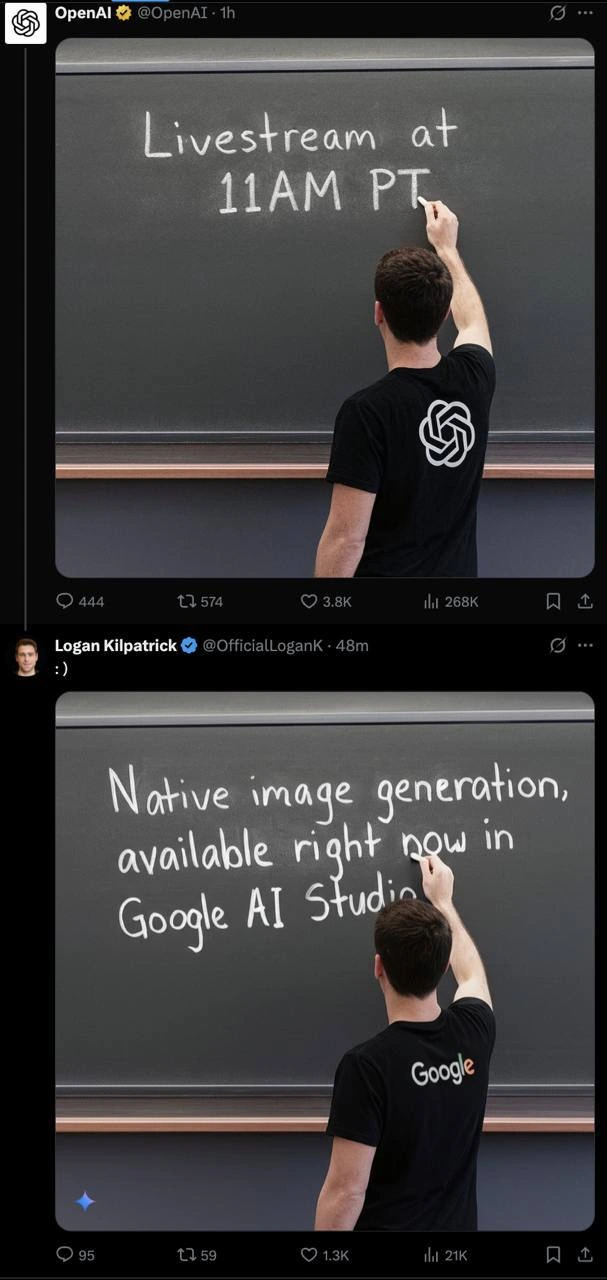
Now, what do we see in the meme? It shows screenshots of two posts on social media (from X, which used to be called Twitter). In the first post (on top), OpenAI is hinting at a big reveal: a person wearing an OpenAI T-shirt is writing on a chalkboard the message “Livestream at 11 AM PT.” That means OpenAI is saying, “We’re going to have a live broadcast at 11 o’clock (Pacific Time), where we’ll presumably announce or demonstrate something new.” Companies often do this — they announce an upcoming announcement — to get everyone excited and to make sure people tune in at that time. The use of a chalkboard is interesting: instead of just typing the announcement, they staged a photo where someone physically writes it out. It gives a kind of academic or nostalgic feel (like a teacher writing on the board). It’s a bit playful and different, which helps it stand out on a social media feed full of digital graphics.
The second post (right below the first in the image) is from someone named Logan Kilpatrick, and it’s clearly connected to Google (he’s wearing a shirt with the Google logo). The image looks almost the same as the first at a glance — same chalkboard, same person position — but now the chalkboard text says “Native image generation, available right now in Google AI Studio.” And the OpenAI logo on the person’s shirt has been replaced with the Google logo. This post came just 48 minutes after the first one (as we can tell from the timestamps in the screenshot).
So what does Google’s message mean? They’re basically saying: “We’ve just added a new feature: our platform called Google AI Studio can now generate images natively (as a built-in capability). And you don’t have to wait at all; you can use it immediately.” Google AI Studio sounds like a platform or environment where developers or users can play with Google’s AI models (for example, to generate text, images, etc.). By saying “native image generation,” it implies that this feature is integrated into their system (not something you have to use a third-party for). It’s likely a response to things like OpenAI’s image generator (DALL-E) or other popular AI image tools.
The key part is “available right now.” Compare that to OpenAI’s message — OpenAI is telling people to wait for 11 AM to even hear what’s coming. Google is not only saying what the feature is (image generation), but also that you can go and try it immediately. It’s the difference between “Come back later to see what we’ll have” vs. “You can have it now.” Google basically undercut the anticipation by dropping their news instantly.
Why is this funny or noteworthy? It’s the timing and imitation. OpenAI gave a tease, trying to build suspense. Google jumped in before that suspense could even pay off, and they did it in a way that mirrors OpenAI’s announcement style. It’s a blatant one-up. “One-upping” someone means doing something better or sooner to show you’re ahead. Here Google one-upped OpenAI by: 1) using the same quirky chalkboard announcement idea (so they directly reference what OpenAI did), and 2) trumping the timing (no waiting, available now). It’s a bit playful and a bit competitive-snarky at the same time. Essentially, Google is saying “Whatever you’re going to announce, we have it too — and we’re not making you wait.”
For someone new to this, it helps to know that OpenAI and Google are rivals in the AI space. Think of two big sports teams always trying to outscore each other. OpenAI might score a point by introducing a cool new AI feature, then Google tries to score a point right back by introducing its own version. Lately, there’s been a lot of back-and-forth like this in AI. It’s because AI is seen as the next big thing in tech (there’s a ton of hype, excitement, and also fear of missing out). No company wants to be left behind. So, when OpenAI, for example, came out with ChatGPT and made a huge splash, Google hurried to showcase its own AI (like their Bard chatbot and other features). The meme is a humorous take on how fast and direct this competition has become.
The chalkboard scenario in the meme is a bit imagined (it’s not a literal photograph of the two actually doing this, but a composed image to illustrate the point). It’s essentially saying: OpenAI wrote a note on the board, and before the class even started, Google wrote its own note, in the same style, one-upping the first. It captures that feeling of ai_rivalry and launch_one_upmanship (launching something in a way that one-ups the other).
In summary, the meme is showing a situation where OpenAI tried to build hype for a later announcement, and Google swiftly responded by not only copying the announcement format but also by delivering a competing announcement immediately. It’s funny in a nerdy way because it’s both a parody of how tech companies act and a fairly accurate reflection of reality. The tech community recognizes this as a sign of just how intense (and sometimes petty) the competition in AI has become. One moment you’re excited about OpenAI’s upcoming thing, the next moment you’re distracted because Google dropped their surprise — even using a bit of humor to do it. It’s like technological trolling: a friendly “Gotcha!” between companies that makes spectators smile and shake their heads at the same time.
Level 3: Rapid Response Rivalry
Although the chalkboard setting feels old-school, this meme highlights a cutting-edge corporate rivalry in AI/ML. It’s poking fun at how frenetic the AI tools “arms race” has become, especially between OpenAI and Google. The humor comes from the almost absurd speed and mimicry on display: OpenAI announces a plan (“Livestream at 11 AM PT”), and then Google (through the @OfficialLoganK tweet) not only copies the exact announcement format (same chalkboard, same pose, just swapping the OpenAI logo for Google’s) but also trumpets a one-upping message (“Native image generation, available right now in Google AI Studio”) less than an hour later. It’s a feature launch one-upmanship in real-time. Developers who follow industry news recognize this pattern and likely chuckle (or groan) because it’s too real – major tech players constantly leapfrogging each other’s announcements.
This meme plays on the idea of “stealing thunder.” OpenAI’s chalkboard teaser was meant to drum up excitement: they essentially said, “We have something cool to show you at 11, stay tuned!” But Google turned that into an opportunity to say, “Why wait? We have something cool and it’s available now!” The juxtaposition is funny because it’s so brazen. Google’s post isn’t even pretending to be coincidental – it directly mirrors OpenAI’s post, as if to say, “Anything you can do, I can do sooner.” For a senior developer or anyone who’s seen competitive product launches, this recalls classic tech rivalries. It’s reminiscent of the old browser wars or the smartphone battles where companies would rush to announce matching features immediately after a competitor, just so they’re not seen as lagging. Here, it’s about generative AI: one company teases a reveal (perhaps they’re going to announce an image generation feature on their livestream?), and the other flat-out announces their image generation feature first, and it’s not just a tease – it’s already live.
We’re basically witnessing an AI hype sprint. After the explosive success of ChatGPT (OpenAI’s conversational LLM) in late 2022, Google entered “code red” mode. Historically, Google was an AI research leader (they invented the Transformer architecture that powers many Large Language Models), but OpenAI captured the public mindshare. This has led to a rapid volley of releases: one week OpenAI unveils GPT-4 or plugins, the next week Google rushes out Bard improvements or integrates generative AI into Google products. It’s a tit-for-tat cycle, and engineers at these companies feel the whiplash. Many in the industry have joked that it’s an AI feature arms race, and this meme turns that up to eleven by suggesting even a simple marketing trick (writing on a chalkboard for a livestream promo) gets instantly copied and upstaged.
For those of us who have been around tech, this also rings a bell from the era of cheeky corporate trolling. Think of the classic “I’m a Mac, I’m a PC” ads where Apple openly mocked Microsoft, or the time when Audi and BMW traded billboards (Audi teased “Your move, BMW” and BMW responded with a giant “Checkmate” ad). Likewise, here Google’s response tweet is the checkmate move to OpenAI’s teaser. The meme caption even suggests this is the return of playful trolling in tech competition. After years of more polished, diplomatic competition, this feels like a throwback to when companies would openly one-up each other with some swagger. It’s equal parts nostalgic and ridiculous – AIHumor with a dash of 90s-style tech rivalry.
From a developer’s perspective inside these companies, one can imagine the chaos behind the scenes. OpenAI’s team sets up a slick announcement (maybe a new version of DALL-E or a multimodal GPT). They choose the chalkboard motif – perhaps to create a sense of mystery or academic cool. Meanwhile, at Google, someone high up sees that tweet and says, “We need to get our news out now.” Cue a scramble: engineers and product managers at Google AI Studio likely had a similar image-generation feature in the pipeline. They might have planned to announce it later, but OpenAI’s teaser at 10 AM forced their hand. Suddenly there’s an emergency meeting: “Can we announce our feature before they steal the spotlight? Do we have a demo ready? How fast can we put out a promo image?” It’s not hard to imagine a Google marketer quickly mocking up a nearly identical chalkboard graphic, swapping in the Google logo and new text, and Logan K (a developer advocate manager) posting it within minutes.
The result is a PR win for Google – they look fast and bold – but it’s also a bit cringey. They basically memed OpenAI’s announcement. For insiders, it’s impressive that Google can turn around a launch on a dime, but also worrisome that the competition has become this reactive. Engineers often dislike such last-minute pivots; it can mean rushing out features that aren’t fully ready or cutting corners in testing, all for the sake of buzz. (Remember how Google’s hurried demo of Bard initially flubbed a fact, wiping billions off their stock? Rushing has risks!). This mirrors experiences many developers have had: plans upended by a competitor’s move, leading to frantic all-nighters to push a response. It’s stressful and can lead to technical debt or sloppy releases, because marketing needs to win the headline that week.
The meme is funny because it exaggerates the rivalry to a cartoonish scenario – yet it’s only barely an exaggeration. Tech folks following IndustryTrends know that generative AI launches have been relentless. There’s an absurdity and exhaustion in seeing one announcement immediately eclipsed by another. It validates a shared feeling: these companies are so neck-and-neck that even their announcement style isn’t safe from copycats. Google didn’t just match the substance (an image generation feature) – they copied the style (the chalkboard tweet) and trumped the timing (“right now” vs “later”). It’s corporate one-upmanship at hyper-speed, and if you’ve been on the losing end of that before, you can’t help but laugh at how spot-on this depiction is.
And let’s not forget the meta-joke: OpenAI was trying to build suspense for later, and Google essentially said “surprise, we’re spoiling your surprise.” It’s like announcing the punchline of someone else’s joke before they finish. In developer terms, OpenAI opened a pull request for attention, but before it could be merged at 11 AM, Google force-pushed their changes to main 😅. That unspoken developer trauma – seeing your thunder stolen – is very real. Many of us have had a moment where we planned a big release or demo, and then another team or competitor unveiled something similar right beforehand. It stings! You end up doing a retrospective thinking, “Should we have kept quiet until we were ready to launch?”
In essence, this level of analysis sees the meme as a commentary on the openai_vs_google race. It highlights the speed, the hype, and the almost comical tactics (like chalkboard duels) that define today’s AI competition. It’s a knowing nod between developers: “This is the AI world now – blink and your competitor has already leapfrogged you. Game on.”
For seasoned tech folks, it’s a knowing laugh: “Yep, this is the AI world now – blink and your competitor has already leapfrogged you. Game on.”
Level 4: Preemptive Hype Scheduling
In computer science, a race condition describes a scenario where two processes or threads compete for the same resource or outcome without proper coordination, leading to unpredictable results. The meme’s title cheekily uses “race-conditions” as a verb, implying that Google treated the announcement timeline like a shared resource and rushed to update it before OpenAI could finish their move. Just as unsynchronized threads might clobber each other’s data, Google’s announcement preempted OpenAI’s big moment.
Think of the tech news cycle as a shared memory region. OpenAI wrote to that shared memory first by tweeting “Livestream at 11 AM PT” on a chalkboard (the visual metaphor for their announcement). This is analogous to one thread writing a value that says “I have something coming up later.” But before OpenAI could “use” that value (i.e. actually hold the livestream at 11 and bask in the attention), Google performed a second write to the same chalkboard: “Native image generation, available right now in Google AI Studio.” In concurrency terms, Google’s write operation overwrote the state set by OpenAI. This is akin to a write-after-write hazard – the later write wins, and the earlier information (the 11AM teaser) is effectively eroded or overshadowed in the final state visible to the audience.
This happened because there was no lock or synchronization guarding the “announcement space.” In an idealized cooperative world, companies might coordinate major releases to avoid stepping on each other’s toes, but in truth there’s no mutex for marketing. No one issued a lock(announcementSlot) before writing on the chalkboard. As a result, the two “threads” ran in parallel, and the one that completed first (Google’s real-time drop) grabbed the spotlight. It’s a classic case of uncoordinated concurrent processes: OpenAI assumed its event would execute at time T (11 AM) without interference, but Google didn’t respect that critical section – it jumped in earlier, effectively preempting the schedule.
We can draw parallels to operating system scheduling too. OpenAI’s livestream was like a scheduled task with a set start time – perhaps running at a normal priority. Google came along with a higher-priority interrupt: an immediate release. The “scheduler” here is essentially public attention (or the tech media) that can only focus on so much at once. Google’s immediate announcement caused a context switch in that attention. OpenAI was in the middle of preparing its big reveal (much like a process waiting for its timeslice at 11), when Google’s process said “I’m running now.” Without any OS (or industry agreement) to prevent it, Google’s task ran to completion first, meaning by the time OpenAI’s timeslot arrived, the context (and excitement) had shifted. This is preemptive scheduling in the realm of hype: the highest priority (or earliest execution) event wins the CPU of public interest.
In distributed systems theory, one might say Google and OpenAI lacked a consensus protocol for who gets to announce when. There’s no Paxos or Raft election deciding the “leader” of the day’s news – each company is a node acting in its own self-interest. The result? A form of eventual consistency in news: eventually the community learns about both announcements, but initially Google’s update became the visible truth in the “system state” that everyone was talking about. This is reminiscent of a TOCTTOU (Time Of Check To Time Of Use) race condition: OpenAI checked (announced) that they would hold the spotlight at 11, but by the time they tried to use that spotlight, the conditions changed because Google introduced new data in the interim. The assumption of an exclusive timeslot turned out to be non-atomic – it wasn’t an all-or-nothing transaction, and Google committed its update before OpenAI could commit theirs.
To put it in pseudo-code, it’s as if:
# Shared resource: chalkboard message (public's immediate focus)
chalkboard_message = None
# OpenAI announces an upcoming event (writes to shared resource)
def openAI_thread():
global chalkboard_message
chalkboard_message = "Livestream at 11 AM PT"
time.sleep(60*60) # wait 1 hour until the actual event time (11 AM)
go_live() # Now OpenAI starts the livestream event
# Google sees this and immediately launches their feature (competing write)
def google_thread():
global chalkboard_message
if chalkboard_message == "Livestream at 11 AM PT":
# Google decides to one-up the announcement with an instant release
chalkboard_message = "Native image generation is LIVE now in Google AI Studio"
launch_feature_immediately()
# Without locks, Google overwrites the announcement before OpenAI goes live.
In this dramatization, OpenAI’s thread writes an announcement and plans to execute an hour later. Google’s thread notices that state and immediately writes a new value and executes its launch. The final chalkboard_message the world sees is Google’s info because that write happened last.
Of course, in reality Google didn’t literally have access to OpenAI’s chalkboard, but the meme visually jokes that they “cloned” the scene. It captures the essence of a race condition: one party’s action interleaved at just the right (or wrong) time to make the other party’s intended sequence of events behave unexpectedly. The outcome was that Google’s news stole the thunder. In a properly synchronized system, OpenAI would have had a mutex on the “announcement spotlight” until after 11 AM. But in the wild west of IndustryTrends_Hype, no such locks exist – leading to the comedic, almost non-deterministic scramble we see here.
The underlying joke for seasoned developers is how this cutthroat AI rivalry mimics a low-level concurrency bug. It’s as if the entire scenario is running in a multi-threaded environment without guardrails: one process just outpaced and clobbered the other’s state. The meme takes a niche technical concept like a race condition and applies it to corporate one-upmanship. It’s funny because it’s unexpectedly apt: even multi-billion-dollar companies can behave like threads in shared memory, stepping on each other’s toes when the system (the market) doesn’t enforce order.
In short, Google “race-conditioned” OpenAI by not waiting its turn – a nerdy way to say they won the sprint by disabling the etiquette locks and going full speed.
Description
Composite screenshot of two X/Twitter posts stacked vertically. 1) Top tweet from @OpenAI shows a person facing a classroom chalkboard, writing in thick white chalk: “Livestream at 11 AM PT”. The person wears a black T-shirt with the OpenAI spiral-knot logo. 2) Bottom tweet, posted 48 minutes later by @OfficialLoganK, clones the scene but the chalk now reads: “Native image generation, available right now in Google AI Studio”. The same pose, angle, and lighting are used, yet the shirt logo has been swapped to the multicolored “Google” wordmark. The juxtaposition pokes fun at the fast-moving generative-AI feature race, where even announcement formats are copied and upstaged within the hour
Comments
7Comment deleted
Livestream mutex acquired by OpenAI at 11:00, but Google slipped in a non-blocking compare-and-swap and pushed to prod at 10:59
Nothing says 'we've been planning this for months' quite like hastily writing a competitive feature announcement on a blackboard 48 minutes after your rival's livestream announcement - the true latency we should be optimizing for in AI isn't inference time, it's PR response time
When your competitor schedules a product demo, so you ship to production during their pre-roll ads. Classic 'move fast and break their launch momentum' strategy - because in the AI space, being second to announce but first to ship is the new 'release early, release often.' OpenAI learned what every startup knows: never tweet your deployment schedule when Google's CI/CD pipeline has a 10-minute lead time
AI launches are now pub/sub: OpenAI publishes Livestream@11, Google subscribes and triggers release_feature(native_image_gen) - great latency, dubious consistency guarantees
BigTech PR is eventually consistent: Thread A cron-schedules 11AM PT; Thread B calls ship_now(). Without a lock, the ‘right now’ write wins the attention quorum
Native image gen 'available right now' in AI Studio - because nothing says production-ready like a whiteboard sprint demo with undisclosed rate limits
The jokes write themselves Comment deleted