Requesting 2038 vacation to demonstrate the classic Unix timestamp bug
Why is this Bugs meme funny?
Level 1: Too Big to Count
Imagine you have a little digital counter that keeps track of something, like the number of days until your next school vacation. But this counter is old and it wasn’t made to count super high – let’s say it can only go up to 9999. Now, if you try to make it count to 10,000, it doesn’t know how – it flips back to a weird negative number or just breaks and stops working. 😯
In this meme story, the computer system had a clock/counting mechanism a bit like that counter. It could count years and days up to a point (up to the year 2038), but anything beyond that was too big to count for it. The clever (or sneaky) developer purposely asked for a vacation in the year 2038 just to see the system get confused and break. It’s like a kid knowing that a scoreboard will crash if it tries to go past 99, and scoring the 100th point on purpose. The boss was like the teacher saying, “Oh no, you broke the scoreboard!” and asking “Why did you even go for 100 points??”. And the kid (the developer) goes, “I did it to show you it would break!” 😅 It’s funny in a mischievous way: the developer basically broke the rules to reveal a hidden flaw. The core of the joke is that the computer’s calendar couldn’t handle a date that far in the future, and the developer knew this and cheekily proved it. Even if you don’t know about computer dates or the year 2038, you can laugh because it’s a story of someone intentionally pushing something to its limit just to see it go kaboom – a little bit naughty, but also pretty clever!
Level 2: Date with Disaster
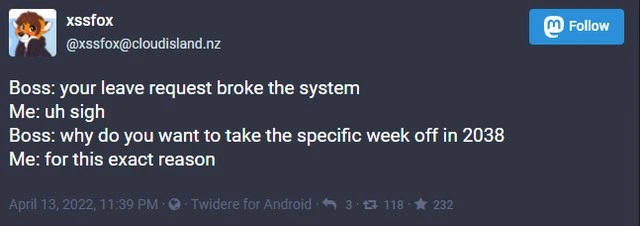
Let’s break down the joke in simpler terms. The meme is presented as a short dialogue between a boss and an employee (the developer). It reads:
Boss: “Your leave request broke the system.”
Me (Developer): sigh
Boss: “Why do you want to take that specific week off in 2038?”
Me: “For this exact reason.”
In plain English, the employee put in a vacation request for a week in the year 2038, and doing so crashed the company’s leave-tracking software! The boss is confused why the developer chose such a far-future date. The developer responds that he did it on purpose – specifically to reveal the bug that just happened. Essentially, he’s saying: “I picked that week in 2038 to demonstrate that your software has a problem with dates in the future.”
Now, why would the system crash just because of a 2038 date? This is all about how computers store time. Many computer systems (especially older ones, aka legacy systems) use what’s called a Unix timestamp to represent dates and times. A Unix timestamp is just a single number: the count of seconds since January 1, 1970 (this start point is called “the Unix epoch”). For example, a timestamp of 1,000,000,000 corresponds to a date in 2001. These timestamps are often stored in a 32-bit integer variable. 32-bit means it’s using 32 binary digits, and if it’s a “signed” 32-bit, it can store a range of numbers roughly from -2 billion to +2.147 billion. That upper limit (around 2.147 × 10^9 seconds) is not an arbitrary number – it’s the largest value a 32-bit container can hold. It turns out that when you count that many seconds from 1970, you land in January 2038. If you try to go one second past that, the number can’t be represented in 32 bits anymore. It overflows, which is a fancy way of saying the number “runs out of room” and wraps around to a very negative number (almost like a car’s odometer rolling over from 99999 to 00000).
Integer overflow is a common bug in software: it’s when a counter or number gets too large and resets or becomes a negative due to fixed size limits. Here, the year_2038_problem is a well-known overflow bug. After 03:14:07 UTC on Jan 19, 2038, a 32-bit counter will wrap around and make the time jump backwards by about 136 years (which obviously doesn’t make sense for any calendar!). If an application hasn’t been updated to handle larger date values (like using a 64-bit number for time), any calculation or comparison involving times beyond that will give wrong results or cause errors. In the meme, the “leave request” likely tried to record a date in late 2038. The software’s date-handling code wasn’t expecting to deal with a number that large – or rather, it couldn’t handle the numerical result – and so the program freaked out (crashed). That’s the leave_request_bug in action.
For a junior developer or someone new to this concept, think of it this way: the software had a hard limit on how far in the future it could schedule things. 2038 happens to be that limit for many old systems. When the developer selected a vacation week in 2038, he hit that exact limit, kind of like pushing a machine past what it was built to do. It’s similar to typing a really long number into a calculator that can only handle a certain number of digits – the calculator might give an error or a weird result. In fact, a real-world analogy is the Y2K problem: old programs only stored years with two digits (e.g., “99” for 1999). When the year 2000 came (“00”), those programs got confused and thought it was 1900 or just invalid. Similarly, here the program couldn’t comprehend “2038” because its internal clock went kaput after 2037.
Let’s also notice the cheeky behavior of the developer in this meme. Normally, nobody would request vacation 16 years in advance – that’s highly unusual in a workplace! The boss’s confused question “why that week in 2038?” shows that this is not a normal use case; it’s an edge case (a scenario at the extreme end of what the system can handle, which often isn’t tested). The developer sighing (“uh sigh”) suggests he anticipated the failure. His goal was to expose a hidden bug that he knew existed. This is actually something developers and testers do: if we suspect a system has an issue with a certain extreme input, we might intentionally try it out to see if it breaks. Here, the dev basically did a QA test by requesting time off on a date he knew might be problematic. When he says “for this exact reason,” he’s effectively telling the boss: “I picked that date specifically to break the system and show you there’s a problem that needs fixing.”
The meme format (made to look like a tweet or social media post) and the reaction counts (118 boosts, 232 likes) show that this joke resonated with a lot of other developers. They likely find it funny because they’re aware of the 2038 issue and maybe have even joked about it at work. It’s a bit of DeveloperHumor mixed with a cautionary tale about LegacySystemsAndModernization. If you’re new to this field, the takeaway is: computers have limits based on how they’re built, and if we’re not careful to update old assumptions, those limits can sneak up and crash our systems. And sometimes, the people who know about these issues have to get creative (like our meme’s hero) to make others pay attention to the problem!
Level 3: The Ticking time_t Bomb
For seasoned developers, this meme hits on a relatable pain: the looming Year 2038 problem. It’s a satirical take on how LegacySystems with old date handling can spectacularly fail when faced with a far-future date. In the image’s dialogue, a manager complains, “Your leave request broke the system,” and questions why the developer chose a vacation in the year 2038 of all times. The punchline comes when the dev deadpans, “for this exact reason.” 😏 In other words, the developer intentionally selected that week in 2038 to trigger the bug and prove a point. This scenario humorously captures a dynamic many of us know well: the exasperation of dealing with BugsInSoftware that stem from long-known issues, and perhaps the sly satisfaction of finally exposing them.
So why is requesting time off in 2038 such a system-killer? In many older applications (like an antiquated leave-management system), dates might be stored or calculated using a 32-bit Unix timestamp (time_t). The week-long vacation in 2038 likely includes the infamous January 19, 2038 date. The moment the system tried to handle that date – perhaps calculating how far away it is or converting it to an internal format – the 32-bit timestamp overflowed. Suddenly, the program got a wildly incorrect result (like a date in 1901, or a negative interval) and couldn’t cope. The system probably threw an error or crashed outright, hence “broke the system.” It’s a classic edge case (future_date_edge_case) that wasn’t handled in the code. For a senior engineer, this is the epitome of LegacySystemsAndModernization woes: everyone knows the 2038 apocalypse is coming, but here we are with production software still not updated. The humor has a dark twist of I-told-you-so: the developer presumably knew the software wasn’t 2038-safe and, perhaps after being ignored, demonstrated it in the most cheeky way possible.
The line “for this exact reason” is both funny and telling. It implies the developer requested that specific week off precisely to watch the system blow up (or to ensure he’s on vacation when it does 🙃). In workplaces, it’s a common cynical joke: “When that 2038 bug hits, I’ll be retired or on a beach far away.” Here the dev actually tries to schedule a vacation in advance for that doomsday week! By doing so, he forced the bug to surface now rather than when the actual year arrives. It’s a brilliant bit of malicious compliance and quality assurance rolled into one. The boss’s reaction (“Your leave request broke the system”) suggests management had no clue that such an SystemFailure was lurking. This reflects a real industry pattern: non-technical folks might not understand why something seemingly as simple as a far-future date could crash software. Meanwhile, developers have PTSD from things like integerOverflow bugs and Y2K-like incidents, so they stress about these “silly little details” that can bring giant systems down.
Technically, the satirical situation underscores how modernization tasks (like upgrading data types or rewriting old code) often get postponed. After all, 2038 felt ages away… until it’s not. Many systems running on 32-bit architecture or older database schemas are still out there. Fixing this isn’t always trivial: expanding the date field to 64 bits can ripple through databases, APIs, and stored data. It’s the kind of “we’ll handle it later” technical debt that accumulates. The meme resonates with senior devs because it’s a shared anxiety and a bit of gallows humor: we know some software will fail come January 2038 if left unchecked. We also know some managers won’t prioritize it until something breaks. Here, the dev forced that priority by literally breaking it on purpose. The RelatablePain comes from experience: many of us have had to point out that an edge case could be catastrophic (and sometimes the only way to prove it is to demonstrate the failure).
It’s worth noting the format of the meme itself: it’s styled like a social media post (the screenshot is from a Mastodon/Twitter-like feed). The fact it garnered 118 boosts and 232 likes (as shown at the bottom) tells us many other developers nodded in agreement or chuckled. That high engagement is basically the community saying, “Oh, I totally get this!” It’s both funny and a bit nerve-wracking — a joke that pokes at a real time bomb lurking in old code. Just as Y2K jokes were common pre-2000, the Year 2038 bug is a known punchline in programming circles. We laugh, but we also cringe because it’s true. This “ticking time_t bomb” meme encapsulates that perfectly: the mix of humor, nostalgia for old tech, and the ever-present knowledge that LegacySystems can come back to bite us if we don’t deal with them. And if management ever asks “Why are you planning a vacation in 2038?”, now they know – it might be the only way to get them to pay attention to a ticking problem!
// A tiny C illustration of the Year 2038 overflow (on a 32-bit system)
#include <stdio.h>
#include <stdint.h>
int main() {
int32_t timestamp = 2147483647; // 0x7FFFFFFF, max Unix time in 32-bit (Jan 19, 2038)
printf("Before: %d\n", timestamp);
timestamp += 1; // adding one second causes overflow
printf("After: %d\n", timestamp);
return 0;
}
// On a true 32-bit system, the output would be:Before: 2147483647After: -2147483648
(The counter wraps from max positive to a negative value, a guaranteed recipe for a date/time bug!)
Level 4: Two’s Complement Countdown
At the silicon and CS_fundamentals level, this meme highlights the infamous Year 2038 problem – a textbook case of an IntegerOverflow in a 32-bit timestamp. In many legacy C and Unix systems, time has been kept as the number of seconds since the Unix epoch (January 1, 1970). This count is typically stored in a signed 32-bit integer (often the time_t type). A 32-bit signed integer can represent values from -2,147,483,648 to +2,147,483,647. These limits come from two’s complement binary representation: the highest bit acts as a sign flag. When you add 1 to the maximum positive value ($2^{31}-1 = 2,147,483,647$), the binary representation flips – the sign bit goes from 0 to 1 – and the value wraps around to -2,147,483,648. In the context of timekeeping, 2,147,483,647 seconds after 1970 corresponds to 03:14:07 UTC on January 19, 2038. The very next second would mathematically be 2,147,483,648, but a 32-bit signed counter can’t represent that – it overflows to a negative number (-2,147,483,648) instead. Suddenly the clock thinks it’s approximately 2^31 seconds before epoch, which lands back in December 13, 1901. This absurd time-travel glitch is what likely broke the system in the meme.
From an operating systems perspective, this is a fundamental limit: any 32bit_timestamp_overflow will wreak havoc on date computations. If an input date beyond the 2038 cutoff was processed, the code may have attempted to convert that future date into an epoch timestamp, producing a negative or nonsense value. Many software routines aren’t built to handle a date that appears to be in the year 1901 or an invalid negative duration – leading to crashes or corrupt behavior (a classic date_handling_fail). This is akin to a clock that physically can’t display the next hour, so it snaps back to showing something incoherent. The joke here is rooted in a very real technical deadline: legacy systems that haven’t been updated will literally run out of representable time.
Under the hood, this is not just a random bug; it’s a deterministic outcome of how binary arithmetic works with fixed sizes. The term epoch_time_overflow describes this exact scenario: the counter for time runs out of bits and rolls over. In academic terms, it’s reminiscent of the Y2K problem, but instead of two-digit years, we have a fixed-width binary counter. Interestingly, some LegacySystems chose a signed 32-bit for time so they could represent dates before 1970 as negative values (symmetry around the epoch). It seemed like a farsighted idea in the 1970s – 68 years of range felt safely beyond the horizon. But as with many design decisions, the finite limit has crept up on us. Modern systems have largely transitioned to 64-bit time representations (for example, a 64-bit time_t on 64-bit Unix, or high-level languages using big integers for timestamps). A 64-bit signed second count can represent over 292 billion years, effectively pushing the “end of time” for computers far beyond any practical concern. However, if old 32-bit components or databases persist, they become ticking bombs in our infrastructure. The 2038 bug has even been likened to a mini Y2K, and scholarly discussions and RFCs have debated solutions (from extending the type size, to interpreting the bit patterns differently – none of which are trivial in deployed systems). In short, the meme’s scenario is a playful exposition of a deep technical truth: thanks to two’s complement arithmetic and historical design limits, at a certain point time literally runs out for 32-bit computers, and if you ask a legacy system about dates beyond that point, you might just crash it with a temporal paradox.
Description
Dark-mode social feed screenshot: top left shows a small anime avatar and the handle “xssfox @[email protected]”, while the top right has a blue “m Follow” button. The post’s white text on a charcoal background reads line-by-line: “Boss: your leave request broke the system”, “Me: uh sigh”, “Boss: why do you want to take the specific week off in 2038”, “Me: for this exact reason”. A grey metadata footer displays “April 13, 2022, 11:39 PM • Twidere for Android” followed by reply, boost, and like counts “3 118 232”. The joke targets the Year 2038 problem: a leave-management system using 32-bit signed Unix time overflows when asked about a date in 2038, crashing the application. The meme highlights how legacy date handling and integer overflow bugs still lurk in production software

Comments
7Comment deleted
Submitting PTO for 03:14:08 UTC on 19 Jan 2038: if 32-bit time_t overflows, the HR system dies and they finally budget the 64-bit fix; if it doesn’t, I’ve just locked in vacation 15 years ahead - call it an idempotent feature test
The only developer who actually read the "temporary" workaround comment from 1970 that said "TODO: fix before 2038"
Booking PTO for January 19, 2038 is the only vacation request that doubles as an integration test - and the HR system failed it 16 years early
Ah yes, the classic 'I'll just schedule my PTO for 2038 to see what happens' move - the developer equivalent of poking a sleeping dragon with a stick. Nothing says 'I understand our technical debt' quite like weaponizing the Year 2038 problem against your own HR system. Bonus points if the boss's response was filed as a P0 incident with root cause analysis due by EOD. At least now management has 14 years to migrate from 32-bit time_t before this becomes a *real* problem... or they'll just add it to the backlog and mark it as 'won't fix.'
When your leave request overflows time_t, it's the ultimate 'I'm not touching production that week' strategy
Requested PTO for 2038‑01‑19; HR said I have −1 days available - apparently our “enterprise” scheduler still uses a 32‑bit time_t
Submitting PTO for 2038 is free chaos testing: if the HRIS still uses 32‑bit time_t, approvals wrap to 1901; if not, congrats on the time64 migration