Skip to content
DevMeme
3986 of 7435
Pixel 6 auto-declines calls: a bug hilariously reframed as must-have feature
Bugs Post #4339, on Apr 20, 2022 in TG

Pixel 6 auto-declines calls: a bug hilariously reframed as must-have feature

Why is this Bugs meme funny?

Level 1: The Broken Doorbell

Imagine you have a doorbell at home that’s broken. When people press it, it doesn’t ring at all. Normally, that’s bad because you wouldn’t know someone is at the door. It’s a bug (a mistake), just like a phone not ringing for an incoming call is a mistake. But let’s say you really hate being interrupted by surprise visitors or salespeople. In that case, you might joke, “Hey, this broken doorbell is actually a great feature! It means I get peace and quiet and no one can bother me.” You don’t truly mean that the broken doorbell is a designed feature—you’re just humorously saying that this accident has a silver lining for you.

In the meme, a new Google phone (the Pixel 6) has a bug that makes it act like a broken doorbell: it doesn’t ring for some calls. A famous tech reviewer jokes that he likes this accident, because it stops people from calling him. He’s basically saying, “I didn’t ask for this mistake, but it kind of works in my favor!” It’s funny because we know phones should ring, yet he’s pretending it’s a special no-calls feature. It’s like laughing off a mistake by saying it was on purpose. Even if you’re not technical, you can relate — sometimes a mistake can feel like a tiny win, and it’s okay to chuckle about it!

Level 2: Bug vs Feature 101

Let’s break down the humor for those newer to the dev world. First, a bug is an error or flaw in software that causes it to behave in unintended ways. In this case, the bug in the Google Pixel 6 phone causes some incoming calls to be declined automatically — the phone doesn’t ring at all, and the caller is turned away as if you hit the “decline” button. That’s not how a phone is supposed to work! Normally, if someone calls you, your phone should ring or vibrate to let you know. A bug like this can be frustrating because you might miss important calls without ever realizing someone tried reaching you.

Now, a feature is the opposite: it’s a functionality that is intended and advertised. When developers joke “It’s not a bug, it’s a feature,” they’re playing on the idea that maybe this mistake could be seen as a planned benefit. It’s a bit of classic tech humor. In everyday terms, it’s like saying, “Oh, the phone hanging up on people isn’t an error – it’s a special mode for people who hate being disturbed!” Of course, everyone knows that’s tongue-in-cheek. No phone maker would intentionally design a feature that blocks calls without telling you – that would normally be considered a serious flaw. But in comedy (and programmer inside-jokes), we pretend this was on purpose to get a laugh.

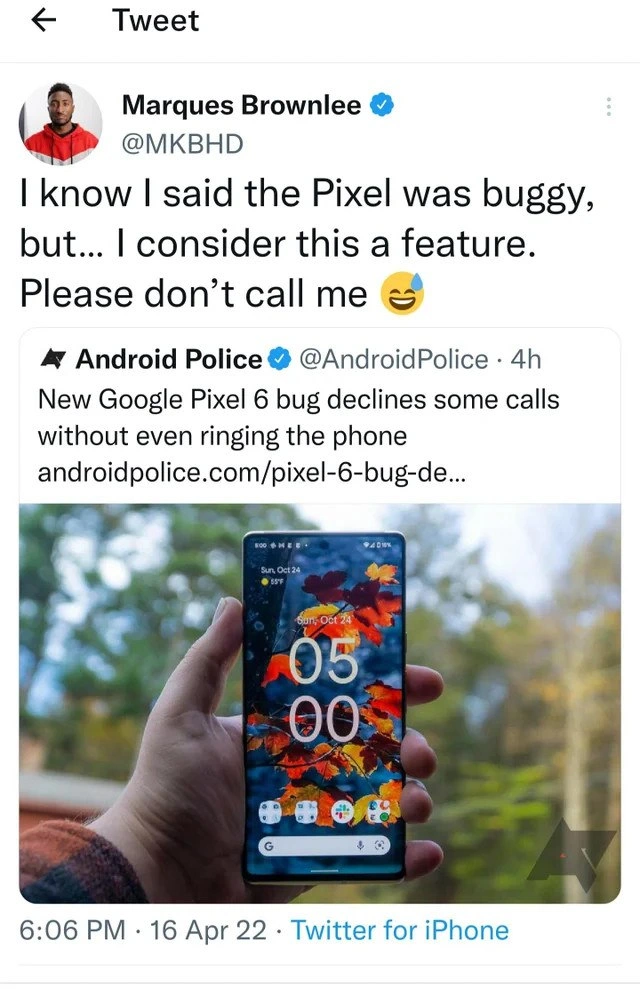
The meme itself is a screenshot of a tweet by Marques Brownlee, known as @MKBHD on Twitter. Marques is a popular tech reviewer. He says: “I know I said the Pixel was buggy, but… I consider this a feature. Please don’t call me 😅” with a laughing emoji. He’s referring to the Pixel 6 being “buggy” (having many bugs) and then cleverly spinning this particular bug as if it’s actually a good thing for him. The face-with-sweat-smile emoji (😅) shows he’s joking but also a bit relieved – as in “haha, actually I don’t mind this one!” The second part of the screenshot is a tweet from Android Police, a tech news outlet, mentioning the Pixel 6 bug that declines calls. They even included a photo of the Pixel 6’s screen. The large digits “05 00” on the phone screen likely show a weird clock or some UI element, but it’s mainly there to illustrate the phone model (Pixel 6 has a distinctive display style).

There’s an extra layer if you look closely: the timestamp at the bottom of the tweet says “Twitter for iPhone”. That means Marques posted his tweet using an iPhone, not from the Pixel 6 itself. This is a playful detail that tech folks notice: he’s teasing the Pixel 6, but using a competitor’s phone to do it. For a newcomer, this might be confusing – why would a Pixel user have an iPhone? In reality, tech reviewers like him carry multiple phones, and he might trust the iPhone for certain tasks (like reliably tweeting or taking a photo of the Pixel). Or it’s just part of the joke: even the guy praising the Pixel’s bug is using an iPhone, hint hint. It’s a subtle nod to the reliability difference or simply that he has both ecosystems on hand.

From a mobile development perspective, this meme highlights how unexpected bugs can slip into even high-profile devices. The Pixel 6 was a new model from Google (launched in 2021 with a new chip called Google Tensor and Android 12 software). New software updates or hardware changes can introduce odd glitches. For instance, something in the phone’s Android OS telephony subsystem (the part of the software that handles calls) likely had a flaw. Maybe a setting like “Do Not Disturb” was accidentally toggling on, or the phone app’s logic for incoming calls had a mistake. In pseudo-code, it’s as if the phone’s program did this:

// Pseudocode for how a phone decides to ring or decline an incoming call
boolean shouldRing = checkRingerMode();    // true if ringer is on and no DND mode
if (incomingCall) {
    if (!shouldRing) {
        call.decline();  // BUG: Pixel 6 mistakenly goes here even when it should ring
    } else {
        phone.ring(call); // Normal behavior: ring so user knows there's a call
    }
}

In the Pixel bug, checkRingerMode() might have been giving the wrong answer (always false), so the phone thought it should never ring. That’s a simplified idea of how such a bug could happen in code. For a junior dev, it’s a reminder that a single logical error can cause a big user-facing problem—like silencing all calls!

So why is this funny? Because Marques (and many of us) sometimes don’t want to be bothered by calls, especially spam calls or interruptions. He’s basically saying: “I complained about Pixel 6 being glitchy, but this glitch that stops people from calling me… I actually like! 😉” It’s a form of relatable humor: lots of people joke that phone calls are annoying in the age of text messages. By calling the bug a “feature”, he’s making light of the situation. And developers and techies find it extra funny because we immediately recognize the phrase from our work lives. We’re used to managers or colleagues half-jokingly calling something a feature to deflect the fact it’s a bug. This meme lives at the intersection of TechHumor and real-life tech issues — anyone who’s debugged a weird problem or dealt with phone quirks can chuckle and think, “I see what you did there.”

Level 3: Pixel Perfect Silence

The Pixel 6’s silent call bug is a masterclass in tech irony. Here we have Google’s flagship smartphone—stuffed with AI smarts and cutting-edge hardware—forgetting how to do the one job phones were born to do: ring when someone calls. Instead, some incoming calls on the Pixel 6 get silenced auto-declined without ever buzzing the user. Cue the classic developer refrain: “It’s not a bug, it’s a feature.” In this meme, tech reviewer Marques Brownlee (MKBHD) jokingly rebrands the bug as a must-have feature: a built-in excuse to dodge unwanted calls. For weary engineers, this lands as dark humor: we’ve all seen product teams spin a nasty bug into a “value-add” if they can get away with it.

Picture a mobile developer or QA engineer at Google discovering this glitch in the wild. Declining calls without even ringing sounds like a botched Do Not Disturb mode, maybe a misfired conditional in the Pixel’s telephony code. Perhaps some Android service is mistakenly thinking the phone is in quiet mode 24/7. The result? The phone stays eerily silent, and the caller goes straight to voicemail. Annoying for normal users, sure—but for someone like Marques (who quips “Please don’t call me 😅”), it’s an accidentally convenient form of peace and quiet. It’s as if the Pixel’s software said: “I know you hate interruptions, so I got you, fam.”

This humor resonates with seasoned devs because it highlights how bugs in software can sometimes align with a user’s secret wishes. It’s a textbook case of BugVsFeature. We joke that an irritating flaw can be marketed as a perk. (Who hasn’t seen release notes that describe a bug fix as “improved user privacy by limiting notifications” when in reality notifications were broken?) In the Pixel 6’s case, the meme also pokes at Google’s expense: even with all their resources, they shipped a phone that acts like it has a mind of its own about taking calls. The Android Police article title (“declines some calls without even ringing”) reads like a bug report, but here it’s meme fodder.

And to add an extra layer of irony, Marques tweeted this from Twitter for iPhone (as the screenshot’s footer reveals). That’s right: he’s playfully praising the Pixel’s “feature” while using an iPhone. This detail is comedic gold for tech insiders. It’s reminiscent of those times when a Samsung social media manager accidentally tweets from an iPhone—awkward and hilarious. In context, it subtly says: “The Pixel 6 is great (when it’s not glitching), but I keep an iPhone handy just in case.” For the grizzled tech veterans, it’s yet another reminder that new releases (especially in MobileDev) come with quirks, and you sometimes need a backup phone when your primary decides to go rogue. We’ve all carried two devices during buggy beta tests or waited for that OTA patch from Google to fix yesterday’s oopsie. Until then, why not call the glitch a “Zen Mode” feature and enjoy the blissful silence?

Description

Screenshot of a tweet inside the Twitter mobile UI. The verified account "Marques Brownlee @MKBHD" says: "I know I said the Pixel was buggy, but… I consider this a feature. Please don’t call me 😅". Embedded below is another verified tweet from "Android Police @AndroidPolice" reading: "New Google Pixel 6 bug declines some calls without even ringing the phone androidpolice.com/pixel-6-bug-de…" with a photo of a hand holding a Google Pixel 6; the screen shows large white digits "05 00" over autumn-leaf wallpaper and the date "Sun, Oct 24". At the bottom, the timestamp "6:06 PM · 16 Apr 22 · Twitter for iPhone" adds ironic flair. Visually, the main colors are Twitter’s white background and blue accents, plus the colorful phone image. Technically, the meme pokes fun at a software bug in the Pixel 6 that silently rejects incoming calls, jokingly labeling it a "feature" that prevents unwanted interruptions - classic “bug vs. feature” humor familiar to mobile developers and QA engineers
Comments

7
Anonymous ★ Top Pick Pixel 6 now returns a silent 503 with exponential backoff instead of ringing - finally, a smartphone that applies the circuit-breaker pattern to my relatives
  1. Anonymous ★ Top Pick

    Pixel 6 now returns a silent 503 with exponential backoff instead of ringing - finally, a smartphone that applies the circuit-breaker pattern to my relatives

  2. Anonymous

    Finally, a phone that implements the same call-handling strategy as our production incident response system: silently drop everything and hope nobody notices

  3. Anonymous

    Google finally shipped Do Not Disturb with zero configuration required - the PM just forgot to put it behind a feature flag

  4. Anonymous

    When your phone's call-handling logic implements an aggressive 'do not disturb' mode without consulting the requirements doc - that's not a regression, that's an unsolicited feature enhancement. Every senior engineer knows the best way to handle production incidents is to simply redefine the acceptance criteria post-deployment. Ship it and call it 'proactive notification filtering.'

  5. Anonymous

    Rename an IMS call‑state regression to “AI attention management,” close the Jira as “By Design,” and you’ve shipped Do Not Disturb v2 - from Twitter for iPhone

  6. Anonymous

    Pixel 6 ships Do Not Disturb-as-code: a circuit breaker that randomly sheds inbound stakeholder calls before the ringtone

  7. Anonymous

    Pixel 6's call bug: CAP theorem in action - prioritizing partition tolerance by ghosting availability entirely

Use J and K for navigation