The Ludicrous Theater of Stock Photo Hacking
Why is this Security meme funny?
Level 1: Hammers Don’t Hack
Imagine you want to get into a locked room quietly to take something. A real burglar might pick the lock or find a sneaky way in. But a cartoon burglar? He’d smash the door with a giant hammer or blow it up with TNT for a big boom – totally over the top! This meme is funny for the same kind of reason. It shows “hackers” (the computer bad guys) doing the wrong things to break into a computer. Instead of using computer tricks to sneak in, they’re whacking, prying, and threatening their poor laptops like it’s an action movie. It’s like trying to solve a puzzle by breaking the puzzle pieces with a crowbar – it just doesn’t make sense. In real life, if you actually took a hammer or gun to your computer, you wouldn’t magically get secret information; you’d just have a broken computer! So the joke is that these picture people are literally “hacking” (in the old sense of chopping) the computers, which is a very silly way to think about it. Even a kid knows that if you want to beat a video game, you use the controller, not smash the console. The meme makes us laugh because it’s showing the totally wrong and goofy way to “hack,” and we all get that nobody does that – except maybe in crazy make-believe pictures.
Level 2: Code vs Crowbar
Let’s break down why these pictures are so off-base, in simpler terms. Cybersecurity is the field of protecting computers and networks from attacks. A hacker, in the popular sense, means someone who tries to break into systems they're not supposed to. In reality, hackers use software tools, clever programming, and knowledge of computer systems to find weaknesses (called vulnerabilities) and exploit them. They might run special programs to guess passwords (that's called a brute force attack, done by software trying many combinations), or they might trick people with fake emails (called phishing), or inject malicious code (like SQL injection attacks) into websites. Notice how none of that involves physically hurting a computer! Hacking is an invisible battle fought with code and keyboards.
Now look at these stock photo “hackers.” They’re basically using literal tools of violence on a laptop: a hammer, a crowbar, even a gun. It’s as if the people who made or chose these images have no idea what a real computer attack looks like, so they imagined a misconceptionsInTech scenario of a hacker “attacking” a computer the way one might attack something physically. This is a classic case of unrealistic_hacking_portrayal by media. It’s done for drama: a guy furrowing his brow at lines of code doesn’t look exciting to most folks, but a masked man with a weapon – now that grabs attention. These images are played for SecurityTheater – they depict hackers in a theatrical, exaggerated way to hype up the idea of danger.
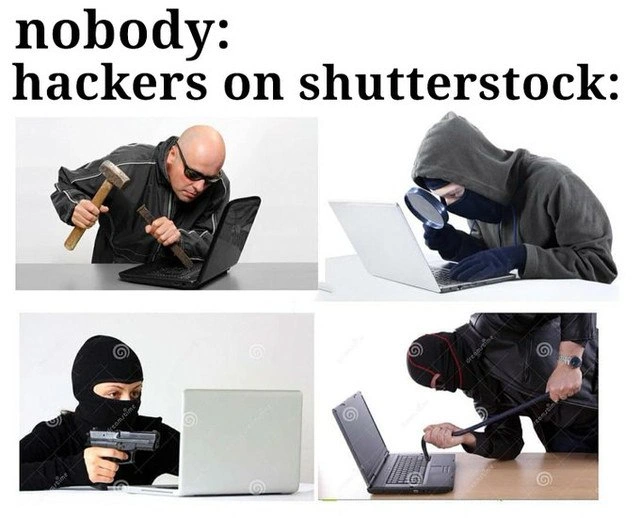
Let’s decode each image: the top-left shows a man with sunglasses and a hood about to hammer a laptop. In everyday tech terms, nobody solves a computer problem with a hammer (unless the problem is the computer itself and you’re very, very frustrated!). There’s even a joking phrase in IT: “When all you have is a hammer, every problem looks like a nail.” Here it’s like they think the laptop is a nail to be hacked. The top-right image has a hooded person using a magnifying glass on the screen. Maybe the idea was “investigation” or looking for clues, like a detective. In cybersecurity, professionals do examine logs and code carefully, but not with an actual magnifying glass! We use software tools to search through data. The bottom-left has a masked person pointing a gun at a laptop – which is both funny and absurd. What are they going to do, shoot the data out of the computer? (Pro tip: bullets won’t make the passwords fall out.) It’s a play on the term “hold at gunpoint,” as if the hacker is literally holding the computer hostage. And finally, bottom-right is someone prying open the laptop with a crowbar. Maybe they thought of the term “cracking” a system and interpreted it as physically cracking the machine open. In real life, if you physically pry apart a laptop, you’re more likely to just break it completely (and any data you wanted to steal will be harder to get, not easier!). This is definitely not how you do debugging or data theft – nobody does crowbar_debugging in real IT work.
This meme’s caption format, “nobody: / hackers on shutterstock:”, is a way to poke fun using contrast. The “nobody:” part means literally no one is doing or saying anything (it’s blank). It sets the stage by saying “there’s no real demand or expectation here.” Then “hackers on shutterstock:” suggests that, out of nowhere, stock photo hackers are doing these wild things. It’s implying “No real hacker asked for this portrayal, but look how stock images show hackers!” This meme format is common for humorously pointing out that something is unnecessary or over-the-top. In this case, it’s saying the over-the-top thing is how stock photos imagine hackers.
The tags like HackerCulture and IndustrySatire hint at why tech folks share this meme: it’s making fun of how the industry (especially media and stock image libraries) portrays our culture. Hacker culture in reality values knowledge, stealth, and skill with code. But the industry’s hype around hackers often results in cringey images and headlines. (Ever see a news article about hacking illustrated with a guy in a black hoodie, green binary code reflected on his face? So cliché!). Those clichés are exactly what this meme is ridiculing. It’s an inside joke among developers and security professionals: “Look at what the outside world thinks we do, versus what we actually do.”
For clarity, let’s compare real hacking techniques with these silly stock photo versions:
| Real Hacking Method | Stock Photo "Method" |
|---|---|
| Quietly testing thousands of passwords with a script (software brute force) | Hitting the laptop with a hammer to brute-force it literally |
Using a network scanner like nmap to find open ports |
Examining the screen with a magnifying glass as if hunting bugs like Sherlock |
| Stealing data via malware or sneaky code injection | Holding a gun to the computer to demand its data (scaring the silicon?) |
| Carefully opening a device to extract a hard drive (if doing hardware forensics) | Ramming a crowbar under the keyboard, as if data will pop out physically |
As you can see, the left column is how cybersecurity actually works – with code, tools, and sometimes hardware expertise – and the right column is a cartoonish exaggeration from the stock images. It’s a bit like comparing a surgeon to someone who uses a chainsaw because they saw it in a horror movie. One is precise and technical, the other is just for shock effect.
Newer developers or anyone who’s taken an intro to security knows that “hacking” mostly happens in software. You might use command-line tools, specialized programs, or write scripts to probe a system. For example, a real hacker might run ping or ssh commands, or write a Python script to test a website for vulnerabilities. They work quietly behind a keyboard. Conversely, these shutterstock_hackers look like they failed an anger management class with their poor laptops. The meme humorously highlights this disconnect.
It also serves as a light critique: stock photo sites often get tech topics wrong. Search for “computer hacker” on a stock site and you’ll see endless hooded figures in dark rooms, sometimes with Matrix-style green code streaming down, or weird additions like handcuffs on a keyboard, or yes, people smashing devices. The tech community tags this as MisconceptionsInTech because it’s a clear misunderstanding of what the actual work entails. No cybersecurity training will ever include “Choose your weapon: Hammer vs. Crowbar for Advanced Hacking 101.” Yet, if someone only learned about hacking from pop culture, they might joke, “Do I need a balaclava to code an exploit?” We laugh, but it shows how pervasive these stereotypes are.
In summary for this level: The meme is pointing out in a very visual way that media stereotypes of hackers can be ridiculously off-base. It’s a funny reminder that what you see in industry hype (especially marketing or news) isn’t always accurate. Real hackers use keyboards, not crowbars. If you’re a junior dev or just getting into security, know that hacking is about finding smart ways to make a computer do something unintended – no ski mask or sledgehammer required. And if you ever need an image for your security presentation, maybe skip the guy with the gun at his laptop – unless you’re aiming for laughs!
Level 3: Security Theater Props
In the world of cybersecurity, real hackers slip through digital cracks with code and cunning – not carpentry tools. This meme hilariously contrasts actual hacking with its ham-fisted portrayal in stock photography. It uses the classic "nobody: … / hackers on shutterstock:" format to exaggerate how no one actually does this, yet Shutterstock’s image library is full of absurd hacker tropes. The result? A spot-on satire of SecurityTheater in tech imagery.
At first glance, each of the four stock photos screams misconception. We see a so-called “hacker” literally taking a hammer to a laptop, another peering at a screen through a magnifying glass, a third aiming a handgun at a computer, and a fourth prying a keyboard with a crowbar. These goofy props are supposed to dramatize “hacking” for a non-technical audience. It’s unrealistic_hacking_portrayal to the max – a physical, almost slapstick interpretation of digital crime. The humor is obvious to any seasoned engineer: HackerCulture knows that breaking into systems is done with exploits and networks, not brute physical force. Yet here we have hammer_vs_laptop and gun_at_computer as if the laptop itself is being held hostage!
Why is this so funny (and a bit painful) for experienced devs and security pros? Because it satirizes the huge gap between industry hype and reality. In real breaches, attackers write scripts, deploy malware, or find logic flaws in code – subtle, technical, often invisible work. But mainstream media and image libraries feel the need to make “hacking” visually exciting, so they reach for Hollywood-inspired clichés. Think of it as the pictorial equivalent of movie hackers furiously typing gibberish on multiple screens with 3D rotating skulls – pure SecurityTheater. We’ve all rolled our eyes at those CSI-style hacking montages; this meme distills that absurdity into four frames of laptop abuse.
Importantly, the meme’s text format plays a key role in the humor. The “nobody:” line is intentionally blank, implying literally nobody is acting or asking for this, and then “hackers on shutterstock:” introduces these over-the-top scenes. It’s a tongue-in-cheek way to say: “No real hacker does this, but stock photos sure think they do!” The nobody_hackers_meme_format sets up the punchline that follows in the images. It’s a popular meme convention for highlighting a non sequitur or an exaggerated trend that appears out of nowhere – in this case, ridiculous hacker stock photos.
From a senior engineer’s perspective, there’s an extra layer of wry humor in how these images misuse terminology. Ever heard of a “brute force attack” to crack passwords? Here we have brute force taken literally – a brute swinging force at a laptop. Or consider penetration testing (pen-testing), a practice where security pros probe systems for weaknesses. One stock photo shows a gun pointed at a laptop, as if penetrating the poor machine with bullets is an attack strategy. It’s a clever visual pun unintentional by the photographer: this is what happens when non-tech folks interpret hacker jargon! The magnifying glass image is presumably attempting to depict “looking for clues” or doing forensic analysis, but it comes off like a Sherlock Holmes parody. And the crowbar? Perhaps a mangled take on “cracking” a system – as in physically cracking it open. In reality, no hacker is shucking their laptop like an oyster to steal data; they’re more likely writing a Python script to exploit a vulnerability.
This meme also resonates because it pokes fun at media MisconceptionsInTech. Developers often groan about how TV shows and newspapers choose cheesy visuals for complex topics. If an article is about a data breach, you’ll invariably see that hooded figure stock photo, face obscured, fingers on a keyboard – or these even sillier variants with hammers and guns. It’s industry satire highlighting how out of touch these portrayals are. The tag stock_photo_meme says it all: it’s mocking the entire stock photo industry’s approach to tech topics. The fact that all four images feature masked or hooded figures in gloves indoors is itself a joke: any programmer can tell you it’s hard to type in ski gloves! Real attackers don’t sit in a photo studio with prop weapons; they’re probably inconspicuous, maybe sipping coffee in a hoodie, running scripts on a second monitor.
By showcasing these laughable shutterstock_hackers, the meme underscores a form of visual security hype. Companies and media want hacking to look dramatic and threatening, so they resort to tangible violence because actual hacking isn’t visible. There’s irony in that: the true power of a hacker is in unseen code and network packets quietly doing damage. But you can’t easily illustrate a stealthy SQL injection or a buffer overflow in a news graphic. So instead, we get a bald guy literally trying to “hammer out” some code (maybe he’s frustrated with semicolons), and a ninja-ish character performing crowbar_debugging on hardware. If only stopping a cyberattack was as simple as whacking the hacker’s laptop – every sysadmin would keep a mallet in their desk drawer!
In short, this meme is a nod and a wink from the tech community, highlighting the gulf between real cybersecurity practices and their caricatures in popular media. It’s funny because it’s true: we’ve all seen these ludicrous images and thought, “Seriously? That’s not how any of this works.” The meme captures that collective eye-roll. As insiders, we recognize the security theater and sensationalism, and we’re in on the joke. Nothing unites engineers quite like laughing at how the rest of the world misunderstands our work – especially when the misunderstanding is as comically extreme as a hacker threatening his own laptop with a gun.
Description
This is a four-panel meme with the caption "nobody: hackers on shutterstock:". It satirizes the absurd and unrealistic portrayal of hackers in stock photography. The top-left panel shows a bald man in sunglasses attempting to use a hammer and chisel on a laptop keyboard. The top-right panel features a hooded figure in a balaclava inspecting a laptop screen with a magnifying glass. The bottom-left panel depicts a person in a balaclava aiming a pistol at a laptop screen. The bottom-right panel shows another person in a balaclava trying to pry open a laptop with a crowbar. The joke highlights the disconnect between the cinematic, physically aggressive actions in stock photos and the reality of hacking, which is a knowledge-based, digital activity. It's a widely shared inside joke among tech professionals who find these representations comical
Comments
7Comment deleted
The fastest way to get root access according to stock photos is with a crowbar. Meanwhile, the rest of us are still just trying to guess the admin password: 'password123'
Shutterstock threat model: hammer, Glock, crowbar; our incident post-mortem: the real weapon was a transitive npm dependency with write access to the CI runner
Meanwhile, our actual security incident was Karen from accounting clicking "Yes" to every UAC prompt while installing CouponBuddy.exe from a popup that promised to clean her registry
Meanwhile, actual security researchers are just running `nmap` in a terminal while wearing sweatpants and drinking their third coffee, wondering why their threat model doesn't include crowbar-wielding attackers with magnifying glasses. The closest thing to 'hacking with an axe' is forcefully killing a hung process with `kill -9`, and even that's considered poor form in production
Stock hackers wield hammers; real ones wield 'curl | bash' - hardware intact, root access revoked
Shutterstock’s idea of pentesting: rubber‑hose cryptanalysis on the laptop - STRIDE’s undocumented seventh category, Blunt Force Tampering
Every time I see a “hacker with a crowbar” stock photo, another exec funds endpoint armor while the breach walks in via a public S3 bucket and a hard‑coded Jenkins token