Statistical learning debates lose to the deep-net “stack more layers” mindset
Why is this AI ML meme funny?
Level 1: Just Pile It On
Imagine two kids trying to solve a problem: they want to reach a cookie jar on a very high shelf. The first kid is very studious – he sits down and thinks hard, drawing diagrams on a little chalkboard. He’s figuring out exactly how to build a stable tower using books and boxes so it won’t wobble. He’s using big words like “center of mass” and “structural support” (even though he might not fully understand them) and decides he needs to carefully choose just the right boxes so the tower doesn’t tip over. Meanwhile, the second kid just starts grabbing whatever he can find – stools, crates, pillows, anything – and piling them up quickly under the shelf. The first kid is still fine-tuning his perfect plan when the second kid’s haphazard tall stack of stuff somehow reaches the cookie jar, and he happily grabs the cookies. 🚀 The tower looks messy and overly tall, and it really shouldn’t have worked so well, but it did. Now everyone is laughing wondering, who’s the silly one here? The one with the complicated plan that didn’t get a cookie, or the one who just piled things on until it worked? The meme is just like this: sometimes in AI the very smart, complex approach gets beaten by a simple “just add more” approach. It’s funny (and a bit surprising) because it’s like winning by doing the obvious thing while the other person was busy overthinking. In the end, the easy solution reaching the goal makes us question which approach was the real joke all along.
Level 2: Big Words, Simple Fix
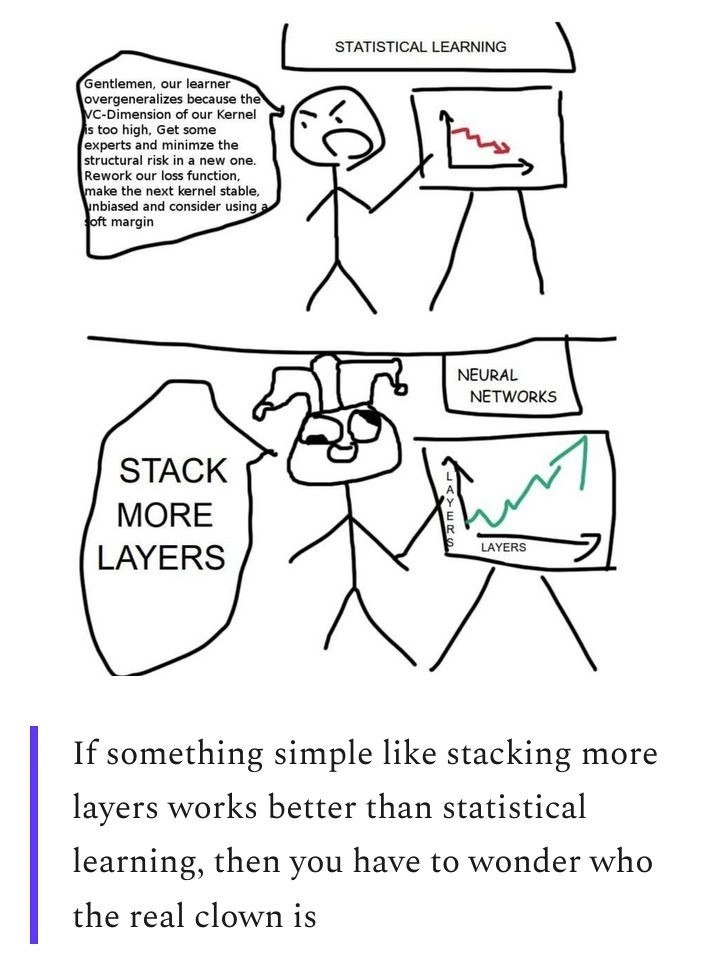
Let’s break down what’s happening in this comic in more everyday technical terms. In the top panel (labeled "STATISTICAL LEARNING"), we have a stick figure acting like a very scholarly machine learning expert. He’s pointing to a red downward-sloping graph on a whiteboard and spouting a lot of big words. What is he really saying? Essentially: “Our model is not doing well on new data (it’s overfitting), and the reason is that our chosen model is too complex (too high VC-Dimension). We should call in specialists to help design a better approach: maybe create a new kernel function (this refers to methods like SVMs where you choose a kernel to map data into a higher-dimensional space), and use methods to ensure it’s stable and unbiased. Let’s also tweak our loss function (the measure of error we train the model to minimize) and use a soft margin (allow a bit of error tolerance) to avoid overfitting issues.” Whew! That’s a mouthful. In simpler terms, the stick figure is proposing a bunch of careful, technical fixes to address why their current machine learning model is failing. Every term he uses is from classical machine learning methodology:
- VC-Dimension: Think of this as a number that tells us how complicated a model’s patterns can get. A higher VC-Dimension means the model can wiggle through more data points – which can be good (fit complex patterns) or bad (fit random noise). The figure complains the VC-Dim of their kernel is too high, meaning the model might be too flexible and is probably fitting noise (hence it "overgeneralizes", likely meaning it doesn’t predict well on new data).
- Kernel: In algorithms like Support Vector Machines, a kernel is like a fancy math function that projects data into a new space where it might be easier to separate. There are different types (linear, polynomial, RBF…), each with its own complexity. A complex kernel can fit very intricate patterns (high VC-Dimension). The expert wants a new kernel that’s more “stable and unbiased” – i.e. one that won’t go crazy fitting noise.
- Structural Risk Minimization: This is a strategy to avoid overfitting by not just minimizing error on the training data (that’s empirical risk) but also keeping the model complexity in check (structural risk). It’s like saying, “don’t just learn the training examples by heart; keep it simple so it’ll work on new examples too.”
- Loss function: This is basically how the model judges its own predictions. Reworking the loss function could mean they want to penalize complexity or errors differently to guide the model to simpler solutions.
- Soft margin: This term comes from SVMs. A hard-margin SVM insists on separating all training points perfectly (which can overfit if data isn’t perfectly separable), whereas a soft-margin SVM allows some mistakes but in return finds a more robust boundary. He’s suggesting using a soft margin to generalize better, allowing a little error so the model doesn’t contort itself to fit every point.
So, top panel dude is clearly a statistical learning theory nerd throwing every advanced concept at the problem to tame an overly complex model. The tone is serious, almost overly analytical – you can imagine him adjusting his glasses and referencing research papers while colleagues nod solemnly (or fall asleep).
Now, the bottom panel (labeled "NEURAL NETWORKS") flips the script. Here, the same stick figure has a big grin and a completely different approach. Instead of a whiteboard graph with a declining line, he’s holding a chart with an upward green line labeled "Layers" on the x-axis. Next to him, two giant cartoonish hands shout the solution in bold text: "STACK MORE LAYERS." This visual exaggeration – giant glove-hands with the solution written on them – makes the idea look bombastic and simple-minded in comparison to the careful plan above. “Stack more layers” refers to building a deeper neural network, meaning add more layers of neurons (computation units) to your deep learning model. In practice, stacking more layers makes a neural network deeper (hence “deep learning”), and usually more powerful because it can learn more complex features from the data. It’s like giving the model a bigger brain with more levels of reasoning. But it also means way more parameters (knobs to tune) and usually a higher risk of overfitting if you don’t have enough data or the right training process.
The humor comes from the stark contrast:
- The top approach is highly nuanced and intellectually intimidating. It’s the kind of talk you hear in an ML theory seminar or an advanced textbook. If you’re a junior developer or new to data science, it sounds like, “We must dive into the math and carefully redesign our approach, employing experts and complex theory.” It feels like a long road ahead to fix the model.
- The bottom approach is almost laughably straightforward: “Why not just increase the size of the neural network?” It’s something a newcomer might blurt out: “Can’t we just make the network bigger and see if it works better?” – and surprising everyone, it actually works. No fancy math discussion, just push a slider (layers) to the right and watch performance improve.
If you’ve ever worked on a machine learning problem, you may recognize this dichotomy. Sometimes you spend days thinking about the perfect features to add or the ideal algorithm to use (that’s like the top panel’s vibe), and then someone comes along and says, “I threw a bigger neural net at it and got better results.” It’s both frustrating and amusing. The meme exaggerates it for comedic effect: the drawn stick figure literally goes from frowning and lecturing the room with a declining graph to smiling with an “all solved” rising graph after applying the “just make it deeper” tactic. The AIHumor here is understanding that “just stack more layers” is a kind of running joke in the MachineLearning community – a bit of a meme in itself. It’s a riff on how deep learning success has often come from very brute-force scaling (more layers, more neurons, more data) rather than clever tweaks or deep theoretical insight.
For a junior audience, it’s key to know that deep neural networks are a type of model that learn by stacking layers of simpler computations. Each layer learns something from the data and passes it to the next; more layers generally means the ability to learn more abstract, high-level features. However, more layers also make the model more complex (lots more weights to train) and historically were harder to train (issues like vanishing gradients). But thanks to modern techniques and hardware (GPUs, better algorithms), we can train very deep networks now – some models have hundreds of layers (like ResNet-152 in image recognition, for example). Empirically, it was found that going from, say, a 5-layer network to a 50-layer network often gave huge boosts in accuracy on tasks like image classification. It wasn’t obvious at first why this worked so well (and researchers are still digging into the theory), but it became a winning formula in many competitions and applications. Thus “stack more layers” became a tongue-in-cheek mantra. It’s somewhat facetious because obviously you can’t indefinitely add layers (there are diminishing returns and practical limits), but whenever people got stuck improving a model, someone would inevitably quip, “Maybe we need it deeper.”
Meanwhile, the terms from the top panel come from an older paradigm, where you often had smaller models (like an SVM or a shallow decision tree or a regression model) and a lot of the work went into making sure that model was set up right to generalize. That often involved manually choosing transformations of the data (features) or regularizing the model to keep it simple. Statistical learning as a field gave us guidance like: don’t use a super flexible model on a small dataset, it will just memorize it (overfit)! Instead, constrain it – for example, use a simpler kernel or add regularization terms, etc. The bottom panel’s advice kind of blows that up: it says, in effect, “Actually, throw an even more flexible model at it (a deeper neural net) and it might do even better!” For a newcomer, this is a bit counter-intuitive and pretty funny when put in this context, because it’s the opposite of what you might learn in a first ML class about controlling model complexity.
To sum up the meme in relatable terms: it’s comparing a professor-like approach (carefully analyze why the model overfit and fine-tune it with theory) to a practitioner/hacker approach (just make the model bigger and brute-force learn everything). The punchline is that the "dumb" brute-force approach seems to win. This doesn’t mean theory is useless (far from it – theory helps us in the long run), but it captures a truth that in many practical scenarios, experimental intuition and scaling have outpaced our theoretical understanding. And that reversal – where the complicated careful plan is defeated by the simple fix – is what makes people in AI/ML chuckle. It’s a classic piece of DataScienceHumor: if you’ve been in the trenches trying to improve a model, sometimes the best advice (half-joking, half-serious) you hear is, “Have you tried making it deeper?” and the meme shows exactly that scenario, with an extra wink asking which approach is the real clown act in the end.
Level 3: Have You Tried More Layers?
This meme strikes a chord with anyone who’s witnessed the ongoing duel between elegant theory and pragmatic hacks in the AI/ML community. On one side, you have the traditionalists and researchers steeped in data science rigor – the folks who will bring up VC-dimension bounds, prove theorems about model convergence, and agonize over why the classifier is overfitting. They speak in equations and expect every tweak to be justified by better generalization guarantees. On the other side, you have the deep learning practitioners who, perhaps half-jokingly, propose the all-purpose solution: “Eh, just add another layer (or ten) and see what happens.” The caption “If something simple like stacking more layers works better than statistical learning, then you have to wonder who the real clown is” nails the comedic tension here. It’s poking fun at how often a simple, brute-force approach (more layers, more neurons, more data) outperforms the highly analytical approach of classical statistical_learning. The “clown” reference implies that maybe the joke is on the serious theoreticians: if their sophisticated methods get trumped by what feels like a caveman solution (“make it bigger!”), perhaps the real clowns are the ones overcomplicating things.
In real-world terms, this scenario has played out many times in the past decade. A room full of data scientists or academics might spend hours debating how to craft the perfect model – selecting just the right features, the optimal kernel trick, the best regularization strategy – essentially doing machine learning by brainpower. Meanwhile, a deep learning team down the hall just takes a base neural network model and increases the depth from 10 layers to 50, tosses the data at it, tunes a few hyperparameters, and voila – suddenly they’re achieving state-of-the-art accuracy. It feels like a pragmatic shortcut that shouldn’t work by conventional wisdom, yet it does. This dynamic is both hilarious and a bit painful for those who invested heavily in the old ways. It’s classic AIHypeVsReality material: the hype is that NeuralNetworks can solve everything if you just make them big enough, and the reality (in many tasks) has indeed been that deeper networks win competitions, benchmarks, Kaggle leaderboards, you name it. We’ve seen it in computer vision (where hand-crafted features and SVMs were crushed by deep convolutional nets that just kept getting deeper), in speech recognition, and even in games and robotics. There’s an infamous mantra in deep learning circles: “More data + bigger model = better results.” This meme extends that to a tongue-in-cheek extreme, implying that more layers specifically is the golden ticket.
For a senior developer or researcher, the humor also lands because it underscores a recurring pattern in tech: theories are great, but when raw empiricism repeatedly wins, you start questioning your assumptions. It’s reminiscent of times in engineering when a quick hack outperforms the “proper” solution, leaving the experts a bit humbled. The stick figure in the top panel is basically the caricature of a research meeting: “Gentlemen, our learner overgeneralizes because the VC-Dimension of our kernel is too high...” – it’s verbose, precise, even pompous. You can almost hear the groans of junior engineers in the back, half-understanding the jargon and dreading a month of model tweaks. Then comes the bottom panel revelation: What if we just scale up the darn thing? The stick figure now happily holds a chart with performance skyrocketing as LAYERS increase, and two big cartoon hands shout “STACK MORE LAYERS.” Those goofy oversized hands emphasize how ridiculously simple and almost childish that solution is compared to the learned discourse above. It’s like a one-two punchline: first panel sets you up with complexity, second panel delivers the silly answer that works. Seasoned folks laugh (perhaps a tad cynically) because they’ve experienced this. They’ve sat in meetings dissecting a problem to death, only to have someone half-jokingly say, “Have we tried just giving it a bigger network?” – and sometimes that Hail Mary approach actually fixes the issue.
The meme is also subtly pointing at the culture clash in the field of DataScience and AI research. The classical statisticians might view the “stack more layers” mentality as naïve, brute-force, and lacking understanding – akin to using a sledgehammer where a scalpel was intended. Deep learning enthusiasts, with equal fervor, might retort: “Well, the proof is in the pudding – the big hammer got the job done, didn’t it?” It reflects a bit of inter-generational ribbing in AI. Younger practitioners raised in the deep learning era sometimes skip over the theory (learning via frameworks like PyTorch/TensorFlow, intuitively knowing more layers often help) and may find the older textbook approach overly cautious. Meanwhile, veterans who honed their skills on established statistical methods watch the new breed achieve incredible results with methods that feel like “cheating” (just throwing computational power and data at the problem) and have to adapt or risk seeming outdated. The humor has a slight edge: it’s making light of the pride both sides have. The theorists can come off as clowns for overcomplicating an issue, and the deep-net devotees can look like clowns for thinking everything is solvable by brute force – but since the brute force is actually winning here, the meme implies the real clown is the one whose approach isn’t delivering.
In industry and academia, this manifests in actual debates and decisions. Do we invest time to manually craft features or do we just build a bigger deep model and let it learn features? Do we trust theoretical model_capacity limits, or do we empirically push them and see where things break? More often now, the answer has been the latter: push it until it breaks (and often it doesn’t break, it just works better!). The shared experience of seeing a simplistic approach outperform a sophisticated one generates a mix of laughter, relief, and maybe a touch of despair (for the purists). It’s funny because it feels so wrong from a classic standpoint, yet it’s so true in practice. The line “who is the real clown?” encapsulates that perfectly – nobody wants to be the clown, especially not after talking a big game with fancy terms. So when the pragmatic colleague’s wild idea succeeds, the highbrow approach ends up with a pie in the face. For those in the AI/ML world, this meme is premium DataScienceHumor: it captures an inside joke about our field’s tendency to swing between theoretical rigor and experimental brute force, and it does so with a simple cartoon that anyone who’s tuned into AI research trends can appreciate and chuckle at.
Level 4: Occam vs Overkill
At the highest technical level, this meme spotlights a theoretical showdown in machine learning between classical statistical learning theory and the modern deep learning ethos. The top panel’s word salad of jargon – VC-Dimension, kernel, structural risk minimization, soft margin – is essentially a crash course in how statisticians rigorously bound model complexity to prevent overfitting. The VC-Dimension (Vapnik-Chervonenkis dimension) is a formal measure of a model family’s capacity, meaning the largest number of data points a model can shatter (i.e., classify perfectly no matter how they’re labeled). A high VC-Dimension implies a very flexible model that can fit just about anything – powerful, but prone to learn noise (overfit) if not constrained. Structural Risk Minimization (SRM) is the principle of balancing fit vs. complexity: you minimize error on training data and include a penalty for model complexity (often tied to VC-Dimension or related capacity metrics). The stick figure’s plea to “minimize structural risk” and use a “stable, unbiased kernel with a soft margin” references techniques from Support Vector Machines (SVMs). In plain terms, he’s saying: Our current model is too complex and is generalizing poorly. Let’s get some experts to craft a better, simpler model (perhaps a new kernel function) and use techniques like soft-margin (allow a bit of error for robustness) to improve generalization. This is the high-minded, theory-driven approach: carefully redesign the solution using math so the model won’t overfit. It’s all very textbook and aligned with academic statistical_learning principles from the 90s and 2000s (think Vapnik, Cortes, and co. establishing how to tame model capacity). The goal is a leaner model with just the right complexity – invoking Occam’s Razor (simpler models over complex ones) to achieve better true performance.
Now enter the bottom panel, labeled “NEURAL NETWORKS.” The same stick figure has changed tune completely. Instead of brooding over VC-dimensions and kernel tricks, he’s grinning wildly, flanked by two giant glove-shaped hands proclaiming “STACK MORE LAYERS.” The graph beside him has “Layers” on the x-axis and is blissfully climbing upwards in green. This represents the empiricist deep learning mindset: If the model isn’t performing, just make it bigger (add more neural network layers) and feed it more data. From a classical perspective, this is sacrilege – adding layers means adding thousands or millions more parameters, exploding the model capacity to astronomical levels. In theory, an over-parameterized deep network can have a VC-Dimension so high it’s essentially unmeasurable (some results suggest it’s proportional to number of parameters, which for modern nets is in the tens of millions, so effectively infinite capacity). By Occam’s standards, this is overkill: you’re wildly exceeding the minimal complexity needed. Such a model should severely overfit... and yet, in practice, deeper networks often generalize better! This is one of the great paradoxes that has spurred modern research: deep nets defy the old bias-variance trade-off intuition. In fact, experiments have shown phenomena like double descent where increasing model capacity (beyond the point of fitting the training data perfectly) can decrease test error again. It’s as if throwing in more layers, more neurons – more of everything – finds a sweet spot where the network, despite its overkill complexity, manages to find a function that generalizes well on new data.
Under the hood, the deep learning approach relies on massive data, regularization tricks, and the dynamics of stochastic gradient descent to tame this wild capacity. Techniques like dropout (randomly dropping units during training) and L2 regularization act like the “soft margin” analogs in neural nets, implicitly keeping the model’s effective complexity in check even as we add layers. Moreover, each additional layer in a deep neural network enables it to learn more abstract features of the data (hierarchies of representation), which can actually make the model more generalizable if the problem truly has deep patterns to uncover. There’s also the universal approximation theorem which assures us that a neural network with enough layers (or neurons) can approximate any function – the meme humorously takes that to the extreme: why fuss over exacting theories when, theoretically, you can approximate anything by just going deeper? Of course, the theorist’s counterpoint is that approximation power isn’t the same as generalization power on finite data. Classical statistical learning would demand: control the capacity (maybe by limiting layers or neurons) to match available data. But the deep_learning_vs_statistics culture clash emerges because, time after time in recent years, simply scaling up models has beaten carefully tuned “small” models on benchmarks. When a brute-force increase in model_capacity outperforms a finely-calibrated approach grounded in decades of research, it feels like the theoretical playbook got clown-slapped. The meme’s punchline nudges us to consider that disconnect: if the dumb solution of “just add layers” wins, does that make the theory-heavy approach a joke? Or, seen another way, is the real clown the one gleefully stacking layers without truly understanding why it works? The meme leans toward the former interpretation – a pointed AIHumor jab that perhaps the joke’s on the over-thinkers this time. It highlights a core AI hype vs. reality tension: blindingly large deep nets (hype) somehow do deliver real results (reality), leaving theory scrambling to catch up. The generalization showdown between Occam’s elegance and overkill engineering defines this Level 4 analysis, and the battleground is the very heart of machine learning: how do we get models that actually work on new data? This comic simply suggests one camp’s answer is “who cares about all that theory – just throw more layers at it until it works!” and shockingly, that empirical brute force often carries the day.
Description
Meme composed of two hand-drawn stick-figure panels and a caption. Top panel is headed "STATISTICAL LEARNING"; a stick figure at a whiteboard with a downward-sloping red graph says, "Gentlemen, our learner overgeneralizes because the VC-Dimension of our Kernel is too high, Get some experts and minimize the structural risk in a new one, Rework our loss function, make the next kernel stable, unbiased and consider using soft margin." Bottom panel, separated by a horizontal line and headed "NEURAL NETWORKS", shows the same stick figure now grinning and holding a chart with an upward green line labeled "LAYERS" on the x-axis while two giant glove-shaped hands beside him simply read "STACK MORE LAYERS." Beneath the drawings a text block states, "If something simple like stacking more layers works better than statistical learning, then you have to wonder who the real clown is." The joke contrasts the mathematically rigorous but convoluted vocabulary of classical statistical learning theory with the empirical deep-learning habit of solving overfitting by increasing network depth, poking fun at AI research pragmatism versus theory
Comments
6Comment deleted
Six PhDs spent the sprint debating VC-dimension bounds; the junior added two more transformer blocks, called it “depth regularization,” and his PR was the only one that shipped
After 20 years in ML, I've learned that the real structural risk minimization is minimizing the risk of explaining to stakeholders why your theoretically optimal SVM got demolished by an intern's 500-layer transformer trained on a gaming laptop
This perfectly captures the existential crisis of ML researchers who spent years mastering VC-dimension theory, kernel tricks, and structural risk minimization, only to watch a 22-year-old intern achieve SOTA by adding three more transformer layers and calling it 'GPT-4.5'. The real tragedy? Both the loss function and their career trajectory are non-convex
Months of SRM proofs and margin bounds later, an intern adds 12 layers and a GELU and wins by 3 points - apparently the only VC dimension the board cares about is the venture capital to buy more H100s
SRM promised bounds; layers delivered leaderboards - academia's the real universal approximator of irrelevance
Statistical learning: minimize structural risk; deep learning: maximize parameters until double‑descent forgives you - aka the “just add another layer” architecture