Technical Debt Holding Back New Features
Why is this TechDebt meme funny?
Level 1: Ignoring Chores Bites Back
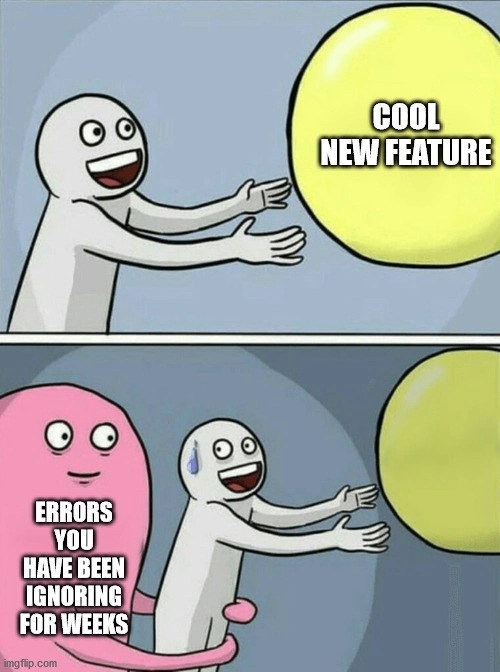
This meme is funny in a very relatable way. Think of it like this: imagine you have some chores or homework that you’ve been avoiding for a while – maybe your room is super messy or you have math homework due. Then you get a brand-new video game or toy, something really cool and exciting that you want to play with right now. Just like the character reaching for the “COOL NEW FEATURE,” you run after the fun thing and ignore the boring chores. It feels great at first because, hey, playing is more fun than doing homework or cleaning your room.
But those ignored tasks don’t actually go away. In fact, the longer you ignore them, the more they pile up. It’s like all your unfinished homework and chores turn into a big pink monster that’s quietly creeping up on you. Suddenly, at the worst moment (maybe right when your parents check your room, or the night before the homework is due), that monster of undone tasks grabs you! In the meme’s second picture, the character is sweating and getting caught by the pink blob. That’s exactly how it feels when you’ve put off your responsibilities for too long – stressful and a little scary!
We laugh at this meme because we’ve all been that person at some point. Chasing the fun new thing while pretending the boring problems aren’t there is a very human thing to do. The joke here is showing those ignored problems as a goofy-looking pink blob monster giving the person a “hug” from behind. It’s a silly way to say: if you ignore your problems, eventually they will demand your attention. Just like a messy room or unfinished homework will come back to cause trouble later, the programmer’s ignored errors came back to grab him. The meme makes this serious idea feel light-hearted by using a cartoon, which is why it’s amusing and easy to understand – it’s basically saying “don’t let the fun new toy make you forget about the mess you left behind, or that mess might surprise you!”
Level 2: Chasing Features, Chased by Bugs
Let’s break down what’s happening in this cartoon. In the first panel, we see a happy developer character eagerly reaching out towards a big yellow ball labeled “COOL NEW FEATURE.” This represents how a developer (especially when under pressure or excited about new ideas) will focus on adding a new feature to a software project. A feature in software is any new functionality or improvement that users will notice – for example, a new button, a new report, or a whole new service. It’s the fun part of development because you get to build something new and shiny that people might praise or get excited about. This is why our stick-figure dev looks so delighted – they’re imagining the glory of shipping that cool new feature.
Now, in the second panel, we see reality catching up. The same developer is sweating and looking nervous because a pink blob creature labeled “ERRORS YOU HAVE BEEN IGNORING FOR WEEKS” has grabbed onto them from behind. This represents all the bugs and error messages in their project that they haven’t fixed yet. In real life, a bug is a mistake or problem in the code that causes errors or incorrect behavior. For example, maybe there’s a function that sometimes crashes or a calculation that’s wrong. Those are errors that ideally should be fixed. But developers sometimes ignore errors – perhaps they saw some error logs in the console or got some bug reports and thought, “I’ll deal with those later, I want to finish this new feature first.” Those postponed bug fixes pile up in what we often call a bug backlog (a list of all known issues waiting to be resolved). Here the meme jokingly imagines those unresolved bugs as a pink monster that has been quietly growing while the developer wasn’t paying attention. After “weeks” of being ignored, the errors are now impossible to ignore – just like the blob grabbing the dev.
This relates to a common concept in software development known as technical debt. Technical debt is a metaphor that treats neglected problems in code like a debt you owe. If you don’t fix issues now (like not paying your credit card bill), you “borrow” time, but you’ll have to pay it back with interest later. The interest, in this case, is the extra headache and effort it takes to fix the bugs after they’ve grown or after they’ve caused bigger problems. The meme’s humor comes from showing technical debt as this literal debt-collector blob. Those “ERRORS... IGNORING FOR WEEKS” are exactly technical debt. They didn’t go away; they just waited until the worst moment and then pounced. If you’ve ever seen a project where small bugs were ignored release after release, you might also have seen what happens eventually: the software might crash, or users start complaining, and then the team has to drop everything to fix a ton of issues under pressure. That feels like being tackled by a pink blob of previously ignored bugs!
For a newer developer (or someone learning to code), this meme is a gentle warning wrapped in humor. Developer priorities can get skewed: it’s tempting to always start a new project or new feature because it’s exciting and visible. Meanwhile, bug fixing and debugging can be tedious and not as glorious. But as the meme illustrates, ignoring bugs doesn’t make them disappear. They actually become harder to deal with over time. It’s a lot like if you never take out the trash; eventually the house starts to smell and you have a much bigger clean-up job. Similarly in coding, those error logs you ignored could lead to more complicated failures later (maybe more data gets corrupted or more parts of the codebase start breaking because of that one unfixed issue). That’s why experienced developers talk about finding a balance between adding new features and fixing existing problems. You can certainly push off some minor issues for a while, but you have to be careful – wait too long, and your technical debt blob might sneak up and give you a not-so-friendly hug in the form of a severe bug at the worst time. The meme uses a simple cartoon to convey this message: don’t let the fun of a new feature completely distract you from the errors crawling up behind!
Level 3: The Debt Comes Due
In this meme’s two panels, a developer is wide-eyed and reaching for a “COOL NEW FEATURE” – depicted as a shiny yellow orb of temptation. But creeping right behind them is a pink blob monster labeled “ERRORS YOU HAVE BEEN IGNORING FOR WEEKS.” The second panel shows the blob wrapping around the developer like a horror-movie creature. This is an all-too-familiar scenario in software engineering: chasing feature velocity while technical debt lurks in the shadows. Seasoned developers immediately recognize the dark humor. We’ve all seen a team focus on shipping that next shiny feature, blissfully ignoring a growing pile of error logs and bug reports – until those ignored errors come back to collect their debt. The pink blob is basically tech debt personified, giving the coder a big hug at the worst possible time.
Why is this funny to an experienced dev? Because it’s painfully true. We often prioritize new features (the stuff that product managers and users get excited about) over maintenance (the boring bug fixes and refactors). It’s enthralling to build something new, like adding a fancy user-facing capability or another microservice. Meanwhile, minor bugs and system errors are left unattended (“we’ll get to them next sprint, promise!”). Those little issues don’t stay little – they accumulate. Each ignored exception, each failing test, each “TODO: fix later” is like interest accruing on a credit card. Eventually, that technical debt interest comes due. The meme captures that moment: the developer sweating as the debt literally grabs them from behind. It’s humorous in the way that makes you nervously chuckle, because you know the bug backlog has a habit of jumping out at you when you least expect it (Friday 5 PM deploys, anyone?).
This is also highlighting an industry anti-pattern. Startups and big companies alike often celebrate rapid feature delivery – new UI redesigns, new API endpoints, cool integrations – while quietly sweeping known bugs under the rug. Best practices say “fix bugs promptly,” but reality often says “the demo is next week, just get the feature working (we’ll ignore those failing tests for now).” Every experienced engineer has tales of woe from this approach. Perhaps you’ve seen error logs grow into thousands of lines of pink/red text (the color many consoles use for errors) because no one had time to investigate. Eventually, one of those errors turns into a full outage or a nasty data corruption. Suddenly that fun feature rollout halts as everyone scrambles to slay the bug monster that’s been growing in the dark. The meme’s blob literally wrapping the developer is a perfect metaphor for how deferred bugs can entwine and strangle a project.
Let’s be honest, the real horror comes when those errors you’ve been ignoring decide to make a dramatic appearance in production. It might be at 3 AM on a weekend – a scenario the Cynical Veteran in all of us knows too well. That “COOL NEW FEATURE” you shipped will be less cool when an on-call engineer gets paged because an unhandled exception (that everyone ignored for weeks) crashed the app. As the saying goes, “if you don’t schedule time for maintenance, your system will schedule it for you.” The meme gets a laugh because we see our own mistakes in it. It’s Developer Humor rooted in truth: we’ve chased the new and shiny, and ended up caught by the bugs we didn’t bother to fix.
In code, ignoring errors might look like this:
try:
launch_new_feature()
except Exception as e:
# Ignore the error for now... it'll be fine, right? 😅
pass
Here, the developer literally catches an exception and does nothing – effectively hugging the pink blob and hoping it won’t squeeze. This is the kind of debugging pain we set ourselves up for. Senior engineers have learned (often the hard way) that technical debt behaves exactly like this pink blob: the longer you ignore it, the stronger it grabs you later. The humor has a bite because it’s a snapshot of the exact moment technical debt comes due and yells “Remember me?!”. The meme perfectly nails the balance between Feature Creep excitement and the looming consequences of ignored errors – a balance every development team has to manage, or else get surprise-hugged by a blob of their own making.
Description
A two-panel meme using the 'Running Away Balloon' or 'Holding Back' comic template. In the first panel, an enthusiastic, smiling stick figure character is eagerly reaching for a large yellow balloon labeled 'COOL NEW FEATURE.' In the second panel, the character is being held back by a large, pink, blob-like creature labeled 'ERRORS YOU HAVE BEEN IGNORING FOR WEEKS.' The character's expression has now turned to one of sweating and panic as they are prevented from reaching the new feature. This meme perfectly visualizes the concept of technical debt, where neglecting existing bugs and errors inevitably obstructs or complicates the development of new functionality. It's a universal and painful experience for senior developers who must often confront the consequences of past shortcuts before they can build something new and exciting
Comments
7Comment deleted
That 'cool new feature' is usually just a request to add a CSV export, but the ignored errors are a race condition that occasionally corrupts the entire database
Shipping that shiny GPT feature feels great - right up until the error budget you’ve been overdrawing for three sprints compounds into a SEV-1 and hugs your pager at 2 a.m
After 15 years in the industry, you realize that 'COOL NEW FEATURE' is just management-speak for 'the thing that will generate 47 new edge cases we'll discover in production while those ignored errors form a union and demand overtime pay.'
The most dangerous phrase in software engineering isn't 'it works on my machine' - it's 'we'll fix those errors after we ship this feature.' Spoiler: those errors are now legacy issues with their own Jira epics, and that 'cool new feature' is the reason you're getting paged at 3 AM because it's interacting with the technical debt you've been avoiding since Q2 2022
Feature toggles won’t toggle a negative error budget - SLOs just enabled parental controls
OKR: ship the cool new feature. SLO: enjoy the cuddle from the error budget you burned ignoring those “harmless” stack traces
New feature euphoria: because that race condition from sprint 17 pairs perfectly with microservices