Researchers Hate Him: Clickbait Spoof Claims More Layers Unlock AGI
Why is this AI ML meme funny?
Level 1: Blocks Can’t Think
Imagine you’re building a tower out of LEGO blocks. You keep stacking more and more blocks, thinking that if the tower gets tall enough or complicated enough, it will magically come to life and start talking or thinking like you do. 😄 Of course, no matter how huge that tower gets, it’s still just a pile of LEGO bricks – it won’t turn into a real, thinking robot. We laugh at that idea because we all know adding more of the same thing doesn’t suddenly create something as special as a human mind.
This meme is funny for the same reason. It pretends that solving one of the hardest problems in the world (making a machine as smart and adaptable as a person) is as easy as doing one simple, goofy thing. It’s like someone claiming, “Hey, I found a magic trick that all the experts missed!” – when we’re pretty sure that’s too good to be true. We know that in real life, big problems don’t have such quick fixes. So, we smile or laugh because the meme is clearly joking: it’s showing an obviously fake “quick fix” (just add more layers!) to highlight how ridiculous it would be to have a shortcut to real intelligence. In other words, it’s funny because everyone can see that’s not how thinking works, and the contrast between the huge problem and the silly solution makes it absurd in a fun way.
Level 2: More Layers, More Magic?
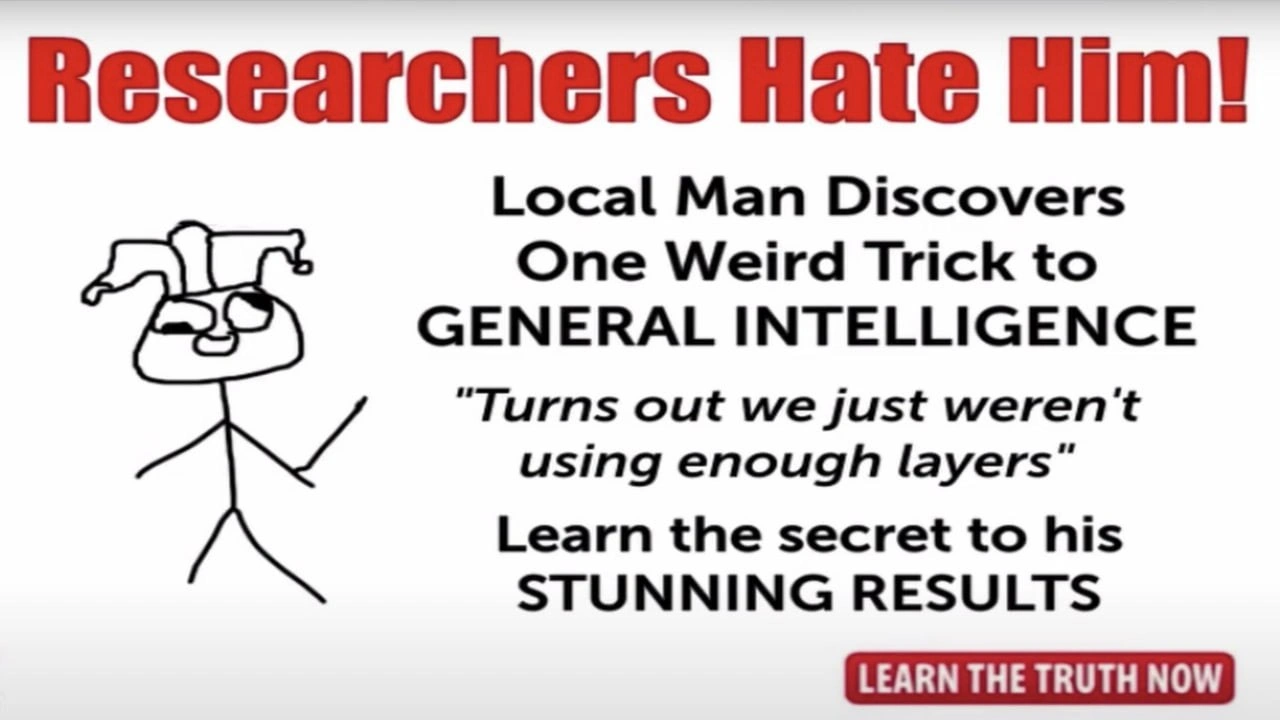
Let’s break down the joke in simpler terms. The meme is styled like a cheesy internet ad. You know those suspicious headlines like, “Doctor discovers one weird trick to lose weight” or “Banks hate him for this simple financial secret!”? Here it says, “Researchers Hate Him! Local Man Discovers One Weird Trick to GENERAL INTELLIGENCE.” It’s copying that classic clickbait format to make fun of an over-simplified idea in AI.
Now, what does “using enough layers” refer to? This is talking about neural network layers. In machine learning, a neural network is a program loosely inspired by the human brain that learns to do tasks by adjusting a lot of internal parameters (kind of like little knobs or weights) based on examples. These networks are organized into layers. A layer is basically a set of artificial neurons that each take some input, do a calculation, and pass an output to the next layer. The first layer of neurons looks at the raw input data (for example, the pixels of an image). The next layer takes the first layer’s output and looks for a bit more complex patterns (maybe it detects edges or simple shapes in those pixels). Subsequent layers build on that, detecting higher-level features (like parts of objects), and the final layer might decide what the image is (say, “this is a cat”). Stacking many layers means the network can figure out very intricate, abstract patterns by combining simpler patterns from earlier layers. That’s why we call it deep learning – “deep” simply means the network has a lot of layers. With enough layers and the right data, these models have gotten really good at specific tasks (like recognizing faces, understanding speech, etc.).
Artificial General Intelligence (AGI), on the other hand, means an AI that isn’t just good at one or two tasks, but can handle any intellectual task thrown at it, much like a human can. Right now, we have AI that’s superhuman at some narrow things (chess or Go, for instance, or finding cat photos), but it can’t wake up one day and decide to learn something completely different outside its training. AGI is like the dream of a machine that could learn and think as broadly and flexibly as a person – it could play chess, tell a joke, learn a new language, do science, all that. We’re nowhere near that yet; it’s a tough, maybe decades-long or even centuries-long challenge (some even debate if current approaches will ever get us there). It’s often called the “holy grail” of AI research because it’s such a big, ultimate goal.
The joke in this meme is suggesting that a local guy (drawn as a little stick figure wearing a funny jester hat) found the “secret” to achieve AGI, and that secret is just adding more layers to our neural networks. The text even says in italics, “Turns out we just weren’t using enough layers.” This is obviously a tongue-in-cheek statement. People have been trying for ages to inch toward general intelligence, and it’s extremely complicated. There’s no single tweak or “trick” that suddenly makes a simple program as smart as a human. By phrasing it that way, the meme is mocking the idea of an easy fix. It’s kind of like saying, “Oh, solving world hunger? Turns out we just weren’t using a big enough cooking pot!” — it sounds silly because it is silly.
For a newcomer, think of it like this: adding layers to a neural network is one way to make an AI model more powerful, similar to adding more gears and machinery to a device to make it do a more complex job. But if you imagine building a robot, there’s a point where bolting on more of the same parts won’t give it new abilities — you might need a different kind of part or a new design entirely. Likewise, just piling on layers in an AI without changing the approach might stop helping. In fact, if you make a network too deep or complicated without enough data or proper tuning, it can actually get worse at learning new things. It might just end up memorizing the examples it’s seen (we call this overfitting) instead of understanding the general idea, which means it won’t perform well on new, unseen tasks. General intelligence, by definition, means doing well on new tasks, so a strategy that leads to memorizing rather than understanding is not the “secret” you’d want.
Finally, notice the big red button in the meme that says “LEARN THE TRUTH NOW.” This is exactly what you’d see on a sketchy clickbait ad, right? The meme is mimicking the whole vibe of those “too good to be true” ads. It’s saying: here’s a sensational claim (a man discovered the key to AI omnipotence!) paired with a call to action as if you could click and find out. In reality, there’s no secret link — the whole thing is a joke. We find it funny because it mixes something very serious and complex (creating a truly intelligent AI) with a format that’s known for oversimplified, often bogus solutions. It’s a parody of both the hype around AI and the gullibility of clickbait. Essentially, the meme is a way for tech folks to laugh at the idea that such an immensely difficult problem could ever be solved by a quick hack that “researchers didn’t think of.” We know real breakthroughs in AI come from years of hard work and incremental progress, not a single magic bullet. So this spoof ad gives us a chuckle by highlighting just how absurd an easy answer to AGI really sounds.
Level 3: Overfitting the Hype
For seasoned developers and researchers, this meme hits on a very familiar kind of tech hype. It combines the over-the-top style of an internet clickbait headline with the lofty promises of AI miracle solutions we often see in press releases. The bold red phrase “Researchers Hate Him!” instantly brings to mind those spammy ads (“Doctors hate him!”) that tease a miracle cure or a “one weird trick” solution. Here it’s been remixed to tech: “One Weird Trick to GENERAL INTELLIGENCE.” Anyone who’s been around AI/ML circles will recognize the satire. The meme is basically saying, “Yeah, sure, this random guy in a jester hat solved AI’s hardest problem overnight with a simple hack — sounds legit!” It’s poking fun at the sensationalism in some AI industry trends coverage, where complex research gets reduced to flashy, misleading headlines.
The line “Turns out we just weren’t using enough layers” is the punchline, and it’s loaded with irony. In the machine learning community, there’s an inside joke that if your neural network isn’t performing well, you could just try making it bigger or “deeper” (i.e., add more layers). There’s even a kernel of truth in that—early deep learning breakthroughs did come from using more layers in neural networks (hence the term deep learning). But experienced folks also know that blindly piling on layers leads to practical problems like sky-high training times and the risk of overfitting (where your model memorizes training data and then fails to generalize). So when someone quips “we need more layers,” it’s often said with a smirk, acknowledging that it’s a simplistic fix and not a guarantee of real improvement. The meme exaggerates this trope to an absurd level: implying that the only thing holding back Artificial General Intelligence was not having a big enough neural network. Context tags like neural_network_layers and overuse_of_layers_gag capture this exact humor — it’s a gag about the almost magical importance people jokingly assign to layer count.
Now, why would researchers hate him? Because this fake clickbait scenario is basically a slap in the face to all the hard work and complexity in AI research. Imagine dedicating your career to AI and wrestling with its hardest questions, only to see a headline suggesting that some random “local man” found a quick shortcut you supposedly missed. It’s the ultimate oversimplification. The meme uses that familiar “weird trick” trope — where an outsider discovers a secret that experts supposedly don’t want you to know — to mock how some folks portray AI breakthroughs. The stick figure’s jester hat is a nice touch: it signals that this character is a bit of a fool or clown, yet in the story he’s claiming a genius breakthrough. That contrast is pure satire. It’s like those parody news articles where a fool accidentally solves a big problem, and the experts are shown as either ignorant or jealous. In reality, of course, AI experts would either laugh or facepalm at the idea that AGI was achieved by “just add layers.” The meme’s title phrase “Researchers Hate Him” is joking that the entire scientific community is irate, which in context really means they’d hate the spread of such nonsense.
Many of us in tech have seen patterns like this: a complex engineering or scientific challenge gets distilled down to an almost meme-worthy promise by the time it hits marketing or media. Think of headlines like “This new algorithm learns just like a human!” or startup pitches that oversell what their AI can do. There’s a shared eye-roll among professionals when we see those. This meme is essentially capturing that AI hype vs. reality vibe. It’s a piece of AI humor that thrives on our awareness of the gap between what’s actually happening in machine learning labs and what the public sometimes believes. In fact, around the time this meme was posted, big neural networks (with lots of layers) like GPT-3 were making headlines. Some excited articles were hinting that these might be steps toward AGI, while most researchers were pumping the brakes, saying “Impressive, yes, but it’s not truly understanding anything.” That tension in the community – between breathless hype and cautious reality – is exactly what this joke plays off.
In short, the humor for a senior audience comes from recognition. We recognize the clickbait_headline_meme format and we recognize the oversimplification of a genuinely hard problem. It’s a bit of catharsis, too: laughing at something that frustrates many in the field — namely, the tendency to think there’s a quick fix or a miracle shortcut in AI. The meme basically says, with heavy sarcasm, “Don’t worry guys, solving AI was easy after all!” And if you’ve been through the grind of real-world projects or research, that kind of absurd statement is both funny and a relief to laugh at. It highlights how ridiculous grand claims sound to those who know the nitty-gritty details, and it bonds the tech community through a shared “Can you believe what some people think?” sentiment.
Level 4: Deeper ≠ Smarter
At a theoretical level, adding more layers to a neural network does increase its power to represent complex functions—but it doesn’t automatically grant general intelligence. The classic universal approximation theorem in neural network theory even tells us that a network with just one sufficiently large hidden layer can approximate any function (given the right parameters). In practice, though, deep learning relies on stacking many layers to learn rich, hierarchical features (for example, lower layers detect edges in images while higher layers detect shapes or objects). Deeper networks can solve tougher problems than shallow ones, but Artificial General Intelligence (AGI) is a far more ambitious goal than any single-task problem.
From a research perspective, the meme’s “one weird trick” of endlessly adding layers brushes aside numerous fundamental challenges:
- Diminishing returns: Simply making a network deeper yields smaller and smaller gains after a point. Each additional layer might help slightly (or not at all) once the model is already expressive enough. You often need exponentially more data or compute for each extra performance boost. There's a concept of scaling laws in AI that show performance improves with model size, but nowhere do they indicate a sudden emergence of human-level reasoning just by hitting a magic number of layers.
- Optimization difficulties: Extremely deep networks are hard to train. Early neural network research hit a wall with just a few layers because of issues like vanishing gradients (gradients that become nearly zero and stop the early layers from learning) and exploding gradients (values that blow up and destabilize training). Modern techniques—like Rectified Linear Unit (ReLU) activations, better weight initialization, and architectures such as ResNets with skip connections—were breakthroughs that allowed training of very deep models by alleviating these problems. In other words, adding layers wasn’t a trivial "just do it" thing; it required significant innovations to even work correctly.
- Generalization limits: More layers means a model can fit the training data more flexibly, which is a double-edged sword. A network with an enormous number of parameters can end up overfitting—memorizing the exact data it saw—without truly learning general concepts. True general intelligence would need the ability to handle totally new situations, not just the patterns it was trained on. If you naïvely increase layer count without new strategies, you often get a model that impressively fits past data but fails to generalize to new tasks (the opposite of what “general” intelligence requires).
Crucially, intelligence isn’t just about recognizing patterns in a fixed dataset; it involves reasoning, planning, remembering, and adapting in real-time to an open-ended world. Present-day deep networks, no matter how deep, operate within the constraints of their training: they excel at the specific kinds of problems and data they were trained on (like translation, image recognition, or game playing) but can’t suddenly jump beyond that scope. AGI, by definition, would need to cope with almost any problem or environment thrown at it, which likely demands new architectures or learning paradigms. Researchers are exploring ideas like combining neural networks with symbolic reasoning, adding systems for memory and attention that mimic working memory, or methods like meta-learning (learning how to learn) to push toward more general AI. These are complex, open problems—certainly not solved by a mere layer-count increase.
The meme exaggerates a common misconception in AI hype: the idea that there’s a straightforward, purely quantitative path to human-like intelligence. It’s poking fun at the notion that AGI could be just an engineering problem of “scale it up.” If it were that simple, we might have seen signs of AGI emerge when models went from 10 layers to 100 layers, or when parameter counts went from millions to billions. But even the largest models (for example, GPT-3 around when this meme was made, with 175 billion parameters across dozens of layers) — while astonishing in some respects — clearly lack true understanding or common-sense reasoning. They can output fluent text and mimic knowledge because they statistically absorbed patterns from huge datasets, yet they don’t truly understand or learn new concepts on their own the way a human can.
In summary, from an advanced perspective, “we just weren't using enough layers” is a tongue-in-cheek mockery of simplistic thinking. It ignores the qualitative gaps between today’s narrow AI and a hypothetical general intelligence. Real AI/ML researchers are well aware that simply making networks deeper isn’t a magic key to human-level cognition. The meme tickles those in the know because it parodies the grandiose claims and oversimplifications that sometimes circulate in the AI industry. It’s essentially saying: if only it were that easy! — highlighting by absurdity how far removed such clickbait claims are from the real science of AI.
Description
White background with bold red headline reading "Researchers Hate Him!" beside a crude stick-figure wearing a jester hat. Below, black clickbait-style text says: "Local Man Discovers One Weird Trick to GENERAL INTELLIGENCE" followed by the italic line "Turns out we just weren't using enough layers" and another bold line "Learn the secret to his STUNNING RESULTS." A red button at bottom right states "LEARN THE TRUTH NOW." The meme parodies diet-ad clickbait to mock AI hype, joking that adding extra neural-network layers magically delivers artificial general intelligence, highlighting the oversimplification and sensationalism often seen in machine-learning discourse
Comments
6Comment deleted
The path to AGI, according to clickbait: just keep adding layers until the gradients, the budget, and the CFO all vanish simultaneously
The same guy who solved scaling by adding more servers just pivoted to AI and discovered consciousness emerges at layer 2048 - right after the OOM killer does
Ah yes, the 'bitter lesson' of AI research: when in doubt, add more layers. It's the neural network equivalent of 'have you tried turning it off and on again?' - except instead of rebooting, we just stack another hundred transformer blocks and call it progress. The real 'one weird trick' researchers actually hate is when someone points out that their groundbreaking 99-layer architecture performs marginally better than the 98-layer version from last week, but now requires a small nuclear reactor to train
Apparently AGI is linear in depth; the only nonlinearity is the CFO's budget function
The scaling hypothesis distilled: when architectures fail, just deepen the abyss until emergence saves the day
If AGI is “just more layers,” our org should be omniscient - unfortunately attention saturates between Legal and Procurement, and gradients vanish at Finance