Skip to content
DevMeme
2042 of 7435
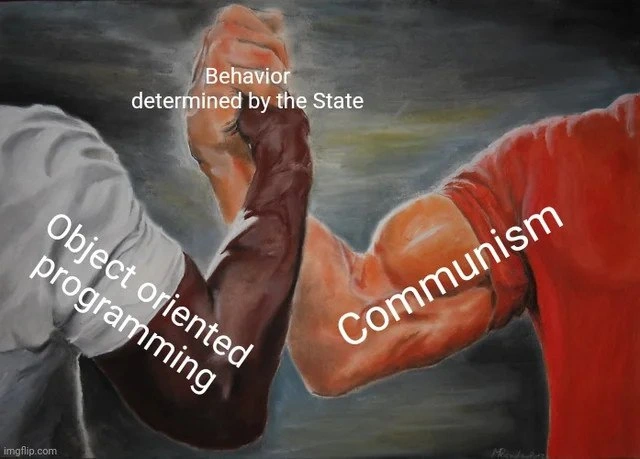
When object-oriented programming and communism agree on state-driven behavior control
CS Fundamentals Post #2275, on Nov 9, 2020 in TG

When object-oriented programming and communism agree on state-driven behavior control

Why is this CS Fundamentals meme funny?

Level 1: One Thing In Charge

Imagine you have a toy robot that has a little switch on it. When the switch is flipped to “happy” mode, the robot dances. When the switch is flipped to “sad” mode, the robot slows down and frowns. That switch setting is like the robot’s state – it decides how the robot behaves. Now think about a classroom where the teacher is in charge of the class. When the teacher says “quiet time,” all the students sit and read. When the teacher says “play time,” everyone runs around and plays. In the classroom, the teacher (the person in charge) is like the State telling everyone what to do. The funny picture is saying that these two very different situations – a toy robot and a strict rule-setting government – have something in common: one thing in charge controls how everyone or everything behaves. The meme shows two strong arms (one labeled for coding, one for communism) shaking hands to agree on this idea. It’s silly because we don’t normally compare programming and government, but here they’re best buddies about one rule: the behavior is decided by the state! It’s like saying, “Whether you’re a toy, a computer program, or a whole country, if one boss is calling the shots, everyone’s actions follow that boss’s rules.” And that’s why it’s funny – it connects a geeky coding rule to a big world idea in a playful way.

Level 2: All About the State

Let’s break down the joke in simpler terms. On the left side, we have object-oriented programming (OOP). OOP is a way to write code where you bundle data and functions into units called “objects”. Each object has state, meaning it stores information in variables (often called attributes or fields). The object also has methods (its behaviors or actions). The key point: what an object does can depend on its current state. For example, imagine a simple Door object in a program with a variable isLocked that tracks its state (locked or unlocked). The door might have an open() method, and that method will behave differently depending on the state of isLocked:

class Door {
    boolean isLocked;  // state: locked or unlocked

    void open() {
        // Behavior depends on state
        if (isLocked) {
            System.out.println("The door won't budge.");
        } else {
            System.out.println("Door swings open!");
        }
    }
}

In this code, the output of door.open() is determined by the door’s isLocked state. If isLocked == true, the behavior is “won’t budge”; if isLocked == false, the behavior is “swings open”. This is what we mean by an object’s behavior being determined by its state. It’s a fundamental idea in OOP and in programming in general: the state_and_behavior of an object are closely linked. Many design principles and patterns (like the aptly named State pattern) are about organizing code so that changing an object’s state changes its behavior in a clean, controlled way.

Now, the right side of the meme is communism. Without diving too deep into politics, communism is a socio-economic ideology that, in practice, often involves strong central planning. “The State” (with a capital S) usually refers to the government or the collective authority of the people. In a communist system (especially the way it’s portrayed in jokes or Cold War history), the idea is that the State determines almost everything about daily life: who works where, how resources are distributed, what the priorities of society are. In other words, individual behavior (like what job you do, what goods you can buy) is determined by the State’s decisions. The government’s policies and plans set the course, and everyone is expected to follow that central plan. That’s why the meme’s phrase “Behavior determined by the State” makes sense in a political context: under communism, the centralized_control of the government influences how people behave or how the economy runs.

So the meme text sits above the two clasped hands and reads “Behavior determined by the State”. This is one phrase that cleverly applies to both contexts:

  • In OOP: An object’s behavior is determined by its state (its internal data).
  • In communism: People’s behavior is determined by the State (the government authority).

The meme image (two muscular arms in a strong handshake) is a popular format to show two different groups or ideas finding agreement on something. Here the two arms are even color-coded: the right arm wears a red sleeve (red is often associated with communism/socialism), and the left arm has a white/neutral sleeve (standing in for the techie side). Each arm is labeled – one “Object oriented programming”, the other “Communism”. They’re agreeing, as written on the handshake, that state drives behavior. It’s a visual handshake_agreement_visual pun: the agreement is literally written at the meeting point of the two arms. The humor comes from the sheer absurdity of pairing these two worlds. It’s classic developer humor to take a programming concept and find a whimsical parallel in real life or even in politics. In this case, the word “state” is the lynchpin. It’s one of those same word, totally different meaning scenarios. Programmers talk about “state” all the time (meaning the current data values in a program), and outside of coding, people talk about “the State” to mean the government. By phrasing it as “Behavior determined by the state”, the meme maker created a state_and_behavior_pun that perfectly overlaps the two meanings. If you’re new to coding, don’t worry – it’s not suggesting your code is communist 😅. It’s just wordplay: OOP and communism agree on the power of “state”. It’s funny because it’s true in each domain separately, and it’s bizarre to see them combined. This kind of technical satire is meant to get a chuckle from folks who understand both references, or to prompt you to learn what “state” means in programming if you only knew the political meaning. After all, when else would you see a programming paradigm and a political ideology high-fiving each other? Only in a nerdy meme like this!

Level 3: State Pattern Solidarity

"Behavior determined by the State"

In this meme’s epic handshake, we see Object oriented programming (left arm) and communism (right arm) clasping hands in agreement over a shared creed: behavior is determined by the state. It’s a clever play on words bridging a software design principle with a political ideology. On the programming side, state refers to an object’s internal data, which crucially influences how its methods behave. In political terms, the State (capital “S”) means the government authority, especially in a communist context where the central government controls social and economic behavior. The humor sparks from this dual meaning of “state” and the unlikely alliance it creates. Two seemingly unrelated domains – coding and communism – find common ground in a centralized control metaphor: an object’s behavior is dictated by its state, and in communism, citizens’ behavior is dictated by the State. It’s the classic epic handshake meme format: two muscular arms (unlikely allies) agree on one idea, highlighted by the caption above their clasped hands. Here that caption is both a technical truth and a tongue-in-cheek political slogan.

From a senior developer’s perspective, this joke runs deep into CS fundamentals and design patterns. Seasoned programmers know that managing program state is a big deal – and often a source of bugs, complexity, or technical satire at the office. In ObjectOrientedProgramming (OOP), an object bundles both state (fields storing data) and behavior (methods using that data). The internal state can completely change what the object does. There’s even a famous design pattern called the State Pattern (from the GoF Design Patterns) which explicitly embodies this idea: an object’s behavior changes with its current state object. For example, a Document object might behave differently if its internal state is “Draft” versus “Published” – calling publish() does one thing in Draft state and nothing (or an error) in Published state. The meme’s slogan “Behavior determined by the state” could easily come straight from a software architecture handbook describing that pattern. At the same time, it sounds like a political maxim from a authoritarian playbook, which is hilarious. You’d rarely expect to hear programming terminology echo a communist mantra, and that surprise is exactly why this meme lands so well among tech folks.

Why is this so relatable? Because controlling program behavior via state is a daily reality for developers. We’ve all written code where a tiny boolean flag or an enum value decides a huge difference in what happens next. Change a single variable’s value (the object’s state) and you unlock new behavior – just like changing the government’s directive can make society do something completely different. This handshake humorously equates an OOP object’s internal variables with a Communist government’s central commands. It’s technical humor meeting political metaphor. And it tickles developers because we often anthropomorphize our code: we joke about “dictator” objects or “memory overlords” when one piece of code (like a global config or state manager) dictates the behavior of many parts of the system. Here the centralized_control_metaphor is strong: in a strict communist system, a centralized State plans and directs all economic behavior; in strict OOP, the object’s state dictates exactly how it will act when you call its methods. Both are single points of truth that all behavior must obey – one in code, one in society.

There’s also a bit of inside irony for senior devs: global state in a program (like a singleton or static config that many components depend on) can feel like an authoritarian regime in your codebase. Everything depends on that one central variable being correct. If it’s wrong, chaos ensues everywhere – much like how a bad decree from a central government could throw an entire economy into turmoil. Experienced devs have been burned by mismanaged state: a forgotten variable initialization or an out-of-sync object state can cause bizarre bugs across the system (hello, 3 AM production issues!). We end up muttering things like “the code is behaving weirdly... it must be some state issue.” That’s why this meme resonates: it’s essentially saying “Yes, comrade, code indeed lives and dies by its state!” 😄 This unlikely camaraderie between OOP and communist doctrine is a nerdy solidarity moment — almost like dubbing it Comrade-Oriented Programming as a joke. It highlights, in an exaggerated way, the central role of state in controlling outcomes. For a design-minded developer, it’s a reminder that whether you’re using the State design pattern or debugging a stateful system, behavior follows state as surely as night follows day. And for anyone who knows a bit of history, the red sleeve on the right arm and that word “State” evoke images of centralized regimes – making the meme both a tech joke and a bit of sociopolitical wordplay. It’s not often you see a coding paradigm and a political ideology doing a perfect handshake, but here we are: OOP and communism united by the power of state.

Description

The image uses the classic 'epic handshake' meme: two heavily-muscled forearms, one in a white sleeve and one in a red sleeve, clasp hands in the center of the frame. The arm on the left is labeled "Object oriented programming" while the arm on the right is labeled "Communism" - both texts are angled to match the arms. Sitting directly above the interlocked hands is the caption "Behavior determined by the State". Visually, the background is a muted, brush-stroked grey, emphasizing the arms and their agreement. Technically, the meme plays on the dual meaning of “state”: in OOP, an object’s behavior is driven by its internal state, and in political communism, behavior is often portrayed as directed by the State. The humor comes from fusing a software design paradigm with a socio-political system, highlighting how both hinge on centralized control of state and behavior
Comments

9
Anonymous ★ Top Pick Object-oriented design and communism both bet on the State to dictate behavior - seasoned devs know where that ends: one giant mutable global, five-year plans, and every thread queuing for the same lock in production
  1. Anonymous ★ Top Pick

    Object-oriented design and communism both bet on the State to dictate behavior - seasoned devs know where that ends: one giant mutable global, five-year plans, and every thread queuing for the same lock in production

  2. Anonymous

    After 20 years of arguing about whether state should be immutable or mutable, we finally discovered the real problem: our objects were seizing the means of production all along, and every setter was just another step toward the dictatorship of the proletariat pattern

  3. Anonymous

    The real joke here is that both OOP and communism promised to solve all our problems through proper organization and shared resources, yet somehow we still end up with spaghetti code and breadlines. At least with OOP, when the State becomes too bloated and controls everything, we can refactor to functional programming - though good luck refactoring a political system without a revolution and a major version bump

  4. Anonymous

    Object-oriented communism: behavior centrally planned by a Singleton - the State - and every thread queues for the lock

  5. Anonymous

    OOP and Communism agree: centralize state control, and watch encapsulation crumble under collective mutations

  6. Anonymous

    “Behavior determined by the State” is great in GoF; less great when your State is a Singleton central committee - enjoy queues, timeouts, and five‑year roadmaps in prod

  7. @scout_ca11sign 5y

    The difference is that oop actually achievable

    1. Deleted Account 5y

      *actually works

    2. @gizlu 5y

      <3

Use J and K for navigation