Finally, Irregular Expressions
Why is this Languages meme funny?
Level 1: Weird Word Finder
This is like inventing a magic highlighter that finds words on a page, except the normal highlighter was already hard to use, and now someone made a “weird” version in a science lab. The joke is funny because programmers already complain that regular expressions look confusing, so “irregular expressions” sound even worse.
Level 2: Pattern Matching Potion
Regular expressions, often called regex, are compact patterns for finding text. For example, a regex can search for email-like strings, phone-number formats, file extensions, or lines that contain a specific structure. They are used in editors, programming languages, command-line tools, logs, validation code, and data cleanup scripts.
The meme changes “regular” to “irregular.” In everyday English, regular means normal or orderly, while irregular means strange or unpredictable. That is funny because regex already feels strange to many developers. A simple pattern can be readable, but a complicated one may look like punctuation soup: ^(\w+)-(\d{4})-(?:ok|fail)$.
The scientist and glowing green liquid exaggerate the idea that someone invented a new dangerous technology. Instead of making pattern matching easier, “irregular expressions” sound like a tool that would make confusing text matching even more confusing.
Level 3: Regex Lab Accident
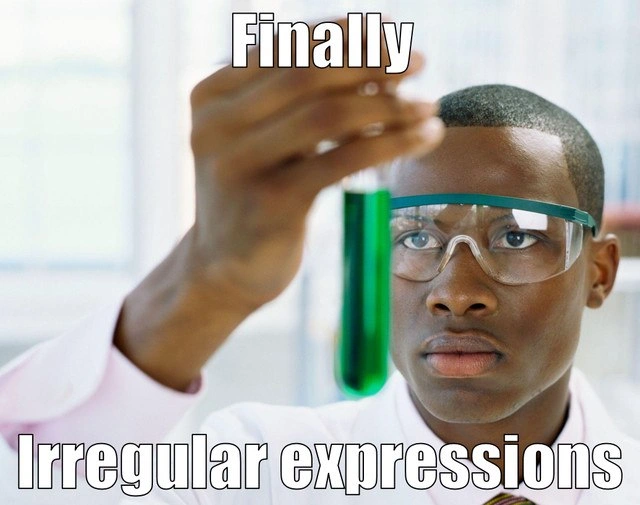
The image shows a scientist in goggles staring intensely at a test tube, which makes the phrase Irregular expressions feel like a specimen. That is why the meme works: regular expressions already have a reputation for looking like laboratory waste spilled into source code. Calling the upgraded form “irregular” suggests an even more cursed syntax: all the unreadability of regex, now with even less promise that anyone can predict what it matches.
Experienced developers know the specific pain. Regex often starts as a neat one-liner for parsing a filename, validating an input, or extracting fields from a log. Then product discovers three exceptions, localization adds weird punctuation, a vendor sends malformed data, and the pattern grows into a glyph wall that only its author understands. Six months later, the author is gone, the test suite has one happy path, and everyone treats the pattern like a cursed artifact.
The meme also mocks a recurring tooling fantasy: if a thing is powerful but hard to reason about, surely the next version will be even more powerful and therefore better. In practice, more expressiveness can mean more ambiguity, slower failure modes, and a larger gap between “the engine accepts this” and “a human can maintain this.” The scientist’s serious face is perfect because every team has had someone proudly present a regex so clever it should have been stored in a containment chamber.
Level 4: Beyond Regular Languages
Finally
Irregular expressions
The lab-photo seriousness makes the phrase feel like a dangerous research breakthrough: someone has synthesized the opposite of regular expressions in a tube of bright green liquid. The wordplay is silly, but it points at a real theoretical boundary. In formal language theory, a regular expression describes a regular language, the class of patterns recognizable by a finite automaton: a machine with a finite number of states and no unbounded memory.
That limitation matters. A formal regex can match “one or more digits,” “a word followed by punctuation,” or “any string over this alphabet ending in abc.” But it cannot, in the pure theory sense, match arbitrary nested parentheses or require an unbounded number of a characters followed by the exact same number of b characters. Those need more computational power, such as a stack in a pushdown automaton. The meme’s imaginary “irregular expressions” sound like regexes that escaped the regular-language cage and started doing things no clean finite-state model should be trusted with before coffee.
The extra joke is that real-world “regex” engines already blurred the line. Many practical engines include backreferences, lookaround, conditionals, recursion, named capture groups, and engine-specific behavior. Some of those features can push matching beyond regular languages, while others create performance traps where a pattern that looks short can trigger catastrophic backtracking. So “irregular expressions” are not just a fictional invention; they are what happens when a compact pattern language accumulates decades of convenience features and then gets handed to a production log pipeline.
Description
A stock-photo-style image shows a serious scientist in safety goggles holding up a test tube filled with bright green liquid. Large white Impact-style text at the top says "Finally" and the bottom text says "Irregular expressions." The meme is a programming wordplay riff on regular expressions, imagining a cursed laboratory breakthrough that would make pattern matching even less predictable than regex already feels.
Comments
8Comment deleted
Irregular expressions: all the readability of regex, now with nondeterministic capture groups and no test suite strong enough to prove anything.
Wtf Comment deleted
Repost from reddit Comment deleted
Who posted it should at least give credits to the original poster Comment deleted
i always do that Comment deleted
Evaluated expression: reply.text Return value: <a href="https://purninja-st.s3.eu-central-1.amazonaws.com/tmp-processed/gG1iFfQgtVzUoneZL0mbTrmx.png"></a>Irregex Comment deleted
RE2 the most irregular expressions I ever heard about Comment deleted
Irregular meaning Asian? Comment deleted