Rainbow optimism to deadline despair: developers at start vs end of projects
Why is this Deadlines meme funny?
Level 1: Big Plans vs Last-Minute Panic
Imagine you have a school project that you’re super excited about. On the first day, you get the assignment and you have tons of ideas. Let’s say you decide to build a fancy volcano model for science class. You’re smiling like SpongeBob with a rainbow, thinking, “This is going to be the coolest volcano ever! I’ll add trees, dinosaurs, maybe even real smoke!” In this moment, you feel happy, creative, and sure that you’ll make something amazing. This is like the beginning of the project in the meme – full of big plans and excitement.
Now fast forward to the night before the project is due. Uh-oh! 😰 You’re in your room surrounded by pieces of the volcano model. There’s paint on your hands, glue all over the table, and you’re very tired. It turns out building that volcano was a lot harder and took more time than you thought. You also kept adding ideas (those dinosaurs and trees took extra time!). Now it’s late, and you’re scrambling to finish before tomorrow morning. You might be a little panicked, thinking, “Why did I say I’d do this extra stuff? I just need to get it done!” You look kind of like a tired SpongeBob slumped at his desk. This is last-minute panic.
So, in simple terms, the meme is like comparing two moments in any big task or project:
- The beginning: when you’re full of excitement and optimism (everything is colorful and fun, like a rainbow).
- The end: right before the deadline, when you’re exhausted and stressed (everything feels hard and you just want to be done).
It’s funny because we all know this feeling. It’s like starting to write a long essay days in advance, feeling great about it, and then still being up late the night before it’s due, super tired. The meme uses SpongeBob’s happy face and tired face to make us laugh about a situation that is very relatable. Even if you’re not a developer, you can understand the idea of starting with big excitement and ending with “oh no, I’m so tired trying to finish on time!”. It’s a reminder that sometimes we all get a little too excited at first and don’t realize how much work something will be – but it’s okay, it happens, and at least we can laugh at ourselves (like SpongeBob) afterwards!
Level 2: Crunch Time Crash Course
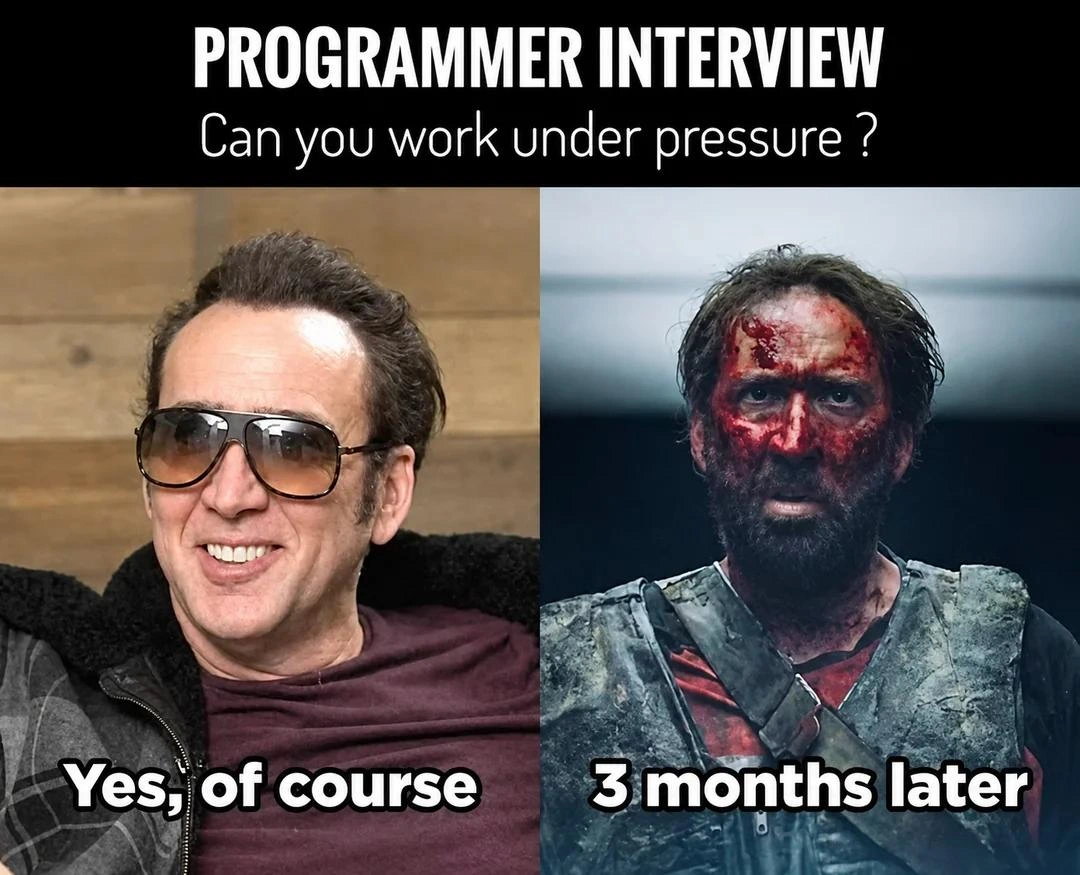
Let’s break this down in simpler terms. This meme shows two stages of a software project using SpongeBob for comic effect. On the left, we have “developers at the beginning of a new project with exciting features.” This means when a project starts, the programmers (developers) are super excited. They have a bunch of cool ideas (the “exciting features” are the new things the software will do), and they’re happy like SpongeBob with a rainbow. A new project often means a greenfield project – basically starting from scratch without worrying about old code. Developers love this because they can use the latest tools, write clean code, and they feel optimistic about achieving everything. Think of this as the honeymoon phase of coding: energy is high, and the team imagines building something amazing. The rainbow SpongeBob conveys optimism and creativity – he literally has a rainbow called "Imagination" over his head, symbolizing how developers imagine all the possibilities at the start.
Now, fast forward to the right side: “developers at the end of a project trying to complete those exciting features before the rescheduled due date.” This is the project’s final stage, right near the deadline (the due date). By now, things have changed. The due date was rescheduled, meaning the original deadline to finish the project was missed or postponed – that’s a sign the team hit some delays or obstacles. Crunch time is happening: that’s a term we use for the intense period of work right before a deadline when everyone is rushing and often working extra hours. In the image, SpongeBob is in a dark room, slouched in front of his computer, looking absolutely tired and frazzled. This represents the developers who have been pushing themselves, probably working late nights, to try to get those features done in time. The excitement is gone, replaced by stress and exhaustion. All the rainbow joy has faded into a blurry-eyed stare at the screen. This is a humorous way to show DeveloperFrustration – they’re frustrated because the work turned out harder or bigger than expected, and now they’re under huge deadline pressure.
Why does this happen? Several common things in software projects can lead to this scenario:
Underestimating the work: At the beginning, people often underestimate how long tasks will take. Those features that sounded easy (“sure, we can add a chat system and an AI module, no problem!”) turn out to be very time-consuming. It’s easy to be optimistic early on, especially if you haven’t hit any snags yet. This is sometimes called the planning fallacy – assuming things will go as planned (they rarely do in software!).
Scope Creep: This is when more and more features or requirements get added as the project goes along (the project scope “creeps” upward). For example, mid-project someone might say, “Actually, wouldn’t it be great if the app also did X?” All those additions can make the project bigger than originally intended. In the beginning the team says yes to new ideas because excitement is high, but later they realize they have too much to do. SpongeBob’s rainbow stage welcomes new ideas; later, that huge pile of tasks contributes to his tired look.
Unforeseen problems: Maybe some features were harder to implement than anticipated. Perhaps integrating different parts of the project caused bugs, or the new tech had a steep learning curve. These hiccups eat up time. For instance, a developer might spend days fixing a nasty bug that no one expected to occur. That’s time that wasn’t planned for, which delays other work.
Deadline pressure: The “due date” is when the project must be finished – say, a release date promised to a client or the end of a sprint in Agile. If the work isn’t done by the initial date, managers might reschedule it (set a new due date). However, even with a new deadline, there’s usually a sense of “we’re late, we must hurry!” The team might then enter crunch time, meaning they work evenings or weekends, trying to catch up. This is bad for developer productivity and morale, but it happens a lot in the real world (especially in game development and startups, but also in regular IT). The meme’s right panel shows exactly that: a developer late at night, exhausted, still coding away because the clock is ticking.
All these factors combined set the stage for DeveloperBurnout. Burnout is when someone is so overworked and stressed that they become extremely tired, lose motivation, and their performance suffers. In the meme, the right-hand SpongeBob looks burned out: he’s still working, but he’s a shell of his cheerful self from the start of the project. The humor comes from seeing the expectation vs. reality. It’s funny in a “I recognize that” way. Many developers joke about how at the start of a project or feature, they’re full of DeveloperMotivation and big dreams, posting colorful sticky notes on a board or getting excited about using, say, a new JavaScript framework. But by the end, they’re muttering “I just want this done” under their breath at 1 AM.
In simpler terms, at the project’s beginning everyone is like: “Yay! We get to build cool stuff!” By the project’s end, those same people are like: “Oh no... we still have to finish all this cool stuff… and we’re late.” The meme captures that transition with SpongeBob’s two very different facial expressions and environments (bright rainbow world vs. dark crunch cave). It’s a piece of ProjectManagementHumor because it lightly mocks the way projects are often managed or mismanaged. And it’s DeveloperHumor and DeveloperFrustration rolled into one: we laugh, but only because we’ve felt that pain ourselves (or seen it happen).
For a junior developer or someone new to the industry, the key takeaway is: software projects can be rollercoasters. At first, you feel on top of the world, and everything is possible. But as deadlines approach, reality can hit hard — things take longer, unexpected problems arise, and you might have to push really hard to get finished. It’s important to learn good habits (like realistic planning, saying “no” to extra features if time is short, and maintaining a steady pace) to avoid the worst crunch. But this meme is joking that, despite our best intentions, we often end up in exactly this situation: start happy, end tired. Don’t worry, it happens to the best of us, and recognizing it is the first step to managing it better!
Level 3: From Hype to Death March
At the start of a new project, developers often feel greenfield euphoria – everything is shiny, possible, and exciting. The left panel’s SpongeBob with a rainbow (*Imagination!*) perfectly represents that mood: bright-eyed optimism, endless creativity, and confidence that all those exciting features will practically build themselves. It's a classic case of expectations vs. reality in the project lifecycle. By the end of the project (right panel), that rainbow optimism has degenerated into a death march slog. The once enthusiastic SpongeBob is now a sleep-deprived zombie at his keyboard, illuminated only by the ghostly blue glow of an overdue backlog. This stark contrast is darkly funny because every experienced developer has lived this transition.
Why does this happen so often? In part, because of scope creep and the planning fallacy. In the beginning, managers and devs alike tend to underestimate how complex those “exciting features” really are. New frameworks get adopted, big promises are made, and the team says "yes" to ambitious ideas under the influence of rainbow-tinted optimism. There’s even a joke principle for this: Hofstadter’s Law, which states: “It always takes longer than you expect, even when you take into account Hofstadter’s Law.” In practice, the first 90% of the code takes 90% of the time — and the last 10% of the code also takes 90% of the time. 🕒 By the midpoint of the project, reality strikes: integrations are harder than expected, technical debt starts accumulating, and those exciting features reveal edge cases that blow up original estimates. The project timeline slips, and the release deadline that once felt so distant is suddenly charging at the team like an angry bull. Cue the DeadlinePressure and long nights.
That mention of a rescheduled due date in the meme is a big red flag. It implies the project already missed its original deadline or had to be extended — a hallmark of troubled projects. Yet even with an extension, the team is now rushing in CrunchTime. The humor here is bittersweet: instead of cutting scope or re-evaluating, management often just pushes the date a bit and expects the same “exciting” feature set to be done. This turns the final stretch into a Crunch Time death march, where DeveloperHumor turns dark and caffeine becomes a food group. The right panel SpongeBob, blurry and exhausted, depicts DeveloperFatigue and DeveloperBurnout setting in. Notice the dim, bluish office lighting and SpongeBob’s frazzled look – it’s practically the universal sign of a programmer who’s been staring at a JIRA board at 2 AM. The contrast is comedic because it’s ProjectManagementHumor born of truth: projects often begin in a blaze of motivational kickoff meetings and end in a scramble of late-night bug fixes.
Let’s break down the transformation from Day 1 optimism to last-week despair. In theory, modern Agile practices and good project management are supposed to prevent this extreme boom-bust cycle. In reality, teams still fall into the trap: initial DeveloperMotivation leads to overcommitment, then deadlines slip, and suddenly it’s a mad dash to deliver. It’s like clockwork in our industry. DeveloperProductivity actually drops in crunch mode, but the team is pressured to work harder and longer – a flawed strategy we’ve seen time and again (hello, burnout 💀). The “rescheduled due date” phrasing hints at organizational dysfunction: rather than admitting the plan was too optimistic, they just move the finish line and push everyone harder. The meme nails this irony. As an old war-torn developer might quip: “No plan survives first contact with reality (or with the codebase).” By the project’s end, the codebase is often held together by duct-tape hacks made at 3 AM, and those once-thrilling features have become dreaded obligations.
To visualize the difference between the project’s rosy start and frantic finish, consider this side-by-side comparison:
| Project Phase | Beginning (Greenfield) 🌈 | End (Crunch Time) 🔥 |
|---|---|---|
| Developer Mood | Enthusiastic 😃 – The team is pumped, full of ideas. High DeveloperMotivation with visions of glory. Everyone’s saying “This will be fun, we’ve got this!” | Exhausted 😩 – The team is running on coffee and fumes. DeveloperFrustration is high, morale is low. People joke about moving to a farm and never coding again. |
| Approach to Coding | Idealistic ✨ – Writing clean, modular code. Setting up proper architecture, tests, CI pipelines. There’s time to do it “the right way,” so they go for best practices. | Pragmatic (aka Quick’n’Dirty) 🤕 – Slapping on fixes and hacks just to make things work. Tests? Maybe later. Every other commit is prefaced with // TODO: fix this later. TechnicalDebt is piling up like dirty laundry. |
| Feature Scope | Expanding 📈 – “While we’re at it, why not add more cool features?” New ideas are welcomed and tossed into the plan. The attitude is more is better, and initial success makes everyone bold. | Contracting (or Panicking) 📉 – “Which features can we drop or hide behind a flag?” The team is begging to cut scope. Features that sounded great are now, “do we really need this?” as the clock runs out. Alternatively, everything stays in, and it’s a frantic race to somehow finish it all (feature rush!). |
| Time Perception | Plenty of Time 🗓️ – Deadlines seem far away. Maybe there’s slack in the schedule. The release deadline is just a date on paper, nothing to worry about. Managers and devs confidently promise, “We’ll definitely ship on time, no sweat.” | Where’d Time Go? ⏳ – The deadline looms huge, even after being pushed out. Every day has become a nail-biter. People say, “We might need nights and weekends…” The DeadlinePressure triggers all-nighters. It’s the classic “oh no, it’s due tomorrow” feeling, scaled up to a whole team. |
In summary, this meme takes a lighthearted jab at a serious issue: how software projects can devolve from rainbow-colored optimism to deadline-fueled despair. It resonates especially with senior engineers who have been through a few hype vs. death march cycles. The SpongeBob visual exaggeration drives the point home: one moment you’re holding a rainbow, thrilled about building something new; the next, you’re the burnt-out sponge in the dark, just praying to finish. It’s funny because it’s true. This is solid DeveloperHumor mined from real DeveloperFrustration. And while we laugh, it also reminds us (perhaps a bit cynically) that in software development, CrunchTime and shifting deadlines are almost as inevitable as bugs. After all, as the tired SpongeBob shows, even the most exciting features can turn into nightmares when the clock is ticking and the pressure is on.
# Early in the project: high hopes and clean code
def implement_feature(feature):
print(f"Designing and implementing {feature} with best practices...")
# Everything is structured and well-thought-out here
return "feature built with love 💖"
# ... (time passes, features prove harder than expected) ...
# Late in the project: brute-force to meet deadline
def implement_feature(feature):
print(f"Hacking together {feature} just to make it work 😬")
try:
# Quick and dirty implementation
result = legacy_integration(feature) # assume this is a messy, rushed call
except Exception as e:
result = hotfix(feature, e) # apply a hotfix in desperation
return result # "It works... somehow"
In the code above, early on we return a feature “built with love” (everything is done right). But in crunch time, we override implement_feature to just hack things together with a grimace. This is a bit tongue-in-cheek, but it’s exactly how it feels: the elegant solutions of week 1 give way to duct-tape solutions in week 12. The comments like “# assume this is messy, rushed” and the use of hotfix illustrate the DeveloperProductivity trade-off: you sacrifice cleanliness and maintainability for speed as the due date nears. The code even emits a 😬 (grimacing face) to show the pain. Real projects end up with code like this – quick fixes all over – when the team is under the gun. The result will probably work just enough to hit the (now rescheduled) release date, but it ain’t pretty.
So, the seasoned perspective on this meme is: Been there, done that. It humorously encapsulates a well-known software development trajectory: initial hype, mid-project reality check, and end-of-project crunch. The rainbow represents the innovation and excitement of a fresh project, while the slumped SpongeBob represents the crunch time burnout and deadline pressure that too often conclude the project. In true cynical veteran fashion, it’s a reminder that even when we start with best intentions and DeveloperMotivation, real-world constraints (and perhaps poor ProjectManagement or optimistic promises) can lead to a punishing endgame. The meme is a mirror, reflecting the internal state of dev teams: At launch: “We’re gonna build something awesome!” → Before release: “Oh no, how are we going to get this done?!”
Description
Two-panel SpongeBob meme with a bold white "VS" in the center. Left panel: bright, colorful background with SpongeBob smiling wide, arms raised, and a rainbow arching over his hands; caption underneath reads "DEVELOPERS AT THE BEGINNING OF A NEW PROJECT WITH EXCITING FEATURES." Right panel: dimly lit office scene where a tired, blurry SpongeBob slouches at a computer surrounded by bluish shadows; caption says "DEVELOPERS AT THE END OF A PROJECT TRYING TO COMPLETE THE EXCITING FEATURES BEFORE THE RESCHEDULED DUE DATE." The contrast humorously illustrates how initial enthusiasm for green-field feature work degrades into exhaustion and deadline panic as scope creeps and delivery dates shift, a scenario familiar to engineers dealing with project management pressure and crunch time
Comments
9Comment deleted
Kickoff: “We’ll craft a pristine hexagonal architecture with 100% coverage.” Release week: “Glue the bash script into a sidecar, sed the logs into shape, and rebrand the monolith as ‘service-oriented’ - marketing already announced it’s live.”
The only thing more optimistic than a developer at project kickoff is the PM who thinks 'rescheduled due date' means we've somehow gained time instead of just formalized the original impossible timeline
The rainbow represents the initial architecture diagram where everything is beautifully decoupled microservices. The right side is when you realize it's all running in a single Docker container on someone's laptop because 'we'll migrate to Kubernetes later' - and that rescheduled due date? It's the third time the PM has moved it, each time adding 'just one small feature' that requires refactoring half the codebase
From infinite velocity planning poker to 'ship the stubs' after the third PM pivot
Project kickoff: debating DDD vs ports-and-adapters; week 12: shipping the ‘exciting feature’ behind a feature flag at 02:59, declaring MVP while the error budget becomes the actual budget
Kickoff: “event‑driven rainbow of services.” By the rescheduled due date: “one gray monolith, a feature flag literally named rainbow, and a 2am cron called migration_final_final.sh.”
That feeling when your ideas are waaaay more ambitious than your actual skills Comment deleted
Me right now Comment deleted
Good luck Comment deleted