Tweaking a StackOverflow security snippet ends in a musical disaster performance
Why is this Security meme funny?
Level 1: Backwards Flute
This meme is like a funny cartoon about messing up because you didn’t really learn how to do something properly. Imagine you saw someone play a flute and make beautiful music. You want to do the same, so you get a flute, but you hold it the wrong way around and blow. Do you think you’ll get a nice song? Not at all – maybe just some weird air noises! It looks silly, right? In the pictures, that’s exactly what the kids are doing with the flutes, and it makes us laugh. Now, think of the computer world: someone took a helpful bit of code (like instructions for keeping a secret or a lock in a program) from the internet and thought, “I’ll change this one tiny thing, it’ll be fine.” But because they didn’t really understand it, that tiny change messed it up completely. It’s the same idea as the backwards flute – the tool is correct, but the use is all wrong. The joke here is that whether it’s a musical instrument or a piece of code, if you don’t use it the right way, you won’t get the result you expect. The meme makes us smile because we’ve all been a little overconfident at times, thinking a small tweak won’t hurt, only to end up with a goofy mistake. It’s a funny reminder: learn how the thing works first, or you might end up playing your flute into your ear and wondering why no music is coming out!
Level 2: Snippet Slip-up
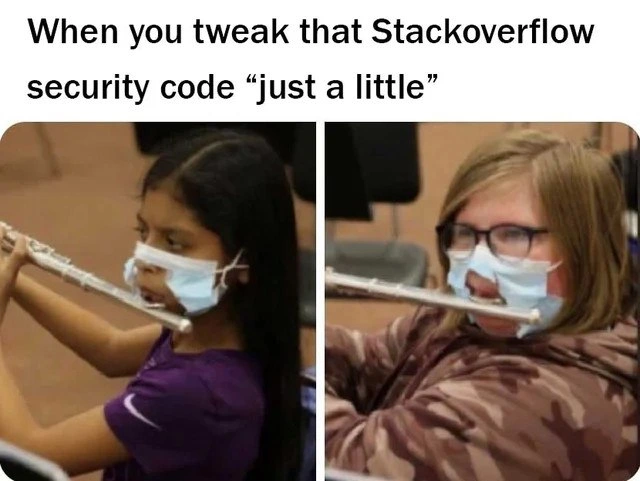
The meme’s caption reads, “When you tweak that StackOverflow security code ‘just a little’.” In plain terms, it’s describing a programmer who grabbed a small piece of code from the internet and changed it slightly, with disastrous results. First, StackOverflow is a famous question-and-answer website where programmers help each other by posting solutions. These solutions often include snippets of code — short pieces of example code that you can copy into your own project. Here we’re dealing with a security snippet, meaning the code is supposed to do something important for security, like checking if a password is correct, encrypting some data, or guarding against hackers’ tricks (for example, preventing SQL injection or XSS attacks).
Now, “tweaking” that code “just a little” means the developer made a small change to the copied snippet. Maybe they renamed a function, removed a line they didn’t understand, or changed a setting to fit their needs. The meme puts “just a little” in quotes to hint that this change might seem small but isn’t as harmless as the person thinks. In fact, that tiny edit has completely broken the code’s usefulness, especially its security. It’s like taking a recipe and swapping salt for sugar because you thought it wouldn’t matter — the end result is a ruined dish, or in our case, broken security.
The pictures drive this point home with a funny analogy. We see two school band students each holding a flute in a completely wrong way. The girl on the left has her flute pointed backwards under her ear, and the boy on the right is pressing the flute’s mouthpiece against his cheek. If you know how flutes work, you’ll immediately see that neither kid can produce a proper musical note like that! The flute is a real instrument, but they’re not using it correctly. This is a direct parallel to the coding scenario: the flute represents the piece of code (which is a tool to do something right), and the student is the programmer. The programmer “thinks” they’re using the code correctly after their little tweak, but in reality it’s as incorrect as holding a flute backwards. No beautiful music will come out of that flute, and no proper security or functionality will come out of that misused code.
For a newcomer to programming, the meme is a lighthearted warning. Copying code from the internet (what we often jokingly call CopyPasteCoding) is very common – pretty much everyone does it when learning or when they’re stuck. But when it comes to sensitive code like security stuff, you have to be extra careful. If you just copy a solution and fiddle with it without really understanding it, you can remove the very parts that made it work. It’s similar to removing a small gear from a clock: the clock might look intact, but it won’t tell time correctly anymore. In coding, removing or changing one little thing in a security snippet might turn a strong lock into a weak one. You could introduce a bug (an error that makes the software behave oddly or crash) or, worse, a security flaw (a weakness that bad guys can exploit). For instance, perhaps the original snippet was checking that a user’s input doesn’t contain any dangerous commands. If you “tweak” it wrong, your version might skip that check, letting bad input through. The program will still run, but it’s no longer safe – kind of like a door that looks closed but isn’t actually locked.
The humor of this meme also carries a bit of good advice. The images of the students and their flutes are funny and absurd, so even if you’re not a coder, you get a sense of “something is clearly wrong here.” If you are a coder, you’re likely chuckling because you remember the first time you broke something by copying code blindly. It’s a rite of passage in programming to realize that even a small change can have big consequences. In the end, the meme is saying: learn the fundamentals and be careful with quick fixes. Just as you’d take a lesson or two before performing with a musical instrument, you should take the time to really understand a piece of code – especially one that guards your app’s security – before you change it. Otherwise, you might end up with a quiet flute and a silent (or crashed) program, learning the hard way that “just a little tweak” can cause a big mess.
Level 3: Little Tweak, Big Leak
For seasoned developers, this meme hits close to home. It perfectly captures the classic blunder of copy-paste coding from StackOverflow combined with a bit of overconfidence. The setup – “tweaking that StackOverflow security code ‘just a little’” – is basically a polite way of saying “I copied a stranger’s code and mucked with it.” We’ve all seen this movie: a well-intentioned dev grabs a snippet for, say, password hashing or input sanitization, then changes one or two things thinking it won’t matter. Cue the facepalm: that “tiny” change often neuters the security entirely. The meme’s two images of student flutists illustrate the outcome. They have real flutes (the right tool) but are using them in hilariously wrong ways – one points the flute under her ear, the other jams the mouthpiece into his cheek. You just know no music is coming out of those instruments. Likewise, a developer might have a perfectly good piece of code meant to prevent hacks or handle sensitive data, but by using it incorrectly, the code’s effectiveness is zero. The top caption’s quotes around “just a little” telegraph the sarcasm: we all know that’s the famous last phrase before something breaks.
In real development teams, this scenario is painfully common (and thus funny in hindsight). Imagine a junior dev finds a StackOverflow answer about preventing SQL injection. It has a neat parameterized query example. But the junior’s environment is a bit different, so they tweak it – maybe they remove a confusing condition or alter a function call. Now their version compiles and seems to work… until it doesn’t. Suddenly, QA finds that a clever tester (or an attacker) can sneak in a ' OR '1'='1' SQL attack because that “minor” edit skipped a binding step. Oops – the bug is back, and so is the vulnerability. Another scenario: someone was integrating an HTTPS call and copy-pasted a snippet to ignore certificate validation (a common StackOverflow trick to deal with self-signed certs during testing). They swear they’ll undo it later but forget. In production, that one-line tweak globally disables a core security check, effectively trusting any certificate. A senior engineer discovering connection.setSSLCertificateChecking(false); // disables SSL certificate verification (not safe!) in the codebase feels exactly like spotting a flute being played backwards at a formal concert. It’s equal parts horror and dark comedy.
Beyond the immediate security fails, there’s a CodeQuality aspect here that senior devs recognize. Code copied from random sources tends to become “mystery code” in your project – no one fully owns it or understands it, especially after a few ill-advised edits. It might lack proper error handling or have hidden assumptions that were documented only in that original Q&A thread (which your tweak just violated). When something goes wrong, debugging that code is a nightmare. It’s like hearing an off-key squawk during a band performance and trying to pinpoint which musician messed up. I’ve spent long afternoons chasing a bizarre bug, only to find a comment in the source like // Source: StackOverflow snippet and realize the original developer never truly grokked it. Often you even find a // TODO: improve this or // FIXME left by the original copier, hinting they knew it wasn't ideal but never actually fixed it. Veteran engineers have learned to be wary of the “StackOverflow paste” – it’s sometimes a band-aid that hides deeper understanding gaps. The meme has us laughing because it’s a gentle roast of this practice. It’s saying: remember that time you thought a 5-line change wouldn’t matter, and all hell broke loose? Of course we do, and we cringe-laugh about it now.
This blend of DeveloperHumor and reality check makes the meme resonate. It jokes about our shared experience in dev communities: quick fixes that backfire. The flautists’ fiasco is a perfect parallel to a botched code snippet – it’s visual proof that having the right equipment (or code) is not enough if you lack technique (or understanding). In both cases, the audience gets an unexpected performance. Seasoned devs chuckle because we’ve cleaned up such messes and learned, sometimes the hard way, that “just a little change” in a security-sensitive piece of code can lead to a big leak (of data or tears, or both). The meme humorously reminds us to think twice before improvising on code we got from DevCommunities threads. Sure, StackOverflow is an amazing resource, but blindly modifying a snippet from it is like going on stage without practice – you might hit a sour note that everyone will notice.
Level 4: Key Signature Mismatch
At the most technical level, this meme highlights how security code demands precision much like a musical score. In cryptography and secure coding, every step is like a note in a composition – change one note and the whole melody can fall apart. A StackOverflow security snippet is often a distilled solution to a complex problem (say, hashing passwords or sanitizing input) that works correctly only if used exactly as intended. When a developer casually “tweaks” such code, they risk violating the algorithm’s assumptions or omitting a crucial step. It’s akin to playing a classical flute piece but improvising a few notes without understanding music theory – the result isn’t just a slightly different tune, it’s complete dissonance. In software terms, a tiny change to security code can introduce a major vulnerability. For example, using an insecure random number generator “just to simplify” can make an otherwise secure token predictable to attackers. Or removing an apparently redundant check can open a backdoor for malicious input. Security algorithms often come with formal proofs or well-studied guarantees; a small deviation (like using a weaker cipher mode or skipping input validation) can break those guarantees entirely. There’s a famous mantra in cybersecurity: “Don’t roll your own crypto.” That warning fits here because tweaking someone else’s vetted solution is, in effect, rolling your own without realizing it. The meme exaggerates this by showing flutists playing in absurdly wrong ways – a visual metaphor for how misusing a proven method turns a beautiful solution into nonsense. The mathematical rigor behind encryption, authentication, etc., is unforgiving: almost correct is completely wrong. In short, the humor in the meme hides a fundamental truth from computer science and security theory: even minor unauthorized changes to a delicately crafted algorithm can break its soundness, just as a single off-key note can ruin an entire performance.
Description
Meme with two side-by-side photos of school band students holding flutes completely incorrectly. Top text reads: "When you tweak that Stackoverflow security code “just a little”" (including the inner quotes). In the left panel, a student in a purple shirt points the flute backward under their ear; in the right panel, another student in a camo hoodie jams the mouthpiece into their cheek - both clearly unable to play a note. The visual joke equates misuse of instruments with blindly copy-pasting community-provided security code and then making small, ill-informed edits that render it useless or dangerous. Technically, it pokes fun at developer overconfidence, copy-paste culture, and the risk of introducing vulnerabilities or bugs when modifying security-sensitive snippets pulled from StackOverflow without proper understanding
Comments
7Comment deleted
I replaced the constant-time HMAC check with `hash.equals()` to “simplify the code” - now the red team is improvising timing attacks like it’s jazz night
Just like that time we disabled SSL verification to 'fix' the certificate error in production - technically the warnings went away, so mission accomplished, right?
This perfectly captures the senior engineer's nightmare: watching a junior dev 'optimize' that battle-tested Stack Overflow authentication snippet by removing the 'unnecessary' salt generation because 'it was slowing down the login by 3ms.' Sure, the mask is still technically on your face, and yes, the code still compiles - but you've just turned your bcrypt implementation into plaintext with extra steps. It's the security equivalent of commenting out CORS headers because 'the frontend team said they were getting errors.' The real kicker? This modified code will sail through code review because it 'works on my machine' and the PR description says 'minor refactoring for performance.'
One regex tweak in that SO-pasted XSS filter and suddenly your DOM is a playground for every payload on PayloadsAllTheThings
That 'minor tweak' - verify=False, CORS '*', and skipping JWT signature checks - turns the accepted answer into a mask-with-a-hole; compliance hears a band recital, attackers hear root
That two‑character fix swapped the constant‑time token compare for ==; the build passed, and the timing attack started playing our login like a flute
Уууу тупые Comment deleted