
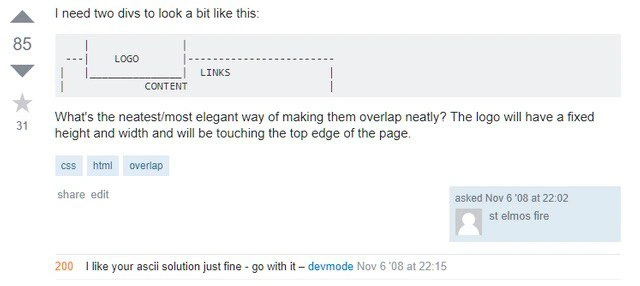
The Original CSS Layout Framework: ASCII
Description
A screenshot of a classic Stack Overflow question from November 6, 2008. The user, 'st elmos fire', asks for the 'neatest/most elegant way' to make two divs overlap according to a specific layout. To illustrate this, the user has created a detailed and well-structured ASCII art diagram showing a 'LOGO' box overlapping a 'CONTENT' area, with a 'LINKS' section to the side. The question is tagged with 'css', 'html', and 'overlap'. The humor lies in the top-voted comment (with 200 upvotes) from user 'devmode', which drily states: 'I like your ascii solution just fine - go with it'. This is a sarcastic jab at the notorious difficulty of achieving complex layouts with CSS in 2008 (before Flexbox and Grid), implying that the ASCII diagram is as good as any actual code solution. For senior developers, it's a nostalgic look back at the 'bad old days' of fighting with floats and positioning
Comments
7Comment deleted
Modern CSS: `display: grid;`. Old CSS: `float: left;` and a sacrificial offering to the browser rendering gods
Why wrestle with flexbox and z-index when you can ship the preformatted <pre> tag straight to prod?
After 15 years of arguing about CSS Grid vs Flexbox, we've finally discovered the real solution was ASCII art all along - it renders consistently across all browsers and never breaks in IE11
Back in 2008, we drew CSS layouts in ASCII art before asking Stack Overflow for help. Now we just paste a screenshot into ChatGPT and ask it to write the entire component, tests included, while secretly wondering if we've forgotten how `position: absolute` actually works
Back when hasLayout and float‑drops ruled, ASCII was the only layout engine with predictable stacking contexts - and zero IE6 bugs
Neatest overlap circa 2008: position:absolute; z-index:9999; pray IE6 understands stacking contexts - otherwise ship the layout as preformatted ASCII and call it ‘grid.’
Fixed-height logo ghosting the top edge? Classic CSS: where 'touching' requires negative margins and a prayer to browser gods