The Duality of Lag: Gamer Rage vs. Programmer Resignation
Why is this Networking meme funny?
Level 1: Tantrum vs Patience
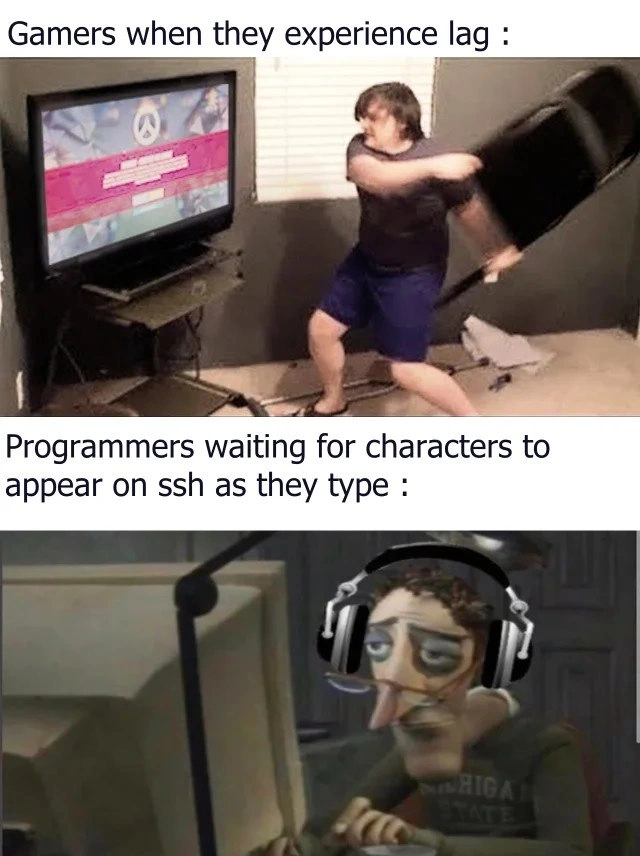
Imagine a little kid trying to watch their favorite cartoon online, but the video keeps freezing and loading. The kid gets really mad – they might yell or even throw the remote because they can’t stand the wait. That’s like the gamer in the top picture: something fun (a video game) is slow and not working right, and the gamer loses their temper big time, almost like a tantrum.
Now imagine an adult waiting for a very slow computer or internet page to load at work. The adult doesn’t yell or smash the computer (they know that would just make things worse). They might sigh, take a deep breath, and just quietly wait for it to finish loading, even if they’re annoyed on the inside. That’s like the programmer in the bottom picture: they’re doing something important on a computer that’s far away (through a tool that shows text from a distant computer), and the letters they type are appearing very slowly. It’s super irritating, but instead of screaming, the programmer just sits there calmly, accepting that it’s slow.
The meme is funny because it shows these two people reacting in totally opposite ways to a slow, laggy connection. One is acting out their anger like a kid who can’t get their cartoon, and the other is being patient like an adult who knows sometimes you just have to wait. Basically, it’s saying: when a game lags, gamers might go wild with frustration, but when work lags, programmers just quietly endure it. It’s a big exaggeration, but it highlights the difference in attitude – and it makes us laugh because we can see a bit of truth in it.
Level 2: Lagging Letters
Network lag means a delay between doing something and seeing the result, and this meme shows it in two situations. First, the gamer: when gamers talk about lag, they mean the game isn’t responding quickly because of a slow internet connection. Maybe they pressed a button to make their game character move or shoot, but nothing happened for a second, and in that second their character might have lost the game. Infuriating, right? That’s why the top picture shows a gamer so angry he’s about to smash the TV with a chair! It’s an exaggerated joke – most people won’t actually destroy their TV, but it captures the feeling of helpless anger when a fun experience is ruined by a bad connection. In online games, players often watch their ping (a number in milliseconds that tells how delayed their connection is). When ping shoots up, you’ll hear groans or colorful language in voice chat. High ping = game lag = gamer frustration.
Now, the second situation is a programmer using SSH. SSH (Secure Shell) is a tool that lets developers remotely access a server’s command line securely. Think of it like opening a window from your computer into another computer that might be thousands of miles away. You type commands in a terminal window, and those commands run on that far-away server. This is super common for developers, especially when managing websites, cloud servers, or any remote work on systems not right in front of them. But here’s the catch: if that connection is slow (due to network latency), you’ll see a delay, even with something as simple as typing. Each letter you type has to travel over the internet to the remote server, and then the letter (or the result of that key press) travels back to show up on your screen. If the network is fast, you can’t even tell this is happening – it feels instant. If the network is laggy, you get what the meme describes: you press a key and… wait… the character appears a moment later. Press the next key… wait again. It’s like the computer is teasing you.
For a programmer, this is a common annoyance. Imagine trying to write code or even a simple command where every letter appears with a half-second delay. It would test anyone’s patience. But the meme jokes that programmers handle it with calm, just sitting there with a blank look, whereas a gamer handling a similar delay is all fury. Why might a programmer be (or appear) calmer? A few reasons:
- Work mindset: If you’re working (and especially if you’re a professional on the clock), you tend to stay composed. You can’t start smashing equipment every time something in the tech stack is slow (your colleagues or boss wouldn’t appreciate that!).
- Expectation: Developers kind of expect things to go wrong occasionally. Whether it’s a server being slow, a command taking forever, or the network acting up, it’s seen as part of the job. So when it happens, they’re like, “Ah, here we go again,” and just deal with it.
- Alternatives: In a game, if you lag, you might try to reconnect or you might just rage quit the match because it’s essentially ruined. In an SSH session, if you lag, you often don’t have a better option – you need to run that command on that remote machine. So you stick with it, patiently. You might quickly check your internet or VPN settings, but usually it’s a “wait and hope” scenario.
The bottom image shows a character with a headset sitting at the computer, hands off the keyboard, just waiting. Any programmer who’s worked on a distant server recognizes that pose. It’s the “nothing I can do until it responds” posture. The humor is that the programmer could be screaming internally, but on the outside they’re just still. In contrast, the gamer’s whole body is engaged in expressing anger (notice the gamer’s controller is already on the floor – he’s beyond caring about the gamepad, it’s revenge time on the laggy TV!).
Some technical terms from the meme:
- CLI: Command Line Interface – a text-based interface where you type commands (that black or white text screen where letters show up). No graphics, just text in and out.
- Latency: This is the delay we’ve been talking about. High latency = big delay (bad for both gaming and SSH). Sometimes called “lag” in casual terms.
- Network latency: Same as above, specifically meaning the delay caused by network transmission. For example, if a server is far away or the connection is poor, you get higher network latency.
- VPN: Virtual Private Network – often used by remote workers to securely connect to a company’s network. It can add some overhead to your connection. If a VPN is “flaky,” it means it’s not very stable – data might be taking a roundabout route or getting momentarily lost, causing more lag.
- Developer frustration: This meme falls under “developer frustration” humor because it highlights a little misery of the job. It’s the kind of thing developers laugh about so they don’t cry – waiting for your tools to respond is frustrating, but we joke about it.
- Latency optimization: This term means techniques to make things respond faster. In gaming, latency optimization might involve matchmaking you to closer servers, using faster networking code, etc. In programming/SSH, it could mean using tools like the aforementioned Mosh, or tweaking settings to make the terminal feel snappier on bad connections.
So, in summary for this level: The gamer is furious because lag disrupted their play. The programmer is calm (at least externally) because lag is a known nuisance in their work and they’ve learned to be patient. The meme exaggerates both reactions for comedic effect. It’s a slice of TerminalHumor and tech life contrast that many find funny because it’s relatable. If you’ve waited for a slow computer, you know the feeling. And if you’ve ever played a game that suddenly froze at the worst time, you definitely know that feeling! This meme just puts those two side by side in a dramatic, funny way.
Level 3: Rage vs Resignation
This meme humorously contrasts how two tech-savvy groups handle the exact same enemy: lag. In the top panel, a gamer experiencing network lag is in full meltdown mode – we see a kid wielding a metal chair like a battle axe against the betraying TV screen. It’s an over-the-top depiction of gamer rage. And yet, anyone who’s played fast online games (first-person shooters, battle royales, you name it) recognizes that feeling. In a game, a half-second delay can mean the difference between victory and defeat. Imagine pressing a button to dodge an attack, but your character stands still because the command hasn’t reached the server in time. Heart-pounding frustration! Gamers often joke (or not joke) about “rage-quitting” – smashing controllers, yelling at the router, or in this case, introducing the monitor to Mr. Chair. It’s a comical exaggeration of how viscerally frustrating lag can be when you’re emotionally invested in real-time action.
Now compare that to the bottom panel: a programmer calmly waiting for characters to appear on an SSH terminal as they type. No yelling, no smashing – just a thousand-yard stare and a quiet acceptance. The 3D animated character with big headphones looks exhausted and eerily serene at the same time. This is the face of someone who has fought and lost to the network many times and has made peace with it. It’s a very developer experience (DX) kind of joke. Coding or managing servers via a remote CLI (Command Line Interface) sometimes means dealing with sluggish response. For instance, you’re logged into a production server in a distant region over a spotty VPN, trying to edit a file or run a command, and the letters appear one... by... one... seconds after you type them. Every experienced dev, especially system administrators, has encountered this “typing through molasses” scenario. And what can you do? Shouting at the terminal won’t help – it’s not even listening until that Enter key command finally goes through! So you just sit, maybe sigh, maybe take a sip of your cold coffee, and wait.
The humor here is also about cultural contrast. In gamer culture, being openly furious at technology is almost part of the fun stories (“Dude, I lagged out and nearly broke my keyboard!”). In professional developer culture, you’re expected to stay cool under pressure. A senior developer likely has a kind of zen in the face of technical delays. They might grumble in chat or mutter under their breath, but physically they remain composed (okay, maybe a stress ball gets squeezed). Smashing your work computer in frustration? That’s a one-way ticket to an awkward conversation with IT and your boss. 😅 In fact, the calm figure could be interpreted less as patience and more as resignation: an acceptance that “yup, the network is slow again, nothing to do but wait it out.” It’s that classic on-call at 3 AM vibe – you’re remote into a server, it’s unresponsive, but you have to fix it, so you just soldier on slowly.
Let’s break down why the programmer’s reaction is more subdued, beyond just office etiquette:
- Experience with Delays: Developers deal with all sorts of waiting in their workflows (compiling code, running tests, waiting for deployments). Waiting becomes second nature. Laggy SSH is just another queue to endure.
- Lack of Control: Both gamers and devs can’t directly fix network lag in the moment, but the dev knows this. They often have tools like
pingortracerouteto diagnose latency, but if the packets are taking a detour through the stratosphere, no instant fix exists. Instead of futile rage, devs tend to channel energy into troubleshooting or simply coping. - Stakes and Consequences: The gamer is angry about losing a game round or seeing their fun ruined. The developer is often working – maybe deploying a critical fix on a live server. If they let frustration take over, they could mistype a command or, worst-case, accidentally
rm -rf /the wrong directory in anger. Keeping calm isn’t just zen, it’s survival. - Coping Mechanism: Ever hear the phrase “It’s always DNS”? It’s an inside joke that whenever there’s a mysterious network issue, people half-jokingly blame DNS (the internet’s phonebook). It highlights how common network issues are. Seasoned devs have a rich library of these jokes, essentially as a way to laugh off the frustration. The bottom image’s stoic stare is one step away from a meme caption like: “This is fine. The letters will show up... eventually.” It’s gallows humor – laughing through the pain of a slow terminal.
In practical terms, a programmer facing SSH latency might try some rational fixes (check their internet, switch Wi-Fi, toggle the VPN, or move closer to the router). But often, by the time you do all that, the SSH session finally coughs up the text you were waiting for. So you learn to just wait those few extra seconds. It’s a weirdly meditative aspect of remote work. Some devs will joke that it teaches you patience – you get a mini Zen moment where you can’t do anything but breathe until the command output arrives. Compare that to a gamer’s mindset: in the middle of a match, nobody’s thinking “ah, what a nice opportunity to practice patience.” Nope, they’re seeing red because lag is directly undermining their goal in real time.
Finally, the meme strikes a chord because it’s so true: developers often have to tolerate janky tools or networks as part of the job. It’s a shared pain. When we see that bottom image, many of us recall waiting for a slow CI pipeline or a remote shell and feeling exactly that numb stare. It’s TerminalHumor at its finest – finding comedy in the absurd things devs put up with. Meanwhile, we’ve either been the gamer on top or seen it: the friend who yells and punches the couch when the Wi-Fi cuts out mid-game. By placing these side by side, the meme exaggerates reality to get a laugh. It’s saying, “Look how differently we handle lag when playing versus working.” And implicitly, “We’ve all been both of these people.” The gamer unleashes fury at the screen; the programmer quietly mutters “serenity now…” while waiting for the lag to subside. Two latency woes, two opposite reactions – and both perfectly valid in context. That contrast is what makes the joke land.
Level 4: Round Trip Realities
Under the hood, both scenes in the meme are driven by network latency and how different systems handle it. In real-time online games (like the one on the smashed TV), every millisecond counts. Games often use UDP-based protocols and clever client-side prediction to minimize lag impact. But when latency spikes or packets drop, the game can freeze or stutter – your character might start rubber-banding or shots won’t register. The gamer's dramatic rage (chair meets TV) reflects the frustration of these packets in purgatory: the game’s state is out-of-sync due to delays. In fast-paced shooters, a 100 ms delay can feel like an eternity and a 300 ms lag is practically unplayable chaos. The on-screen message likely indicated a connection issue (perhaps a high ping or server disconnect warning), which in a competitive match feels like the world is imploding.
On the other side, an SSH session runs over TCP (ensuring reliability at the cost of some latency overhead). When you type into an SSH terminal, each keystroke travels over the network to a remote server. If that server is on the other side of the world, physics alone (the speed of light through fiber) imposes maybe 150+ ms of round-trip time. Your local terminal typically operates in character-at-a-time mode for SSH – meaning it sends each keypress immediately to the server, which then echoes the character back to display on your screen. With a smooth, fast network this round trip is so quick you don’t notice. But add some delay, and those characters start appearing with a visible lag. It’s like a slow Morse code exchange: type a letter… wait for it to ping-pong to the server and back… finally see the letter. If latency fluctuates (jitter) or packets get momentarily delayed, the effect is a sluggish, sputtering cursor. The programmer’s blank stare at the screen, hands off the keyboard, is them essentially waiting for network I/O to catch up. They know each command or letter is somewhere in transit.
There are also protocol details making this worse or better. For example, TCP’s Nagle’s algorithm tries to batch small packets for efficiency, introducing tiny delays (~40ms) for interactive streams. Most SSH clients disable Nagle (using TCP_NODELAY) to avoid added latency per keystroke – because waiting for a network buffer to fill would make an interactive shell unbearably slow. Even so, TCP has to acknowledge packets, handle congestion control, and possibly recover lost packets, all of which can pause the action momentarily. If the VPN or network is flaky, SSH might even freeze until a lost packet is retransmitted. The patient programmer in the meme has likely seen that “stuck terminal” syndrome before – they know it’s the network or remote host causing it, not their typing.
Interestingly, the industry has created tools to mitigate such lag for remote shells. For instance, Mosh (Mobile Shell) is an alternative to SSH that uses UDP and predictive local echo. With Mosh, when you type, it can show characters instantly on your screen even if the network is slow, and then reconcile with the server state when packets arrive. It’s designed for exactly this scenario: high-latency or intermittent connections. Similarly, online games implement client-side prediction and lag compensation – when those systems fail or reach their limits, you get the dramatic “lag spikes” that drive gamers crazy. At a fundamental level, both the gamer’s plight and the dev’s delay come from the same source: the finite, unpredictable speed of data over a network. Whether it’s a fancy 3D game or a humble terminal, lag is an equalizer. The humor (and pain) here is that no amount of skill or rage can instantly overcome network physics – but notice how differently the users react to this reality. The gamer’s world is real-time and reactive, so high ping feels like betrayal, whereas the developer’s world, while ideally responsive, often has no choice but to gracefully degrade into a waiting game when the network hiccups. The meme exaggerates both: the gamer's explosive “I can’t take this!” versus the programmer’s stoic “It is what it is.” mindset, both dealing with the cruel latency of the net.
Description
A two-panel meme comparing reactions to network latency. The top panel, captioned 'Gamers when they experience lag:', shows a person in a moment of extreme rage, about to smash a television with a chair. The TV screen displays a video game, possibly Overwatch, with a pink error message, indicating a connection issue. The bottom panel, captioned 'Programmers waiting for characters to appear on ssh as they type:', features a tired, hollow-eyed cartoon character from the movie 'Coraline', wearing large headphones and staring blankly at a computer screen. The meme humorously contrasts the explosive, immediate frustration of a gamer with the soul-crushing, stoic resignation of a developer. For senior engineers, this is deeply relatable; while game lag ruins leisure, SSH typing lag is a chronic productivity killer that slowly drains one's will to live, a familiar pain for anyone who has worked on a remote server over a high-latency connection
Comments
12Comment deleted
A gamer's lag is a 150ms ping that costs them the match. A developer's lag is a 1.5-second RTT to a server where each keystroke feels like sending a postcard to see what you typed
Gamers lose it at 120 ms ping; I debug prod over a 300 ms satellite hop, double bastion, and Nagle still on - each keystroke is a live TCP slow-start demo, but I stay zen because the post-mortem template has even higher latency
The real irony is that the gamer's 20ms ping spike causes furniture damage, while we calmly watch our keystrokes arrive 500ms late over SSH through three VPN tunnels and a satellite link, knowing full well we could've just used mosh but chose suffering instead
After years of SSH'ing into production servers across three continents with 300ms RTT, watching each character materialize like a dial-up modem loading a JPEG, senior engineers have achieved what gamers never will: the transcendent ability to type an entire command, wait patiently for the echo, spot the typo in character 47, and calmly Ctrl+C without throwing a single peripheral. It's not patience - it's PTSD from that one time you fat-fingered 'rm -rf' on a remote box and had to watch each character appear in slow motion, powerless to stop the inevitable
Gamers rage at 80ms; we call it multi‑region Vim - keystrokes go to a write‑ahead log and the server eventually replays them
Gamers tilt at 50 ms, but after enough 3am prod sessions we calmly type through 300 ms RTT - Nagle and delayed ACKs turning Vim into a turn‑based RPG - until we remember mosh exists
Gamers smash screens at 100ms ping; we sip coffee, tweak MTU, and dream of mosh
How relatable Comment deleted
And LA on remote > 300 Comment deleted
mosh shell Comment deleted
+1 Comment deleted
Exactly my thought! Comment deleted