Skip to content
DevMeme
2160 of 7435
Dennis Ritchie Proclaims: C is Eternal, Java is Temporary
Languages Post #2411, on Dec 3, 2020 in TG

Dennis Ritchie Proclaims: C is Eternal, Java is Temporary

Why is this Languages meme funny?

Level 1: Trendy vs Timeless

Imagine you have a favorite toy or candy. Last year, everyone was crazy about a new flashy toy – let’s say a dancing robot that was super cool for a while – but now nobody talks about it. It was fun, but kind of temporary. On the other hand, think about something classic like a simple teddy bear or plain chocolate candy. Teddy bears and chocolate have been loved for generations; they’re timeless.

This meme is joking in that way: it’s saying Java is like the flashy new toy that might be popular today but could be forgotten tomorrow, while C is like the classic toy that never goes out of style. The picture even shows an older, wise-looking person on a peaceful beach basically telling us, “Don’t even bother with that new thing – stick with the classic!” It’s funny because they’re talking about programming languages as if they’re these eternal or short-lived toys. The humor is in the exaggeration: of course Java isn’t literally a one-day fad, and C isn’t magic, but the meme pretends they are to make us laugh. It feels like when a grandparent jokingly says, “Back in my day we had something that was built to last, not like these new gimmicks.” Even if you’re not a programmer, you get the idea: some things change quickly, and some things stay the same for a long, long time. This meme just uses that idea to poke fun at computer languages in a playful, silly way.

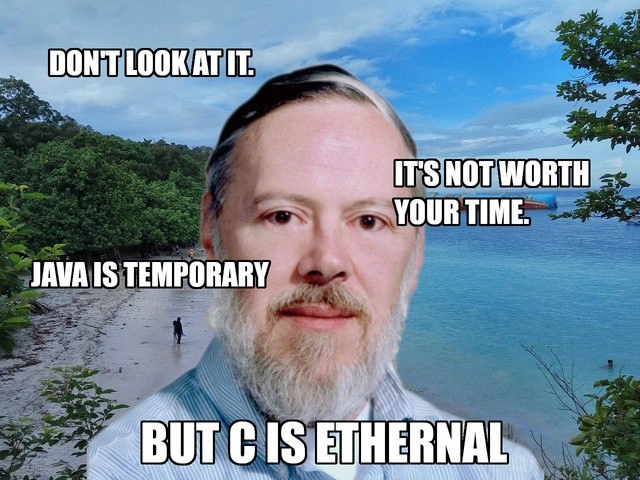
Let’s break down the meme’s joke in simpler terms. It’s comparing two programming languages – Java and C – and humorously suggesting one is just a passing trend while the other will last forever. In big meme text, it literally says: “Java is temporary, but C is eternal.” (The meme spells it “ethernal” with an extra H, which is just a goofy way to say eternal for comedic effect.) This reflects a common theme in programming jokes: language comparison and playful LanguageWars, where developers poke fun at each other’s favorite tools.

Java is a popular programming language that was introduced in the mid-1990s. It’s designed to be high-level and portable – meaning Java code runs on any system that has the Java Virtual Machine (JVM) installed. Java handles a lot of things for the programmer automatically. For example, it has automatic garbage collection, so it manages memory cleanup for you. It’s also heavily used in big enterprise applications and was the backbone of Android app development for a long time. In contrast, C is a much older language (from the early 1970s) that is considered low-level or “close to the metal.” C code is compiled directly into machine code that the computer’s CPU can execute, with no virtual machine in between. In C, the programmer has to manage memory manually (using functions like malloc() to allocate memory and free() to release it). C doesn’t have built-in concepts of classes or objects – it’s a procedural language – whereas Java is object-oriented (everything in Java is organized into classes and objects). Basically, C gives you more direct control (and responsibility), while Java provides more built-in safety nets and cross-platform convenience.

To clarify the differences and context, here’s a quick side-by-side overview:

Aspect C (the “eternal” one) Java (the “temporary” one)
First Released Early 1970s, by Dennis Ritchie at Bell Labs. Mid-1990s, by James Gosling at Sun Microsystems.
How it Runs Compiled to native machine code (runs directly on hardware). Compiled to bytecode, runs on the JVM (a virtual machine).
Level of Abstraction Low-level (closer to hardware, you manage details). High-level (runs in a managed runtime, many details handled for you).
Memory Management Manual – you explicitly allocate and free memory (e.g. using malloc/free). Automatic – Garbage Collection frees memory for you when objects are no longer used.
Programming Paradigm Procedural (focus on functions and data, with direct pointers). Object-Oriented (focus on classes/objects, no direct pointer manipulation in Java).
Typical Uses Operating systems (e.g. parts of Linux, Windows), embedded systems (microcontrollers), performance-critical libraries, system software. Enterprise applications (banking systems, large servers), Android mobile apps, cross-platform applications, anything needing “write once, run anywhere”.
Relation The ancestor of many languages (C++, C#, and yes, Java’s syntax is inspired by C). Often called a C family language originator. A descendant in spirit – uses C-style syntax (curly braces, similar loops, etc.), but with many differences. Runs on a C/C++-based runtime (the JVM is written in C++).
Longevity ~50 years of continuous strong usage. Code written decades ago in C still runs today. It’s considered “classic” and fundamental in computing. ~25+ years in use. Hugely popular, especially 2000s–2010s, and still powerfully present. Not actually disappearing, but the joke implies newer languages could overtake it.

The meme leverages these differences for humor. The phrase “Java is temporary” suggests that Java might be just a trend or that its popularity could fade. In developer culture, people sometimes joke that today’s hottest language or framework might become obsolete tomorrow as technology evolves. On the other hand, “C is eternal” implies that C is a timeless classic that will always be around. Indeed, C has been around for a very long time (in tech terms) and is still extremely important. A lot of software that we use every day is built on C. For example, the core of operating systems like Unix/Linux is written in C. Many programming languages’ interpreters or virtual machines (including parts of Java’s own system) are implemented in C or C++. So, C is kind of like the infrastructure language of the computing world.

Now, why put this text on a beach background with a blurred photo of a bearded man? This format resembles a known meme template where an authoritative figure (often with a wise or stern expression) gives advice or warnings. The beach setting with tropical vibes adds an ironic contrast – it’s calm and eternal (oceans, sand) while the text is urgent and absolute. The bearded man’s face is blurred, possibly to anonymize a real person’s image. Given the context, many tech-savvy viewers would guess it’s referencing Dennis Ritchie (the creator of C, who had a distinctive beard). Using the “father of C” as the figure underlines the joke: it’s like he’s personally saying “Trust me, my creation will outlive that other language.” Blurring it also makes it a bit funnier and more universal – it could represent any experienced old programmer delivering sage (or sarcastic) advice.

The top lines “DON’T LOOK AT IT. IT’S NOT WORTH YOUR TIME.” are exaggerated warnings. It’s as if someone is telling you not even to look at Java, as though Java were some dangerous or distracting thing – clearly an over-the-top, playful jab. This kind of hyperbole is common in language_memes; communities jokingly tell others to avoid rival languages entirely. Of course, in reality, Java is a perfectly fine language and hugely useful. The humor comes from tribalism in tech – developers sometimes form camps around their favorite language or tool. Just like sports fans or gamers tease the other team, programmers tease other languages. So here we have the C enthusiasts implying, “Java? Pfft, don’t waste your time – C is the real deal.” It’s caricatured advice, not actual career guidance!

For a junior developer or someone new to this humor, the key takeaways are:

  • Language longevity: Some languages (like C) have been around a very long time and are still critical in computing. Others (like Java) are newer in comparison. Even though Java’s been around ~25 years (which is not temporary at all), in the grand timeline of programming, C is older and has proven its staying power.
  • Community jokes: Developers often make jokes about languages “dying” or being “eternal”. It’s usually tongue-in-cheek. For example, people joke that “Java is the new COBOL” (implying it will stick around in legacy systems forever, not that it’s short-lived!). On the flip side, others poke fun that newer languages might replace older ones. Here the meme flips that script by saying the older one (C) is immortal.
  • Meme style: The bold white text with black outline is the classic meme caption style. It’s meant to be read as a dramatic pronouncement. Paired with the image of a wise-looking guy on a beach, it creates a humorous scene — almost like a quirky ad or a weirdly specific motivational poster for programmers.

In summary, this meme is a lighthearted example of TechHumor in the “language wars” genre. It’s not seriously telling you to avoid Java or only use C, but rather exaggerating the idea that C’s importance is everlasting and joking that Java (despite being hugely successful) is just a fleeting moment in time. Experienced devs find it funny because it echoes countless cheeky debates in the programmer community. If you’ve ever heard developers playfully argue Java vs. C (or Python vs. Java, or tabs vs. spaces, etc.), this meme is basically capturing that vibe in one image. It’s part of the culture where we laugh at our tools and ourselves. After all, today’s newbie coder might start with Python or JavaScript and think C is old news, while someone who’s been around will grin and say, “Talk to me in 20 years – C will still be here!” 😄

Level 3: Language Holy Wars

In the pantheon of programming languages, C is the grizzled elder and Java the ambitious mid-lifer. This meme exaggerates their rivalry in classic DeveloperHumor fashion. The image shows a tranquil tropical beach, but the overlaid bold text is anything but serene:

DON'T LOOK AT IT.
IT'S NOT WORTH YOUR TIME.

Those lines in Impact font mock the drama of a LanguageWars veteran warning a young developer away from some shiny new tech (here, Java). It’s as if an old guru on a beach is saying: “Ignore that thing over there – trust me, you’ll regret wasting time on it.” The next part spells out the punchline:

JAVA IS TEMPORARY.
BUT C IS ETHERNAL.

Misspelling "eternal" as "ethernal" is a tongue-in-cheek touch – maybe a pun (putting a bit of “ether” in eternal, as if C exists everywhere in the ether of computing), or just a goofy meme misspelling to amplify the humor. Either way, the message is clear: the meme claims that Java’s relevance will fade, but C’s legacy will last forever. This taps into a long-running joke in programming culture about how low-level languages like C never die, while higher-level languages come and go. Seasoned developers have seen hyped languages rise, then fall out of fashion – but C, born in the early 1970s, is still running strong half a century later.

Why is this funny to an experienced coder? It plays on tribal loyalty and the absurd absolutism of language fanatics. In real life, both languages are hugely influential: Java has powered enterprise software and Android apps for decades (hardly “temporary”!), and C is literally everywhere under the hood – operating systems, databases, embedded devices, you name it. But the meme boils it down to a comedic dichotomy: one is a mere fad, the other is an everlasting truth. This kind of LanguageComparison humor is common on developer forums – exaggerating claims that “X is dead, long live Y” that we know are over-the-top. It’s funny because it satirizes the way programmers sometimes talk about languages with almost religious fervor. The phrase “Java is temporary, C is eternal” riffs on motivational sayings (“Pain is temporary, glory is eternal”), turning a technical preference into an epic proclamation. Picture an old C programmer, possibly the blurred bearded figure (which looks a lot like Dennis Ritchie, C’s creator) calmly sipping a drink on that beach, advising: “Don’t even bother with those new-fangled languages, kid. They’ll pass. C is forever.” It’s a dramatization of the LanguageWars many of us have witnessed (or participated in) on forums and at meetups.

From a senior perspective, there’s nodding and smirking here. We’ve all heard declarations that “Java is the next COBOL” or that “C will outlive us all.” The humor comes from a kernel of truth: C’s longevity is legendary. Code written in C decades ago still runs today, and almost every new language’s runtime (including Java’s JVM itself) is implemented in C or C++ under the hood. Meanwhile, Java – despite being incredibly widespread – has seen challenges (JavaScript on the web, Python for scripting, Kotlin on Android, etc.). So calling Java “temporary” pokes fun at the hype cycle: yesterday’s hot language can become today’s legacy system. The meme captures that timeline angst in a jokey way. It’s the kind of darkly humorous hyperbole an old-timer might use after surviving countless tech fads: “Go ahead, learn that fancy framework or JVM language – but I guarantee, when all is said and done, we’ll still be writing C in the foundations.”

Technically speaking, the meme hints at deeper contrasts between the languages. C is a low-level, compiled language – often called “portable assembly” – giving you direct control over memory and hardware. It has minimal runtime overhead. Java is a higher-level, interpreted (well, bytecode-compiled) language running on the JVM with automatic memory management (garbage collection). Those differences mean C excels for system-level programming (OS kernels, device drivers, high-performance libraries), whereas Java was designed for cross-platform convenience (“write once, run anywhere”) in application-level software. An experienced dev reading “C is eternal” might chuckle, recalling that even if you write code in Java, at some level a C (or C++) program (the JVM, native libraries, etc.) is making it possible. There’s a running joke that if civilization collapsed, the last surviving software would probably be some COBOL in a bank and C running on a stray microcontroller (along with cockroaches 😜). The meme plays into that persistent lore of tech: the closer a language is to the metal, the longer its lifespan.

In essence, this beach meme is parodying the language_memes and flame wars we’ve all seen: one person dramatically swearing by an “old faithful” technology and dismissing the new hotness as not worth a glance. The tropical backdrop and the imperative “DON’T LOOK AT IT” give it an absurd, almost cinematic flair (some folks are reminded of movie scenes like “Don’t open your eyes!” in Indiana Jones). It’s TechHumor that makes us laugh at ourselves: we know no language is truly eternal or entirely temporary, but the bold certainty is what makes it comical. Every senior dev has a story of investing time in a promising new language or framework that fizzled out – and also of maintaining some gnarly C code that just won’t die. This meme condenses that shared experience into a one-liner joke. It’s the kind of thing you chuckle at and maybe forward to your teammate who won’t stop teasing you about that “outdated” C codebase (or vice versa, the one who insists your fancy new Java service is overkill). It’s a playful jab in the never-ending LanguageWars, reminding us how passionate (and silly) we can get about our favorite tools. And if you’re a C veteran, you might even feel a tiny swell of pride at the idea that your language is eternal. Just don’t take it too seriously – the extra “H” in ethernal is there to assure it’s all in good fun. 😉

Description

A meme featuring a portrait of Dennis Ritchie, the creator of the C programming language, superimposed over a scenic beach background. The image is overlaid with bold, white text in the style of classic image macros. The text reads: 'DON'T LOOK AT IT. JAVA IS TEMPORARY. IT'S NOT WORTH YOUR TIME. BUT C IS ETHERNAL'. The word 'eternal' is misspelled as 'ethernal'. This meme is a classic example of 'language war' humor, using a revered historical figure to lend weight to the argument. It portrays C as a timeless, fundamental technology while dismissing Java as a passing trend. For senior engineers, especially those in systems, embedded, or OS development, this is a nod to the enduring legacy and foundational importance of C, the language that built much of the modern computing world. The humor lies in the dramatic, almost cult-like reverence for C over more modern, managed languages
Comments

21
Anonymous ★ Top Pick Java has a garbage collector, but C has a legacy that will never be collected
  1. Anonymous ★ Top Pick

    Java has a garbage collector, but C has a legacy that will never be collected

  2. Anonymous

    Java’s bytecode will get garbage-collected, but the C buffer overflow you shipped in 2003 will still be popping shells on someone’s thermostat in 2053 - that’s the real “ethernal.”

  3. Anonymous

    Java is temporary, but the null pointer exception in that C code you wrote in 1987 is still segfaulting in production somewhere, keeping Dennis's legacy alive one core dump at a time

  4. Anonymous

    After 50 years, C is still the lingua franca of systems programming - turns out when you're close enough to the metal, you don't need garbage collection because you ARE the garbage collector. Meanwhile, Java's on its 21st version trying to convince us that 'this time' the startup time will be acceptable

  5. Anonymous

    Every decade we announce a “C replacement,” then bootstrap it with a C toolchain and a POSIX-shaped surface - immortality by dependency

  6. Anonymous

    Java is temporary; the C .so your JVM still talks to via JNI is eternal - ABIs are the only contracts we never dare refactor

  7. Anonymous

    Java virtualizes away your problems; C makes you own them eternally, segfault by segfault

  8. @Artkash 5y

    Should there be "eternal?"

  9. Deleted Account 5y

    F for Ritchie

  10. @Dimarza1 5y

    C# for anything

    1. Deleted Account 5y

      no

      1. @Dimarza1 5y

        Why not? Could you describe?

        1. @RiedleroD 5y

          C#→Microsoft Microsoft→Evil

          1. Deleted Account 5y

            also this

            1. @RiedleroD 5y

              that was a joke… well, half a joke. Microsoft is evil, but that doesn't say much about the quality of their programming language.

              1. @RiedleroD 5y

                fuck powershell though

              2. Deleted Account 5y

                i mean, i don't think it's gonna be good if a single entity controls the language entirely, especially if that entity is microsoft

                1. @RiedleroD 5y

                  agreed.

        2. Deleted Account 5y

          it is slow, has runtime reflection, and it forces oop onto the user

          1. Deleted Account 5y

            also it can be used only for userspace stuff, so already not everything

            1. Deleted Account 5y

              granted, you don't want to, but you can

Use J and K for navigation