When the Merge Request is a Dumpster Fire
Why is this CodeReviews meme funny?
Level 1: This Is Fine, Right?
Imagine you’re watching your favorite cartoon, and suddenly the TV screen starts showing crazy white lines everywhere. The picture is all scrambled and you can barely see what’s happening. Normally, you’d be upset or try to fix it, but instead you just shrug with a goofy smile and say, “Eh, it’s fine, I can still follow the story,” even though it’s obviously not fine. That’s essentially what’s going on in this meme. The computer screen that developers use to check each other’s code is acting all weird and glitchy – kind of like a book with ink spilled all over the pages. But instead of freaking out, the developer looking at it just jokes, “this is fine.” It’s like pretending everything’s okay when it’s clearly a mess.
Why is that funny? Because it’s so silly and relatable. We’ve all had moments where something important breaks or goes wrong (like a game freezing with a crazy glitch), and we just nervously laugh and carry on because we don’t know what else to do. In the meme, even though the code review screen is broken, the developers act like nothing bad is happening. It’s the same as a little cartoon dog calmly sipping coffee in a burning house saying “This is fine.” The humor comes from that contrast: things are broken and on fire (figuratively), but we put on a brave face and joke about it. So, in simple terms, the picture is funny because the developers are treating a very NOT-fine situation as if it’s totally normal – a bit like seeing a big mess and just saying, “No worries, everything’s okay!”
Level 2: Merge Request Mayhem
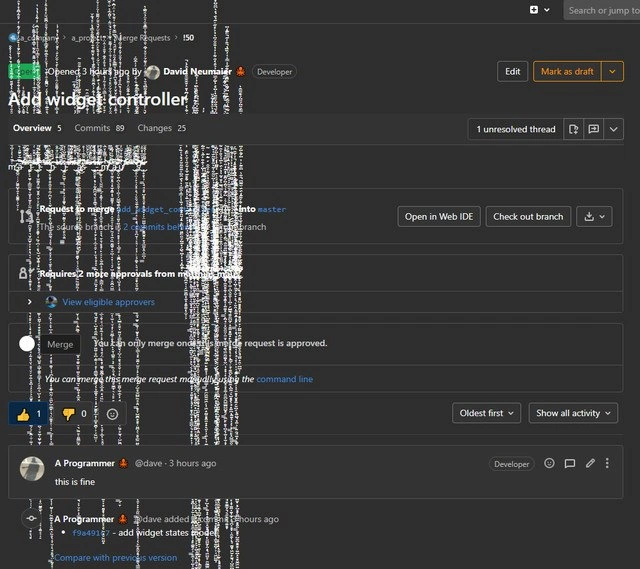
In simpler terms, this meme shows a GitLab merge request page – that’s the screen where developers ask teammates to review and approve code changes (similar to a Pull Request on GitHub). Normally, you’d see the code diff, comments, and buttons clearly. But here it’s all messed up: the page is glitching out with tall white bars and gibberish where the content should be. It’s as if the website’s styling (the CSS, which controls how things look) or the display driver had an error, turning the interface into a scrambled mess. You can still spot pieces of the UI: for example, the button labeled Mark as draft (to mark the merge request as work-in-progress) and Open in Web IDE (to edit the code in a web editor) are partially visible. The merge section says there are approval rules (“Requires 2 approvals…”) and even suggests you could merge via the command line. So we know it’s the right page, but it’s almost unreadable. It’s like trying to read a book that got soaked in water – the words are there but all blurred and streaky.
Now, the funny part: a user (aptly named “A Programmer”) left a comment saying “this is fine” along with a little developer emoji badge next to their name. If you’re not familiar, “this is fine” is a popular meme phrase from a cartoon where a dog is sitting calmly in a burning room, saying everything’s okay. People in tech love to use that phrase sarcastically when things are clearly NOT fine. Here, the reviewer is joking that even though the code review page is basically broken and unusable, they’re pretending everything is normal. It’s a form of dry, keep-calm humor.
Why would a developer say that? Well, in real life, tools like GitLab sometimes do glitch or crash at the worst times – maybe due to a new update or a browser bug. Developers often handle these frustrating moments by joking about them. It’s a way to stay sane. Instead of raging that the software has a bug (the page’s UX failure), they’ll say “no problem, totally fine 👍” ironically. The meme exaggerates this: the team’s vital code review process is being derailed by a bizarre UI bug, yet the reviewer just gives a thumbs-up in jest. It highlights a common DeveloperHumor coping mechanism: when something essential breaks (like your version control interface showing gibberish), you drop a meme reference (“this is fine”) and carry on. In practical terms, they might actually refresh the page, try a different browser, or use git in the terminal to manually merge the code if the interface won’t work. The tags like CodeReviewPainPoints and UXFailures attached to this meme hint that this is a known pain: code reviews are already stressful, and a broken interface makes it worse – you can’t even see the code you’re supposed to approve! Yet, the joke is that developers have almost become numb to such problems. They’ll give an approving nod with a sarcastic smile and say “looks good to me” even if the screen looks like an old TV with bad reception. It’s funny in the way that only shared frustration can be funny: everyone who writes software knows these moments, and we laugh so we don’t cry.
Level 3: Glitch in the Review Matrix
At first glance, this image looks like a code review page gone cyberpunk. It's actually a GitLab Merge Request interface (Add widget controller) that has completely freaked out: vertical white pixel columns slicing through the dark theme like digital confetti. In plain terms, the code review UI itself has crashed into glitch-art territory. You can still make out familiar bits – buttons like Mark as draft and Open in Web IDE, the merge button, approval requirements – but they're all obfuscated by what looks like the Matrix pouring down the screen. This isn’t a stylistic choice; it’s almost certainly a UI rendering glitch. Maybe the CSS decided to take a day off or the browser's GPU rendering went haywire, causing visual artifacts (those white columns are basically graphical garbage).
For seasoned developers, this image is hilariously relatable. We've all been in the middle of a critical code review when the tools meant to help us bug-hunt start bugging out themselves. The humor here comes from a deep, slightly painful familiarity: the very platform meant to ensure code quality (the Merge Request page on a version control system) is itself suffering a broken CSS render or front-end meltdown. It’s a perfect example of “physician, heal thyself” in software form – our bug-catching tool has a bug! The text snippet in the meme shows a commenter named “A Programmer” (with a little developer badge emoji) posting “this is fine”. That phrase is a well-known tongue-in-cheek reference to the famous "this is fine" meme (picture a dog sipping coffee in a burning room). In this context, it's pure developer sarcasm. The reviewer is basically saying “Yeah, the merge request page looks like corrupted pixel salad, but sure, whatever, everything’s okay.”
Why is that funny to an experienced dev? Because it’s a coping mechanism we know too well. When you’ve been on call at 3 AM and seen production servers on fire (sometimes literally, sometimes figuratively), a glitched interface barely fazes you. CodeReviews often come with their own pain points – endless nitpicks, merge conflicts, CI pipeline failures – but a completely glitched UI takes the cake. Instead of freaking out, the team responds with dark humor: they pretend nothing’s wrong. It’s a form of collective resilience in tech culture. We joke that "the deploy went great, just ignore the fact that the dashboard is blank". Here, the reviewers literally continue the code review process as if a cascade of white pixel columns is normal. Perhaps they’ll even click the Merge button through the visual noise or use the CLI fallback (git merge via command line) because, as the interface itself hints, “You can merge this request manually using the command line.” The absurdity that the version control web UI is disintegrating, yet the team proceeds to approve the code, strikes a chord with anyone who’s battled fragile dev tools. It’s a satire of our daily reality: software engineers often deal with bugs in the very tools that manage bugs, and our response is usually a mix of exasperation and “keep calm and ship it” humor. In short, the meme packs in multiple layers of inside joke: the UXFailure of a critical system, the irony of reviewing code on a broken page, and the classic developer attitude of stoic sarcasm in the face of yet another glitch.
Description
A screenshot of a GitLab merge request page in dark mode. The title of the merge request is 'Add widget controller'. It shows 5 commits, 89 additions, and 25 deletions. The merge request requires 2 more approvals and is 2 commits behind the target 'master' branch. A comment from the developer, 'A Programmer' with the handle '@dave', simply says 'this is fine'. The 'this is fine' comment is a direct reference to the popular 'This is Fine' dog meme, where a dog sits calmly in a room engulfed in flames. The joke is that the developer is acknowledging the chaotic or problematic state of their own large merge request with a sense of ironic detachment and gallows humor, a feeling many senior engineers recognize when pushing complex or contentious changes that are destined for a difficult code review
Comments
14Comment deleted
A merge request with 89 changes is less of a 'request' and more of a 'hostage situation'. The 'this is fine' is just the developer Stockholm syndrome talking
The merge view looks like /dev/urandom got symlinked to main.css, but hey - two approvals, so “definition of done” apparently includes undefined behavior
After 99 commits and 25 changes, this PR has achieved what every senior engineer fears most: it's become sentient enough to generate its own scope creep through review comments alone
When your PR has been open so long that the code review interface starts looking like the Matrix - 89 commits, 25 changed files, still waiting for 2 approvals. At least 'A Programmer' thinks 'this is fine' while the digital rain of technical debt cascades around them. Classic case of when the merge conflict becomes an existential crisis: do you take the red pill and rebase, or the blue pill and force push?
GitLab: 'Merge ready!' Fine print: 'Via CLI, because UIs are for juniors and on-call is forever.'
PR title: “Add widget controller.” GitLab UI: raining glyphs. Translation: you didn’t add a controller - you shipped a fragment shader. Needs two approvals: the architect and your GPU
Nothing says enterprise maturity like a merge request UI rendered as VRAM confetti while the approvals gate still blocks the merge - reliability implemented at exactly the wrong layer
Wtf Comment deleted
HE COMES Comment deleted
explain? Comment deleted
Just google it Comment deleted
Zalgo! Comment deleted
ZALGOOOOOOOOOO Comment deleted
Hehehehe Comment deleted