Welcome to Agile: Where the Points Don't Matter
Why is this Agile meme funny?
Level 1: Points Don’t Matter
Imagine you and your friends make up a game on the playground. One friend is kind of like the “game master” and keeps changing the rules as you play. First they say, “Whoever collects 5 leaves gets 10 points!” So everyone runs around getting leaves. But then halfway through, they suddenly say, “Actually, now jumping on one foot is worth 20 points!” It’s pretty confusing, right? You might work hard to earn points, but the rules keep shifting, and those points you earned for the leaves don’t really mean anything anymore because the game master decided something else matters now. In the end, when the game is “over,” your friend just laughs and says, “Haha, well none of those points counted for a prize anyway!” You’d probably roll your eyes and think, “This game was silly – we did all that for nothing.” Developers feel the same way when planning their work sometimes. They spend time guessing how “big” each task is (like earning points), but then things change or the bosses don’t actually use those numbers for anything real. It’s funny in a cartoonish way because the grown-ups find themselves in a situation that’s as silly as kids making up games – lots of pretend points and ever-changing rules, so at the end of the day everyone just laughs and says, “Well, I guess those points didn’t really matter!”
Level 2: The Agile Game Show
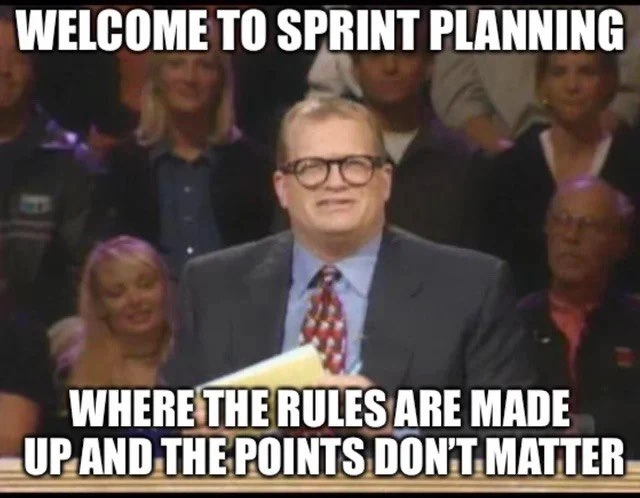
The image is a spoof of a popular improv comedy show called “Whose Line Is It Anyway?”. On that show, the host (pictured with glasses and note cards) opens every episode with the catchphrase: “Welcome to Whose Line, where everything’s made up and the points don’t matter!” The meme replaces the show’s name with “Sprint Planning” to joke that this Agile meeting can feel just as chaotic and made-up. In the background of the image, there’s an audience laughing – in the meme context, think of that as the team of developers who have been through enough Sprint Planning sessions to know the routine has a comedic side. The wording “the rules are made up and the points don’t matter” is basically calling Sprint Planning a game show where any rules can change and the “points” (story points) are essentially meaningless. It’s a slice of AgileHumor that pokes fun at how these meetings sometimes go.
Now, what exactly is Sprint Planning? It’s a key meeting in the Scrum framework (a type of Agile methodology). In Scrum, development is done in fixed time periods called sprints (often 1 or 2 weeks long). At the start of each sprint, the whole team (developers, the Scrum Master, and the Product Owner) gathers for a Sprint Planning meeting. They review the product backlog (the prioritized list of work to do) and decide which tasks or user stories to pull into the sprint. The team discusses each story’s details and then estimates how much effort it will take – this is where story points come in. Sprint Planning sets the stage for the work ahead: by the end of it, the team commits to a set of stories and the number of points those stories are worth in total, which becomes their goal for the sprint. Ideally, there are some “rules” everyone follows: for example, once the sprint begins, the scope (the chosen stories) shouldn’t change, and each story should meet the team’s Definition of Done when completed. The Agile philosophy encourages adaptation, but there is supposed to be a structured process to these ceremonies.
Let’s talk about story points. A story point is a unit of measure for estimating the relative effort of a piece of work. It’s not an exact hour or day count; instead, it’s a way to express how big or complex a task is compared to other tasks. For instance, a simple bug fix might be 1 point, a medium feature might be 5 points, and a very complex feature might be 8 or 13 points. Some teams use a Fibonacci-like sequence (1, 2, 3, 5, 8, 13, etc.) for story points to avoid too much precision and acknowledge uncertainty (the bigger the number, the more uncertainty about the effort). This relative sizing helps teams gauge how much they can take on in a sprint. The total points a team completes in a sprint is called velocity. If a team usually finishes around 20 points per sprint, they’ll probably plan roughly 20 points in the next Sprint Planning.
To decide on these point values, teams often play Planning Poker (yes, it’s a real Agile technique and not as fun as actual poker, but it tries!). Here’s how it works: each developer has a set of cards with possible point values. For each story, everyone privately picks a card representing how many points they think the story is. Then all cards are revealed simultaneously. If everyone chose the same number, great – that’s the estimate. If not, the high and low estimators explain their thinking, and the team discusses. After a bit of talk, they vote again (maybe a few rounds) until they reach a consensus on the points. The idea is to leverage the whole team’s perspective and avoid one person’s opinion dominating (hence the simultaneous reveal). It’s meant to make estimation more democratic and accurate, and sometimes it even leads to good discussions about the work details. Planning poker can be fun initially (it’s like a mini-game in the meeting), but it can also become tiring (planning_poker_fatigue) when done for many stories in a row, especially if people start debating whether something is 8 points or 13 points for too long.
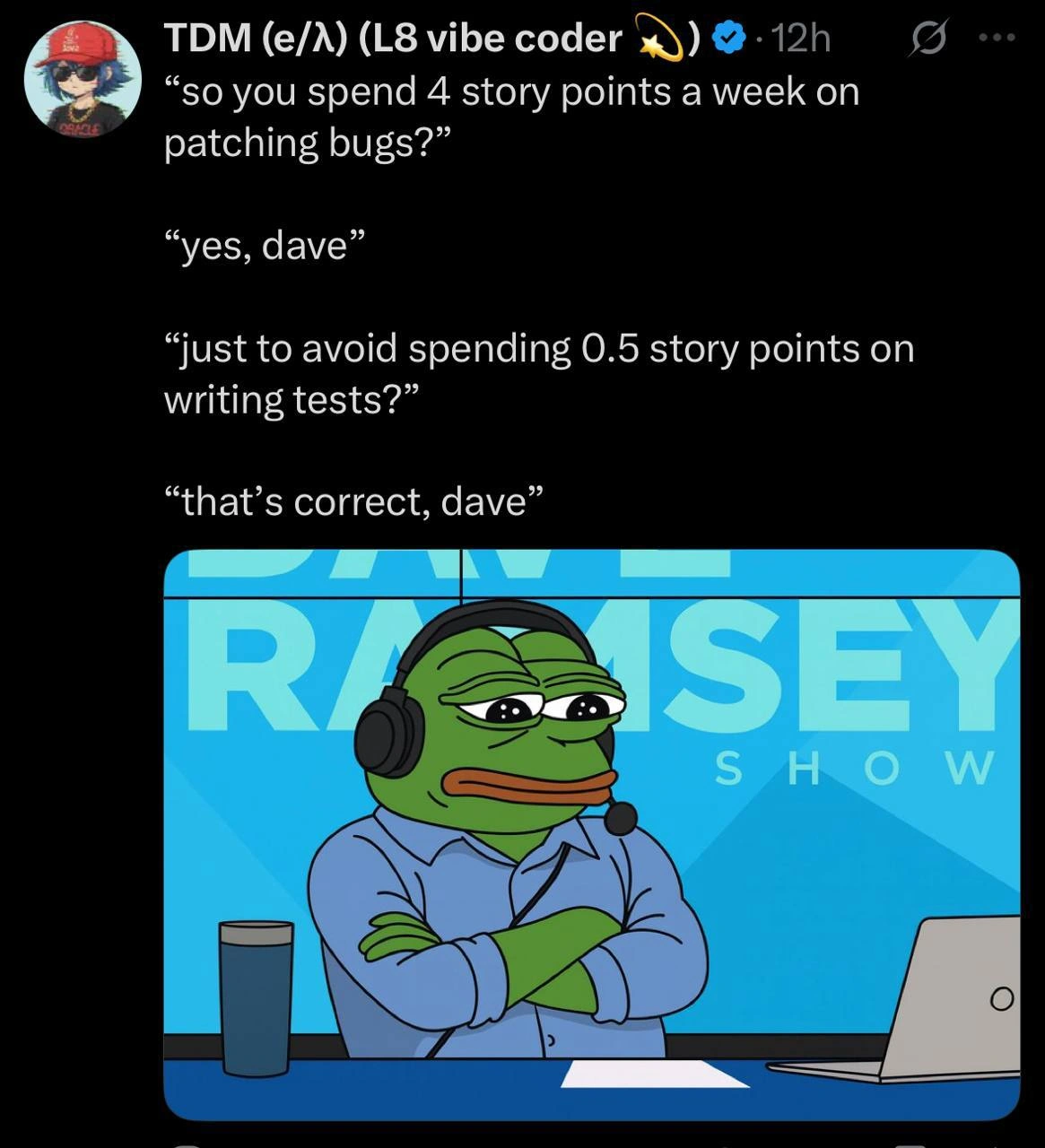
So, if story points and Sprint Planning have all these rules, why does the meme claim the rules are made up and the points don’t matter? Because in real life, Agile processes aren’t always as neat as the theory. In theory: story points help the team commit to a realistic amount of work and not over-promise; the rules of Scrum (like fixed sprints, no changes mid-sprint, regular ceremonies) create a predictable rhythm. In practice: things can get messy. Sometimes the rules get bent: a manager might shove a “critical” unplanned task into the sprint (breaking the “no new work mid-sprint” rule), or the team might quietly re-estimate a story mid-sprint because they discovered it was way more complex than thought. Teams also might interpret the rules differently or have their own house rules (like “we don’t estimate bugs with points” or “we always make each story 3 points no matter what” – yes, some teams do that). This is the process_compliance_flexibility the meme hints at – teams appear to follow Agile, but they tweak the process whenever convenient, essentially making up rules as they go.
And about those points “not mattering”: that’s reflecting a common frustration. Ideally, story points are just an internal tool for the team to project manage themselves. They shouldn’t be treated as a score by management. But it often happens that bosses start fixating on points, like a high score in an arcade game. For example, stakeholders might expect that if the team did 30 points last sprint, they’ll do 30 or more again – treating velocity as a target rather than a historical metric. Under that pressure, teams might start doing weird things. They might assign more points to each story than before (so it looks like they’re doing a lot of points each sprint without actually delivering more work). Or they might split one story into two smaller ones and double-count points. Suddenly, the careful meaning of what a “point” was supposed to represent gets muddy. New developers often find it confusing or disheartening: “We spent all this time estimating, but then everything changed or we adjusted numbers later – what was the point of the points?” Exactly. It can feel like an exercise in futility, hence the story_points_irony. The meme nails this feeling by equating it to a game show whose points don’t actually count towards anything real. It’s a lighthearted way to acknowledge a real DeveloperPainPoint: after all the meetings and numbers and so-called rules, sometimes software development just doesn’t go to plan, and all those estimates and process rituals feel like they were, well, kind of arbitrary.
In summary, for someone early in their career: this meme is saying “Scrum meetings can be a farce!” of sorts. Sprint Planning is supposed to bring order (set rules, assign story point values), but it often turns into a comedic AgileCeremonies spectacle where everyone is pretending the numbers are super serious… until they’re not. It’s a form of AgileHumor that’s very RelatableDeveloperExperience once you’ve been through a few sprints and seen how easily those “serious” estimates can be upended by reality. Think of it as gentle ribbing of the Agile process – we follow it because it’s better than total chaos, but we also laugh because sometimes it still feels like chaos, just with extra steps and funny numbers attached.
Level 3: Whose Sprint Is It Anyway?
In this meme Sprint Planning is being compared to an improv comedy show – literally borrowing from the TV show Whose Line Is It Anyway? where the host (Drew Carey) famously says, “Everything’s made up and the points don’t matter.” Here, the caption tweaks it to: “Welcome to sprint planning, where the rules are made up and the points don’t matter.” Seasoned developers immediately smirk at this mashup, because it rings true to their experience with Agile ceremonies. The joke lands so well because scrum meetings can indeed feel like a game show: the team sits around estimating work with planning poker cards as if they’re contestants on stage, yet everyone knows deep down that these “points” are mostly for show. It’s a classic case of estimation_theater – we pretend the process is rigorous, but at the end of the day, the numbers often get massaged or ignored when reality intrudes. The host in the meme metaphorically represents the Scrum Master or whoever’s running the meeting, dealing out story cards and one-liners as the audience (the dev team) plays along despite knowing the absurdity.
The phrase “the rules are made up” jabs at how Agile guidelines often get bent or reinvented on the fly in real organizations. Scrum has an official rulebook (the Scrum Guide) detailing how to do Sprint Planning, estimating in story points, not changing scope mid-sprint, etc. – but experienced engineers have seen those rules flex more than a rubber band in a 3 AM outage. One sprint, you’re told “no changing estimates after the Sprint starts”; the next sprint, stakeholders suddenly reshuffle priorities and everything planned goes out the window. The team might scramble to re-estimate tasks or split stories mid-iteration, effectively making up new rules to cope. This chaotic adaptation is often justified as “being agile”, but it can devolve into process_compliance_flexibility – a fancy way of saying “we follow the process except when we don’t.” Veterans have a term for this: ScrumBut (as in “we do Scrum, but we skip retrospectives, but we change sprint goals last-minute…”). The meme wryly implies that, in many Sprint Planning meetings, the only consistent rule is inconsistency itself.
Now, the real zinger: “the points don’t matter.” Story points are supposed to measure the relative effort or complexity of work. In theory, they help a team gauge how much they can take on (their velocity) and allow fair comparison of tasks (a 5-point story should be about twice the effort of a 2-point story, etc.). But in practice? Oh boy. Experienced devs have endured countless planning sessions where story point estimates are basically negotiable tokens. Under pressure to meet a certain velocity target, teams might inflate estimates or redefine point scales to make the numbers look good. It’s a textbook example of Goodhart’s Law in action – “when a measure becomes a target, it ceases to be a good measure.” Management starts treating velocity as a scoreboard (“we did 30 points last sprint, we need 40 this time!”), and suddenly those carefully calibrated point values turn into poker chips to be stacked or shuffled arbitrarily. A task that was estimated as 3 points yesterday might magically become 5 points today after some arm-twisting, not because the work changed, but because “we need the extra points.” The result? The story_points_irony that the meme highlights: after all the debate and planning poker drama, the actual numbers don’t matter for delivering software, only for optics. The team knows these points won’t stop scope creep or make code ship faster – they’re as meaningless as the points on Whose Line, serving only to entertain (or appease a manager’s spreadsheet).
This blend of AgileHumor and painful reality is what makes the meme so relatable to senior engineers. It’s an agile_parody born of collective experience: sprint after sprint of “rules” that change whenever convenient and “point estimates” that evaporate under real-world conditions. It satirizes how Agile, a framework meant to bring order and predictability to software development, can sometimes feel like a farcical improv session. Everyone in the room might be playing along with straight faces – discussing whether a task is a 5 or an 8, referencing the Scrum guide as if it’s holy writ – but internally the veterans are chuckling (or groaning) because they know tomorrow a surprise bug or a leadership whim could render all those estimates moot. The meme’s dark punchline resonates as a coping mechanism: if you don’t laugh about the pointlessness of those story points, you might just cry. Better to share a wink with your fellow developers, acknowledging that Sprint Planning can be as relatableDeveloperExperience crazy as a comedy show, and that sometimes, “being Agile” means accepting a little absurdity in your process.
Description
This meme features a screenshot of Drew Carey, the host of the improv comedy show 'Whose Line Is It Anyway?'. The image has bold, white, all-caps text overlaid on it. The top text reads, 'WELCOME TO SPRINT PLANNING', and the bottom text says, 'WHERE THE RULES ARE MADE UP AND THE POINTS DON'T MATTER'. The meme directly parodies the show's famous catchphrase, 'where everything's made up and the points don't matter,' and applies it to the Agile software development ceremony of sprint planning. The joke resonates deeply with experienced developers who often feel that the process of assigning story points to tasks is arbitrary and that the rules of Scrum are inconsistently applied, making the entire exercise feel performative rather than productive
Comments
7Comment deleted
Sprint planning is the bi-weekly ritual where the team collectively agrees to a series of optimistic lies that will become the next fortnight's source of anxiety
Sprint planning is Schrödinger’s backlog: every ticket is simultaneously a 3-pointer and a 13 until someone collapses the estimate waveform
After 20 years in this industry, I've realized story points are just a socially acceptable way to avoid saying "I have no idea, but if I say 13 instead of 8, maybe you'll leave me alone to actually build it."
After 15 years in the industry, you realize sprint planning is just collaborative fiction writing where everyone pretends Fibonacci numbers represent actual time, the team collectively gaslights themselves into believing 'velocity' is predictive, and the real outcome is determined by whoever speaks loudest when the PM asks 'can we squeeze in just one more thing?' The points truly don't matter - what matters is whether you can deploy on Friday and still sleep through the weekend
Sprint planning: where story points follow the planning fallacy - O(1) optimism per dev, inflating to Ω(∞) by EOD
Quarterly OKR: +30% velocity - achieved by upgrading every “3” to a “5”; Goodhart would be proud
Last quarter we doubled velocity by switching to planning poker futures and redefining Fibonacci as 1, 2, 3, 5, 8, 13, Enterprise