How a Spotify playlist mimics every cringey cold-email introduction ever
Why is this Communication meme funny?
Level 1: Polite, Then Pushy
Imagine you’re at school and a kid you don’t really know walks up to you with a big smile. “Hey there, how’s it going?” they say in a super friendly way. That’s a nice greeting, right? Then the kid adds, “My name is Alex, and I heard we both like video games – cool!” They’re trying to show you that you have something in common so you’ll like them. So far, so good: they said hello, asked how you are, told you who they are, and even mentioned something about you (maybe they saw you wearing a Minecraft t-shirt and figured you like games, just like them).
But then, suddenly, Alex changes the topic with a “Anyway…” and starts talking about this new comic book or gadget they have. They say, “It’s the best one ever – everyone else has one!” Now you realize they’re not just here to chat—they want to sell you something or get you to do something. Alex continues, “We should totally trade cards after school – how about Wednesday at 4 PM?” Now they’re basically asking you to agree to a specific time to do this thing. In the end, they finish with a polite, “Best regards, Alex.” It sounds oddly formal after all that. And as they walk away, they casually mention, “If you’re not interested, I won’t bother you again.”
How do you feel about this interaction? It started friendly, but it ended up being a bit pushy, right? The only reason Alex was being so nice was to get you to buy into whatever they were pushing (trading cards, a gadget, etc.). It didn’t feel like a genuine chat between friends; it felt like a mini sales pitch. You might even laugh about it later because it was so over-the-top: first super nice, then boom, sales mode, then a very proper goodbye.
This is exactly what the meme is showing, but with a work email. Someone sends a message that starts off like a friendly hello but quickly turns into “please do business with me”. It’s funny in the meme because they revealed the secret formula using song titles, which makes it really obvious and exaggerated. In real life, we usually just skim these emails or roll our eyes, but seeing it spelled out like a playlist is like watching a comedy skit. It reminds us that when someone is overly polite and friendly out of nowhere, they often want something from you. And that mix of sweet talk and sales pitch can be pretty amusing when you step back and look at it – just like realizing a kid was buttering you up just to ask for a favor.
Level 2: Cold Email Greatest Hits
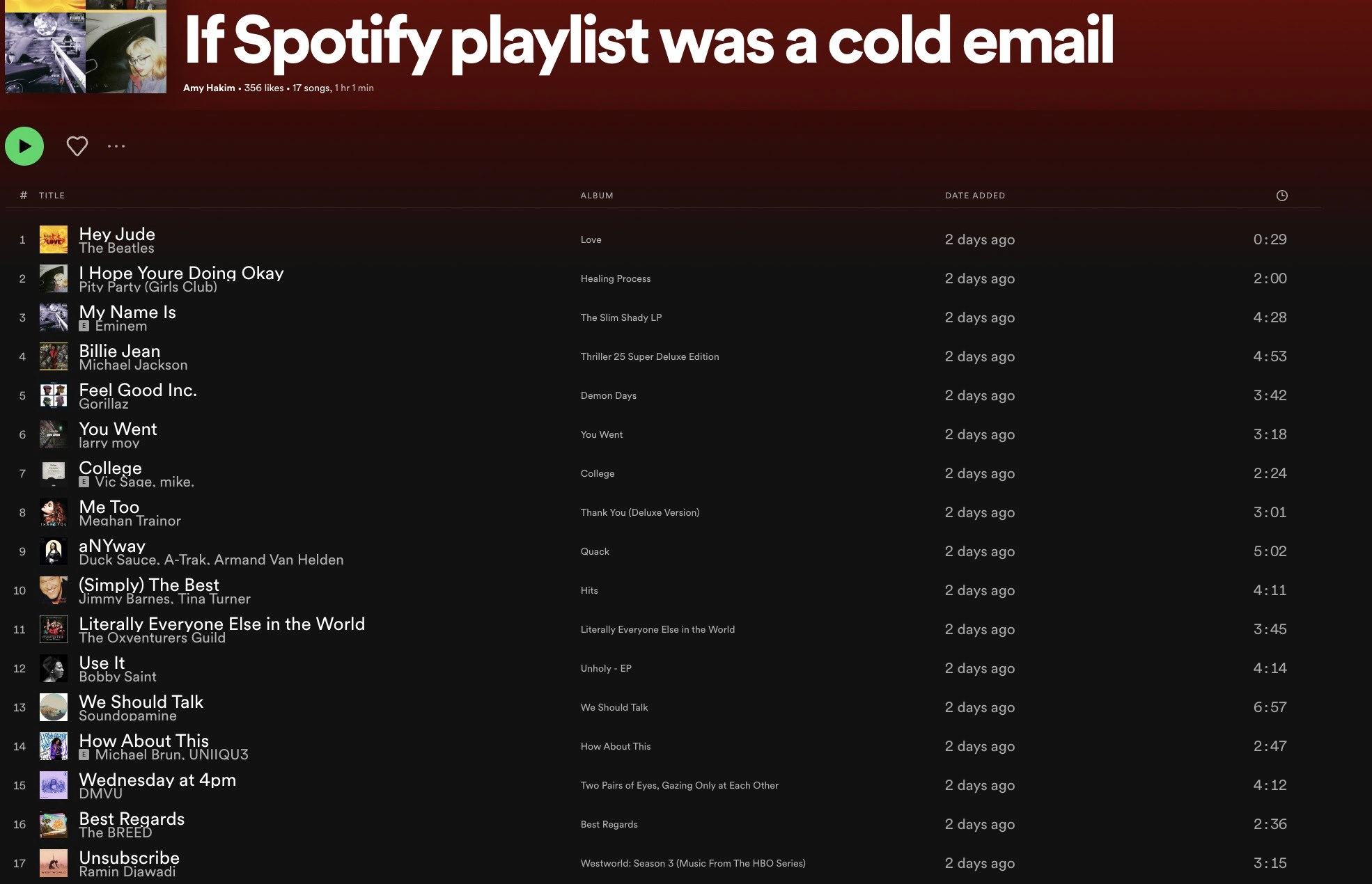
Let’s break down what’s happening in this meme in simpler terms. The image is a screenshot of a Spotify playlist (Spotify is a popular music streaming app where you can make playlists of songs). The playlist is titled “If Spotify playlist was a cold email.” Essentially, someone took 17 songs and arranged their titles so that, when read in order, they form the lines of a classic cold email – the kind of unsolicited introductory email that a salesperson or recruiter might send you out of the blue. Each part of that email is represented by a song title, creating a step-by-step story that anyone who’s dealt with marketing emails will recognize.
First, what is a cold email? It’s an email sent to someone who isn’t expecting it, usually for business purposes – like a sales pitch or a networking request. Think of it as the email equivalent of a telemarketing call or a salesperson knocking on your door, except in your inbox. Developers often receive these from companies trying to sell software tools, services, or sometimes from recruiters offering jobs. The meme is poking fun at how these emails are written because they all tend to follow a similar formula or script, especially in the tech world.
Now, look at the playlist’s song titles as if they are sentences in an email:
“Hey Jude” – This stands in for the greeting, e.g., “Hey [Name],” or “Hi John,”. Cold emails often start with a friendly “Hey” or “Hi” followed by your first name to sound informal and warm. Here, “Jude” is just part of the famous Beatles song title, but it doubles as the name of the person being emailed (like the email is saying hello to Jude). It’s a playful way to say, “Hey you,” while referencing a well-known song.
“I Hope You’re Doing Okay” – This represents the very common opening line “I hope you’re doing well” (or some variation like “Hope you’re doing okay,” “Hope you’re having a great week,” etc.). Nearly every cold email starts with a polite check-in like this. It’s meant to be courteous and start on a positive note. In the meme, they found a song literally named “I Hope You’re Doing Okay” to match that phrase exactly. It’s funny because we see this line so often in emails that it’s almost automatic – and indeed it became the second track in the “email playlist.”
“My Name Is” – This is clearly the part where the sender introduces themselves. In a real email right after the greeting and pleasantry, the person will say “My name is Alice,” for example. Using Eminem’s song “My Name Is” (which repeats the lyric “My name is (what?) My name is (who?)” etc.) is a cheeky way to indicate that introduction. It sets up the expectation that the next thing we’ll hear is the name of the sender.
“Billie Jean” – Here we get a name. Combining with the previous track, it reads as “My name is Billie Jean.” So now we have a full introduction: the sender’s name is Billie Jean (just borrowing the title of Michael Jackson’s famous song). In a real email, it would be the sender’s actual name, of course. The meme creator used a famous name as a stand-in, which also adds humor because Billie Jean is not really an ordinary salesperson’s name – it reminds us of the pop song instead. But it serves the purpose: it’s a name to complete the sentence “My name is ____.”
“Feel Good Inc.” – This sounds like a company name (and indeed in real life it’s the title of a Gorillaz song referring to a fictional corporation). In our email narrative, this would be the sender’s company. So if we put tracks 3, 4, and 5 together it reads: “My name is Billie Jean (and I’m from) Feel Good Inc.” That’s exactly how sales emails introduce the sender and their organization: “I’m [Name] from [Company].” It’s included so you know who they represent and possibly to impress you with the company (here “Inc.” hints it’s a company). The choice of “Feel Good Inc.” is probably because it has “Inc.” in the name and is well-known, making it a fun placeholder for any company name.
“You Went” – Now the email shifts to a more personal tone. “You Went” implies it’s about to reference something you, the recipient, did. This likely connects to the next track...
“College” – When combined with #6, it forms “You went (to) College.” In actual emails, this is where the sender tries to personalize the message by mentioning something about you. A very common tactic is to mention your alma mater or a place you worked: “I saw you went to XYZ College”. Salespeople often scan your LinkedIn profile for any detail to establish common ground or catch your interest. Here, the meme simplifies it to the most generic version: you went to college. (Almost everyone in the tech industry has gone to some college, so it’s humorously generic.) It highlights how sometimes the “personalization” is very surface-level. They might as well say “I see you breathe air – me too!” because it can feel that flimsy if they don’t actually know you. But it’s included because it’s a staple of these intros to prove they did a little homework on you.
“Me Too” – This completes the personalization attempt: “You went to college – me too!” The sender is trying to bond over a shared trait or experience. In many real cold emails, if they find out you went to a certain university and they also did, they won’t hesitate to mention it. For example: “Noticed you attended MIT. Me too, Class of ’09! Small world.” Even if you didn’t go to the same school, they might say something like “I saw you studied computer science; I did as well.” They want you to think of them as a peer or someone with a common background, rather than a total stranger. It’s a classic ice-breaker tactic. In the playlist, using Meghan Trainor’s upbeat song “Me Too” to say “me too!” as part of the sentence is a humorous touch – it turns this attempted camaraderie into a literal call-and-response lyric.
At this point in the email-parody, the sender has greeted you, wished you well, introduced themselves, and tried to establish a personal connection. These first 8 tracks cover the introduction phase which is all about being friendly and building a bit of trust. Now the playlist moves into the actual pitch:
“aNYway” – After all the introduction and small talk, the salesperson typically pivots to the main reason they’re writing. They often use a word like “Anyway,” “Anyhow,” or “So,” to transition. It’s like saying, “Ok, let’s get down to business.” In text, it might look like: “Anyway, I wanted to reach out because…” Choosing a song titled “aNYway” is a clever find (the capital NY might just be stylistic, but it reads as the word “Anyway”). This indicates the exact moment the email shifts tone from personable to promotional.
“(Simply) The Best” – Here comes the brag or the bold claim. “(Simply) The Best” implies that whatever they’re offering is the best. In a real email, this is where they introduce their product or service with lots of positive language. For example: “We have simply the best project management software on the market,” or “Our solution is the best at increasing team productivity.” The song title “Simply The Best” (originally a power-ballad famously sung by Tina Turner) is used to represent that superlative claim. It’s worth noting how over-the-top it sounds as a song title in an email context – that’s intentional to show how these sales pitches can be very exaggerated.
“Literally Everyone Else in the World” – This track continues the pitch with another common marketing strategy: claiming that lots of other people or companies are already on board. A salesperson might say something like, “Literally everyone else in the industry is using our tool,” or more realistically, “We’re already helping companies like X, Y, and Z,” to create FOMO (fear of missing out). The phrase “literally everyone else in the world” is obviously hyperbole – nobody literally has every company as a client – but it emphasizes how these emails sometimes feel. They drop big client names or use sweeping statements to pressure you: “others are using it, so you should too!” The meme found a track with this comically long title to illustrate that part of the email. Reading from track 10 to 11 it’s like the email says: “It’s simply the best – literally everyone else in the world (is using it).”
“Use It” – This is basically the call-to-action, i.e., what they want you to do. After telling you how great their product/service is, the sender will often encourage you to try it or buy it. In actual wording, it might be softer, like “I really think it could benefit you,” but essentially they are saying “You should use it.” The meme gets straight to the point by using a song titled “Use It.” It’s the most direct way to state the sender’s goal: they want you (or your company) to utilize whatever they’re selling. At this stage in the email, the gloves are off – the friendly intros are done, and it’s clearly about business.
“We Should Talk” – After hyping the product, the salesperson usually pushes for the next step: a meeting, phone call, or demo. “We should talk” is a casual way of saying, “Let’s have a chat so I can sell this to you properly.” This is very common phrasing in outreach emails: “We should hop on a call” or “I’d love to discuss how this can help you.” The song “We Should Talk” matches that line precisely. It represents the salesperson suggesting a conversation. It’s kind of presumptive (“should” implies it’s a good idea or somewhat expected), and many developers reading it might think, “Do we really need to?” – but it’s written to sound helpful and enthusiastic.
“How About This” – Usually, after suggesting a talk, the sender will propose a specific time or ask when you’re free. “How about this” suggests that what follows will be a proposal, like “How about this Wednesday?” or “How about we meet next week?”. Here the playlist uses a track called “How About This” to set up the suggestion of a meeting time.
“Wednesday at 4pm” – And here’s the specific time offered. In many cold emails, the salesperson doesn’t wait for you to pick a time — they often volunteer one: “How about Wednesday at 4pm?” This tactic is meant to make it easy for you to say yes (you see a concrete option rather than an open question). It can also create a bit of pressure, like they assume you’re interested enough to calendar something. The meme found a song named literally “Wednesday at 4pm” (what are the odds? it’s perfect!) to represent this detail. So combining track 14 and 15, the email effectively says: “We should talk – how about this Wednesday at 4pm?” You can almost imagine the calendar invite arriving shortly after.
“Best Regards” – Now we’re at the sign-off. “Best regards,” “Regards,” or “Sincerely,” are typical polite ways to end a professional email. They’re basically saying “thank you and goodbye” in a respectful way. The playlist uses a track titled “Best Regards” to symbolize that closing line. In a real email, the sender’s name and maybe title/contact info would follow this, but since the playlist is using song titles only, “Best Regards” stands in for the whole email ending. It’s the second-to-last track because in the email, it’s almost the last thing before the legal stuff or postscript.
“Unsubscribe” – Finally, we have “Unsubscribe.” In an actual marketing or sales email (especially one sent to many recipients), there’s usually a small footer line that says something like “If you don’t want to receive these emails, click here to unsubscribe.” This is there to comply with laws and also as a courtesy to let you opt out of future emails. The meme puts “Unsubscribe” as the last track to mimic that ending. It’s humorous to see it listed as part of the “message,” because normally when reading an email we almost tune out the unsubscribe part (it’s often tiny and at the bottom, separate from the main message). Here, by listing it as a song, it feels like part of the performance. It really drives home that this is a mass email and not a one-to-one personal letter. Also, fun fact: the “Unsubscribe” track is from the Westworld OST – possibly a playful hint that receiving these emails can feel like being trapped in a loop (Westworld’s story deals with repetitive loops), and unsubscribing is the way to break free.
So, when you read all the song titles in order, they form a full narrative that matches an entire cold sales email from start to finish: greeting, pleasantries, intro, personal connection, pitch, call to action, sign-off, and opt-out. It’s a perfect one-to-one mapping. If you didn’t notice at first, go back and read the titles as sentences – you’ll see the email take shape:
“Hey [there], I hope you’re doing okay. My name is [Name] from [Company]. I saw you went to [College] – me too. Anyway, [we have] (simply) the best [product], [and] literally everyone else in the world [uses it]. [You should] use it. We should talk – how about this Wednesday at 4pm? Best regards, [Sender]. (Unsubscribe).”
(We added a few filler words like “and” or “we have” to make it flow, but it’s essentially all there in the playlist.)
For a junior developer or someone new to this scenario, let’s connect the dots why this is funny and relevant:
Universal experience for devs: Once you have a professional online presence (like a LinkedIn profile, or a blog, or your name on your company’s site), chances are you’ll start getting emails from people who want to sell you something or recruit you. These are usually strangers to you (hence “cold” emails, since there was no prior warm contact). The first few times, you might read them fully thinking they’re personal. But you’ll quickly notice a pattern – they all sound oddly similar in structure and wording. This meme is pointing out that exact similarity. It’s basically saying, “Have you noticed every cold sales email looks the same? Here it is, set to music!”
Communication style: The email style being parodied is overly polite and formulaic. It’s almost like the sender is following a checklist: say hi, say something nice, say who I am, mention something about them, then do my sales pitch and sign off nicely. This style is taught in business and marketing as a way to be courteous and engaging. But when you get a ton of these emails, it starts to feel insincere because you know they don’t actually know you. Developers often share these stories with each other (“ugh, got another email asking to hop on a call about some tool I don’t need”). So it’s a form of WorkplaceHumor – we’re laughing at a common on-the-job annoyance.
Marketing vs Engineering perspective: There’s a bit of culture clash here. Sales and marketing folks use energetic, positive language and try to establish rapport (they’ll mention that college or a hobby of yours if they find it). Engineers, by contrast, tend to value directness and factual communication. So an engineer might prefer an email that gets straight to the point about what the product is and why it’s relevant, without the fluff. When they receive something filled with fluff, they immediately know it’s a mass-produced message and often don’t take it seriously. Hence, this playlist is IndustrySatire showing how those attempts at friendliness actually come across to the tech audience – kind of corny and obvious.
Tech humor format: Using a Spotify playlist for this joke is also a very tech-savvy move. It’s not just writing a fake email out; it’s using a real tech interface (Spotify’s UI) to convey the joke visually. The dark theme with tracklist columns looks authentic, which makes it funnier when you read the titles as an email. It’s like a crossover of two unrelated things we use every day: music apps and work emails. This kind of mash-up is common in TechHumor – it’s creative and a bit nerdy. Someone had to think, “what songs have titles that match email lines?” and compile them. That’s a very internet-savvy joke (similar to those memes where someone texts song lyrics and it tells a story).
Relatable details: Little details make it relatable. For instance, “Wednesday at 4pm” as the proposed meeting time – it feels random but also it’s a specific time that a salesperson might genuinely suggest. Why Wednesday? Mid-week is a common time to target people for meetings (not too early in the week, not too late). And 4pm – a time that’s late enough in the day that you might be free, but also soon before end of day (some pressure to fit it in). These are small things, but anyone who’s gotten such scheduling requests might chuckle seeing it so specific. Also the “Best Regards” – we all see those words at the end of formal emails.
Unsubscribe reality: The inclusion of “Unsubscribe” is a wink to reality. By law, bulk marketing emails should include a way to unsubscribe. That’s how you know for sure an email was mass-mailed to many people – if you see an unsubscribe link, it wasn’t personally typed just for you; it’s part of a mailing list or automation. The meme yanks that little footer note and puts it front and center as the final “song.” It reminds us, “Yep, this was a mass email all along.” For a junior dev, it’s good to know: whenever you see “unsubscribe” in a professional email, it means at some point you got onto a mailing list (intentionally or not) and now someone is sending you marketing or newsletter-type emails. You can click that to opt out if you don’t want them to keep coming. The meme highlights it because every developer has probably considered clicking that in annoyance after reading the kind of email we’re talking about.
Why it’s funny: The humor here comes from recognition and exaggeration. It’s funny because it’s so true – the email in the playlist is almost word-for-word what we see regularly. By using song titles, it exaggerates how these emails can sound like a cheesy script or even a piece of theater. You read it kind of sing-song in your head because of the music context, which makes it even more obvious how silly-similar these emails are. It’s like someone took a generic email template and turned it into a dramatic performance. Once you see it, you can’t unsee it: you’ll start noticing these lines in real emails all the time and think of this meme.
In summary, at this intermediate level: the meme is a step-by-step email_copywriting parody laid out as a playlist. It’s teaching us the anatomy of a sales_outreach email (greeting, pleasantry, intro, personal note, pitch, meeting ask, sign-off, unsubscribe) in a humorous way. For someone new to the workforce or tech, it’s a lighthearted introduction to the kind of spammy marketing emails you might soon be receiving. And for those already familiar, it’s a nod and a wink – “You know this routine, right? Here it is, set to some classic tunes!”
Level 3: Symphony of Spam
At first glance, this playlist looks like a normal Spotify list of songs, but to a seasoned developer it reads like a verbatim cold email script set to music. The meme creator has orchestrated a song_title_sequence that mirrors the exact flow of a sales outreach email. It's essentially the Cold Email Greatest Hits album: every clichéd line and tactic from those unsolicited pitches in your inbox gets a track. This clever mash-up of a spotify_playlist with email copy is hilarious because it highlights how formulaic and universally recognizable these messages are. We’ve all gotten that email that starts friendly, slips in a self-introduction, name-drops something personal about us, then bombards us with a pitch and a meeting request. By turning it into a playlist, the meme exaggerates the marketing_email_sequence to show how absurd (and predictable) it sounds when you string it together explicitly.
Each song title on this list corresponds to a line in the stereotypical outreach email. It’s not random at all – it’s an email_copywriting Mad Libs. The humor works on multiple levels: one, it’s funny to see legendary songs (Beatles! Eminem! Tina Turner!) repurposed as corporate jargon; two, it’s RelatableHumor because anyone in tech has seen these exact lines before. The playlist is literally spelling out the email subject_line and body we dread: “Hey [Name], I hope you’re doing well. My name is [XYZ] from [Company]. I saw you went to [College] – me too. Anyway, we have simply the best [product] that literally everyone else in the world uses. You should use it. We should talk – how about Wednesday at 4pm? Best regards, [Sender]. (Unsubscribe)”. Replace the song titles with those phrases and you have an actual message that has likely cluttered your developer_inbox_spam this week.
Why is this so on-point? Because it satirizes the exact sales_outreach formula that marketing teams teach. A cold_email like this is engineered to seem personal and friendly, but developers know it’s a template. The playlist format makes that template super obvious. It highlights a classic CommunicationBreakdown between marketing and engineering culture. Marketers use these warm, chatty openers and shared interests as outreach tactics, thinking it will engage prospects. Engineers, on the other hand, see right through this marketing_tech wizardry. In fact, many devs cringe at the “I hope you’re doing okay” line – we’ve seen it so often it feels as sincere as a form letter (which it basically is). That industry satire hits home: the more cheery and personalized the tone, the more we suspect it's an automated campaign.
Notice the structure, which any senior dev or tech lead could recite from memory:
- Greeting: “Hey Jude” – The email always starts with a casual “Hey [FirstName],” to appear friendly and not too formal. Using “Hey Jude” as the first track is a tongue-in-cheek way to say “Hey you” (plus it’s a classic song everyone can hum, making the meme immediately eye-catching).
- Polite check-in: “I Hope You’re Doing Okay” – Cue the obligatory “I hope you’re doing well” line. Sales reps include this polite opener to soften the intrusion. It’s a nice sentiment on the surface, but coming from a stranger in a mass email, it often rings hollow. Still, it’s practically email etiquette 101 for outreach.
- Self-introduction: “My Name Is” (by Eminem) followed by “Billie Jean” – Put them together: “My name is Billie Jean.” This part of the email is the sender introducing themselves. In real life it’d be “My name is Alice, and I’m with XYZ Corp.” Here the meme uses two famous song titles to literally spell out “My name is [Name].” (Using Billie Jean – a legendary name from Michael Jackson’s hit – is a playful way to fill in a generic name.)
- Company name: “Feel Good Inc.” – In a real email, the intro would continue: “...from Feel Good Inc.” (Feel Good Inc. happens to be a Gorillaz song about a fictional corporation – a perfect stand-in for any company name ending in “Inc.”). This nails the trope where the salesperson immediately mentions their company, assuming you’ll be impressed or interested.
- Personalization attempt: “You Went” + “College” + “Me Too” – This is the classic rapport building line: “I saw you went to [Some College] – me too.” They combed your LinkedIn for any personal detail (school, past company, hometown) to claim a connection. It’s meant to make you think, “Oh, we have something in common!” But engineers know it’s a tactic. It often results in an eye-roll: Oh, you also went to college? Shocking! The meme shortens it to the bare bones — literally just “You went to college, me too” — which makes the flimsiness of the connection even more obvious. (It’s funny because sometimes the only thing you “have in common” is that you both exist in the professional world. Here it’s as broad as having gone to college at all.)
- Pivot to pitch: “aNYway” – After the forced pleasantries, the sender awkwardly transitions with “Anyway,….” This is when the other shoe drops. The small talk is over; now comes the reason for the email. Using the song “aNYway” (with NY stylized, but read as “anyway”) calls out this transition word we all see coming. It’s a wink at how suddenly the tone shifts from friendly to business.
- Value proposition / brag: “(Simply) The Best” + “Literally Everyone Else in the World” – Cold emails love hyperbole. They’ll claim their product or service is “simply the best” (better than all the rest!) and that “everyone else in the world” is using it. This is blatant marketing speak called “social proof” – the idea that if all your peers or competitors use it, you should too or you’ll miss out. The meme picks Tina Turner’s iconic “Simply The Best” to represent the boast, and a song actually titled “Literally Everyone Else in the World” to hammer home the over-the-top claim. It’s a hilarious exaggeration, but not far from how some sales emails feel. (How many times have we read something like: “We work with literally everyone from Google to Facebook…”?)
- Call to action: “Use It” – Here’s the direct pitch in one blunt phrase: “Use it.” In real emails this is phrased as “I think [Product] could really help you at [Your Company].” or “You should give it a try.” The meme cuts to the chase with a track saying “Use It.” It’s a comically honest take on the subtext: the sender just wants you to adopt their product. No fluff, just an imperative.
- Request to talk: “We Should Talk” – After pitching, they push for a meeting or call. “We should talk” is code for “let me give you a demo or sales presentation.” It’s a gentle nudge that assumes you’re interested now (or tries to make it seem rude not to at least chat). The meme uses a track literally named “We Should Talk.” Self-explanatory, and exactly the phrasing a sales rep might use in their email or follow-up.
- Specific meeting time: “How About This – Wednesday at 4pm” – Sales people often don’t wait for you to suggest a time; they propose one to make it easy for you to say yes. “How about Wednesday at 4pm?” is a classic move. They pick a specific date and time to create a sense of urgency or simplicity — it’s easier to click accept on a calendar invite than to think of a time yourself. The meme split this across two tracks: “How About This” and “Wednesday at 4pm.” It’s funny because it visualizes that oddly specific ask as part of the “song” of the email. You can almost hear the calendar ding.
- Sign-off: “Best Regards” – Virtually every professional email ends with a sign-off like “Best regards,” “Sincerely,” or “Cheers,” followed by the sender’s name. “Best Regards” as a song title in the playlist stands in for that polite closing. It’s the moment the salesperson exits stage left, having delivered their pitch. By this point in the email, the friendly tone has fully given way to formal courtesy.
- The unsubscribe: “Unsubscribe” – The final track is the cherry on top. Real cold emails include an unsubscribe link, usually at the bottom in fine print, because legally (thanks to the CAN-SPAM Act) they must give you a way to opt out of future messages. The meme explicitly puts “Unsubscribe” as the last item, making it part of the narrative. It’s a brilliant punchline: after all that forced friendliness and pushiness, there’s a little button saying “If you want me to leave you alone, click here.” And humorously, the song “Unsubscribe” is by Ramin Djawadi from the Westworld soundtrack – a cheeky nod for the nerds. In Westworld, characters are trapped in loops of repeated narratives; hitting “Unsubscribe” is our attempt to break out of the repetitive sales email loop. (It’s both amusing and satisfying to see “Unsubscribe” emblazoned as a big obvious final line – if only it were always that easy to spot!).
So, in this single meme, we have the entire life cycle of a sales email from greeting to goodbye. It’s a compact marketing_email_sequence represented musically. The reason this resonates with developers is because it’s TechHumor drawing from real workplace annoyances. It shines a light on the marketing vs engineering culture clash: marketers rely on enthusiastic, even if scripted, communication to cut through the noise, while engineers are naturally skeptical of anything that feels like fluff or mass messaging. The result? A polite email that was meant to build a connection instead causes a silent groan — the very definition of a communication breakdown.
From an engineering perspective, it’s like seeing the underlying code of the email’s algorithm. This meme basically decompiles the “source code” of a marketing email and prints it out as a track list. Nothing is left to subtext — it’s all explicitly there in song titles. For example, by itemizing “You went – College – Me too,” it mocks how thin that personalization is. (It’s akin to a function that always returns true; it adds almost no real value, because practically everyone “went to college” or at least the statement itself is too generic to be meaningful. Yet they still include it hoping for rapport.)
We can actually imagine the template behind these emails in pseudo-code form, which makes the humor even more stark:
// Cold email form letter disguised as a personal note:
Hi {{recipientName}},
I hope you're doing well. My name is {{senderName}} from {{companyName}}.
I saw you went to {{collegeName}} – me too!
Anyway, we have {{productName}} — it's simply the best solution that literally everyone else in the world uses.
You should use it.
We should talk – how about {{meetingDay}} at {{meetingTime}}?
Best regards,
{{senderName}}
(Unsubscribe link)
Looking at it this way, the email is basically a fill-in-the-blanks form (a glorified mail-merge). The meme exposes this template in a creative format that’s far more entertaining than the actual emails. As a senior dev might joke, these messages are so formulaic you could write a regex to detect them, or feed them to a spam filter with 99% accuracy. In fact, many of us mentally filter out this stuff on sight. The instant we read “Hope you’re doing well” from someone we don’t know, a little alert goes off in our head: spam detected. The playlist meme gets a laugh because it confirms that shared experience — like, “yep, it’s always the same script, isn’t it?”
This is absolutely WorkplaceHumor for the tech industry. It’s IndustrySatire pointing out that while we work on cutting-edge tech, our inboxes are still getting hit with the same old cheesy sales tactics. And it’s not just poking fun at the senders, but also expressing the weariness of the recipients (that’s us, the developers). There’s a reason 356 people liked the playlist – it’s cathartic. It’s the proverbial “ugh, I know right?” but in a fun format.
On a deeper note, the meme implicitly criticizes how impersonal these “personalized” emails really are. Engineers value efficiency and authenticity. Getting a message that follows an obvious template feels inefficient (wasting our time) and inauthentic (pretending to be personal when it’s not). That’s the MarketingTech vs engineering tension: marketing automation can send thousands of emails with personal fields like {Name} and {College} filled in, but it can’t truly forge a connection. The result is a superficial friendliness that often has the opposite effect of what was intended. Instead of endearing us, it alienates us. This is the communication breakdown at play – the medium and message are out of tune with the audience.
In summary, the meme is funny because it strikes at a truth every developer (and honestly, anyone with an email address) knows: those cold outreach emails all sound the same. By turning it into a song_title_sequence, it becomes a parody you can literally read like an album of cringe-worthy hits. It’s equal parts amusing and painfully accurate. We laugh, and maybe groan, because we’ve been there – clicking through our email thinking “Oh look, another one of these….” Only now it’s set to a beat, and somehow that makes it a little easier to digest. After all, if you have to deal with spam, why not remix it into a catchy playlist? 🎶
Description
Screenshot of a Spotify desktop UI with a large white header that reads, "If Spotify playlist was a cold email." Beneath it, the playlist metadata says "Amy Hakim • 356 likes • 17 songs, 1 hr 1 min" and a green Play button is visible. Column headers show "# TITLE ALBUM DATE ADDED ⏱." The track list spells out a full cold-email narrative through song titles: 1 Hey Jude - The Beatles (Love) 2 I Hope You’re Doing Okay - Pity Party (Girls Club) (Healing Process) 3 My Name Is - Eminem (The Slim Shady LP) 4 Billie Jean - Michael Jackson (Thriller 25) 5 Feel Good Inc. - Gorillaz (Demon Days) 6 You Went - larry moy (You Went) 7 College - i Vic Sage, mike. (College) 8 Me Too - Meghan Trainor (Thank You Deluxe) 9 aNYway - Duck Sauce, A-Trak, Armand Van Helden (Quack) 10 (Simply) The Best - Jimmy Barnes, Tina Turner (Hits) 11 Literally Everyone Else in the World - The Oxventurers Guild 12 Use It - Bobby Saint (Unholy EP) 13 We Should Talk - Soundopamine 14 How About This - Michael Brun, UNIIQU3 15 Wednesday at 4pm - DMVU 16 Best Regards - The BREED 17 Unsubscribe - Ramin Djawadi (Westworld OST). Visually, the dark theme and song ordering create the same flow as a sales outreach email: greeting, personal check-in, self-intro, value prop, scheduling ask, sign-off, and "unsubscribe." Technically, it parodies cold-email copywriting patterns familiar to devs who constantly filter marketing spam, highlighting communication pain points and the marketing-vs-engineering culture clash
Comments
9Comment deleted
Cold-email cadences are just a Kafka topic with at-least-once semantics: the playlist starts at “Hope you’re well” and ends at “Unsubscribe,” but marketing set retention=∞ so the producer replays the whole album every 24 hours
This is what happens when your SDR team's Spotify Wrapped meets their Salesforce activity metrics - suddenly every Beatles song becomes a BANT qualification attempt and 'Unsubscribe' climbs the charts faster than a Series A startup's burn rate
This playlist perfectly captures the lifecycle of every cold email in a senior engineer's inbox: starts with false familiarity ('Hey Jude'), attempts empathy ('I Hope You're Doing Okay'), introduces themselves ('My Name Is'), makes it about them ('Me Too'), pivots awkwardly ('aNYway'), claims uniqueness while being identical to everyone else ('Literally Everyone Else in the World'), proposes a meeting ('Wednesday at 4pm'), and inevitably ends where it should have started - with 'Unsubscribe'. The real engineering challenge isn't building the email filter; it's explaining to the sales team why their 'personalized' outreach with 47% open rates still results in 0% conversion when the recipient can literally predict every sentence before reading it
Cold-email cadences are just a saga: 'Hey' -> 'We Should Talk' -> 'Wednesday at 4pm' -> 'Best Regards' -> 'Unsubscribe' - the compensating action that always 500s behind a tracking pixel
Cold outreach tools are just distributed state machines with retries; the “Wednesday at 4pm” step is where the circuit breaker should trip, but marketing reruns the cron with a new subject line
Cold emails as microservices: each 'track' loosely coupled, promises infinite scale ('Billions'), but the whole album orchestrates straight to /dev/null
where is "Sent from iPhone"? Comment deleted
So dev meme Comment deleted
😆 Comment deleted