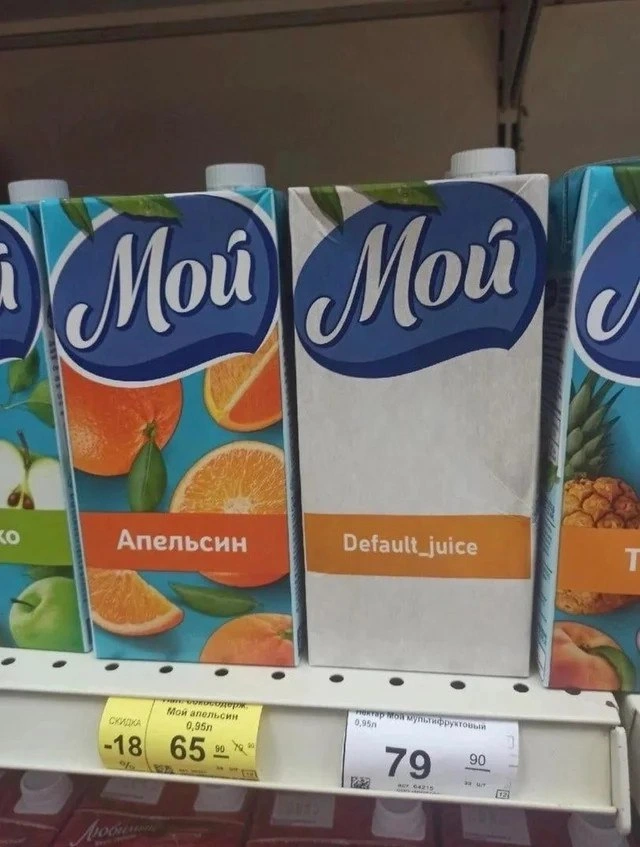
When the placeholder label ships as 'Default_juice' in production
Why is this Bugs meme funny?
Level 1: Oops, Forgot to Name the Juice
Imagine you’re drawing a label for a jar of juice and you write “Juice Flavor” as a temporary title, planning to fill in the real flavor later. But then you forget to change it before you start selling the juice. So people go to the store and see a juice carton that literally just says “Default_juice” instead of something like “Orange Juice.” It’s like giving someone a birthday card that starts with “Dear [Friend’s Name]” because you forgot to write their actual name in the blank. Pretty silly, right? The reason this is funny is because it’s a big, obvious mistake that somehow nobody caught. The carton looks empty and generic, as if it’s waiting for its real name. Everybody can immediately tell that “Default_juice” wasn’t meant to be the real name of the drink. It’s a simple goof-up: someone had one job — to put the correct label on — and it didn’t happen. So the end result is a bunch of juice boxes on the shelf with a label that basically says “(insert juice name here)” for everyone to see. It’s an “oops” moment that makes us laugh because we all know what it’s like to forget something important and then have it on display by accident.
Level 2: Placeholder Goes Public
This meme highlights a classic software oopsie: a placeholder text made it into the final product. In software and design, a placeholder is temporary text meant to be replaced by real content later. Think of default text like “Your Name Here” or sample data like “Lorem ipsum” that developers use during testing. They’re not supposed to be seen by real users or customers. In this case, the juice carton’s label Default_juice was a stand-in name—maybe for a flavor—and someone forgot to swap it out with the actual flavor name (like Апельсин which is Russian for “Orange”). The result? The middle juice carton on the shelf has a blank, white design and literally says Default_juice on the orange band, instead of a real flavor. Production is what we call the live, real-world environment (the app that users see, or here the actual product on store shelves). Normally, QA (Quality Assurance) testing or proofreading should catch these mistakes before anything goes public. QA’s job is to review and test to ensure no bugs or obvious errors remain. A packaging_bug like this means the safety net failed: either the process was rushed or someone assumed “default_juice” was actual intended text (perhaps a non-technical team member didn’t realize it was a filler). For a junior developer, imagine deploying your website and your main page still has a big title saying “Site_Name” because you forgot to set it to the real name – that’s how this feels. It’s both funny and mortifying. The humor comes from the fact that everyone can spot the error instantly, yet it still slipped through all the reviews into the final product. This image became popular in DeveloperHumor circles because it’s a perfect analogy: every programmer has had that fright of “did I leave some dummy text or default config in my code that users will see?”. Here it happened for real, on a juice carton. It’s a gentle reminder: whether it’s a software label or a fruit juice label, always replace your placeholders before release, or you’ll be literally selling “Default Juice” to the public. Oops!
Level 3: The Default_juice Debacle
In the grand saga of production mishaps, printing Default_juice on a real juice carton is a chef’s kiss of a bug. This image literally shows a product on a grocery shelf with a blank label proudly reading Default_juice – the kind of placeholder text a developer or designer was supposed to swap out for “Orange” or “Tropical Punch” or whatever the flavor was. It’s as if someone hard-coded a default value and nobody remembered to replace it before shipping. Quality Assurance (QA) apparently missed this (maybe they were thirsty and distracted?), and now the bug has escaped into the wild where customers can stare at it in all its glory. For seasoned devs, this is painfully relatable: it’s the physical-product equivalent of deploying code that still says TODO: fix this or leaving lorem ipsum dummy text on a live website. We’ve all seen placeholder_text_blunder moments in software (like a button labeled “Button1” or an error message “undefined variable name” popping up for users). But here the placeholder made it past digital form and got printed on packaging by the thousands – a production bug you can actually hold in your hand. The humor (and horror) comes from the sheer obviousness: unlike a subtle memory leak or a one-pixel UI misalignment, a carton screaming Default_juice at shoppers is a colossal facepalm. This suggests multiple layers of failure: perhaps a localization_placeholder wasn’t replaced because the translation file had a missing entry or the design template had a default label that nobody edited under deadline pressure. In true ProductionIssues fashion, maybe someone copy-pasted the previous flavor’s template, changed the fruit picture but forgot the text field, and then the print run went out unchecked. It’s a QA nightmare and a developer’s dark comedy: a reminder that even the simplest tasks (“change placeholder to real name”) can slip through the cracks when everyone assumes “surely someone else will catch it.” As a cynical veteran might quip, “At least it wasn’t a NullPointerException printed on the carton.” Here’s hoping the actual juice tastes better than the label’s naming effort.
Description
On a grocery-store shelf, three Russian juice cartons of the brand name “Мой” stand side by side. The left carton shows bright orange slices and a label bar reading “Апельсин”, while the right carton shows mixed fruit artwork. The middle carton, however, is completely blank white except for the blue “Мой” logo and an orange bar that mistakenly reads the literal placeholder text “Default_juice”. Price tags beneath read “-18 65 90”, “79 90”, and “0,95л”. The visual gag mirrors a classic software failure where default or test strings make it past QA, illustrating how un-replaced placeholders become real-world bugs once code (or packaging) hits production
Comments
6Comment deleted
Proof that if your config service 503s during deploy, the factory just prints the enum key and ships 100k cartons of “Default_juice” - see you at the post-mortem
When the product owner says "just ship it, we'll fix the labels in the next sprint" and three years later it's still in production because changing it would break seventeen microservices that hardcoded the flavor string
Ah yes, the classic 'Default_juice' flavor - tastes exactly like a missing translation key with a hint of forgotten string interpolation. Someone's i18n pipeline clearly needed more than just a code review; it needed a grocery store QA pass. This is what happens when your fallback value makes it past staging, through production, all the way to the beverage aisle. At least they didn't ship it as 'undefined' or 'null' - that would've been a different kind of refreshing
Default_juice: shipped to prod with FLAVOR env unset and the i18n key as the label - priced higher, because enterprise defaults are a premium feature
Physical proof that $FLAVOR was unset and the i18n fallback is show_key: true - CI went green; customers got Default_juice
Deployed without FLAVOR env var? Prod serves Default Juice - scalable, zero-config regret