That moment the dev team hears “we’re a family” in an all-hands
Why is this CorporateCulture meme funny?
Level 1: Pretend Family Trick
Imagine you’re at school and one of your classmates suddenly says, “Hey, you and I are like family!” That sounds kind of nice at first, right? But then suppose this classmate asks, “Since we’re family, will you do my homework for me tonight?” Now it feels different, doesn’t it? You’d probably give them the same look as the characters in the picture — a sort of “really?!” face, half bored and half annoyed.
In a real family, people help each other out and care about each other without keeping score. But if someone who isn’t actually your family starts using the word “family” just when they want a favor, it feels like a trick. It’s like they’re using pretend family vibes to make you do something you normally wouldn’t want to do.
That’s exactly what’s happening in this meme. The boss at work is telling everyone “we’re a family” during a big meeting. He probably wants the employees to feel happy, united, and willing to go above and beyond. But the employees (like the grumpy Squidward and Mr. Krabs in the picture) aren’t fooled. They’ve heard “we’re family” before and learned it often means the boss is about to ask them for extra work or to put up with something tough. Their blank, unamused faces are basically the same as if a friend tried the “but we’re family!” line to get you to do their chores. They’re skeptical and a little irritated.
The funny part is that just saying “we’re family” doesn’t make it true. The workers in the meme know that. Their expression says, “We don’t believe you.” It’s humor that anyone can understand: even as a kid, you know when someone is trying to butter you up with sweet words to get their way. This meme is showing that exact feeling in a workplace. The big boss uses the nice word “family,” and the employees all internally react with, “Yeah, sure we are,” just like you would with that classmate who only acts like a friend when they need a favor. That contrast between the warm words and the cold reactions is what makes people smirk when they see this meme.
Level 2: All Hands, No Hugs
Now let’s break down what’s going on for someone newer to the tech world. An all-hands meeting is a company-wide gathering (the term comes from “all hands on deck,” meaning everyone). It’s the kind of big meeting where the CEO or managers address the whole company. In the meme’s top text, the bosses say “more than a company, we’re a family” to the staff. This line is often used in workplace culture to suggest the team has tight bonds and cares about each other beyond just the job.
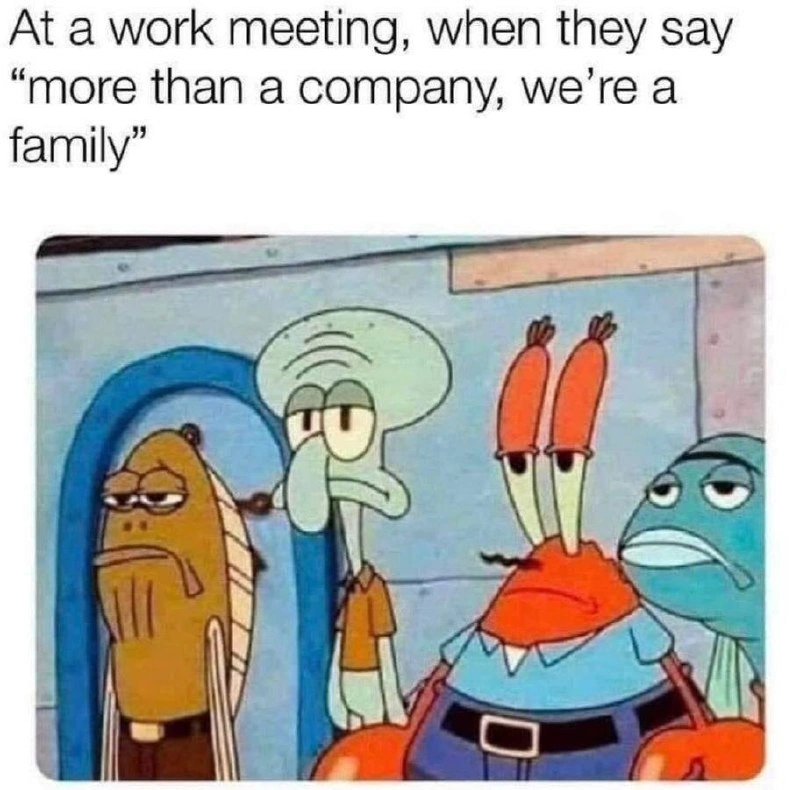
So why do the characters in the image look so unimpressed? The bottom picture is from the cartoon SpongeBob SquarePants, showing Squidward (the squid cashier), Mr. Krabs (the crab boss), and two other fish characters. They all have half-closed, tired eyes and blank, bored expressions. In internet terms, this image is being used as a reaction image – it visually represents how people feel in response to something that was said. Here, the dev team’s reaction is basically a collective “Yeah, right… sure we are.” They look skeptical because they’ve probably heard this kind of talk before. Squidward in the show is known for being cynical and unenthusiastic, which fits perfectly: the developers are channeling their inner Squidward, not convinced by the “family” claim at all.
Now, what does “we’re a family” imply at work? It sounds friendly – like everyone will support each other unconditionally. In a real family, people might forgive mistakes easily or help you out just because you’re related. But a company isn’t literally family. Your manager isn’t your parent, and your coworkers aren’t your siblings. Usually, when management uses the family line, they’re trying to encourage camaraderie and loyalty. It can create a nice feeling that “we’re all in this together.” However, employees sometimes feel it’s forced camaraderie – like they’re being pressured to feel close or to make personal sacrifices that normally wouldn’t be expected in a regular job.
For example, imagine the boss says “we’re family” and then follows up with a request: “Since we’re family, can everyone work late nights this week to help out?” At first, a junior developer might think, “Oh, they really care about us like family.” But when that statement is used right before asking you to do something extra (especially without extra pay or rest), it starts to feel a bit manipulative. Unpaid overtime – which means working extra hours without extra pay – is a common problem in tech jobs. If the workload is very high (say there’s a big project deadline soon), a company might hope employees will put in additional time out of dedication. The “family” line can make it seem like you should do it, as a favor or out of love for the team, the same way you might help your brother or sister with their chores. But if it happens too often, developers start to see that phrase as a red flag. It’s like, “Uh oh, last time they said we’re family, I ended up working over the weekend.”
There’s also the concept of process debt mentioned in the description. You might have heard of technical debt – that’s when a team takes shortcuts in code or architecture that later on create a lot more work (like writing quick messy code now that has to be fixed properly later). Process debt is similar, but it’s about how the company operates. If the organization has sloppy or inefficient processes (maybe they always change requirements last minute, or they don’t have enough people to handle the workload, or they never document anything), over time those bad habits pile up. Eventually, things get chaotic: projects run late, people have to scramble to meet deadlines, and teams get burned out. Instead of addressing these process problems (like improving planning or hiring more staff), sometimes management might just try to rally the troops with cheerful messaging. Saying “we’re a family, we’ll get through it together!” is a way to boost morale momentarily, without actually fixing the root cause of the stress. Developers who have been through this will recognize that pattern, which is why their faces in the meme are like, “Here we go again.”
This all leads to employee disillusionment – that’s when workers stop believing the upbeat messages from leadership because those words don’t match what they’re experiencing. It’s a kind of let-down feeling. In this meme, there’s a communication breakdown between the bosses and the team. The bosses think they’re giving a heartwarming speech that will motivate everyone. But the team of developers hears “we’re a family” and remembers the last time that line meant extra work with no reward. It’s a mismatch of understanding (what we could call misaligned expectations). The leadership expects gratitude or enthusiasm, but the team is feeling tired and maybe a bit cynical.
So, in simpler terms: the meme is showing a typical workplace scenario where the company tries to promote a family-like culture, and the employees are quietly rolling their eyes. Every element of the meme drives that point home. The text at the top is the sweet-but-suspicious slogan (“we’re a family”), and the image at the bottom – with those cartoon characters looking so done with everything – is how the team really feels about that kind of talk. A junior dev who sees this might not have experienced it yet, but it’s letting them in on an inside joke of tech workplaces: management humor where what’s said (“you’re family”) isn’t convincing to the people who have been around long enough to see what actually happens.
Level 3: The Family Façade
In tech industry corporate culture, hearing “we’re more than a company, we’re a family” is a well-worn cliché that often sets off alarm bells for experienced developers. Picture an all-hands meeting (a company-wide gathering) where a high-level manager or CEO drops that line. Cue the collective internal eye-roll from the engineering team. This meme nails that exact moment. The top caption presents the rosy slogan, and the bottom image – a scene from SpongeBob SquarePants – shows the dev team’s deadpan reaction.
Why is this funny? Because it’s too real. The SpongeBob characters (Squidward, Mr. Krabs, and a couple of fish in the Krusty Krab) are standing shoulder-to-shoulder with blank, half-asleep stares. Those droopy eyes-half-lidded expressions are the universal developer look of skepticism. It’s basically saying, “We’ve heard this before, and we’re not buying it.” The humor comes from that contrast: enthusiastic management speak versus utterly unimpressed employees. It’s a perfect visual for meeting fatigue – the kind of exhaustion you feel after hearing yet another grand speech that doesn’t match reality.
Under the hood, this meme is commenting on a common communication gap in many companies. Leadership might honestly believe that calling the team a “family” will boost morale and encourage bonding. But to the team, especially senior engineers with battle scars, it comes across as a hollow corporate slogan. They’ve seen this movie before: often the “we’re family” talk comes right before a big request or bad news. It’s like a preemptive sugar-coating. “We’re family, so you’ll all pull together through this weekend’s crunch, right?” In other words, it can be a signal that unpaid extra work or tough times are being glossed over with warm-and-fuzzy language.
This is where the cynicism kicks in. The boss might expect applause for the heartfelt sentiment, but the devs are thinking, “If we’re family, then why do I feel so burned out?” The mention of process debt in the description is key: perhaps the company has accumulated a lot of inefficient practices and overtime (kind of like technical debt, but in workflows). Instead of fixing those underlying issues, management might be resorting to pep talks. The devs’ faces in the meme say it all: they’d prefer concrete improvements over platitudes. It’s a classic case of misaligned expectations — a communication breakdown between what leadership is selling and what the team is experiencing day-to-day.
There’s a darkly comic truth here about modern WorkplaceCulture. Companies love to talk about being a “family” when they want strong loyalty, but as many jaded programmers know, real families don’t usually fire their members due to budget cuts or burnout. 😅 The meme gets a chuckle (or a pained groan) because it pokes fun at that reality. We laugh, but it’s the “I’ve been there” kind of laugh. It resonates with anyone who’s sat through a cheerful all-hands meeting while quietly thinking about the pile of Jira tickets waiting back at their desk.
In the end, the meme uses a popular cartoon and a bit of WorkplaceHumor to highlight the disconnect between management’s rosy messaging and developers’ lived reality. It’s pointing out the irony that saying “we’re a family” doesn’t automatically make a stressful job feel like one. And judging by Squidward and Mr. Krabs’ unamused faces, the dev team is clearly calling the bluff.
Description
The meme shows a two-part layout. Top text reads: "At a work meeting, when they say 'more than a company, we’re a family'" in black sans-serif on a white background. Below, a reaction image from the SpongeBob SquarePants cartoon depicts four characters - Squidward, Mr. Krabs, and two background fish - standing shoulder-to-shoulder inside the Krusty Krab, all wearing dead-eyed, unimpressed expressions. Muted aquatic blues and greys dominate the scene, emphasizing their boredom and skepticism. Technically, the meme satirizes common corporate culture rhetoric that attempts to paper over workload, process debt, or unpaid overtime with forced “family” language. Senior engineers will relate this to meeting fatigue, management slogans used in sprint kickoffs, and the communication gap between leadership messaging and day-to-day developer reality
Comments
6Comment deleted
“‘We’re a family’ - great, so Legacy Monolith is the uncle who never moves out, Microservice Cousin keeps breaking every contract, and I’m the parent getting paged at 3 AM to clean it all up.”
"We're a family" - the same family that treats inheritance like a zero-downtime deployment: you get nothing until the parent process terminates unexpectedly
When management says 'we're a family,' seasoned engineers know it's the corporate equivalent of technical debt - a promise that sounds good upfront but means you'll be paying for it with your evenings, weekends, and the mythical 'work-life balance' they mentioned during your interview. Real families don't require you to be on-call 24/7 or justify your PTO requests through three layers of approval
When leadership says “we’re a family,” seniors hear: monolith with tight coupling, undefined SLAs, and guilt‑based retries
When leadership says “we’re a family,” I translate it to: you’ll inherit the 2008 monolith, adopt the pager, and spend the holidays doing “quality time” with prod
Tech 'family' means inheriting endless tech debt from dad (the legacy monolith) while mom (management) guilts you into unpaid overtime fixes