How to write Python, according to a Java dev
Why is this Languages meme funny?
Level 1: Less is More
Imagine you want to send a greeting to a friend. One way is to write a full formal letter: you start with “Dear Friend,” add a long introduction, several paragraphs of nice words, and finish with “Sincerely, [Your Name].” That’s a bit like the Java way – very thorough and formatted, even if all you wanted to say was hello. Now, another way is just to walk up to your friend and say, “Hello!” with a smile – that’s the Python way, short and simple.
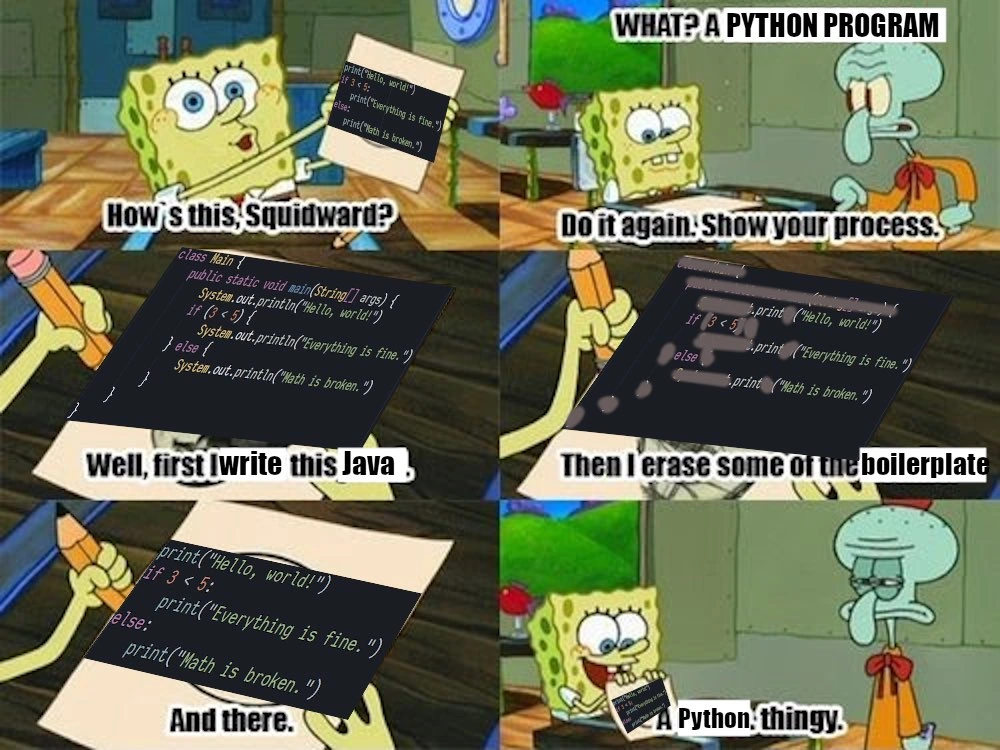
In this meme, SpongeBob first wrote a whole “letter” of code (the Java version) with all the formality and extra words. Then he literally erased all the formal parts, leaving just the small friendly message “Hello, world!” and a simple check if 3 is less than 5. In the end, what Squidward sees is basically the quick hello – the short version in Python. It’s funny because SpongeBob did a bunch of extra work only to undo it and end up with the same result that he could have written from the start. It’s like baking a huge cake and then cutting away everything except one slice, instead of just baking a small slice to begin with. The joke shows that sometimes in programming, using fewer words (or lines of code) can accomplish the exact same thing. Less fuss, same hello – and that surprise makes us laugh!
Level 2: Hello World Showdown
Let’s break down what’s actually happening with the code. SpongeBob essentially wrote a typical Java program and then transformed it into Python by removing the extra wrapping. Here’s the same logic in both languages:
// Java version of the logic
class Main {
public static void main(String[] args) {
System.out.println("Hello, world!");
if (3 < 5) {
System.out.println("Everything is fine.");
} else {
System.out.println("Math is broken.");
}
}
}
# Python version of the same logic
print("Hello, world!")
if 3 < 5:
print("Everything is fine.")
else:
print("Math is broken.")
In both cases, the program prints “Hello, world!” and then checks a simple condition 3 < 5. If the condition is true, it prints “Everything is fine.”; otherwise it prints “Math is broken.” The outcome is identical, but notice how much fatter the Java code is around the actual logic. Why all those extra lines? Let’s explain:
Class Definition and
mainMethod: In Java, every stand-alone program needs a class (in this caseclass Main) and apublic static void main(String[] args)method. This is boilerplate that tells the Java runtime this is where the program begins. It’s like a formal entry point. Python doesn’t require any of that ceremony. You can just start writing your instructions at the top level of the file, and Python will execute them in order. No class wrapper, no obligatorymainfunction signature.System.out.printlnvsprint: To print text in Java, you must call theSystem.out.println()method, which is a bit verbose.System.outis an object representing the standard output stream, andprintlnis a method to print a line of text to it. In Python, printing is dead simple: just use the built-inprint()function with the message. There’s no need to reference a separate system object or end the line with a semicolon. It’s one of the reasons Python is praised for its DeveloperExperience – you type less to do the same job.Braces
{ }and Semicolons;vs Indentation: Java uses curly braces to mark the beginning and end of code blocks (like the body of the class and theif/elseblocks). It also uses semicolons to end each statement. These are syntax requirements in Java’s grammar. In the Java code above, we see braces around themainmethod and around theif/elseblocks, plus a semicolon after eachSystem.out.println(...)call. Python, on the other hand, relies on indentation (leading spaces) to structure code blocks. In the Python version, the lines underif 3 < 5:are indented, which tells Python those lines belong to the if-block. No braces needed! And each statement is on its own line, so no semicolon is required to tell Python it’s the end of the statement. The result is fewer symbols and often improved CodeReadability because the visual structure (indentation) directly shows the logical structure.Boilerplate Code: All the stuff we just mentioned – the class definition, the
mainmethod declaration, the braces, even theSystem.outprefix – is commonly called boilerplate code. It’s code that you write every time in Java regardless of what the program actually does. It doesn’t solve your specific problem (printing a message or checking math); it’s just there to satisfy the language’s framework. Python was designed to minimize boilerplate. In our example, once we drop the boilerplate, we’re basically left with the core logic: aprint()and anif/elsecheck. SpongeBob’s joke of erasing parts of the Java code is literally removing the boilerplate to reveal the Python “solution” underneath. This is why Squidward calls it “a Python thingy” – all he sees in the end is a tiny Python program that does the job.
To a newer developer or someone early in their career, this meme is highlighting a key difference in language design. Java is a statically-typed, compiled language that prioritizes structure and explicit definitions. That’s why it feels a bit like writing a formal essay – you have to include a lot of structure (like headers and footers in an essay) before you even say Hello. Python is a dynamically-typed, interpreted language that prioritizes quick development and readability, so it feels more like jotting down a note – you get straight to the point. Neither approach is “wrong” – they’re just different philosophies. Java’s verbosity can make large-scale applications more maintainable (because everything is explicitly declared), and Python’s succinctness makes writing and reading small programs very convenient.
In practice, a developer wouldn’t actually write a full Java program and then manually delete parts to get Python code – each language has its own ecosystem and syntax. The joke exaggerates to teach: it’s showing how much of the Java code was framework versus how much was actual logic. When SpongeBob deletes the boilerplate, he’s left with only the meaningful lines, which look just like a Python script. It’s a fun way to visualize the concept that, often, “less code, same result” can be achieved in a high-level language. For a junior developer, this drives home why Python is often praised for having a gentle learning curve: you can do cool things (like print messages, make decisions with if statements) without writing a lot of extra stuff around it. Meanwhile, it also hints at why reading Java might feel daunting at first – you have to wade through some required text before finding the real action.
This SpongeBob meme format is popular in developer humor because it uses a familiar cartoon scenario to talk about tech. Squidward asking to “show your process” is like a code reviewer or a curious colleague saying, “How on earth did you get from point A to such a simple point B?” And SpongeBob’s method is silly on the surface, but it teaches a real insight about LanguageComparison: some languages just have more fluff around the substance. By the end of Level 2, you should see clearly what was fluff in Java and how Python manages to be fluff-free for the same task.
Level 3: Ceremony to Simplicity
This meme nails a classic Java vs Python gag by contrasting Java’s heavy ceremony with Python’s breezy simplicity. In the six-panel SpongeBob code review, our absorbent friend shows Squidward a program, and Squidward balks: “WHAT? A PYTHON PROGRAM?” He makes SpongeBob retrace his steps, so SpongeBob obliges: “Well, first I write this Java…” and then “I erase some of the boilerplate” until “And there.” The punchline lands when Squidward dryly mutters, “…A Python, thingy.”
For seasoned devs, the humor is immediate: Java is notorious for boilerplate code – all those extra lines (class Main { public static void main(String[] args) { … }) that do nothing for the actual logic but are required to satisfy the language’s structure. Python, in contrast, lets you express the business logic with minimal fuss. SpongeBob’s absurd “conversion process” is basically a senior engineer’s mental trick: take a verbose Java snippet and strip away every unnecessary keyword, brace, and semicolon. What remains? The pure logic in Pythonic form! It’s like SpongeBob became the Michelangelo of coding, chipping away everything that isn’t the program. 🗿✨
Why is this so relatable in a code review? Because experienced developers often mentally do exactly what SpongeBob does literally. During code review, a senior engineer reading a Java snippet might skip past the standard public static void main(String[] args) declaration and class boilerplate to find the real meat of the code. Here, the meme exaggerates that skill: SpongeBob writes all the formal Java structure, then physically erases it to reveal the concise solution underneath – a perfect visual metaphor for focusing on essential logic over accidental complexity.
This comedic take also pokes at long-standing language wars and design philosophy differences. Java, born in the enterprise world, emphasizes explicit structure and verbosity which can bolster clarity in huge projects but often feels like overkill for simple tasks. Python, influenced by the scripting and academic community, embraces minimalism – no explicit entry point needed for a simple script, no type declarations for basic operations, just the logic. The meme’s exaggerated code review scenario highlights the trade-off senior devs know well: verbosity vs. conciseness. Java’s verbosity can frustrate developers when writing trivial programs (why do we need a whole class to say “Hello, world!”?), while Python’s sparseness can be a breath of fresh air (“That’s it? It just prints without any ceremony?!”).
Underneath the humor is a nod to Developer Experience (DX): less boilerplate means faster reading and writing, which many devs equate with better productivity and CodeQuality for certain tasks. The meme format – using beloved SpongeBob SquarePants characters – adds an extra layer of fun. Squidward’s demand “Do it again. Show your process.” sounds just like a skeptical senior engineer who cannot believe that a few lines of Python cover the same functionality as a whole Java file. And SpongeBob’s innocent method of erasing Java into Python playfully implies what experienced polyglot programmers often joke about: “If Java’s too verbose, just remove everything that’s not the logic and presto, you get Python!” Of course, in real life you’d write Python code directly – but the hyperbole drives home how minimal Python feels next to Java. The final panel’s “…a Python thingy” is Squidward’s grumpy way of conceding that yes, all that remains is a neat little Python script. It’s a perfect encapsulation of the senior dev language tradeoffs: both programs do the same thing, but one surrounds its simple core with layers of formality, while the other lets the simplicity shine. The result is a hilarious yet educational riff on code verbosity that has every multi-language developer nodding and laughing.
Description
A six-panel meme using the 'SpongeBob writing an essay' format to compare Java and Python. In the first panel, SpongeBob proudly shows a paper with a simple Python script to an unimpressed Squidward. The code reads: print('Hello, world!'), if 3 < 5: print('Everything is fine.'), else: print('Math is broken.'). Squidward replies, 'WHAT? A PYTHON PROGRAM. Do it again. Show your process.' The next panels depict SpongeBob's method. First, he writes a full Java program with the same logic, complete with 'class Main', 'public static void main(String[] args)', System.out.println, curly braces, and semicolons, with the caption 'Well, first I write this Java'. Then, he is shown erasing parts of it, with the caption 'Then I erase some of the boilerplate'. Finally, he presents the concise Python code again, stating, 'And there... A Python, thingy.' The meme humorously satirizes the verbosity and boilerplate code characteristic of Java when compared to the syntactic simplicity and conciseness of Python, suggesting a Java developer's thought process involves mentally stripping down ceremonial code to get to the core logic
Comments
7Comment deleted
A Java developer learning Python is like a knight taking off 50 pounds of armor to go for a jog. The freedom is liberating, but for the first few miles, they still run like they're expecting a dragon to show up
Architectural summary: convert Java to Python by running the proprietary ‘backspace-driven refactor’ - IDE integration optional
Twenty years later, you're still maintaining that Java codebase because the Python rewrite got cancelled after someone discovered the original had undocumented business logic hidden in the getters
This perfectly captures the existential journey every Java developer experiences when they first encounter Python: 'Wait, you're telling me I can just... write the logic? Without sacrificing three lines to the ceremony gods first?' It's the programming equivalent of realizing you've been taking the stairs when there's been an elevator the whole time - except your architect insisted the stairs built character and taught you about 'proper structure.' Meanwhile, Python developers are already on the roof having a coffee, wondering what took you so long
Our Java-to-Python migration plan was three steps: delete public static void main, delete types, then write 4,000 tests to buy back the guarantees we just deleted
Our Java to Python migration plan is simple: delete braces and semicolons until it runs - then remember the test suite is now the type checker and observability is the compiler
Senior dev wisdom: Python is Java after the 'enterprise-ready' boilerplate meets a No. 2 pencil