Skip to content
DevMeme
560 of 7435
A developer's defiant response to IDE warnings
IDEs Editors Post #642, on Sep 4, 2019 in TG

A developer's defiant response to IDE warnings

Why is this IDEs Editors meme funny?

Level 1: Oops, Did It Again

Imagine a kid in school who keeps doing something a little naughty even after the teacher says "Don't do that." For example, maybe a student keeps folding paper airplanes and tossing them in class. The teacher notices and says, "Please stop throwing paper airplanes in here." The kid nods, but the very next day, he grins and launches another paper airplane when the teacher isn't looking. He knows it's against the rules, but he just can't help himself and finds it a bit funny.

This meme is like that, but with a programmer. The computer program he’s using (kind of like a teacher for code) says, "Hey, you left something in your code that you didn't end up using!" (That's the IDE warning about the unused variable.) The programmer sees the message, shrugs with a goofy smile, and essentially says, "Haha, okay... I did it again, and I'll probably do it again next time." It's funny because the developer is acting like that mischievous student – knowingly breaking a small rule and kinda laughing it off. We laugh because we recognize that cheeky attitude: being told something is wrong, saying "oops," and then doing the same thing again anyway.

Level 2: Unused Variable Warnings

Let's break down what's happening. The meme highlights a common IDE warning that says, "local variable is assigned but never used." An IDE (Integrated Development Environment) like Visual Studio, IntelliJ, or VS Code is a programmer's workshop — it’s the application where developers write and test their code. Modern IDEs have built-in code checkers (or connect to compilers and linters) that scan your code for mistakes or bad practices. One such flagged issue is an unused variable.

  • Variable: In programming, a variable is like a labeled box that holds a value (a number, some text, etc.) for use later. For example, you might write int count = 5; in C++ or count = 5 in Python to store the number 5 in a variable named count.
  • Local variable: This means the variable is defined inside a function or a specific section of code (rather than globally). It only exists and has a value within that limited area of the program.
  • Assigned but never used: The IDE is basically telling you, "Hey, you created this variable and gave it a value, but then you never actually use it for anything." Imagine writing down a phone number on a piece of paper (assigning a value to a variable), but never dialing it or texting it (never using it). In code, it looks like this:
int count = 42;
printf("Hello!\n");
// 'count' is assigned a value but never used later.
// The compiler/IDE would warn: variable 'count' set but not used.

Why do IDEs and compilers care about this? Because an unused variable often signals a small mistake or leftover code. Maybe you planned to use count but your plan changed, or you copied some code and didn't end up needing that variable. It's considered a minor code quality issue (often called a code smell) to leave such things in. It can confuse someone reading the code ("Why is this here if it does nothing?") and very slightly wastes memory or processor time (though usually the impact is negligible). Think of it like clutter on your desk — one extra pencil lying around isn't hurting, but it might make you pause and wonder why it's there.

Now, what’s a feature flag? A feature flag (or feature toggle) is a deliberate programming tool used to turn certain functionality on or off, usually to test features or roll them out gradually. For instance, you might have a variable newFeatureEnabled = false; and write:

if newFeatureEnabled:
    showNewHomepage()
else:
    showOldHomepage()

Here newFeatureEnabled is a feature flag. Set it to true, and the new homepage code runs; set it to false, and it doesn’t. The key is that the variable controls whether some code is used or not on purpose.

So when the meme says "looping through IDE warnings like unused variables are a feature flag," it's joking that the programmer is treating these unused variables as if they were intentional placeholders for some feature. In other words, it's as if the developer is saying: "I meant to leave that variable unused, it's going to toggle something later!" Of course, that's usually not true — it's just a silly excuse. The variable isn't actually controlling any feature; it's simply not needed, and the developer ignored the warning about it. This joke plays on the classic programmer defense "It's not a bug, it's a feature!" — rebranding a mistake as an intentional design.

If you're new to coding, you might wonder why a developer wouldn't just fix the warning. Good practice is indeed to clean up such things. But in real life, programmers sometimes get lazy or busy and ignore non-critical warnings. If the code works (the program still runs correctly) and the warning isn't breaking anything, it might be left in "just for now." Over time "just for now" can turn into "forever," especially if there’s no strict rule about keeping the code 100% clean. Many of us have had that moment where we see a warning and think, "I'll deal with it later," but later never comes.

There’s also a learning curve: a junior dev might initially treat every warning as an error to fix immediately (which is a good instinct!), whereas an older dev might know that some warnings are harmless in context and can be postponed. For example, a seasoned coder might think, "Yeah, the compiler warns that result isn't used — I left that in while debugging. I'll remove it when I clean up." The funny (and slightly bad) habit is that they might forget to clean up, or even reintroduce a similar unused variable down the line. The meme captures that habit with Goofy's exaggerated "I’ll do it again!" stance.

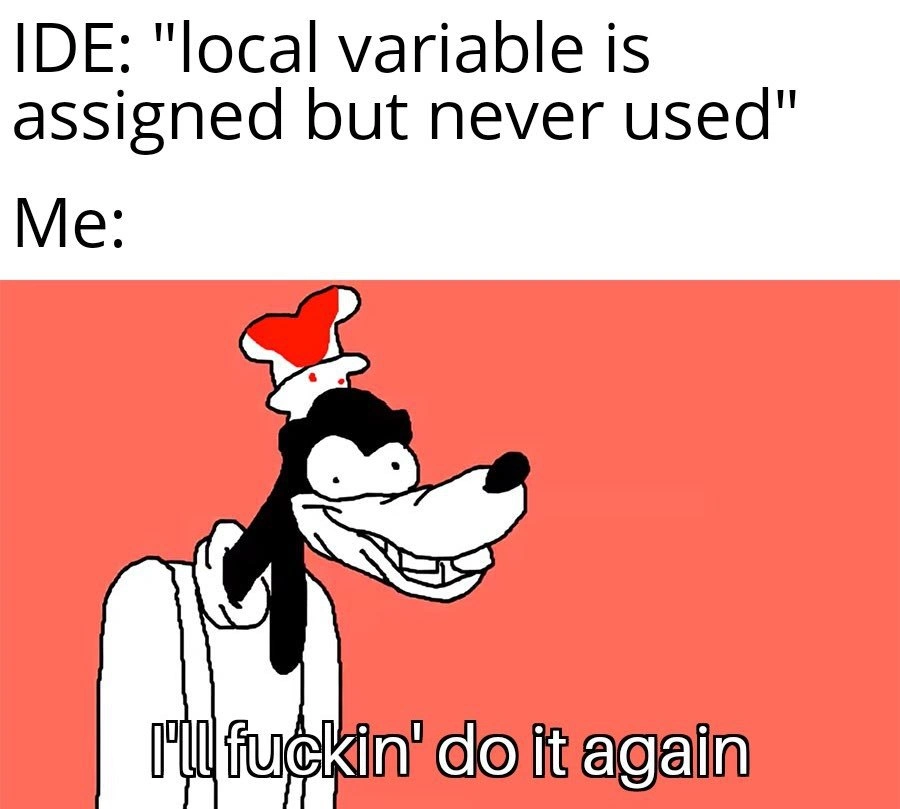
Speaking of Goofy – the bottom image is a crudely drawn version of Disney's Goofy with a mischievous look, saying a famous line "I'll fin' do it again." This image is a popular meme format used to joke about knowingly repeating a mistake or naughty action. Here, it represents the developer knowingly repeating the act of ignoring the IDE’s warning. The top panel sets up the scenario (IDE says there's an unused variable), and the bottom panel delivers the punchline (the developer’s humorous response). It’s basically the programmer laughing and saying, "Haha, I see that warning ... and I bet I'll ignore that kind of warning next time too."

For a junior developer, the takeaway is: this is a lighthearted example of what not to do. It's funny because it's true — many developers have done this — but it's also a gentle reminder that cleaning up your code is important. The meme uses exaggeration and humor to make the lesson memorable. Now you'll definitely remember to either use that variable or remove it, right? Or... you might giggle and think of Goofy and accidentally do it again. 😅

Level 3: Not a Bug, a Feature

In this meme, we see an IDE complaining, "local variable is assigned but never used," and the developer responds with defiant glee. The bottom image is Goofy, a Disney character, grinning maniacally with the caption "I'll fuckin' do it again." This pairing pokes fun at a common code smell: declaring a variable, assigning it a value, and then never actually using it. We all know that feeling. The linter or compiler gives a gentle nudge that something in our code is redundant, but after a long night of debugging, our inner voice (with Goofy's chaotic energy) just laughs, "Heh, I've done it before and I'll do it again."

From a senior engineer's perspective, the humor arises because this scenario is painfully familiar. It's a mini anti-pattern many of us recognize. A typical sequence: you write some code (maybe for debugging or a planned feature) and introduce a throwaway variable like tempResult or flag. Later, you refactor or remove the code that used that variable but forget to delete the variable itself. Now the IDE/editor underlines it in yellow or throws a warning: "Variable is assigned but never used." Instead of immediately cleaning it up, you might ignore it ("eh, it's harmless"), or even cheekily use the variable in some trivial way (like referencing it just to placate the warning) and promise yourself you'll tidy up later. Spoiler: you might not.

The meme's top text is exactly such a warning message from an IDE. The bottom panel's **Goofy "I'll do it again" meme is an internet-famous template symbolizing someone knowingly repeating a misdeed. By using Goofy's wild-eyed grin and that caption, the meme exaggerates the developer's attitude: "Unused variable? Psh, I'll put another one in my next commit too, just watch me." It's an absurd overreaction to a minor issue, which is why it's funny. Developers usually strive to write clean code, yet here we are joking about treating an IDE warning like a dare.

This humor also reflects an open secret in many codebases: IDE warnings often get ignored. Maybe the team has bigger fires to fight (failing tests, looming deadlines, production bugs), so a little unused variable is low priority. Over time, ignoring small warnings can become a habit. The meme phrase "like unused variables are a feature flag" nails this irony. It's as if the programmer consciously treats these leftover variables as intentional toggles for future features. In reality, they're just forgotten leftovers. But calling them a "feature flag" is a tongue-in-cheek way to justify the mess: "Oh, that variable? I meant to do that. It's for some future feature that’s currently turned off." Sure it is.

For seasoned developers, there's a bit of dark humor here. We've seen projects where compiler warnings scroll by the dozens. The first few times you see "assigned but never used" you diligently fix it. The 500th time, you just roll your eyes. Some veterans joke that an empty catch block, a // TODO comment, and a few unused variables are the hallmarks of a "mature" codebase — the war scars of many quick-and-dirty fixes. Code reviews often focus on logic and bugs; a lone unused variable might slip through if it's not hurting anything. An author might even reintroduce the same pattern later out of sheer muscle memory (writing int i = 0; at the top of every loop out of habit, even if i ends up unused).

On a deeper level, the meme highlights how automation meets human nature. The IDE (automation) is relentlessly pointing out an inefficiency, and the human (the developer) is stubbornly saying, "I hear you, but I'm going to pretend this is fine." It's a cheeky nod to how people can rationalize small flaws. This isn't a catastrophic error — it’s not going to bring the system down — so it's treated almost like a running joke. The Goofy image dials that up to 11 by giving the developer a kind of cartoon villain moment of proudly repeating the trivial offense.

In summary, at the senior level this meme gets a knowing laugh because it turns a mundane coder quirk into a dramatic gag. It's relatable: even experienced devs ignore best practices sometimes, especially when exhausted or under pressure. The next time our IDE nags about an unused variable, we might just hear Goofy's voice in our heads cackling, "I'll do it again!" and smile as we (hopefully) press delete.

Description

The meme humorously depicts a common interaction between a developer and their Integrated Development Environment (IDE). The top section displays text: 'IDE: "local variable is assigned but never used"' followed by 'Me:'. Below this, against a solid red background, is a crudely drawn, manic-looking version of the Disney character Goofy. Subtitled at the bottom of the image is the defiant phrase, 'I'll fuckin' do it again'. This meme format is known as 'I'll F***in' Do It Again'. The joke lies in the developer's rebellious and chaotic reaction to a standard code quality warning from the IDE. While the warning often points to dead or unnecessary code, developers sometimes ignore it during prototyping, debugging, or simply out of stubbornness, making this a highly relatable scenario for experienced programmers who have a complex relationship with their automated code quality tools

Comments

7
Anonymous ★ Top Pick That unused variable isn't dead code, it's a strategic placeholder. My IDE calls it a 'warning,' I call it 'optimistic refactoring.'
  1. Anonymous ★ Top Pick

    That unused variable isn't dead code, it's a strategic placeholder. My IDE calls it a 'warning,' I call it 'optimistic refactoring.'

  2. Anonymous

    Dead stores aren’t a bug - they’re just my personal in-memory feature toggles

  3. Anonymous

    Twenty years in, and I still declare variables like I'm prepping for a feature that Product will definitely pivot on tomorrow - but at least now I call it 'defensive programming' in code reviews

  4. Anonymous

    Every senior engineer knows that 'assigned but never used' warning is just the IDE's way of saying 'I see you're debugging by printf again.' Sure, you could remove that variable now, but in 3 hours when the bug resurfaces at 2 AM, you'll be grateful past-you left that breadcrumb in place. It's not technical debt - it's defensive programming with extra steps

  5. Anonymous

    Unused local? That’s my breakpoint anchor - compilers hate it, debuggers love it, and // NOLINT keeps the truce until prod needs receipts

  6. Anonymous

    Unused locals are my forward‑compatible logging hooks - Release DSE deletes them, and when CI flips TreatWarningsAsErrors I slap on // NOLINT and do it again

  7. Anonymous

    Unused vars: because refactoring them out now means rewriting from scratch when requirements pivot tomorrow

Use J and K for navigation