Skip to content
DevMeme
558 of 7435
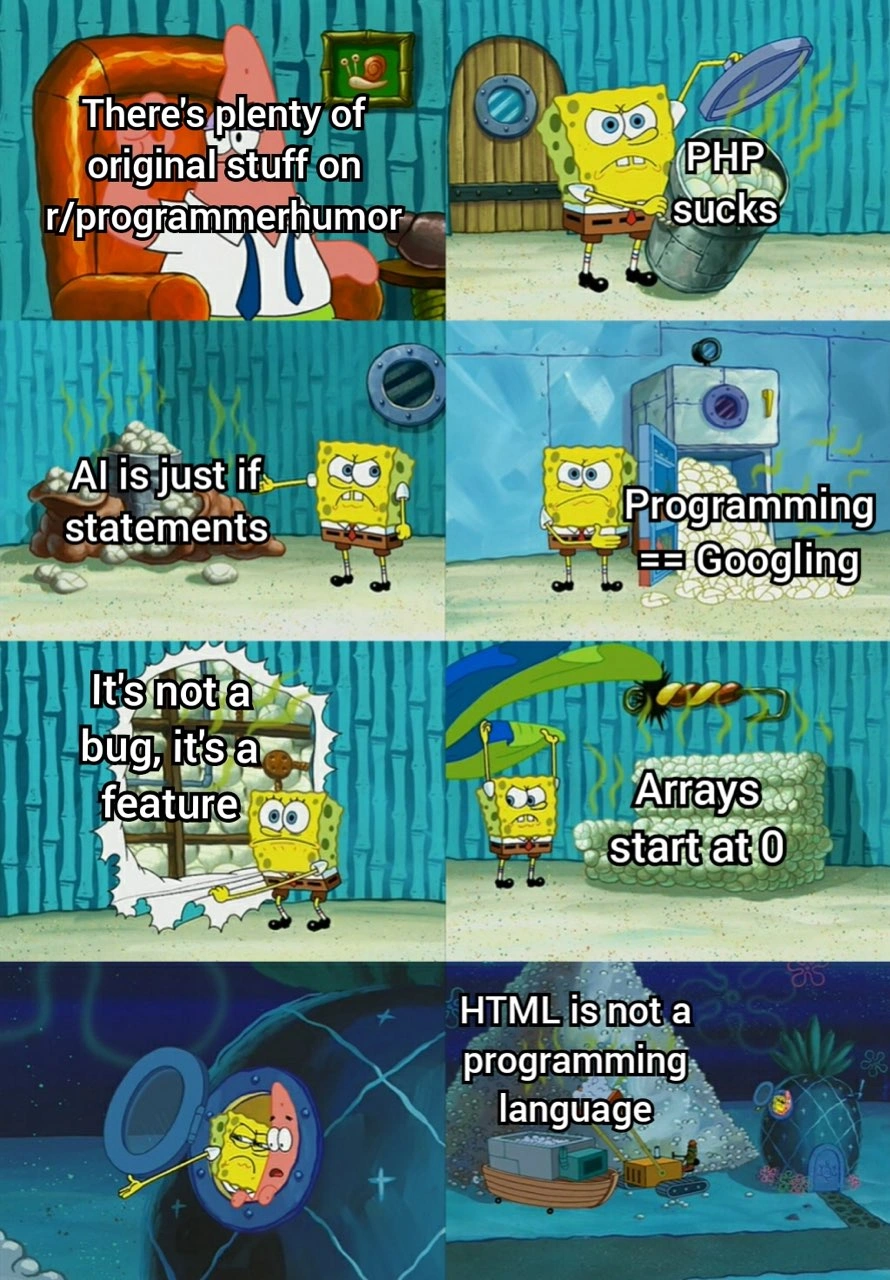
The Seven Deadly Sins of r/programmerhumor
DevCommunities Post #640, on Sep 4, 2019 in TG

The Seven Deadly Sins of r/programmerhumor

Why is this DevCommunities meme funny?

Level 1: Dad Jokes of Coding

Imagine hanging out with a bunch of friends who always tell the same jokes over and over. The first time you hear the joke, it’s super funny and you laugh. The second time, it’s still kind of amusing. By the tenth time, you’re just rolling your eyes and smiling because you’ve heard it so many times. That’s exactly what’s happening here, but with programmer jokes. These one-liners are basically the “dad jokes” of the coding world – corny, overused, yet somehow still endearing.

It’s like when a dad always uses the same old pun every time a certain situation comes up. The kids might groan, “Oh no, not that joke again,” but deep down everyone finds a bit of comfort in it because it’s familiar. In the programming community, phrases like “It’s not a bug, it’s a feature” or “HTML is not a programming language” are just like those dad jokes. New programmers hear them and laugh genuinely, thinking they’re clever quips. Older, experienced programmers have heard them a million times, so they chuckle and shake their heads knowingly. The SpongeBob comic is showing a bunch of these classic jokes one after another, kind of the way a TV clip show revisits old gags. The humor comes from recognizing each joke and the feeling of “here we go again!”

So even if you don’t get the technical details, you can understand the scene: it’s someone rattling off all the well-worn funny lines that always get told in a group. The reason it’s funny is the same reason a familiar knock-knock joke can be funny – not because it’s surprising, but because you’re in on the tradition. The meme is basically saying, “Programmers always make these same jokes, and we all know it.” It’s a playful poke at the coding community itself for being a bit of a broken record. Just like a family might fondly tease Dad for his repeat jokes, developers are fondly teasing themselves here. Even if the jokes are old, sharing them brings everyone together with a grin of recognition.

Level 2: Cliché Crash Course

For those newer to coding, let’s break down what each of these statements means and why they’re so common in programmer talk:

  • r/programmerhumor – This is a community on Reddit (an online forum platform) where programmers share jokes and memes about coding. When Patrick says, “There’s plenty of original stuff on r/programmerhumor,” it’s meant ironically. In reality, that forum is known for repeating the same jokes a lot. So he’s joking that the content is “so original,” while showing examples of very unoriginal (recycled) jokes. It’s like a friendly tease about that community’s habits.

  • “PHP sucks”PHP is a programming language primarily used for making websites (it’s what runs many popular sites and content management systems). Some developers have a love-hate relationship with PHP. It’s considered easy to get started with, but it has a history of design choices that can lead to messy code if you’re not careful. Over the years, many programmers have complained about PHP’s quirks (example: inconsistent function names, or how older versions managed types and security). Saying “PHP sucks” became a running joke – a quick way to vent frustration at the language’s flaws. It doesn’t mean PHP can’t be used to build good software (it powers huge parts of the web!), but in programmer culture, mocking PHP’s rough edges is an inside joke. Think of it as a long-standing language rivalry or “language war” meme: people pick on PHP (sometimes unfairly) just because it’s a well-known target that plenty of us have struggled with.

  • “AI is just if statements”AI stands for Artificial Intelligence, which means making computers perform tasks that normally require human intelligence (like understanding speech or recognizing images). An if statement is a basic programming construct that runs certain code only if a condition is true. For example: if (temperature > 75) { turnOnAirConditioner(); } – this is a simple decision logic in code. The joke here is claiming that AI – which sounds super advanced – is really nothing more than a bunch of simple if-then conditions. This is a tongue-in-cheek oversimplification. Why do people say it? Partly to poke fun at the hype around AI. Early AI programs (and some simple ones even today) were indeed written as many rule-based if/else checks. But modern AI, especially machine learning, works differently (it learns patterns from data rather than following only hardcoded rules). So, saying “AI is just if statements” is like a sarcastic “don’t be too impressed, it’s all just code” comment. It’s a common joke for cutting AI down to size, even though it’s not literally true for how all AI works now.

  • “Programming == Googling” – This joke equates programming with Googling using ==, which in many languages means “is equal to.” Googling means searching something on Google, the popular search engine. The phrase suggests that a big part of being a programmer is simply searching the internet for answers or code snippets. And for real – this is very relatable! Especially when you’re new, you might imagine programmers just know everything by memory. But in practice, even experienced developers constantly search for documentation, error messages, or examples on sites like Stack Overflow (a Q&A site for programming problems). “Programming == Googling” is a humorous way to say “writing code is 50% actually typing and 50% looking up how to do the thing you forgot or never learned.” New developers often feel relief (or surprise) when they learn that everyone uses Google frequently – it’s not cheating, it’s a normal part of the workflow. So this meme panel is basically an inside joke that acknowledges how common internet search is in a coder’s day-to-day problem solving.

  • “It’s not a bug, it’s a feature.” – Here, bug means a mistake or error in a program that makes it act in unintended ways, and feature means a planned aspect or ability of the software. This phrase is an old tongue-in-cheek saying in software development. When someone finds a bug, a developer might jokingly respond that it’s actually an intended feature – in other words, “we meant to do that!” Of course, they usually didn’t mean it; it’s just a bit of humor to lighten the situation. The implication is, sometimes people try to spin a negative (a glitch) as a positive or at least pretend it’s not an error. In real scenarios, you might hear this when a tester or user finds something wrong, and the dev can’t fix it immediately, so they quip “actually, that’s by design!” It’s a way to acknowledge the bug with a wink. This joke is so common that it’s basically part of developer vocabulary. If you ever hear a programmer say “feature, not a bug,” they’re likely being facetious about an unexpected behavior in the software.

  • “Arrays start at 0.” – An array is a basic data structure in programming: essentially a list of items (numbers, words, etc.) stored in order. If you have an array and you want the first item, what number do you use to get it? In many languages, you use 0. That is, if array = ["apple", "banana", "cherry"], then array[0] refers to "apple", array[1] refers to "banana", and so on. The index of the first element is 0 instead of 1. This is known as zero-based indexing. It often trips up beginners, who might expect array[1] to be the first element because we normally count starting from 1 in everyday life. But in programming, starting from 0 is extremely common. So “arrays start at 0” is a well-known fact that every coder learns early. It’s stated so often that it became an obvious thing to joke about – almost a nerdy “did you know?” that everyone actually does know! The meme including this line is basically laughing at how even the most elementary lesson (“remember, kid, the first item is index 0!”) gets repeatedly shared as if it’s profound. For context, the reason many languages choose 0 as the first index is tied to how array memory is addressed internally (as described above) – but as a beginner, just remember: counting starts at zero in a lot of code.

  • (Visual panel with Spongebob leaving) – One frame shows Spongebob slipping out through a door without any caption. This is a visual gag: after bombarding us with all these overused one-liners, Spongebob just sneaks away, as if saying “okay, I’m outta here.” For a newbie, the takeaway is that these jokes might be a bit overused – so much that even Spongebob (the character presenting them) has had enough and leaves the scene! It adds comedic effect by not even needing words. Basically, the meme is self-aware: it knows it just repeated a bunch of tired jokes, and the character’s exit is like a punchline acknowledging that saturation.

  • “HTML is not a programming language.”HTML stands for HyperText Markup Language. It’s the standard language used to create web pages, but it’s a markup language, not a traditional programming language. That means HTML is used to describe content and layout (for example, “this text is a heading, this is a paragraph, here’s an image here”), but HTML by itself doesn’t do any logic or decision-making. A programming language (like C, Java, or Python) can do math, make choices (with if statements), repeat actions (with loops), etc. HTML can’t do those by itself – it’s more like a structure or format. Some people get very nitpicky about this distinction. So whenever someone casually calls HTML a programming language, there’s often a chorus of devs saying, “No, it’s not!” It’s almost a meme in itself how regularly this debate pops up. In simple terms: writing HTML is often called “coding,” but if we’re being strict, it’s more describing a page than programming logic. This meme references that common correction. It’s basically the community’s cheeky way of reinforcing a definition: HTML = markup, not a full programming language. If you’re new: don’t worry, knowing HTML is still a valuable skill and part of web development – it’s just a running joke to argue about whether it counts as “real programming.”

In summary, each of these phrases is a well-known inside joke or reference in the developer world. They’re almost like catchphrases that keep popping up in forums, comment threads, and yes, memes. As a newcomer, you’ll likely encounter all of them at some point – either in jest or as advice. Now you’ll be in on the joke: you’ll understand why people laugh when someone says “It’s not a bug, it’s a feature,” and you’ll know that arrays indeed start at 0 (so you won’t be caught off guard when you see that in code!). This meme is basically a crash course in programmer humor 101, showing you the kind of lighthearted banter and cultural touchstones devs share. It might not make you laugh out loud if you haven’t experienced these situations yet, but keep coding and soon you’ll relate – one day you’ll catch yourself saying one of these lines unironically!

Level 3: Infinite Loop of Memes

Seasoned developers will recognize every one of these meme panels as part of the inside-joke hall of fame in programming culture. The humor isn’t in the novelty – it’s in the opposite: the sheer, shameless repetition of these clichés. The first panel sets the tone with Patrick (Spongebob’s pink starfish friend) smugly proclaiming, “There’s plenty of original stuff on r/programmerhumor.” That’s a wry, self-aware jab at a community (the Reddit subreddit r/programmerhumor) notorious for recycling the same old jokes. In other words, developer communities often see these gag one-liners over and over, posted by different people as if they were new. By having Patrick declare originality while the frames immediately showcase nothing but overused tropes, the meme is winking at the audience: we know these jokes are as stale as month-old pizza, and that’s the point. It’s a gentle roast of the subreddit’s lack of originality, a place where each new generation of coders “discovers” the same jokes and runs them into the ground – much to the eye-rolling amusement of veteran members.

Each subsequent panel in the grid is a Greatest Hits of developer humor, the kind of one-liners that get posted, upvoted, and groaned at weekly. When Spongebob angrily slams a trash can labeled “PHP sucks,” it’s referencing one of the longest-running language wars in web development. For years, it’s been a rite of passage to dunk on PHP, a programming language famous for powering early web apps (and still the backbone of WordPress and many forums) while also being the butt of jokes. Why the hate? Well, PHP grew organically with a hodgepodge of inconsistent function names, quirks like $ signs everywhere, and historically lax design that led to security nightmares if you weren’t careful. A classic example: in older PHP you could mix HTML and code in chaotic ways, making “spaghetti code” that was hard to maintain. Experienced devs who survived that era love to mock-complain about it. So “PHP sucks” jokes are basically a shared venting and bonding exercise. It’s the tech equivalent of an inside community scapegoat: even if PHP has improved a lot (modern PHP is much better structured), the meme persists. Everyone in programming has heard someone rant about PHP’s bizarre behaviors or gotchas (like how the equality 0 == "apple" is true in PHP – yes, that’s real!). Thus, seeing Spongebob literally throwing out “PHP sucks” in the trash is an absurd visual metaphor for how fed up and overdone that sentiment is. Yet, it’s still funny to those of us who’ve uttered it with a grin after debugging an awkward PHP issue at 3 AM.

Next, we have Spongebob pointing at a smoldering pile of rocks with the caption “AI is just if statements.” This is a tongue-in-cheek minimization of the hype around AI/ML. In programmer humor, there’s a streak of cynicism where we deflate buzzwords: every time artificial intelligence is portrayed as magical or sentient, some engineer chimes in with “psh, under the hood it’s just a bunch of if-else conditions.” It’s funny because it’s an exaggeration of real skepticism. Many old-school devs remember earlier days of AI (or at least read about them) where a lot of “AI” really was a series of hard-coded rules. There’s also a bit of schadenfreude in implying that today’s fancy neural networks aren’t fundamentally different from normal code. Of course, as we examined above, modern AI isn’t literally a series of ifs – but the joke resonates because it punctures the mystique of AI with a bit of sardonic “we know what’s really going on” attitude. It’s the kind of quip you’ll see on forums when someone is overhyping AI: a veteran will respond, “Relax, it’s basically just a big switch statement with extra steps.” It’s a humorous reminder not to take every grand claim at face value, appealing to the relatable skepticism developers often have after seeing many “revolutionary” tech trends come and go.

Then Spongebob stands by a washing machine full of... presumably something like paper or code (hard to tell), proudly declaring “Programming == Googling.” This one always gets knowing chuckles, especially from any developer who has spent late nights pasting error messages into Google. The == operator here is programmer syntax for equality, so the caption reads as “Programming equals Googling.” It strikes a chord because it’s so relatable: no matter how experienced you are, you’ll find yourself constantly searching the web for solutions, documentation, or that one blog post explaining a weird bug. It’s practically a running gag on Stack Overflow that the best programmers aren’t those who know everything, but those who know how to efficiently search for what they need. Newcomers often idolize senior devs for their knowledge, only to be surprised when those seniors simply pull up a browser and search for answers like everyone else. The meme nails this reality—half of programming is just troubleshooting via search engine. It’s humorous in a self-deprecating way: we like to pretend we’re wizards of code, but we’re all just a few clicks away from Stack Overflow threads at any given moment. Seeing Spongebob treat a mundane appliance (doing laundry) as an analogy for Googling code is absurd, but it fits the theme of turning ordinary tasks into coding metaphors. For an experienced dev, this joke is basically, “yep, story of my life.”

In the fifth panel, Spongebob tears out a hole in a window while the text proclaims “It’s not a bug, it’s a feature.” Every programmer has heard (or used) this classic excuse with a smirk. It’s the universal quip when a software glitch is discovered: instead of admitting the program is misbehaving, the developer (or more often, a cheeky manager) will jokingly claim the unexpected behavior was intentional all along – an undocumented feature. This joking phrase actually dates back decades in tech culture; it reflects a coping mechanism in development teams. When you’ve spent all night trying to fix a stubborn bug, sometimes humor is the only relief: “Maybe we should just call it a feature and ship it!” Veterans laugh because it triggers war stories: maybe a time when a trivial UI bug was deemed “low priority” and effectively became a “feature” for so long that users got used to it. Or when a sales team once promised a client that what was clearly a bug was actually an intended feature (“It’s not a crash, it’s a self-test!”). The meme visual of Spongebob ripping a new hole likely symbolizes how a bug punches through the expected behavior, yet he’s presenting that gaping hole like he meant to do it. It’s absurd, it’s classic gallows humor for coders, and absolutely everyone in software development knows this line by heart. By including it, the meme cements its tour of programmer clichés – you can almost hear a whole office of devs groaning “not this joke again” while still grinning.

Then comes Spongebob hoisting a huge anchor above a pile of sponges with the label “Arrays start at 0.” This is perhaps the most purely nerdy of the set – it’s not even a joke per se, it’s a statement of fact – which is exactly why it’s funny in context. In any programming beginner forum, someone inevitably brings up, “Hey, did you know the first element of an array is index 0, not 1?” For experienced devs, this is common knowledge, almost a triviality you forget had to be learned at some point. So over time it became a sarcastic meme: stating “arrays start at 0” as if you’re imparting great wisdom, when really it’s like saying “water is wet” to an audience of fish. The humor here is ironic obviousness. We laugh because we remember being newbies and having that little aha moment about 0-indexing, and now it’s quaint that it even needs stating. The image of Spongebob hefting an anchor could be a sly nod: anchors are heavy, and this info is not heavy at all for a veteran – so it’s comedic exaggeration of an easy concept being treated with grand importance. This panel is aimed at the inside joke of initiation: when you’ve been in programming long enough, you start poking fun at the very basics, almost as a gentle hazing of newcomers.

The final frame (bottom right) shows a nighttime scene of Spongebob’s pineapple house with the caption “HTML is not a programming language.” If any debate can rival the ferocity of tabs vs. spaces, it’s the endless online arguments over whether things like HTML count as “real programming.” This line became a meme because of how pedantic it is – sure, technically HTML is markup, but the insistence on correcting people about it is a running joke. In dev circles, someone proudly says “I learned to code! I know HTML,” and a snarky commenter inevitably replies with this line. It’s gotten to the point that the phrase is basically community folklore. By including it, the meme is taking a good-natured jab at how stuck we are on this trivial classification. The scene being at night, outside, with no characters speaking, gives it a bit of dramatic finality – as if to say, “And if you didn’t already know, let’s carve this in stone: HTML. Is. Not. Code.” The humor lies in the exaggeration of how much we love to reiterate this point. Seasoned engineers have seen this argument derail threads countless times, so now the statement itself is a meme, divorced from any actual need to prove the point. It’s like the meme is concluding its list of classic jokes with the ultimate mic-drop of obvious programmer gospel.

By cycling through these familiar punchlines, the meme brilliantly satirizes the unoriginality in programmer humor forums. Each panel’s joke is something that made us chuckle the first few times, but after the hundredth time, we’re laughing more at the fact that it’s still being trotted out. For an experienced developer, the reaction to this meme is a mix of nostalgic laughter (“Haha, I remember when I found that funny!”) and a knowing groan (“Oh no, not this again…”). It’s a shared cultural experience: we’ve all been the eager newbie who posts “PHP sucks, amirite?” thinking we’re clever, and we’ve all become the grizzled veteran rolling our eyes at the next generation doing the same. In a way, these clichés are the comfort food of dev humor – predictable and a bit cheesy, but they bond the community across time. The meme, by presenting them rapid-fire, is doing a good-natured roast of our tendency to beat these jokes to death. And given that it’s using Spongebob (a cartoon that itself has a huge meme repertoire), it adds a layer of slapstick and color to the textual gags. Ultimately, every senior dev scrolling Reddit or Stack Overflow has encountered these lines so often that seeing them all in one place is both hilarious and brutally honest. We’re basically laughing at ourselves for never letting these old jokes die. It’s an infinite loop of memes: each generation of programmers reinvents the same humor, and the cycle continues.

Level 4: One-Liners, Zero-Indexed

At a deeper technical level, these throwaway jokes touch on some core computer science ideas that are anything but simple. Take “AI is just if statements.” In reality, modern Artificial Intelligence (especially machine learning) involves complex mathematical models, not a giant nest of if/else logic. Early “AI” approaches in the 1980s did use explicit rules (lots of if-then clauses in so-called expert systems), so the joke reduces AI to an overly simplistic caricature. But real machine learning systems use linear algebra and calculus-based algorithms (like gradient descent optimizing billions of weights in a neural network) – a far cry from a few hardcoded conditions. In fact, a deep learning model figures out patterns (say, recognizing a cat in an image) through matrix multiplications and nonlinear transformations. You won’t find a literal if (image == cat) { ... } inside a trained neural net – it’s more like emergent decision-making encoded in numeric weights. So, the humor of calling AI “just if statements” comes from knowingly ignoring all that sophisticated theory and engineering; it’s funny because it’s a gross oversimplification that only someone savvy about AI’s complexity would make ironically.

Now consider the quip “HTML is not a programming language.” This one alludes to the formal distinctions in computing languages. HTML (HyperText Markup Language) is a markup language – it defines the structure of a webpage (headers, paragraphs, links), but it has no logic: no loops, no conditionals, no way to perform calculations by itself. In computer science terms, HTML isn’t Turing-complete. A programming language, on the other hand, like Python or JavaScript, can implement algorithms – it has variables, branching, and the capacity for general computation (it can, given enough time and memory, emulate a Turing machine). So the oft-repeated HTML line is a pedantic “correction” that emphasizes HTML’s limitations: it’s presentation, not algorithmic instruction. Amusingly, this argument has a whiff of gatekeeping – as if to say, “Real coding involves logic; just writing HTML doesn’t count.” Technically speaking, it’s true HTML cannot express arbitrary computation (you can’t write an HTML page that calculates prime numbers by itself, for example), but the obsession with labeling it “not a programming language” is a nerdy purity test. The meme mocks how fixated devs can be on such classifications, a fixation rooted in the formal definitions taught in CS theory (markup vs. programming languages, declarative vs. procedural).

Even “Arrays start at 0” has a deep backstory in computer science. This convention – that the first element of an array is index 0, the next is 1, and so on – descends from how low-level languages view memory. In C/C++ and many languages that followed, an array name often points to the start of a block of memory. An index is an offset from that start address. So the element at index 0 is literally at the memory address of the start of the array (offset 0 bytes), index 1 is offset by one element’s size, etc. Zero-based indexing makes pointer arithmetic and address calculation elegantly simple (the address of array[i] is base_address + i * element_size). Famous computer scientists like Edsger Dijkstra even wrote essays praising 0-based indexing for its mathematical neatness in representing ranges and subsequences. By starting at 0, the half-open range [0, n) neatly has n elements with indices 0 through n-1, which simplifies many loop constructs and algorithm definitions. Some early languages (like FORTRAN or MATLAB) did use 1-based indexing to align with everyday counting, but the 0-based approach became dominant in system languages and has been inherited by Java, JavaScript, Python, and many more. So when someone deadpans “arrays start at 0” as if revealing great wisdom, it’s poking fun at a truly fundamental (and well-justified) design choice in programming language history – something every CS student learns in week one. The joke, of course, is that this sounds like a profound truth to a newbie, but to any experienced engineer it’s as obvious as saying “the sky is blue.”

Description

This multi-panel meme uses various Spongebob Squarepants scenes to satirize the unoriginal and repetitive content found on the r/programmerhumor subreddit. The first panel sarcastically claims there's "plenty of original stuff," and the subsequent panels list common, tired tropes presented as humor: "PHP sucks," "AI is just if statements," "Programming == Googling," "It's not a bug, it's a feature," "Arrays start at 0," and "HTML is not a programming language." The meme serves as a meta-critique of low-effort developer jokes that are constantly recycled. For experienced developers, it's a relatable observation about the decline in quality of mainstream tech humor forums, which often cater to beginners by repeating basic concepts or engaging in pointless debates
Comments

7
Anonymous ★ Top Pick The r/programmerhumor starter pack: three gatekeeping arguments, two Stack Overflow memes, a complaint about recruiters, and a profound misunderstanding of how AI actually works
  1. Anonymous ★ Top Pick

    The r/programmerhumor starter pack: three gatekeeping arguments, two Stack Overflow memes, a complaint about recruiters, and a profound misunderstanding of how AI actually works

  2. Anonymous

    r/programmerhumor is the legacy monolith we never decomposed - same bounded context of “PHP sucks” and “HTML isn’t code,” just split across 100 micro-memes so we can call it microservices

  3. Anonymous

    The real hot take is that we've spent 20 years arguing whether HTML is a programming language while CSS quietly became Turing complete and nobody noticed until they accidentally wrote an operating system in flexbox

  4. Anonymous

    This meme perfectly captures the hierarchy of developer hot takes: we'll tolerate PHP bashing and even accept that AI is glorified pattern matching, but dare suggest HTML is a programming language and you're getting ejected from the Krusty Krab faster than a failed CI/CD pipeline. The real irony? Every senior engineer has Googled 'how to center a div' at 3 AM while debugging production, yet we maintain this facade of omniscience. Arrays starting at 0 is the only universally accepted truth here - though I'm sure some MATLAB engineer is seething right now

  5. Anonymous

    At staff level, "Programming == Googling" is just querying the planet‑scale L3 cache of tribal knowledge with unpredictable TTLs; seniority is knowing which keywords bypass the SEO noise

  6. Anonymous

    AI's just ifs in a trenchcoat, but scale it to microservices and watch the real bugs emerge

  7. Anonymous

    After two decades, the only panel that remains universally true is “programming == googling”; the rest got replaced with migrations and SLAs - except the array_start feature flag, which still flips billing during Friday deploys right after someone declares HTML is not a language

Use J and K for navigation